How to self-assess interview performance effectively

Walking out of an interview, most job seekers replay the conversation in their minds, wondering if they nailed it or bombed. That uncertainty eats away at confidence and makes it hard to improve for next time. The truth is, self-assessments often overconfident due to limited info/feedback, leaving you with a distorted view of how you actually performed. This guide teaches you practical strategies to evaluate your interview skills accurately, so you can identify strengths, fix weaknesses, and walk into your next opportunity with genuine confidence.
Table of Contents
- Key takeaways
- Understanding the importance and challenges of self-assessing your interview
- Tools and techniques for effective self-assessment after interviews
- Incorporating external feedback to enhance self-assessment accuracy
- Common mistakes and how to avoid them during self-assessment
- Improve your interview skills with ParakeetAI
- FAQ
Key Takeaways
| Point | Details |
|---|---|
| Accurate self assessment | Self assessment can be accurate when paired with structured methods and validated scales. |
| Combine external feedback | When you add external feedback from interviewers or peers, your insight becomes less biased. |
| Structured evaluation tools | Use a scorecard with criteria such as clarity, relevance, body language, and question responsiveness to guide your assessment. |
| Bias awareness matters | Recognize overconfidence and confirmation bias to counteract distorted self assessments. |
Understanding the importance and challenges of self-assessing your interview
Accurately judging your own interview performance is harder than it sounds. You might feel like you crushed every question, only to get a rejection email days later. Or you walk out convinced you failed, then receive an offer. This disconnect happens because metacognition negatively correlates with actual performance, meaning your awareness of how well you’re doing often doesn’t match reality. Without immediate feedback from interviewers, you’re left guessing based on incomplete information and your own biases.
Several psychological traps make self-assessment tricky. Overconfidence leads you to inflate your performance, especially when you lack concrete data points. You might remember the two great answers you gave but forget the three times you rambled or missed the point entirely. Confirmation bias pushes you to focus on evidence that supports your initial impression while ignoring contradictory signals. If you think you did well, you’ll replay the moments that confirm it and dismiss the awkward pauses or vague responses.
The absence of real-time feedback compounds these issues. In most interviews, hiring managers maintain neutral expressions and avoid giving away their reactions. You can’t tell if your answer landed or fell flat. This information vacuum forces you to interpret subtle cues that might mean nothing, like a nod or a smile. Without understanding why interview preparation matters, you might not even know which aspects of your performance to evaluate.
Despite these challenges, self-assessment remains essential for growth. Every interview offers lessons, but only if you can identify what worked and what didn’t. Recognizing your tendency toward overconfidence or self-doubt is the first step. Once you understand these biases exist, you can build systems and frameworks that counteract them. The goal isn’t perfect self-awareness, it’s creating a process that gets you closer to the truth than raw intuition alone.
“The greatest enemy of knowledge is not ignorance, it is the illusion of knowledge.” Accurate self-assessment starts with acknowledging what you don’t know about your own performance.
These challenges aren’t reasons to give up on self-evaluation. They’re reasons to approach it systematically, using tools and techniques that minimize bias and maximize objectivity. When you combine structured methods with external input, you transform vague impressions into actionable insights that genuinely improve your interview skills.
Tools and techniques for effective self-assessment after interviews
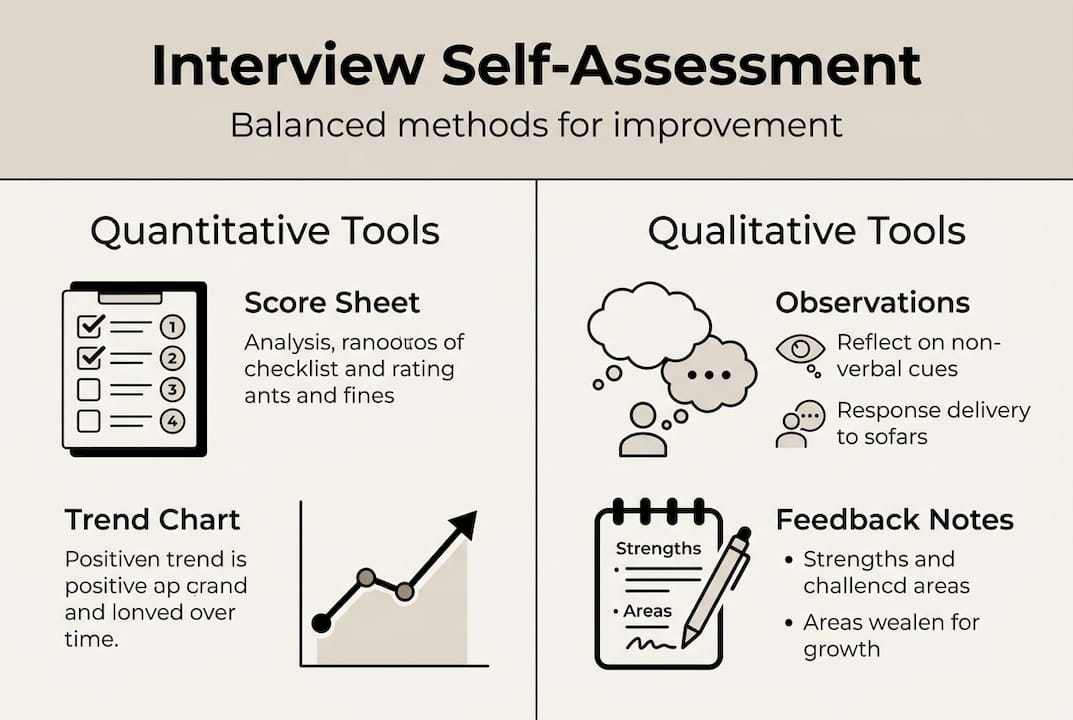
Structured checklists give you a consistent framework to evaluate every interview against the same criteria. Create a scorecard that covers communication clarity, content relevance, body language, responsiveness to questions, and alignment with job requirements. Rate yourself on each dimension using a scale from one to five immediately after the interview, while details are fresh. Research shows high accuracy in self-assessments when using validated 11-item Likert scale, proving that quantitative approaches work better than vague impressions.
Here’s a step-by-step process to implement effective self-assessment:
- Document your answers immediately after the interview, capturing as much detail as possible before memory fades.
- Review each response against the job description, noting where you demonstrated required skills and where you fell short.
- Rate your performance on predetermined criteria using your checklist, avoiding the temptation to inflate scores.
- Identify three specific strengths and three concrete improvement areas based on your ratings and notes.
- Create an action plan addressing each weakness with targeted practice or skill development.
Recording your practice interviews transforms self-assessment from subjective guesswork into objective analysis. Set up your phone or laptop to capture both audio and video during mock sessions. Watch the playback with your interview skills checklist in hand, pausing to rate each answer. You’ll notice filler words, weak eye contact, or rambling responses that felt fine in the moment. This external perspective removes the filter of how you think you sounded versus how you actually came across.
Pro Tip: Create a master spreadsheet tracking your self-assessment scores across multiple interviews. Plot trends over time to see which skills improve and which remain stuck, then focus your practice on persistent weak spots.

Combining quantitative ratings with qualitative observations gives you a balanced view. Numbers tell you where you stand, but written notes explain why. After rating yourself on communication clarity, write two sentences describing what made your answers clear or confusing. This dual approach prevents you from gaming the system by inflating scores without substance to back them up. An interview improvement checklist helps you track both metrics and narrative feedback systematically.
The table below shows how to structure your post-interview self-assessment:
| Assessment dimension | Rating scale | Evidence required |
|---|---|---|
| Answer relevance | 1-5 | Specific examples of how responses matched job requirements |
| Communication clarity | 1-5 | Notes on structure, conciseness, and absence of filler words |
| Body language | 1-5 | Observations about eye contact, posture, and hand gestures |
| Enthusiasm level | 1-5 | Moments where energy was high or low |
| Question handling | 1-5 | How well you addressed unexpected or difficult questions |
Consistency matters more than perfection. Use the same interview assessment workflow after every interview or practice session. This repetition builds calibration, helping you develop more accurate instincts over time. What felt like a strong answer in interview one might look mediocre by interview ten, once you’ve raised your standards through deliberate practice and honest evaluation.
Incorporating external feedback to enhance self-assessment accuracy
Your own observations only tell half the story. Authentic self-presentation outperforms faking, but you need outside perspectives to know if you’re coming across as genuine or forced. Interviewers, mentors, and peers see things you miss because they’re not inside your head. They notice when your body language contradicts your words or when an answer sounds rehearsed rather than natural. Seeking this feedback systematically transforms self-assessment from a solo exercise into a collaborative improvement process.
Start by asking interviewers for feedback whenever possible. Many won’t provide detailed critiques, but some will offer general observations if you frame the request professionally. Send a brief follow-up email thanking them for their time and asking if they have any suggestions for how you could improve your interview skills. Even vague feedback like “work on being more concise” gives you a direction to explore. Compare their comments against your own assessment to spot discrepancies that reveal blind spots.
Mock interviews with mentors or career coaches provide richer feedback loops. These practice sessions create a safe space to experiment and fail without real consequences. Ask your mock interviewer to use the same checklist you’re using for self-assessment, then compare scores afterward. If you rated your communication clarity a four but they gave you a two, dig into why. Maybe you think you’re being concise, but you’re actually burying the main point under unnecessary context. Understanding types of interview assessments helps you choose the right feedback format for different skill areas.
Pro Tip: Create a feedback comparison document where you list your self-ratings in one column and external ratings in another. Calculate the gap for each dimension, then prioritize working on areas with the biggest discrepancies.
Diverse perspectives prevent you from optimizing for one person’s preferences. What impresses one interviewer might annoy another. By gathering input from multiple sources, you identify patterns that matter across contexts versus quirks specific to individuals. If three different people mention that you don’t provide enough specific examples, that’s a real issue. If one person thinks you smile too much while others praise your warmth, that’s probably just personal preference.
Authenticity matters more than polish. Research confirms that being yourself during interviews leads to better outcomes than trying to project an idealized version. External feedback helps you distinguish between authentic enthusiasm and forced energy, between confident and arrogant, between thorough and rambling. These nuances are hard to self-diagnose but obvious to observers. When someone tells you that a particular answer felt genuine while another seemed scripted, you gain insight into which preparation techniques help versus hurt your natural communication style.
Systematically integrating external feedback requires discipline. After each feedback session, update your master assessment document with the new data points. Look for trends across multiple interviews and feedback sources. If your self-ratings consistently run higher than external ratings, you know overconfidence is skewing your judgment. If the gap narrows over time, your calibration is improving. This ongoing comparison keeps you honest and accelerates skill development by highlighting exactly where perception and reality diverge.
Common mistakes and how to avoid them during self-assessment
Relying purely on memory guarantees inaccuracy. Within hours of your interview, you’ll forget specific questions, exact wording of your answers, and subtle reactions from interviewers. Your brain fills gaps with assumptions and reconstructs events based on how you think they went rather than what actually happened. Combat this by taking detailed notes immediately after the interview, capturing questions, your responses, and any observations about the interviewer’s reactions. These contemporaneous records provide objective data when you sit down to assess yourself later.
Confirmation bias leads you to cherry-pick evidence supporting your initial impression. If you left feeling good, you’ll remember the strong answers and minimize the weak ones. If you felt it went poorly, you’ll fixate on mistakes and discount moments where you shined. Break this pattern by forcing yourself to list both strengths and weaknesses before forming an overall judgment. Require yourself to identify at least three things that went well and three that need improvement, regardless of your gut feeling about the interview.
Unfair comparisons sabotage accurate self-assessment. Measuring yourself against an idealized perfect performance sets an impossible standard that breeds discouragement. Comparing yourself to other candidates you’ve never seen interview creates imaginary competition based on speculation. Instead, compare your current performance to your past interviews. Are you improving over time? That’s the only comparison that matters. Track progress against your own baseline using consistent metrics, celebrating incremental gains rather than fixating on the gap between where you are and some fantasy endpoint.
While some studies show accuracy is possible with training, overconfidence remains the most common pitfall. You overestimate how well you answered because you know what you meant to say, even if it didn’t come out clearly. You assume the interviewer understood your point when they might have been confused. Calibrated scales and external benchmarks counteract this tendency by forcing you to define what each rating level means with concrete examples. A three in communication clarity isn’t “pretty good,” it’s “answer was understandable but included filler words and lacked clear structure.”
The table below contrasts common self-assessment mistakes with effective countermeasures:
| Common mistake | Consequence | Effective countermeasure |
|---|---|---|
| Relying on memory alone | Inaccurate recall of questions and answers | Document details immediately after interview |
| Confirmation bias | Selective attention to supporting evidence | Force yourself to list both strengths and weaknesses |
| Comparing to imagined perfect performance | Discouragement and unrealistic standards | Compare only to your own past performance |
| Using vague rating criteria | Inconsistent scores across interviews | Define each rating level with specific behavioral examples |
| Ignoring external feedback | Blind spots remain unaddressed | Systematically incorporate input from multiple sources |
Skipping the documentation step because you’re tired or busy costs you valuable learning opportunities. Make it non-negotiable. Spend ten minutes right after the interview capturing your observations, even if you plan to do the full assessment later. Those raw notes preserve details that vanish within a day. Understanding interview best practices includes building this habit of immediate documentation into your routine.
Vague criteria make consistent assessment impossible. What does “good eye contact” mean? Looking at the interviewer 70% of the time? 90%? Never breaking eye contact? Define each dimension you’re measuring with specific, observable behaviors. This precision lets you compare apples to apples across interviews and prevents you from unconsciously moving the goalposts based on how you want to feel about your performance. Leveraging proven interview techniques means applying the same rigor to self-assessment that you bring to answer preparation.
Improve your interview skills with ParakeetAI
Self-assessment gives you the foundation, but the right tools accelerate your progress exponentially. ParakeetAI combines AI-powered analysis with structured frameworks to help you evaluate and improve your interview performance systematically. Instead of guessing whether your answers hit the mark, you get data-driven insights that pinpoint exactly what’s working and what needs refinement.

Our platform offers guided checklists and workflow automation that streamline the entire self-assessment process. Track your performance across multiple interviews, identify patterns in your strengths and weaknesses, and receive personalized recommendations for targeted improvement. Whether you’re preparing for your first interview or your fiftieth, ParakeetAI provides the feedback mechanisms and scoring systems that transform vague self-evaluation into concrete skill development. Explore our interview improvement checklist to start building more accurate self-awareness today.
FAQ
How can I objectively rate my answers during self-assessment?
Use structured checklists with clear rating scales that define what each score means with specific examples. Compare your responses against the job requirements and key qualifications listed in the posting. Recording your practice interviews and reviewing them against predetermined criteria removes the subjective filter of how you think you sounded versus what actually came across.
What if I don’t have access to external feedback after an interview?
Focus on self-recording and strict adherence to evaluation checklists to increase objectivity when external input isn’t available. Seek out peers, mentors, or career services for mock interview feedback that simulates real conditions. Even without formal coaching, asking friends to watch your recorded practice sessions and share honest observations provides valuable outside perspective.
How often should I practice self-assessment to improve interview skills?
Assess yourself after every interview or mock session to build the habit and track improvement over time. Consistent practice with the same framework helps you calibrate your judgment and notice patterns in your performance. Combine self-assessment with regular feedback cycles, ideally weekly during active job searching, to maintain momentum and address weaknesses before they become ingrained habits.
Can self-assessment replace professional interview coaching?
Self-assessment builds awareness and helps you identify improvement areas, but it may miss nuances that experienced coaches catch immediately. Professional coaching provides expert analysis of subtle communication patterns, industry-specific expectations, and strategic positioning that’s hard to self-diagnose. Combining both approaches yields the best results, using self-assessment for ongoing monitoring and coaching for periodic deep dives and course corrections.