
Human vs AI Interview Feedback: Real Impact for Tech Professionals

Most hiring managers agree that AI is transforming how job interviews are assessed worldwide. For tech professionals with two to five years of experience, knowing how american companies evaluate candidates can be the difference between landing a role or missing out. Understanding the strengths and gaps of both human and AI interview feedback empowers you to refine your approach and make smarter, data-driven improvements to your performance.
Table of Contents
- Defining Human vs AI Interview Feedback
- Core Differences in Feedback Delivery
- Key Benefits and Drawbacks Explored
- Practical Use Cases in Tech Interviews
- Risks, Bias, and Ethical Considerations
- Maximizing Results: Hybrid and Best Practices
Key Takeaways
| Point | Details |
|---|---|
| Human Insight vs AI Efficiency | Human feedback offers emotional intelligence and contextual understanding, while AI provides consistent and rapid data-driven analysis. |
| Hybrid Assessment Benefits | Combining AI tools for initial screenings with human evaluators for nuanced assessments maximizes depth and efficiency in interviews. |
| Awareness of Biases | Both AI and human assessments face bias risks; awareness and mitigation strategies are critical for fair evaluations. |
| Transparency in Processes | Organizations should ensure clear documentation of AI assessment methodologies to maintain accountability and candidate trust. |
Defining Human vs AI Interview Feedback
Interviewing professionals face an emerging landscape where artificial intelligence and human assessment intersect, creating new paradigms for performance evaluation. Understanding the nuanced differences between human and AI interview feedback becomes critical for tech professionals navigating modern job markets. AI-powered interview analysis represents a significant technological advancement in assessment methodologies.
Human interview feedback traditionally relies on complex interpersonal dynamics, emotional intelligence, and contextual understanding. Recruiters and hiring managers bring years of professional experience, intuitive pattern recognition, and nuanced judgment to their assessments. They can detect subtle communication signals, evaluate cultural fit, and interpret non-verbal cues that pure algorithmic systems might miss. In contrast, AI interview feedback operates through structured data processing, analyzing verbal responses, linguistic patterns, and predefined performance metrics with remarkable speed and consistency.
The primary distinction emerges in assessment depth and approach. While human feedback thrives on empathy and contextual comprehension, AI feedback excels in objective, data-driven analysis. AI tools can rapidly process multiple interview dimensions simultaneously - speech patterns, response structure, technical knowledge alignment - providing instantaneous, quantifiable insights. However, research comparing AI and human feedback suggests that current AI systems may struggle with comprehensive, nuanced evaluation across all interview domains.
Pro tip: Leverage both AI and human feedback by treating AI insights as complementary data points rather than definitive assessments, enhancing your interview preparation strategy through multiple perspectives.
Here’s a concise comparison of core strengths and limitations of human vs AI interview feedback:
| Aspect | Human Feedback Strengths | AI Feedback Strengths | Key Limitation for Each |
|---|---|---|---|
| Empathy & Context | High emotional intelligence | Objective, consistent analysis | Humans may be subjective |
| Speed & Scalability | Tailored, interactive responses | Fast processing, scalable review | AI lacks situational awareness |
| Bias Risk | Can recognize individual nuance | Reduces overt bias via standardization | Humans may hold hidden biases |
| Depth of Insight | Interprets nonverbal cues | Quantifies subtle response trends | AI misses subtle social cues |
Core Differences in Feedback Delivery
Tech professionals must understand the fundamental distinctions in how human and AI interview feedback are delivered. Research comparing interview methodologies reveals critical nuances in communication and assessment approaches that significantly impact candidate evaluation strategies.
Human feedback delivery centers on emotional intelligence and adaptive communication. Recruiters and managers dynamically adjust their questioning technique based on real-time candidate responses, reading subtle nonverbal cues and creating conversational flow that allows deeper insights. They can detect hesitation, enthusiasm, and underlying communication skills that transcend scripted responses. Their feedback integrates psychological understanding, providing contextual commentary about candidate potential beyond mere technical competence.
AI feedback delivery, by contrast, operates through systematic, data-driven processes. Algorithmic assessment focuses on quantifiable metrics - response time, linguistic complexity, technical accuracy, and structured communication patterns. These systems generate instant, standardized evaluations with remarkable computational speed. Advanced interview analysis techniques demonstrate AI’s capability to process multiple evaluation dimensions simultaneously, offering granular performance insights that human reviewers might overlook.

Pro tip: Combine AI and human feedback insights by requesting specific analytical metrics from AI tools and contextual interpretation from human recruiters to develop a comprehensive understanding of your interview performance.
Key Benefits and Drawbacks Explored
Technology professionals analyzing interview feedback must critically examine the multifaceted advantages and limitations of both human and AI assessment approaches. Comparative research on expertise evaluation reveals a complex landscape of strengths and potential shortcomings in different feedback methodologies.
AI-driven interview feedback presents remarkable benefits in processing speed, objectivity, and scalability. Algorithmic assessment can rapidly analyze multiple candidate dimensions simultaneously, generating instant performance metrics with unprecedented consistency. These systems eliminate human biases, provide standardized evaluation frameworks, and offer granular insights into communication patterns, technical competencies, and response structures that might escape human perception.
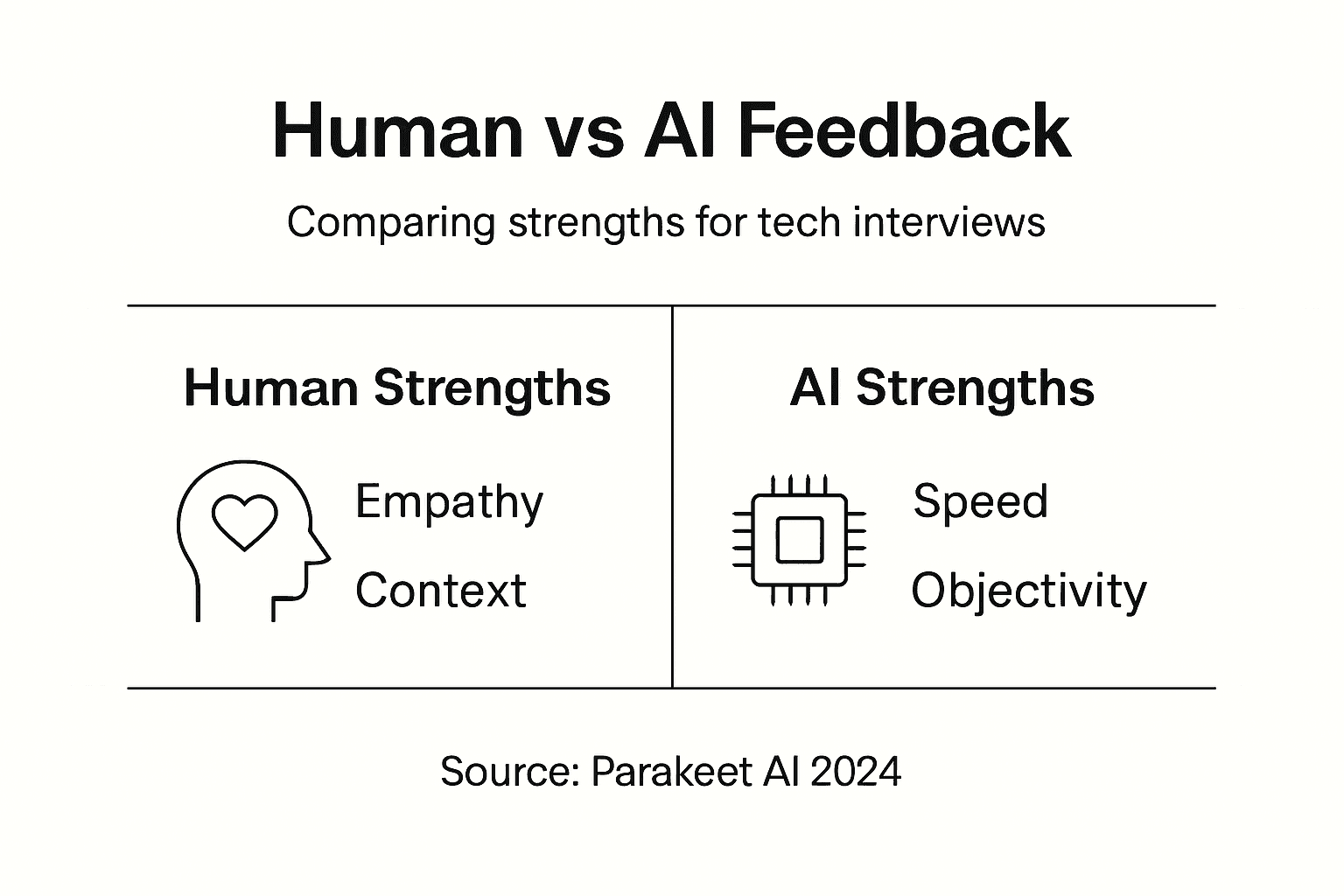
However, AI feedback is not without significant limitations. The technological approach struggles with nuanced emotional intelligence, contextual understanding, and ethical reasoning that human recruiters inherently possess. While AI excels at quantitative analysis, it often fails to capture the subtle interpersonal dynamics, cultural fit assessments, and psychological insights that experienced human evaluators can intuitively recognize. This fundamental gap suggests that the most effective interview feedback strategies will likely emerge from hybrid approaches that strategically combine AI’s computational power with human emotional intelligence and contextual interpretation.
Pro tip: Develop a balanced feedback strategy by using AI tools for objective performance metrics while seeking human recruiters’ insights for holistic, contextually rich candidate assessments.
Practical Use Cases in Tech Interviews
Tech professionals increasingly encounter hybrid interview approaches that strategically combine AI and human evaluation techniques. Innovative interviewing strategies demonstrate how organizations are reimagining candidate assessment to maximize efficiency and depth of insight.
Initial screening processes represent the most immediate and impactful use case for AI interview technologies. Large technology companies and rapidly scaling startups leverage algorithmic tools to quickly filter massive candidate pools, analyzing resumes, technical assessments, and preliminary video interviews with unprecedented speed. These systems can evaluate coding challenges, technical knowledge, and communication skills across hundreds of applicants simultaneously, dramatically reducing recruitment timeline and human resource expenditure.
Advanced AI interview tools excel in standardized technical assessments, particularly for roles demanding quantifiable skill verification. Software engineering positions, data science roles, and cybersecurity jobs benefit from AI’s ability to administer consistent, objective technical evaluations. Scalable candidate evaluation methods enable organizations to implement rigorous, unbiased initial screening that identifies top technical talent efficiently. However, critical nuanced assessments like cultural fit, leadership potential, and complex problem-solving still require human intuition and adaptive interviewing techniques.
Pro tip: Prepare for AI-driven initial interviews by practicing standardized technical responses and ensuring your digital communication skills are polished and professional.
Risks, Bias, and Ethical Considerations
Technology professionals must critically examine the complex ethical landscape surrounding AI-driven interview technologies. Ethical concerns in algorithmic assessment reveal profound challenges that extend far beyond simple technological implementation.
Algorithmic bias represents the most significant ethical risk in AI interview technologies. Machine learning systems inherently reflect the biases present in their training data, potentially perpetuating systemic discrimination against underrepresented groups. These biases can manifest subtly - through language processing algorithms that inadvertently penalize certain communication styles, or screening mechanisms that disproportionately disadvantage candidates from diverse educational or professional backgrounds. The fundamental challenge lies in creating AI systems that can recognize and counteract these deeply ingrained prejudicial patterns.
Transparency and accountability emerge as critical ethical considerations in AI-driven interview technologies. Research on AI evaluation methods underscores the importance of developing clear, auditable decision-making processes. Organizations must implement robust oversight mechanisms that allow candidates to understand how algorithmic assessments are conducted, challenge potential discriminatory outcomes, and ensure that AI tools complement rather than replace human judgment. This requires ongoing monitoring, diverse training data, and a commitment to continuous improvement of AI interview technologies.
Pro tip: Request transparency documentation from potential employers using AI interview tools, including information about their bias mitigation strategies and algorithmic evaluation processes.
Below is a summary of ethical risks and mitigation best practices for AI interview tools:
| Ethical Risk | Example Impact | Recommended Mitigation |
|---|---|---|
| Algorithmic Bias | Disfavors diverse communication styles | Use diverse, inclusive training data |
| Transparency Gaps | Candidates unclear on assessment | Provide detailed process documentation |
| Accountability Issues | Hard to challenge outcomes | Enable appeal processes and audits |
Maximizing Results: Hybrid and Best Practices
Navigating the complex landscape of AI interview technologies requires a strategic, nuanced approach that balances technological efficiency with human insight. Research on collaborative assessment strategies demonstrates the critical importance of developing integrated evaluation frameworks that leverage both artificial and human intelligence.
Hybrid interview methodologies represent the most promising approach for modern tech professionals. This strategy involves using AI tools for initial screening and data-driven analysis, while reserving critical evaluation stages for human experts who can interpret nuanced communication, assess cultural fit, and make holistic judgments. Successful implementation requires organizations to develop clear protocols that define specific roles for AI and human evaluators, ensuring that technological tools complement rather than replace human decision-making.
Effective hybrid interview practices demand continuous refinement and collaborative development. Technology teams must invest in ongoing training, develop transparent evaluation criteria, and create feedback mechanisms that allow both AI systems and human evaluators to learn and improve. This approach requires robust data management, regular algorithmic audits, and a commitment to eliminating systemic biases. By treating AI as a collaborative tool rather than an autonomous decision-maker, organizations can create more equitable, insightful, and effective interview processes that respect both technological capabilities and human complexity.
Pro tip: Develop a personal strategy for AI interview interactions by practicing both algorithmic-friendly responses and maintaining your unique communication style to demonstrate adaptability.
Enhance Your Interview Success with AI and Human Insights
Tech professionals face the challenge of balancing empathetic human feedback with objective AI analysis to unlock their true interview potential. The article highlights the struggle to combine emotional intelligence and data-driven insights during interviews. It emphasizes the importance of addressing both nuanced communication style and rapid, standardized evaluation — key pain points that can make or break your next opportunity.
Parakeet AI offers a real-time interview assistant that listens to every question and provides you with AI-generated answers instantly. This allows you to practice algorithm-friendly responses while sharpening your unique communication style for human evaluators. By bridging the gap between AI precision and human nuance, you gain the confidence to excel in hybrid interview environments.
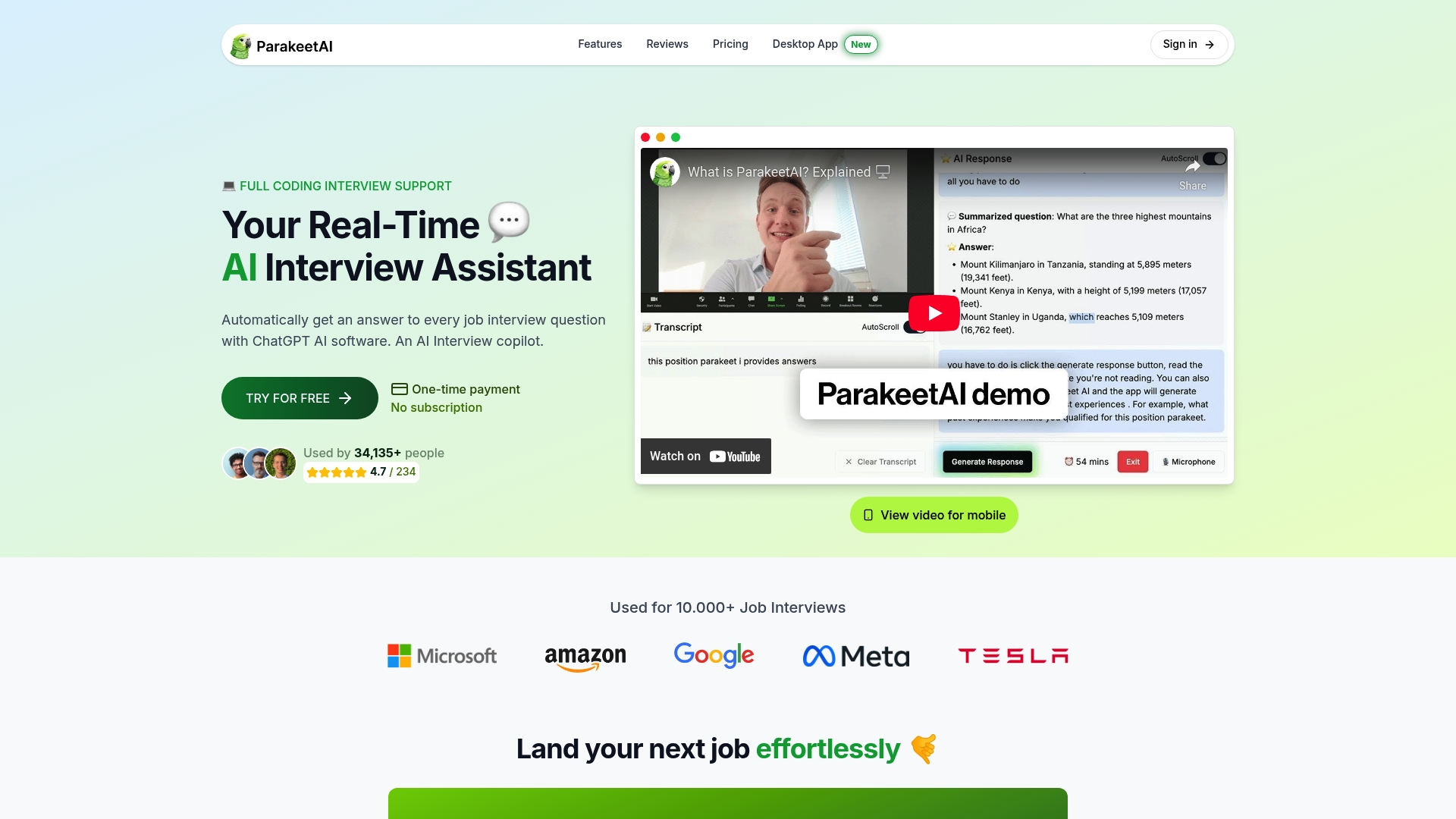
Ready to transform your interview approach and thrive in today’s tech hiring landscape Use Parakeet AI now to get instant, data-driven feedback that complements human intuition. Discover how you can prepare smarter and respond faster with the only AI assistant designed specifically for your job interview success at https://parakeet-ai.com.
Explore more tips and insights on combining technology and human feedback by visiting this powerful resource today.
Frequently Asked Questions
What are the key differences between human and AI interview feedback?
Human feedback focuses on emotional intelligence, context, and interpersonal dynamics, while AI feedback offers objective, data-driven analysis, processing multiple dimensions of responses rapidly and consistently.
How can I effectively combine human and AI interview feedback?
Utilize AI insights for quantitative metrics and human feedback for contextual interpretation. This hybrid approach provides a comprehensive understanding of your interview performance.
What are the risks associated with AI interview feedback?
AI interview feedback can suffer from algorithmic bias, which may lead to discriminatory outcomes. Transparency and accountability are essential to mitigate these ethical risks.
How can tech professionals maximize the benefits of AI in interviews?
By preparing standardized technical responses for AI assessments and maintaining a personal communication style for human evaluators, tech professionals can effectively navigate the interview process.