
Interview example guide: practical tips and AI help 2026

Job interviews can feel overwhelming, especially when you’re unsure how to articulate your experience or respond to challenging questions. Many job seekers believe that simply reviewing their resume is enough preparation, but the reality is that structured practice with concrete examples makes all the difference. This guide provides practical interview examples across industries and explains how AI tools can personalize your preparation, reduce anxiety, and help you deliver confident, compelling answers that land the job.
Table of Contents
- Common Interview Questions And Example Responses
- How AI Enhances Interview Preparation With Examples
- Comparison Of Traditional Vs AI-Driven Interview Practice Methods
- Practical Steps To Use Interview Examples And AI For Best Results
- Enhance Your Interview Readiness With Parakeet AI
- Frequently Asked Questions About Interview Examples And Preparation
Key takeaways
| Point | Details |
|---|---|
| Practical examples clarify responses | Concrete examples help you structure answers to common interview questions effectively. |
| AI tools personalize practice | AI-driven platforms simulate real interviews and provide instant feedback tailored to your role. |
| Preparation reduces anxiety | Practicing with examples and AI builds confidence and lowers interview stress significantly. |
| Avoid common pitfalls | Understanding frequent mistakes helps you sidestep errors that cost job offers. |
Common interview questions and example responses
Understanding what questions you might face and how to answer them prepares you to practice more effectively. Interviewers across industries rely on a core set of questions designed to assess your skills, cultural fit, and problem-solving abilities. Knowing these questions in advance lets you craft thoughtful, structured responses that showcase your strengths.
For technical roles, you’ll encounter questions about your coding abilities, system design thinking, and how you approach debugging. Software engineering interview questions often include algorithm challenges and scenarios testing your understanding of data structures. For example, when asked “Describe a time you optimized a slow-running application,” a strong answer follows the STAR method: you explain the Situation (the app had 5-second load times), the Task (reduce load time by 50%), the Action (profiled code, implemented caching, optimized database queries), and the Result (achieved 2-second load times and improved user satisfaction by 40%).
Behavioral questions appear in virtually every interview. Questions like “Tell me about a conflict with a coworker” or “Describe a project that failed” test your self-awareness and interpersonal skills. A compelling answer demonstrates growth and learning. For instance, you might describe a project where miscommunication led to missed deadlines, explain how you initiated weekly check-ins to improve team alignment, and share that subsequent projects finished on time with 30% fewer revision cycles.
Pro Tip: Use the STAR method (Situation, Task, Action, Result) for every behavioral question. This framework keeps your answers focused and demonstrates clear impact. Write out three to five STAR stories covering different competencies before your interview.
Tailoring answers to the job description is critical. Review the posting carefully and identify key skills and values the employer emphasizes. If the role prioritizes collaboration, weave teamwork examples throughout your responses. If innovation matters most, highlight times you introduced new processes or technologies. Generic answers signal lack of preparation, while customized responses show genuine interest and strategic thinking.
For IT roles, IT interview questions and answers often focus on troubleshooting scenarios, security protocols, and your approach to managing infrastructure. When asked “How do you prioritize multiple urgent tickets,” explain your triage system: assess business impact first, communicate expected resolution times clearly, and escalate when necessary. Concrete examples with measurable outcomes (“reduced average ticket resolution time from 4 hours to 90 minutes”) strengthen your credibility significantly.
How AI enhances interview preparation with examples
With a grasp on questions and answers, using AI tools can elevate your preparation to the next level. AI-driven interview platforms have transformed how job seekers practice by creating realistic simulations that adapt to your responses in real time. These tools analyze your answers, body language, and delivery to provide objective feedback you can’t get from self-study alone.

AI generates practice questions tailored to your target role and industry. Instead of generic interview prep, you face questions specific to software development, marketing, healthcare, or whatever field you’re entering. The AI pulls from vast databases of actual interview questions used by top companies, ensuring your practice mirrors real scenarios. This targeted approach means you’re not wasting time on irrelevant questions.
Instant feedback is where AI truly shines. After each practice answer, the system evaluates your response for clarity, completeness, and relevance. It identifies filler words (um, like, you know), flags overly long answers, and suggests stronger word choices. Some platforms analyze your tone and facial expressions during video practice, pointing out when you seem uncertain or disengaged. This immediate, specific feedback accelerates improvement far faster than traditional methods.
“Job seekers who practice with AI interview tools report 35% higher confidence levels and receive 28% more job offers compared to those using only traditional preparation methods.”
Repeated practice with AI reduces nervousness by building familiarity. The more you practice answering tough questions in a simulated environment, the less intimidating the real interview becomes. AI platforms let you retry answers until you’re satisfied, creating a safe space to experiment with different approaches. You can practice the same question five times, refining your response each iteration without judgment.
AI tools also track your progress over time. Dashboards show which question types you handle well and which need more work. You might discover you excel at technical questions but struggle with behavioral scenarios about leadership. This data-driven insight helps you allocate practice time efficiently, focusing energy where you need it most.
Interview best practices tech jobs emphasizes combining AI practice with human feedback for optimal results. While AI excels at objective analysis, experienced mentors provide nuanced guidance about company culture and industry-specific expectations. The ideal preparation strategy leverages both resources.
Comparison of traditional vs AI-driven interview practice methods
Now that you know how AI can help, let’s compare it with time-tested traditional methods to see what fits your style best. Both approaches have merit, and understanding their strengths and limitations helps you design a preparation strategy that matches your learning style, budget, and timeline.
Traditional methods include mock interviews with friends or career counselors, studying common interview questions from books or websites, and rehearsing answers alone in front of a mirror. These approaches have helped job seekers for decades. Mock interviews with humans provide authentic conversational flow and unexpected follow-up questions. Career counselors offer industry expertise and can simulate the pressure of a real interview. Self-study is free and flexible, letting you prepare on your own schedule.
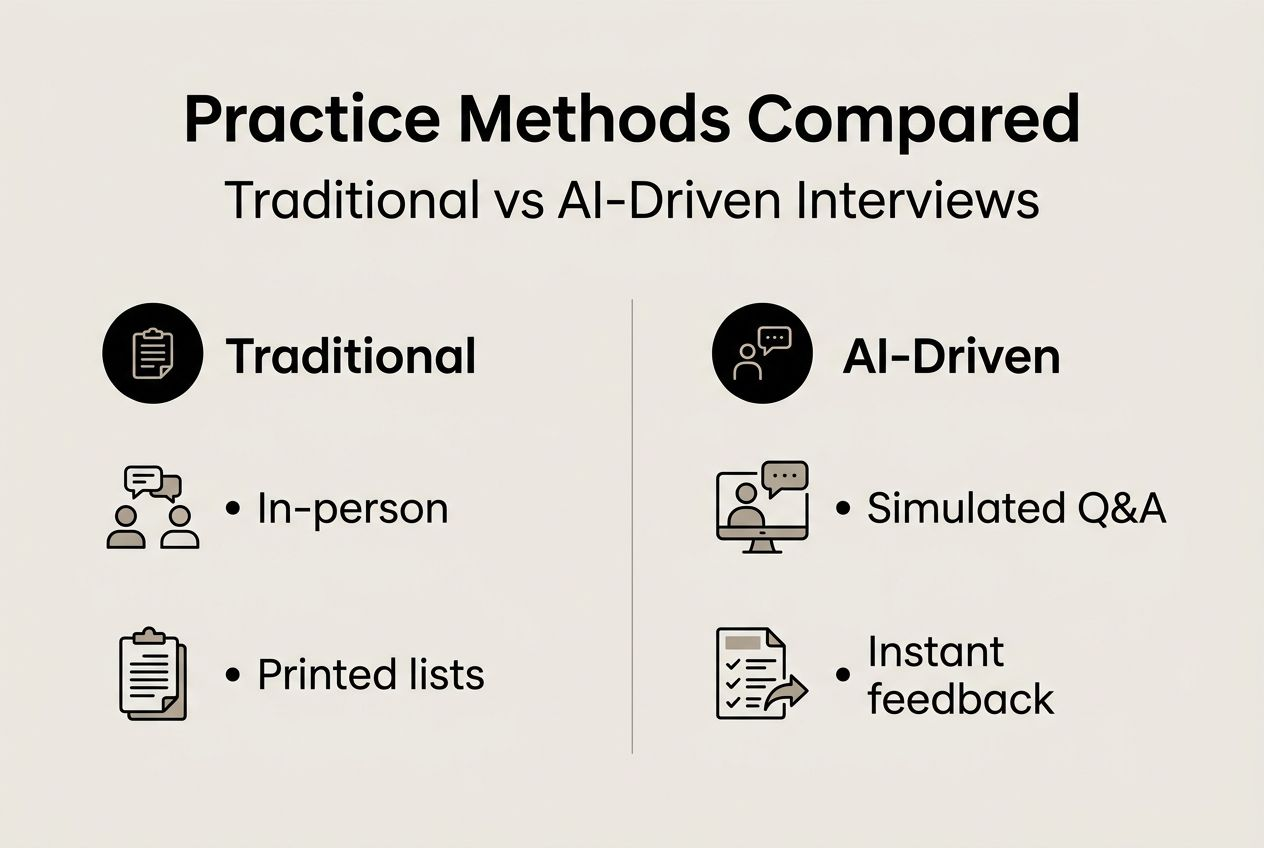
AI-driven methods use software platforms that simulate interviews through video or text interfaces. These tools employ natural language processing to understand your answers and generate relevant follow-up questions. They provide instant scoring, highlight areas for improvement, and often include libraries of role-specific questions. AI platforms are available 24/7, never tire of repetition, and deliver consistent, objective feedback without personal bias.
| Method | Advantages | Disadvantages |
|---|---|---|
| Traditional mock interviews | Authentic human interaction, nuanced feedback, tests conversational skills | Scheduling challenges, potential bias, limited availability, can be expensive |
| AI simulations | 24/7 access, instant feedback, unlimited practice, objective analysis, affordable | Less authentic interaction, may miss cultural nuances, requires technology comfort |
| Self-study (books/websites) | Free, flexible timing, broad question coverage | No feedback mechanism, difficult to assess performance, lacks accountability |
| Career counselors | Industry expertise, personalized guidance, networking opportunities | High cost, limited sessions, availability constraints |
Accessibility differs dramatically. AI platforms typically cost $20 to $50 monthly, while career counselors charge $100 to $300 per session. Traditional mock interviews with friends are free but depend on their availability and willingness to provide honest feedback. AI never cancels or reschedules, making it ideal for job seekers with unpredictable schedules or those in remote locations without access to career services.
Realism varies by method. Human mock interviews replicate the interpersonal dynamics of real interviews better than any AI. You experience nervousness, read body language, and navigate conversational tangents. However, AI platforms increasingly incorporate video analysis and natural language processing that creates surprisingly realistic scenarios. Some advanced AI tools even simulate different interviewer personalities (friendly, skeptical, rushed) to prepare you for various situations.
Pro Tip: Combine both methods for maximum effectiveness. Use AI for daily practice and skill building, then schedule periodic mock interviews with humans to test your progress in realistic conditions. This hybrid approach gives you the repetition and feedback of AI plus the authenticity and unpredictability of human interaction.
Common interview pitfalls tech jobs highlights mistakes that both methods can help you avoid, such as rambling answers, failing to quantify achievements, or neglecting to ask thoughtful questions at the end.
Practical steps to use interview examples and AI for best results
With knowledge of methods and tools, you’re ready to apply these practical steps to ensure your interview success. Creating a structured preparation routine that combines practical examples with AI practice maximizes your chances of delivering impressive interviews consistently.
Start by researching common questions for your target role. Visit company websites, read Glassdoor interview reviews, and explore industry-specific question databases. Software developer interview questions provides extensive examples for technical roles. Compile a list of 15 to 20 questions you’re likely to face, organizing them by category: technical skills, behavioral scenarios, company fit, and situational judgment.
Next, draft example answers using the STAR framework for each question. Write these out fully, including specific metrics and outcomes. For instance, instead of “I improved team efficiency,” write “I introduced automated testing that reduced bug reports by 45% and cut release cycles from two weeks to one week.” Concrete details make your examples memorable and credible.
Practice your answers with an AI interview platform. Record yourself delivering each response and review the AI feedback carefully. Pay attention to patterns: do you consistently speak too quickly, use filler words, or fail to provide enough detail? Focus on one improvement area at a time rather than trying to fix everything simultaneously. Repeat each question until you can deliver a smooth, confident answer without reading notes.
Simulate full interviews regularly. Set aside 45-minute blocks where you use AI to conduct complete mock interviews from greeting to closing questions. Treat these sessions seriously: dress professionally, minimize distractions, and maintain the same energy you’d bring to a real interview. This builds stamina and helps you manage nervousness when facing multiple questions in succession.
| Week | Focus Area | Time Allocation | Milestone |
|---|---|---|---|
| 1 | Research and draft answers | 5 hours | Complete 20 STAR stories |
| 2 | AI practice (individual questions) | 6 hours | Master 10 core questions |
| 3 | Full mock interviews | 5 hours | Complete 3 full simulations |
| 4 | Refinement and company research | 4 hours | Finalize answers, research interviewers |
Review AI feedback critically and track your progress. Most platforms provide performance dashboards showing improvement over time. Celebrate wins when your scores increase or when you eliminate a persistent weakness. If certain questions consistently trip you up, dedicate extra practice time to those areas or seek additional examples from colleagues or mentors.
Pro Tip: Record your AI mock interviews and watch them later with the sound off. This lets you observe your body language, facial expressions, and nervous habits objectively. You’ll notice things the AI might miss, like fidgeting, poor posture, or lack of eye contact. Self-review combined with AI feedback creates powerful insights.
Consistency matters more than intensity. Practicing 30 minutes daily for four weeks yields better results than cramming eight hours the weekend before your interview. Regular practice embeds your examples in long-term memory, making recall effortless during the actual interview. You’ll speak naturally rather than sounding rehearsed because the stories become part of your narrative.
Enhance your interview readiness with Parakeet AI
Ready to put these strategies into action? Parakeet AI provides the perfect tool to practice smarter and win your next interview. Our platform combines cutting-edge AI technology with practical interview preparation, giving you real-time feedback and personalized coaching that adapts to your unique needs and target role.
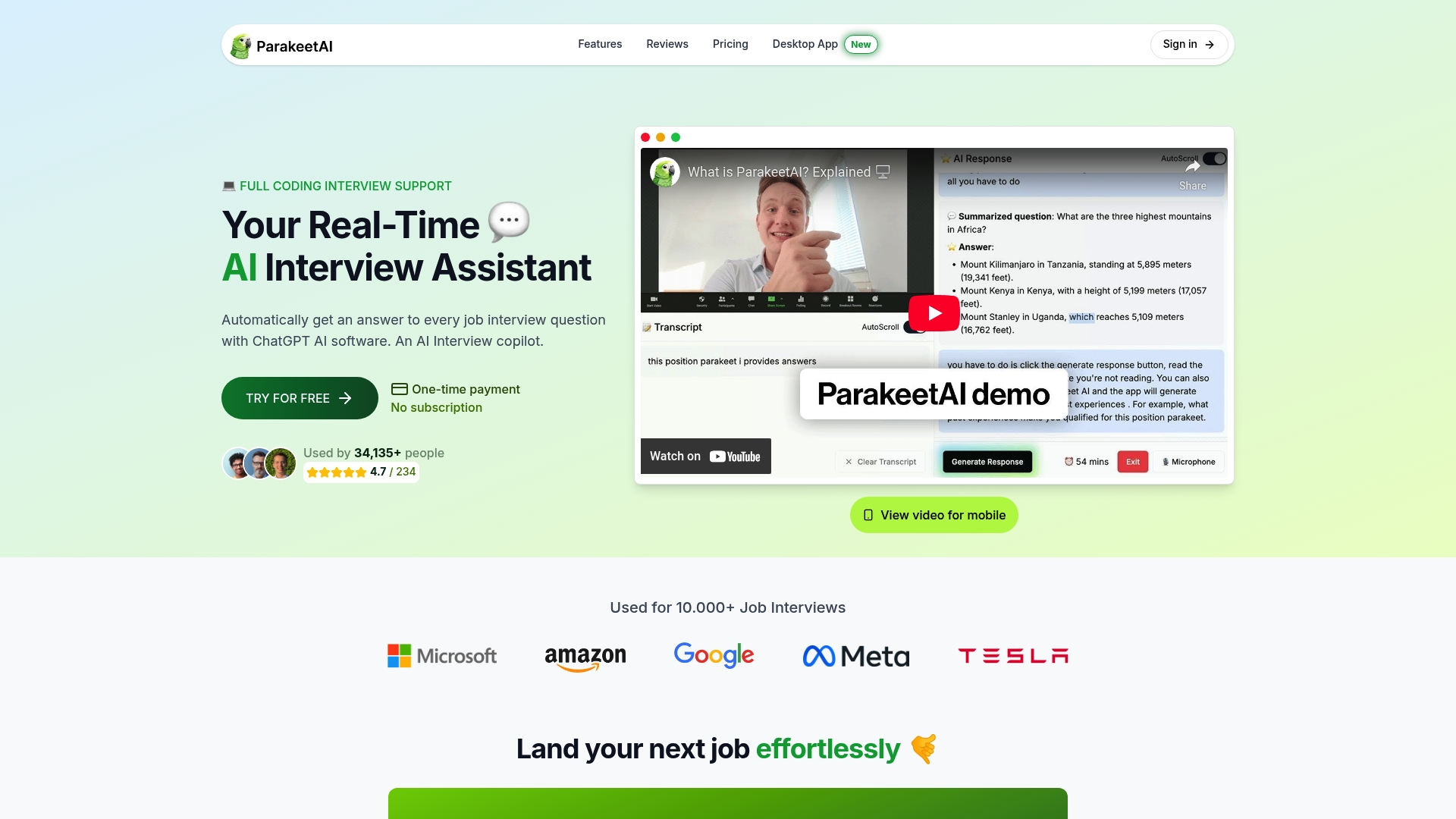
Parakeet AI offers customizable interview simulations across industries and job levels. Whether you’re interviewing for software engineering, marketing, healthcare, or executive positions, our AI generates relevant questions and evaluates your responses against industry standards. You’ll practice with the same questions top companies actually ask, ensuring your preparation directly translates to interview success.
Users receive instant, detailed feedback on every answer. Our AI analyzes your content, delivery, and communication style, highlighting strengths and suggesting specific improvements. You’ll see exactly which parts of your answer worked well and which need refinement. This precision feedback accelerates your growth, helping you master interview skills in weeks instead of months.
The platform supports continuous improvement through comprehensive analytics. Track your progress over time, identify patterns in your performance, and focus practice where you need it most. Many users report feeling significantly more confident after just one week of consistent practice with our AI coach.
Start your journey to interview mastery with Parakeet AI platform today. Our free trial lets you experience the benefits firsthand, with no commitment required. Join thousands of job seekers who have transformed their interview performance and landed their dream jobs with AI-powered preparation.
Frequently asked questions about interview examples and preparation
What makes a good interview example?
A good interview example includes specific details, quantifiable results, and clear connection to the question asked. It follows the STAR method (Situation, Task, Action, Result) and demonstrates your skills through concrete evidence rather than vague claims. The best examples are recent, relevant to the role, and show positive outcomes or lessons learned from challenges.
How can AI improve my interview answers?
AI improves your answers by providing objective feedback on content, structure, and delivery that you can’t get from self-practice. It identifies filler words, rambling, and weak points in your responses while suggesting stronger alternatives. AI also offers unlimited practice opportunities, letting you refine answers through repetition without imposing on friends or mentors.
Are AI interview tools suitable for all job types?
Yes, modern AI interview tools support virtually every job type and industry. Platforms like Parakeet AI offer role-specific question databases for technical positions, creative fields, healthcare, business, and more. While the technology excels at structured interview formats, it’s equally valuable for behavioral questions common across all professions.
How can I practice effectively before my interview?
Effective practice combines research, structured preparation, and realistic simulation. Start by identifying likely questions, draft STAR-method answers with specific examples, then practice delivery using AI tools or mock interviews with humans. Focus on one improvement area at a time, track your progress, and maintain consistent daily practice rather than cramming. Video interview best practices offers additional guidance for remote interview preparation.
What common mistakes should I avoid in interviews?
Avoid rambling answers without clear structure, failing to provide specific examples or metrics, speaking negatively about past employers, and neglecting to ask thoughtful questions at the end. Other pitfalls include arriving unprepared with company research, appearing disinterested through poor body language, and focusing too much on what you want rather than what you offer. Practicing with AI helps identify and eliminate these mistakes before they cost you job offers.