Interview Questions Software Engineering: Model Answers
Can you solve a coding problem correctly and still give a weak interview answer? Yes, if the interviewer can't tell how you interpreted the requirements, why you chose that approach, or whether you'd notice when it fails.
Preparing for software engineering interview questions means practising more than answers. You need to recognise the failure mode each question exposes, then make your reasoning visible. The examples below are practice scenarios, not claims about any company's hiring process.
Software Engineering Interview Categories and Reading Cues
An interviewer who says "coding round" and one who says "technical discussion" may be describing the same forty-five minutes. The label matters less than the evidence the round is built to collect. Each format is a probe for a specific failure mode: the candidate who cannot decompose a problem, the candidate who cannot take feedback mid-task, the candidate who hides uncertainty behind confident phrasing. Read the probe correctly and you know which evidence to offer before you open your mouth.
Interview categories, what they test and their formats
| Category | What It Tests | Typical Format | Difficulty Tags |
|---|---|---|---|
| Behavioral | Ownership, conflict, teamwork, learning from failure | Panel conversation, 30-45 minutes | Easy to Medium |
| Algorithms and data structures | Problem decomposition, complexity reasoning | Whiteboard or shared editor, 45-60 minutes | Medium to Hard |
| Live coding | Implementation under time pressure, narrating decisions | Shared editor with an interviewer, 45-60 minutes | Medium |
| Take-home or work sample | Code organization, testing, trade-off judgement | Asynchronous project, 2-6 hours | Medium |
| System design | Architecture, scale, reliability and trade-offs | Whiteboard-style discussion, 45-60 minutes | Medium to Hard |
| Debugging and code review | Fault isolation, code quality judgement | Live session with existing code, 30-60 minutes | Medium |
Treat these durations as practice-session budgets, not promises about an employer's schedule. The categories overlap in practice. One conversation can ask you to review existing code, repair it, and explain the architectural consequence of the fix, which is why practising categories in isolation only gets you partway.
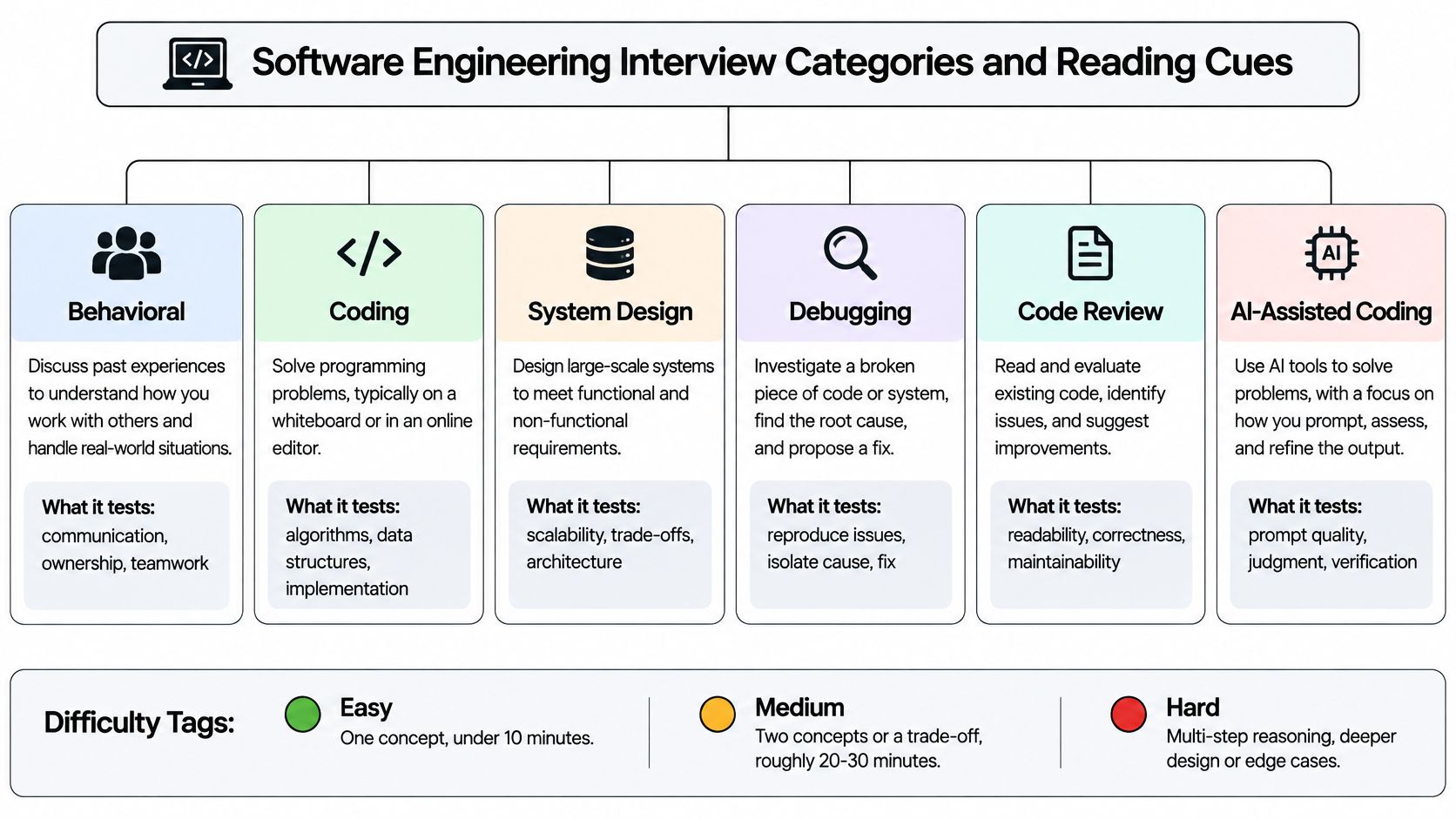
The chart below groups the underlying skills, including AI-assisted coding, which can surface inside several assessment formats.
Read the tag before practising
Use this editorial difficulty scale throughout:
- Easy: One concept, answered in under 10 minutes.
- Medium: Two concepts or a meaningful trade-off, roughly 20-30 minutes.
- Hard: Multi-part, open-ended work requiring 45 minutes or more for a full exercise.
A brief spoken answer can summarise a Hard exercise. The tag describes reasoning depth, not how long you should speak uninterrupted. A candidate who answers a Hard question in ninety seconds usually answered an Easy version of it.
Don't assume the whole process will involve coding. The CoderPad and CodinGame 2025 technology-hiring survey reported technical discussion at 75.27%, resume review at 71.61%, live coding at 49.82%, asynchronous technical tests at 24.54%, take-home or work samples at 21.06%, and portfolio review at 20.51%, with respondents using an average of three assessment methods.
Coding is one signal, not the entire hiring loop. Some candidates complete a whole process without writing a line of code in front of an interviewer; others face three coding rounds in a row. Ask the recruiter which one you are walking into.
Listen for the requested evidence
"Walk me through" asks for a reasoning sequence, so narrate in the order the decisions happened, including the options you rejected. "What would you do if" introduces an open trade-off, so name the constraint you would optimise for before naming the solution. "How would you test" shifts attention toward quality and risk, so describe the failure you are hunting rather than only the test you would write.
During your opening minute, restate the task, ask two useful clarifying questions, and confirm constraints aloud. For a coding task, ask about input size and invalid inputs. For architecture, ask about the critical user action and acceptable failure behaviour. Those questions cost you thirty seconds and buy you the interviewer's confidence that you know what you are building.
If you're still choosing a direction, Access Courses Online's computing career guidance for adult learners can help connect your educational route with the work you want to discuss.
Choose a likely format mix from the role description. Backend candidates might prioritise implementation, design, and debugging; early-career candidates might emphasise fundamentals, projects, and collaboration. Confirm the actual format with the recruiter rather than treating those choices as company policy.
Behavioral Questions With Model Answers
Use STAR: Situation, Task, Action, Result, followed by a reflection. Prepare each story for a 60-90-second spoken answer, with deeper details available for follow-up.
These hypothetical examples illustrate structure. Replace their circumstances and outcomes with your own evidence.
Practise speaking to another person, not reciting a script.

Decisions, mistakes, and failed projects
Tell me about a technical decision you disagreed with [Medium]. This tests influence without authority. The failure mode is confusing technical conviction with permission to dismiss colleagues.
A model scenario: the team preferred synchronous processing, while you worried about latency. You were responsible for evaluating the risk, so you built a representative benchmark that showed a hypothetical threefold latency difference, proposed a reversible queued-processing trial, and documented its operational costs. The team adopted the trial; your reflection explains why evidence and reversibility worked better than arguing.
Describe an incident you caused in production [Medium]. This tests ownership, not whether you've maintained a spotless record.
For example, suppose your deployment caused 120 failed requests over eight minutes. Explain how you confirmed the impact, rolled back, verified recovery, and added a compatibility check to deployment validation. The reflection should identify your mistaken assumption, not merely promise greater care.
Tell me about a project that failed [Easy]. This exposes whether you can separate effort from value.
A practice answer might describe building an internal dashboard before confirming who would use it. Your task was delivery, but you eventually investigated low adoption, stopped unnecessary development, and carried the validated requirements into an existing tool. Reflect on the missing discovery work, then replace this scenario with a genuine failure from your experience.
Relationships and motivation
How do you handle a teammate whose code keeps missing standards [Hard]? This tests empathy and escalation judgement.
A strong response distinguishes unclear expectations from skill gaps or repeated refusal. Describe a private conversation, concrete examples, pairing, and automated checks; then explain when continued delivery risk would justify involving the team lead. If discussing past experience, finish with the actual result and what you'd change.
Why do you want to work here [Easy]? This tests whether your interest survives beyond the company name.
Suppose the job description names API ownership and on-call participation. Connect each to something you've done, explain which responsibility you want to develop, and ask how success is assessed. Don't invent product knowledge or pretend you've used a service you haven't.
Story check: Make your individual action identifiable without erasing your teammates' contributions.
Before rehearsing, remove these warning signs:
- Vague ownership: Replace unexplained “we” language with your responsibility and action.
- Missing evidence: Include a defensible measure or observable outcome.
- Blame: Describe the conditions and your response, not another person's supposed incompetence.
Coding and Algorithm Questions With Model Approaches
Follow a repeatable working method:
- Restate the problem in your own words.
- Confirm constraints, input size, and edge cases.
- Describe brute force and explain its complexity.
- Choose an optimisation tied to the constraint that matters.
- Implement clearly, keeping names and control flow readable.
- Trace two examples and one edge case, checking the result against your stated rule.
The failure mode is usually not forgetting a pattern's name. It's applying a remembered solution without checking whether its assumptions hold.
Coding patterns with example questions and target complexity
| Pattern | Example Question | Target Complexity | Difficulty Tag |
|---|---|---|---|
| Hash map lookup | Two Sum variant or duplicate detection | O(n) time, O(n) space | Easy |
| Two pointers | Pair sum in a sorted array | O(n) time, O(1) extra space | Easy |
| Sliding window | Longest substring without repeating characters | O(n) time | Medium |
| Binary search on the answer | Minimum capacity to ship within D days | O(n log range) time | Medium |
| Heap | Top k frequent elements | O(n log k) time | Medium |
| Graph BFS | Shortest path in an unweighted grid | O(V + E) time | Medium |
| Dynamic programming | Minimum coins for an amount | O(n × amount) time | Hard |
These are algorithmic targets under conventional assumptions, including expected constant-time hash-map operations. For coin change, n means the number of denominations; for shipping, range means the capacity search interval.
Worked answer for longest nonrepeating substring
First clarify whether the result should be a length or the substring itself. Ask what counts as a character, especially if input can contain Unicode.
A brute-force approach examines candidate substrings and checks for duplicates. To avoid repeatedly examining overlapping work, maintain a sliding window and a map from each character to its last-seen index.
Move the right boundary through the input. When a character was previously seen inside the current window, move the left boundary to the greater of its current position and the previous index plus one. Update the character's index and the best length.
Your invariant is precise:
The current window contains no repeated characters, and the left boundary never moves backward.
Trace abcabcbb: the best length remains three as later duplicates advance the left boundary. Then trace abba: the final a must not move the left boundary backward, or you'd incorrectly admit a duplicate.
Check empty input and all-identical characters. For Unicode, agree whether iteration uses code points or user-perceived grapheme clusters; language string indexing doesn't automatically settle that requirement.
The approach takes O(n) time and O(min(n, alphabet size)) space.
Explain alternatives and interview conditions
For top-k frequent elements, count frequencies, then retain candidates in a size-k min-heap. With u distinct elements, the work is O(n + u log k), commonly summarised as O(n log k) for k greater than one; handle k equal to one as a linear case.
Ask whether you can run tests. A North Carolina State University account of a randomized study involving 48 computer-science students reported that observed participants performed more than 50% worse than those solving privately, with higher stress and cognitive load.
That student experiment doesn't invalidate every coding interview. It supports separating reasoning from minor syntax slips and environment friction. Make your evidence easy to assess: state complexity, name the invariant, and test the boundaries.
System Design Questions and How to Structure Answers
A design answer should explain why the components exist, not just name databases and queues. Use this seven-step sequence as a working outline:
- Clarify functionality and scope. Identify the essential user actions and explicitly exclude optional features.
- Set non-functional targets. In a hypothetical exercise, you might agree on 10 million daily users, 99.9% availability, and p99 latency under 300 ms. Ask which target matters most.
- Estimate traffic and storage. For an illustrative workload, 100 writes per second at 1 KB each produces about 8.6 GB per day before indexes, replicas, and overhead.
- Draw the high-level path. Show clients, request handling, storage, and background work.
- Choose the data model and store. Justify the choice through access patterns, consistency, and transactional needs.
- Explore scaling. Introduce caching, partitioning, and queues only where they solve an identified bottleneck.
- Walk through failures. Explain overload, dependency outages, recovery, and the trade-offs you're accepting.
Those numbers are example assumptions, not facts about an employer's infrastructure. Daily users alone don't establish peak requests per second; ask about activity and burstiness before sizing services.
Smaller designs that reveal depth
URL shortener [Easy to Medium]. Establish creation and redirect behavior, then discuss ID generation, collision handling, expiration, and read-heavy caching. A narrow fundamentals exercise is Easy; adding persistence and caching makes it Medium.
The separating deep-dive is collision-safe creation. Explain what happens when concurrent requests produce the same candidate identifier, how uniqueness is enforced, and how retries behave. Candidates lose points when they assume a short hash is automatically unique.
Rate limiter [Medium]. Compare a token bucket, which permits controlled bursts, with a sliding window, which tracks usage over a moving interval. Clarify whether the limit applies to a user, API key, address, or tenant.
Focus on atomic distributed updates. A counter that works on a single process may exceed the limit when several nodes race; explain the consistency and availability consequences of your solution.
Designs with asynchronous failure
Notification system [Hard]. Separate accepting an event from delivering email, push, or another channel. Discuss preferences, fan-out, retry scheduling, provider errors, and idempotency.
The useful deep-dive is duplicate delivery after an uncertain outcome. If a provider accepted a message but your worker lost the response, what can you safely retry? Don't promise exactly-once delivery without explaining the boundary.
Chat service [Hard]. Cover persistent connections, message persistence, recipient delivery, reconnection, ordering, and presence. Distinguish a message accepted by the server from one delivered to a device or read by a person.
Explore reconnection and replay: how does a client resume without losing messages or confusing ordering? Presence can tolerate different consistency guarantees from durable message history.
Interviewers may steer toward a particular component. Follow that cue rather than completing a memorised architecture tour; deeper reasoning about the requested risk is more useful than another box on the diagram.
Debugging, Code Review and AI-Assisted Coding Questions
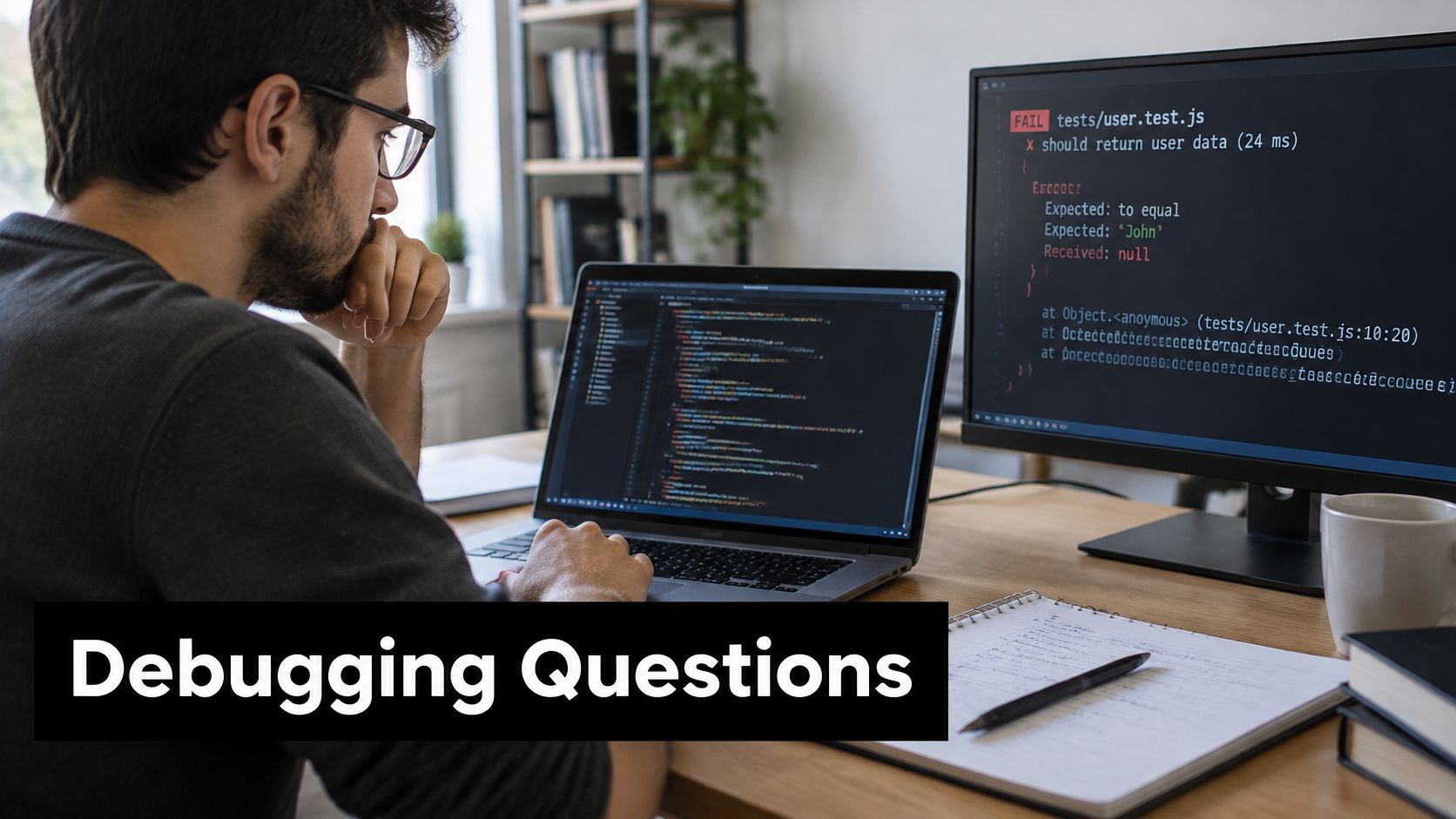
Find the bug in this failing test [Medium] exposes whether you diagnose before editing. Reproduce the failure, record expected and actual behavior, form a hypothesis, and narrow the cause through smaller inputs or commit bisection.
Then make the smallest justified fix and add a regression test. Random edits can make a test pass without explaining why it failed.
Practise explaining the evidence while you inspect the code.
Prioritise review comments
Review this pull request [Medium] tests judgement, not how many comments you can produce. Inspect correctness, boundaries, naming, error handling, and coverage.
Label feedback so the author can act:
- Blocker: A race condition, security flaw, or incorrect result.
- Suggestion: A maintainability improvement with a stated benefit.
- Nit: A nonessential style preference.
For security-focused preparation, Blockchain Jobs' guide to handling secrets securely in code is useful context for reviewing configuration and credential handling. Don't paste secrets into prompts or test fixtures.
Treat generated code as an untrusted draft
The AI assistant generated this query; what do you do [Hard]? Suppose it constructs SQL by joining strings containing user input. Identify the injection risk, replace interpolation with the database driver's parameterised-query API, and test hostile input.
Explain why escaping by hand isn't your preferred repair. The deeper failure mode is delegating responsibility to the generator.
How do you verify AI-generated code [Medium]? Read the diff line by line, run behavioral and boundary tests, check dependency existence and licences, and profile performance-sensitive paths. Validate unfamiliar APIs against their documentation instead of trusting plausible method names.
A Washington State University career-services analysis describes findings from more than 231,000 interview-preparation sessions that emphasise AI-output validation, technical decisions, and communication rather than memorisation alone.
Use this video as an additional prompt for spoken practice.
Our Mock Interview lets you practise out loud against an AI interviewer that answers back, then read the transcript. Review whether you explained verification rather than merely listing tools.
Use AI only when the assessment permits it. A plain disclosure might be: I used an AI assistant for a first draft, then tested it, rewrote the query to use parameters, and took ownership of the final version.
How Interviewers Score Your Answers
Structured interviews use comparable questions and predefined scoring rather than relying on conversational impressions. A meta-analytic estimate published in Human Resource Management reported criterion-related validity of 0.42 for structured interviews, compared with 0.19 for unstructured interviews.
Those values aren't pass rates or guarantees about a particular coding question. They support assessing job-related evidence consistently.
Scoring criteria with strong and weak signals
| Criterion | Strong Signal | Weak Signal |
|---|---|---|
| Requirements clarification | Asks about scale, constraints and out-of-scope items before designing | Starts coding or drawing without questions |
| Correctness | Verifies the solution on examples and edge cases | Checks only the main example |
| Complexity analysis | States time and space with a reason | Gives no complexity or a guess without reasoning |
| Trade-off reasoning | Names an alternative and why it was rejected | Presents one solution as the only option |
| Code quality and testing | Clear names, small functions, tests named for behaviour | Unclear names, no tests mentioned |
| Communication | Narrates decisions and recovers well from hints | Works silently and reacts defensively to hints |
A correct answer can still leave gaps
Suppose you implement a valid breadth-first search but remain silent and never explain why it finds the shortest path. Your correctness evidence may be strong, while your communication and complexity evidence remain incomplete.
Make the sequence visible: explain that you'll confirm scale, propose an approach, then check complexity. You aren't narrating every keystroke; you're exposing decisions another engineer would need to review.
A weak signal is a fixable habit, not a verdict on your engineering ability. Use a check-in when the direction is unclear: ask whether the interviewer wants you to continue implementing or verify the current approach first.
A hint is new information. Your response to it is part of the evidence.
Recover deliberately:
- Acknowledge: Identify the condition you missed.
- Update: Change the affected assumption or approach.
- Explain: State why the revised version handles that condition.
- Verify: Trace the case that broke your earlier reasoning.
Don't defend an obsolete approach just because you've invested time in it. Rubrics differ between teams, so treat this table as a preparation baseline, not a universal hiring scorecard.
Tailoring Answers to Your Resume
Consider this hypothetical resume bullet: Cut CI build time from 28 to 9 minutes by parallelising test shards across 12 runners.
That statement creates several follow-up paths. If you can explain only the headline, the specificity works against you.
Build several answers from the same evidence
For a behavioral answer, describe why slow builds mattered and what you owned. Explain why parallelisation was preferable to rewriting tests at that point, how you obtained agreement, and how you managed flaky-test risk.
For a system design discussion, describe shard scheduling, dependency caching, runner capacity, and result aggregation. Explain whether you balanced shards by historical duration or divided test counts, and what happened when a runner failed.
For a debugging follow-up, show how you found the slowest shard. Discuss timing artifacts, setup overhead, and how you distinguished an expensive test from a slow dependency download.
The failure mode is claiming an outcome without understanding its mechanism. Be ready to explain measurement boundaries: did build time include queueing, dependency installation, compilation, and retries?
Create a defensible story inventory
Use a small collection of substantive stories rather than writing a different script for every question.
- Choose four or five stories: Include a delivery, a disagreement, an incident, and a failure where your involvement is clear.
- Tag their uses: Mark which can support behavioral, design, debugging, or review questions.
- Prepare two lengths: Keep a one-line summary and a 90-second version, with technical details available afterward.
- Match role language: Connect distributed systems, on-call, testing, or other job-description terms to actual evidence.
- Remove unsupported claims: Delete or rewrite any bullet you can't defend under follow-up questions.
Tailoring means choosing which evidence to emphasise. It never means inventing responsibility, tools, or results because they appear in the vacancy.
For each story, check for a defensible number, a consequential trade-off, and your individual contribution. Keep at least one genuine failure story available; if you don't have a trustworthy performance metric, use an honest count or clearly describe the outcome rather than manufacturing precision.
Build Your Three-Week Practice Plan
Prepare against observable weaknesses, not a growing total of completed questions. In HackerRank's 2025 Developer Skills Report, 66% of surveyed developers preferred evaluation on real-world skills rather than theoretical knowledge, which supports giving debugging and narration serious practice time.
Use this workflow to keep preparation varied.
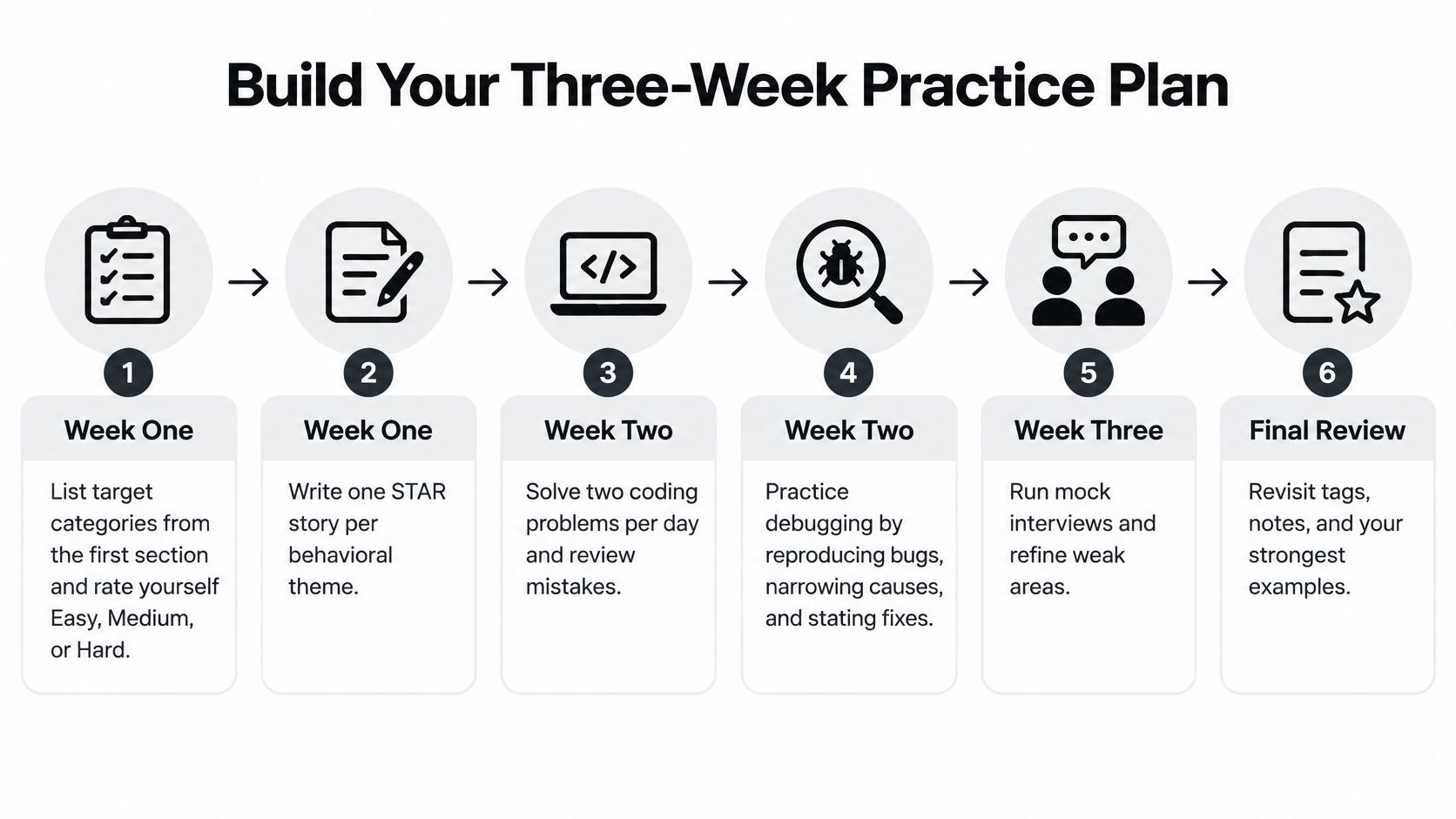
Turn practice into feedback
Week one, choose your categories. List the formats relevant to your target role. In each, mark the highest Easy, Medium, or Hard exercise you can complete while explaining yourself, then identify where that confidence breaks down.
Week one, assemble behavioral evidence. Write a STAR story for each theme: disagreement, ownership, failure, collaboration, and motivation. Record a spoken version and remove background detail that doesn't explain your action.
Week two, practise coding deliberately. Solve two problems a day from the pattern table, time each attempt, and explain it aloud. Log the actual failure: missed constraint, wrong invariant, implementation error, or incomplete testing; then revisit that specific weakness.
Week two, alternate design and debugging. Draw two system-design answers using the seven-step method. Add debugging exercises in which you reproduce a failure, isolate its cause, and state the regression test before considering the task finished.
Week three, run two mock sessions. Use a peer or our AI mock-interview practice tool. Review your answers afterward, noting where a listener would need clarification and where you changed direction without explaining why.
Week three, audit resume evidence. Test your story list against the scoring criteria. Ask follow-up questions about alternatives, failed attempts, measurements, and ownership until the account holds together without memorised wording.
Choose questions without predicting an employer
ParakeetAI's Question Bank is one practice source, not a forecast of what any company will ask. It lists questions real candidates were asked, company by company, ranked by how often they come up.
We extract those questions from ended, English, paid interview sessions whose transcript the user chose to save. That describes the collection's scope, not a complete picture of any employer's process.
Measure progress through changed behavior: you caught an ambiguous requirement, explained a rejected alternative, or found a bug through evidence instead of guessing. Repeating comfortable problems won't test those improvements.
Choose one weakness now and put a practice appointment on this week's calendar. For example, schedule a spoken debugging exercise, record your diagnosis, and review whether every proposed edit followed from an observation.
Our preparation tools let you practise with an AI interviewer that answers back, review the transcript, and explore real candidate questions grouped by company. Visit ParakeetAI to choose a practice exercise for the reasoning or communication skill you're working on this week.