
Interview Transcript Analysis: Unlocking Real Insights

Every hiring team in the United States, Canada, India, or Germany eventually faces the challenge of turning raw interview conversations into real insight. Whether you are a job seeker hoping to learn from feedback or an HR professional optimizing hiring for a fast-paced startup, your approach to interview transcript analysis shapes outcomes. This article lays out proven techniques for extracting actionable patterns from interviews, showing how manual and AI-assisted methods combine for precise, reliable results across diverse candidates.
Table of Contents
- Defining Interview Transcript Analysis Methods
- Types and Approaches to Transcript Analysis
- The Interview Transcript Analysis Process
- AI Tools and Techniques for Faster Results
- Ethical, Legal, and Privacy Considerations
- Common Pitfalls and How to Avoid Them
Key Takeaways
| Point | Details |
|---|---|
| Choose the Right Transcription Method | Manual transcription captures nuances better but is time-consuming, while AI-assisted methods are faster but may miss context. Choose based on your analysis needs. |
| Maintain Consistency in Analysis | Structured coding frameworks help reduce biases and ensure comparable data across interviews. Train your team on these frameworks before analysis. |
| Leverage AI as a Tool, Not a Replacement | Use AI for transcription and initial pattern identification; however, human insight is crucial for final evaluations. |
| Prioritize Ethical Data Management | Be transparent about data handling, secure consent for recordings, and anonymize sensitive information to build trust and comply with regulations. |
Defining Interview Transcript Analysis Methods
Interview transcript analysis is the systematic process of converting audio recordings into written text and then extracting meaningful patterns, themes, and insights from that text. For job seekers and HR professionals in tech and startup environments, understanding these methods is critical because the quality of your analysis directly impacts hiring decisions, candidate feedback, and team building outcomes. The process extends beyond simple transcription. It involves carefully examining word choice, emotional tone, response patterns, and technical depth to uncover what candidates actually know versus what they claim to know.
There are two primary approaches to transcript analysis. Manual transcription requires human listeners to convert audio word-for-word, capturing nuances like hesitations, clarifications, and emotional undertones that automated systems often miss. This method is time-intensive but produces rich, contextual data. Intelligent speech recognition technology uses AI to automatically convert audio into text, offering speed and scalability but occasionally missing context or technical jargon specific to your industry. The choice between these methods depends on your priorities. If you’re conducting 50 interviews and need patterns across candidates, automated transcription with manual review of key sections works efficiently. If you’re making a final hiring decision on two candidates, the detail from complete manual transcription justifies the investment.
Once you have your transcript, the real analysis begins. You’ll examine transcription methods and their impact on data quality by identifying recurring themes, inconsistencies between verbal and written answers, and how candidates handle challenging questions. Many HR professionals analyze transcripts by coding responses. For example, when a candidate answers “Tell us about your biggest failure,” you might code their response as “growth-oriented” or “defensive” based on language patterns. You also track specificity. Someone who says “I improved performance” versus “I reduced query response time from 2.3 seconds to 1.1 seconds in the caching layer” reveals fundamentally different technical depth. Advanced transcription technologies now enable real-time analysis, flagging these differences as the interview happens rather than days later when you’re reviewing notes.
The challenge most hiring teams face is consistency. One interviewer might note that a candidate “seemed uncertain about microservices,” while another writes “asked clarifying questions about distributed systems.” Both describe the same response, but the framing changes perception. Structured transcript analysis methods solve this by requiring specific, evidence-based observations tied to actual words from the transcript rather than impressions. This approach reduces bias and creates comparable data across all candidates.
Here’s how manual and AI-assisted transcript analysis methods compare in key aspects:
| Aspect | Manual Transcription & Analysis | AI-Assisted Transcription & Analysis |
|---|---|---|
| Accuracy with Nuance | Captures tone and subtle context | May miss emotional cues and jargon |
| Speed and Scalability | Slow with high labor cost | Processes dozens of files in minutes |
| Technical Jargon Handling | Strong when analyst has relevant expertise | Depends on AI training; often weaker |
| Consistency Across Cases | Varies by human coder | High initial standardization, less bias |
| Reviewer Effort | Intense, ongoing | Focused on verification and interpretation |
| Ideal Use Case | Final hiring decisions, small batches | High-volume screening, rapid analysis |
Pro tip: Create a simple coding template before your interviews that matches your role requirements. Categories like “technical depth,” “communication clarity,” and “problem-solving approach” help you analyze transcripts consistently across candidates.
Types and Approaches to Transcript Analysis
Transcript analysis isn’t one-size-fits-all. Different methods suit different hiring scenarios, and choosing the right approach can mean the difference between surface-level candidate assessment and deep insight into actual capabilities. The two main categories are inductive approaches and deductive approaches, each offering distinct advantages depending on your hiring goals.
Inductive approaches work backward from the data. You read through transcripts without preconceived categories and let patterns emerge naturally. Thematic analysis is the most common inductive method in hiring contexts. You examine what candidates say, highlight recurring themes, and group similar responses together. For example, after interviewing ten candidates for a startup CTO role, themes might emerge like “prioritizes technical debt management,” “focuses on team scalability,” or “emphasizes product market fit over infrastructure perfection.” This approach works well when you’re exploring what qualities actually matter in your specific role rather than testing against a predetermined checklist. Narrative analysis takes this further, examining how candidates tell their stories. Someone describing a failure as “I owned this mistake and rebuilt the system” versus “The team wasn’t aligned” reveals fundamentally different approaches to responsibility and collaboration. These inductive and deductive analysis methods each illuminate different aspects of candidate performance.
Deductive approaches flip the script. You establish coding categories before interviews even begin, then mark transcript segments against those predetermined categories. If your role requires “cross-functional communication,” you search transcripts for evidence of that skill and code each instance. This method is faster, more standardized across multiple interviewers, and produces consistent comparable data. It’s especially useful when you’re hiring for identical roles repeatedly or assessing candidates against specific competency frameworks your company uses.
Modern hiring teams increasingly blend both approaches. You might start deductively by looking for technical depth in system design answers, then switch inductive to discover unexpected qualities candidates demonstrate under pressure. Technology amplifies this further. AI-assisted analysis using tools like ChatGPT can rapidly identify thematic patterns across hundreds of transcripts, flagging candidates who mention similar challenges or approaches. However, AI works best as a spotter, not the final judge. The AI flags “all candidates mentioned debugging challenges,” but a human needs to evaluate whether one candidate debugged with curiosity and another with frustration.

Pro tip: Start with one deductive category per role that matters most (like “system thinking” for backend roles), then run an inductive pass on surprising or borderline candidates to catch qualities your template missed.
The Interview Transcript Analysis Process
Analyzing interview transcripts follows a structured workflow, though the exact steps depend on your method and timeline. Most hiring teams work through a repeatable process that starts immediately after the interview ends and concludes with actionable hiring decisions. The key is building systems that scale. Whether you’re analyzing one transcript or fifty, consistency matters.
Step one: Prepare and organize your transcript. After recording, ensure you have a clean, timestamped transcript. This is non-negotiable because you’ll reference specific moments. Timestamp every speaker change and note non-verbal cues if available. For example, “02:34 Candidate pauses for 3 seconds before answering” or “15:12 Laughs while discussing previous role.” The systematic coding and thematic identification process requires organized source material. Many teams use dedicated tools to auto-generate timestamps, but manual review catches things automated systems miss.
Step two: Read and annotate. Do a cold read without notes or coding frameworks. Highlight moments that stand out. Where did the candidate shine? Where did they struggle? What surprised you? This gut reaction matters because it often catches patterns your formal framework might miss. Then go through a second time with your predetermined coding categories. If you’re evaluating “problem-solving ability,” mark every instance where the candidate described diagnosing or solving a problem. Create margin notes connecting examples to your criteria.
Step three: Identify themes and patterns. Group coded segments into themes. If a candidate mentioned learning from failure in three different stories, that’s a pattern worth noting. The iterative review of themes ensures you’re not missing subtleties. One candidate might discuss failure as “I debugged and found my assumption was wrong,” while another says “the requirements were unclear.” Same surface theme, different depths. This step is where hiring bias creeps in most easily. Use the actual words from the transcript as your anchor, not your interpretation.
Step four: Interpret and document findings. Write a summary connecting patterns back to job requirements. Don’t write “good communicator” if what you actually observed was “explains complex technical concepts using analogies.” Specificity prevents hiring mistakes. Compare this summary across candidates to identify who genuinely matches your role versus who simply interviewed well.
Pro tip: Complete your initial transcript read within 24 hours while the interview is fresh, then step away for a day before detailed analysis to reduce first-impression bias from influencing your coding.
AI Tools and Techniques for Faster Results
Manual transcript analysis is thorough but painfully slow. When you’re hiring dozens of candidates across multiple roles, the bottleneck isn’t analysis quality—it’s time. This is where AI tools fundamentally change your hiring velocity without sacrificing insight. Modern AI doesn’t replace human judgment. Instead, it handles the grinding work so your team focuses on interpreting nuance and making decisions.
The transcription phase is where AI delivers the biggest immediate win. AI-driven transcription tools like Whisper cut manual transcription time from 4 hours per interview down to minutes, while handling technical terminology and multiple accents far better than human transcribers working at normal speed. The AI generates a timestamped transcript in the format your analysis workflow requires. What used to take a transcription service three days costs nothing and takes 20 minutes. Yes, you should review it. No, you won’t find many errors. This alone accelerates your timeline from hiring decisions in two weeks to decisions in two days.
Once you have transcripts, AI helps with pattern detection across candidates. Rather than reading fifty transcripts manually to identify who mentions similar challenges, AI models rapidly identify thematic patterns in interview datasets by scanning for language clusters and recurring concepts. You prompt ChatGPT with “flag every mention of how this candidate discusses handling ambiguity” across all transcripts, and it returns a comparison in seconds. The AI becomes your spotter, surfacing patterns you’d notice manually only after reading 30 transcripts. This transforms analysis from sequential to parallel.
The critical caveat: AI works as augmentation, not automation. Don’t use AI to make the hire. Use it to flag candidates worth deeper human review. When AI says “both candidates mentioned leadership challenges,” your job is determining whether one described learning and growth while the other blamed others. AI catches the pattern. You interpret the meaning. Teams that treat AI as the final judge hire worse candidates than teams that treat AI as the researcher. AI assistance with coding and pattern detection works best when combined with human interpretive insight, not as a replacement for it.
Pro tip: Use AI for transcription and initial pattern flagging, but reserve the final interpretation and comparison analysis for yourself—this 80-20 split gives you 90 percent of the speed gain with 100 percent of the hiring accuracy.
Ethical, Legal, and Privacy Considerations
When you record and analyze interview transcripts, you’re collecting sensitive personal data. Candidates share career histories, salary expectations, health information, and personal challenges during interviews. How you handle that data determines whether you build trust or face legal liability. This isn’t a checkbox exercise. It’s foundational to responsible hiring.
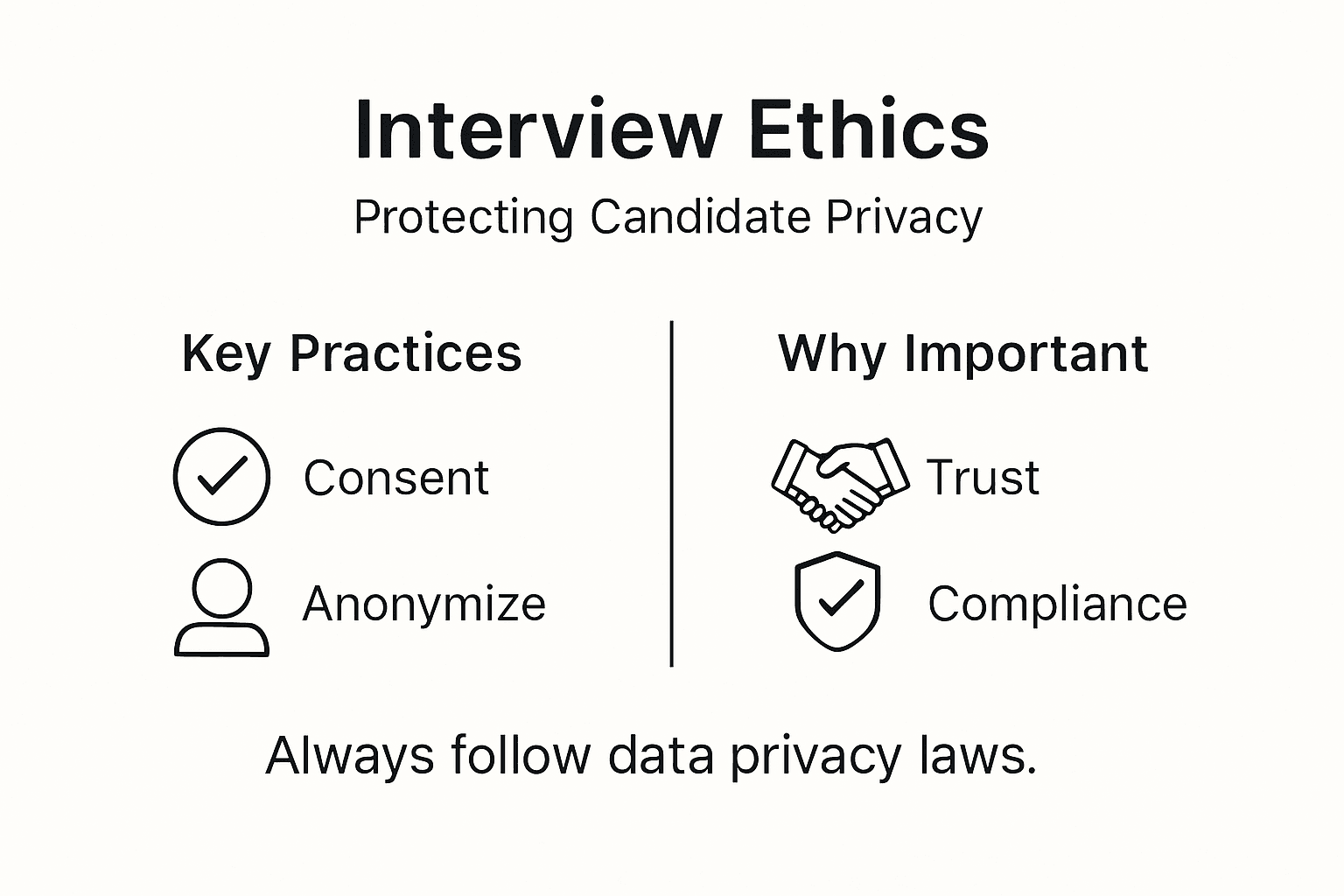
Start with consent and transparency. Before recording, explicitly tell candidates you’re recording the interview, how the recording will be used, and how long you’ll retain it. Get written consent. Many candidates assume interviews aren’t recorded unless explicitly told otherwise, and recording without permission violates wiretapping laws in many jurisdictions. Your consent statement should specify whether recordings will be used solely for hiring decisions or also for training purposes. If you plan to share anonymized interview excerpts with your team for feedback, candidates need to know that upfront. Transparency prevents legal trouble and builds candidate trust even among those you don’t hire.
Next, anonymize aggressively. Anonymization and pseudonym use protect participant identities in your stored transcripts and analysis documents. Replace names with codes (Candidate A, Candidate B), remove company names the candidate worked at, and strip out location details that could identify them. This matters when you share transcripts with your hiring team or store them long-term. If you use cloud-based AI tools for transcription, anonymize audio files prior to uploading to comply with GDPR and data protection regulations. A candidate’s real name in a cloud service violates EU data protection law and risks substantial fines. Strip identifiers before uploading, then reattach them locally only when needed.
Establish clear data retention and deletion policies. Decide how long you’ll keep interview recordings and transcripts. Best practice is deleting everything 90 days after a hiring decision unless the candidate joins your company. Document this policy and follow it consistently. If a candidate requests deletion before that window closes, comply immediately. Store interview data in encrypted systems with access controls. Not everyone on your team needs to hear raw interview audio. Your finance team doesn’t need access. Your hiring manager does.
Consider AI job interview ethics when using automated tools. AI-assisted analysis introduces additional privacy questions. Does the AI vendor train on your interview data? Does it retain copies? Get clear answers in writing. Most reputable transcription services don’t train on customer data, but you need to verify.
Pro tip: Create a one-page data handling policy for your hiring team and have every team member sign it before accessing interviews—this single document prevents most privacy violations and demonstrates intent if compliance questions arise later.
Below is a summary of best practices for ethical transcript management in hiring:
| Practice Area | Why It Matters | Best Practice |
|---|---|---|
| Consent & Transparency | Builds trust and ensures legality | Clearly inform, get written consent |
| Anonymization | Protects candidate identity | Replace names, redact details |
| Data Retention | Reduces liability risks | Delete after 90 days or on request |
| Access Control | Limits exposure | Use encrypted, restricted systems |
| AI Tool Selection | Ensures compliance | Verify vendor’s data handling policy |
Common Pitfalls and How to Avoid Them
Transcript analysis looks straightforward until you’re halfway through your first interview and realize your coding framework doesn’t fit reality. Most hiring teams encounter predictable mistakes that sabotage analysis quality. Knowing what to avoid saves you from hiring the wrong person or missing a strong candidate.
The first major pitfall is transcription carelessness. A transcript with errors creates a cascade of problems. If the AI transcribed “I optimized the API response time” as “I optimized the AP eye response time,” you miss critical technical depth. Many teams accept transcripts without verification, assuming modern AI is accurate. It’s mostly accurate, but not perfect. Technical jargon gets mangled. Accents confuse systems. Background noise creates gaps. Meticulous transcription verification minimizes errors that compound through your analysis. Spend 30 minutes spot-checking transcripts for obvious mistakes. Listen to sections where the AI seems uncertain. Fix them before analysis begins.
The second pitfall is inconsistent coding across your team. One interviewer codes “asking clarifying questions” as evidence of thoroughness. Another codes the exact same behavior as evidence of confusion. You end up comparing apples to oranges. This happens because coding frameworks aren’t specific enough. Don’t write “communication skills.” Write “explains technical concepts without jargon to non-technical audience” or “admits knowledge gaps instead of guessing.” Train your entire team on the framework before analyzing a single transcript. Have multiple people code the same interview and compare results. Where you disagree, refine the framework. Structured coding frameworks and peer review transform subjective impression into systematic assessment.
The third pitfall is ignoring context. A candidate who says “the team wasn’t aligned” in one company might have worked in legitimate chaos. In another context, that same phrase signals blame-shifting. Inconsistencies in transcription methods and neglect of context destroy analysis reliability. Document the context around each response. What question prompted it? How did the candidate’s tone shift? Did they pause or speak rapidly? This context prevents you from misinterpreting a single sentence.
The fourth pitfall is confirmation bias. You like a candidate and unconsciously emphasize their strengths while minimizing weaknesses in their transcript. Reverse this by having someone unfamiliar with your first impression review their transcript independently. Better yet, use AI to flag patterns you might miss before human bias shapes interpretation.
Pro tip: Create a simple checklist before analyzing any transcript: verify transcription accuracy, confirm your coding framework matches the role, document context for every coded segment, and have a second person spot-check your interpretations on borderline candidates.
Accelerate Your Interview Transcript Analysis with Real-Time AI Assistance
Interview transcript analysis demands accuracy, consistency, and speed to unlock genuine insights about candidates’ technical depth and communication clarity. The challenges of manual transcription and potential bias in coding frameworks can slow down your hiring process and cloud your judgment. With Parakeet AI you gain a real-time AI job interview assistant that listens attentively and automatically generates insightful answers during your interviews. This powerful tool helps you overcome common pitfalls like transcription carelessness and subjective interpretation outlined in “Interview Transcript Analysis Unlocking Real Insights”.
Stop wasting precious hiring time on slow manual analysis. Experience the future of hiring by visiting Parakeet AI to streamline your transcript workflows, enhance consistency, and make data-driven hiring decisions with confidence. Explore how AI-assisted analysis complements your human insight for faster, fairer, and deeper candidate evaluation at Parakeet AI. Ready to transform your interview process? Get started now at Parakeet AI.
Frequently Asked Questions
What is the purpose of interview transcript analysis?
Interview transcript analysis helps in converting audio recordings into written text and extracting meaningful insights, patterns, and themes from that text to inform hiring decisions and improve candidate evaluation.
How do manual transcription and AI-assisted transcription differ?
Manual transcription involves human listeners accurately converting audio into text, capturing nuances and emotional tones but is time-consuming. AI-assisted transcription uses technology for speed and scalability but may miss some context and technical jargon.
What are inductive and deductive approaches in transcript analysis?
Inductive approaches work from the data outward, allowing themes to emerge naturally, while deductive approaches start with predefined coding categories to mark segments in the transcript, providing more standardized and consistent data.
How can AI tools enhance the transcript analysis process?
AI tools can significantly speed up the transcription process and help identify patterns and themes across large volumes of transcripts quickly, allowing human analysts to focus on interpreting the nuances and making final hiring decisions.
Recommended
- Interview Question Analysis: Complete Guide
- Real-Time Job Interview Insights: Elevate Your Performance
- Why Real-Time Interview Analysis Matters for Tech Job Seekers
- Post-Interview Analysis: Turning Feedback Into Results
- Why Track Time? Understanding Its Importance and Benefits – Optio Station: Best Project Management App for Prioritization