10 Job Interview Practice Test Options Compared for 2026
You've read the same list of sample questions three times. Your opening answer sounds convincing in your head, but when someone asks why you made that decision, you freeze. The problem isn't necessarily your experience. You haven't practiced retrieving and explaining it while someone else controls the conversation.
A useful job interview practice test makes you answer, not just recognize a good answer on a page. Hearing yourself speak exposes long introductions, missing evidence, and vague descriptions of teamwork. Follow-up questions reveal whether you understand your example well enough to defend a decision or explain what you'd change.
The options below differ in live-interview realism, useful feedback, and effort required to practice regularly. Treat them as complementary tools: a spoken interviewer for conversation, a written drill for structure, and a human or uninterrupted simulation for your final rehearsal. If you're preparing for a governance role, a specialized resource such as SeatSignal's board interview question bank can help you choose more relevant prompts than a general question library.
Practical rule: Choose the format closest to your next interview, then judge progress by the evidence in your answers, not by an overall score.
You don't need accounts everywhere. Pick an option that addresses your immediate weakness, save the response, and repeat the difficult part before moving on.
1. AI Mock Interview Practice
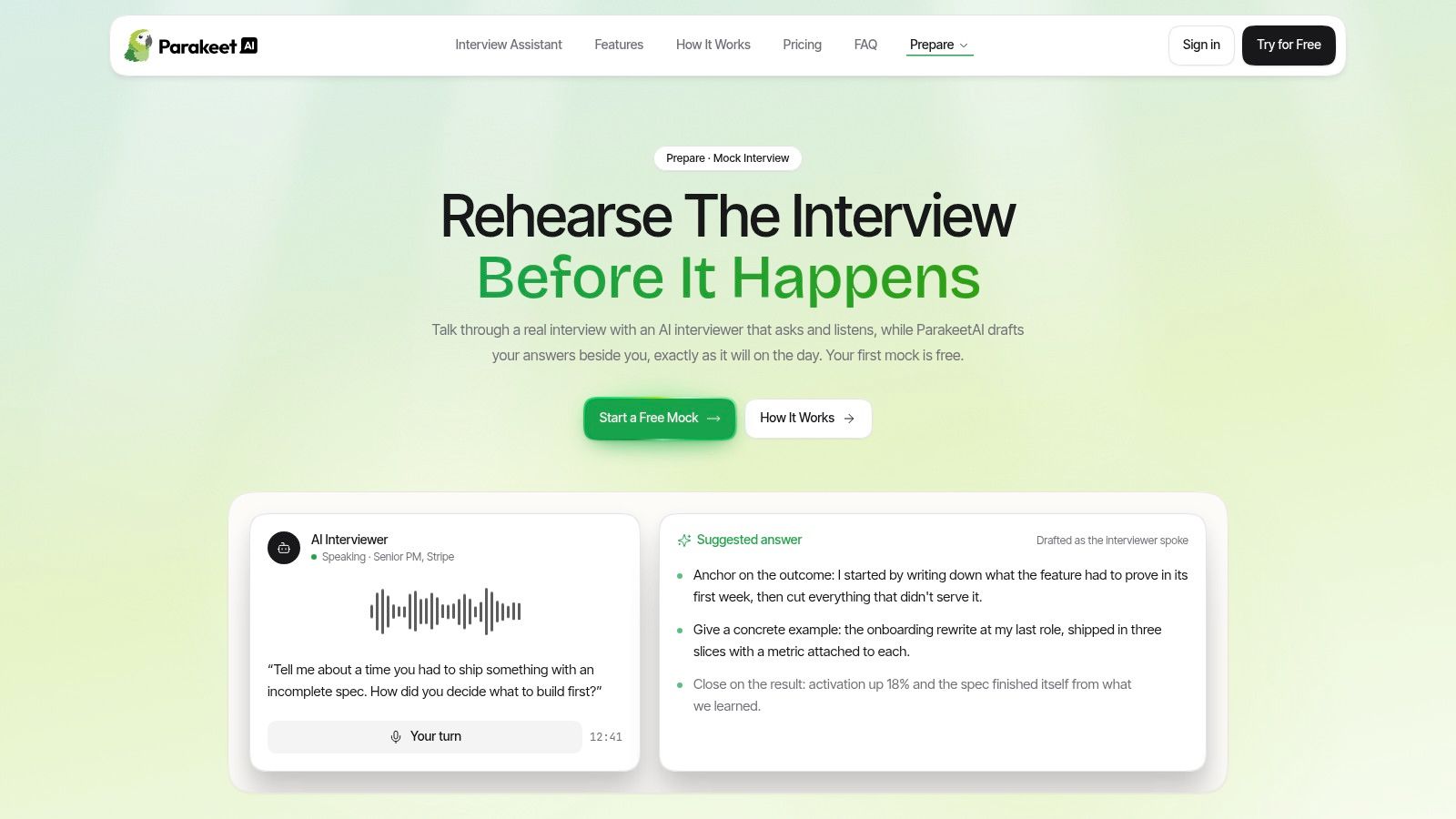
Best for candidates who know their examples but struggle to explain them aloud. Our Mock Interview Practice lets you speak with an AI interviewer that responds and asks follow-up questions. You can read the saved transcript afterward, and your first mock interview is free, with no credit card needed.
The conversational format matters because a follow-up changes the task. Instead of delivering a prepared story, you have to identify what the interviewer still needs: your reasoning, your personal contribution, or the outcome. That's closer to live conversation than reading a prompt and checking a sample answer.
Turn the transcript into a better answer
Read your response without mentally filling in missing details. If you said your team improved a process, can a reader identify what you changed and why? Highlight statements that sound impressive but don't contain observable evidence.
- Strength: Spoken exchanges help you rehearse responding rather than reciting.
- Useful feedback: The transcript shows your actual wording, including missing context and repeated explanations.
- Limitation: An AI interviewer can't fully reproduce a human interviewer's judgment, priorities, or unpredictability.
- Access trade-off: The included free mock is a starting point; additional practice may require payment.
For your next attempt, keep the same example but change the explanation. Start with the decision, give only the context needed to understand it, and finish with an honest result.
If you're preparing in a second language, separate language practice from evidence selection. Resources that help you prepare for job interviews in English can support phrasing, while the spoken mock tests whether you can retrieve that phrasing naturally. Don't memorize a polished paragraph you can't adapt when the question changes.
2. Huru
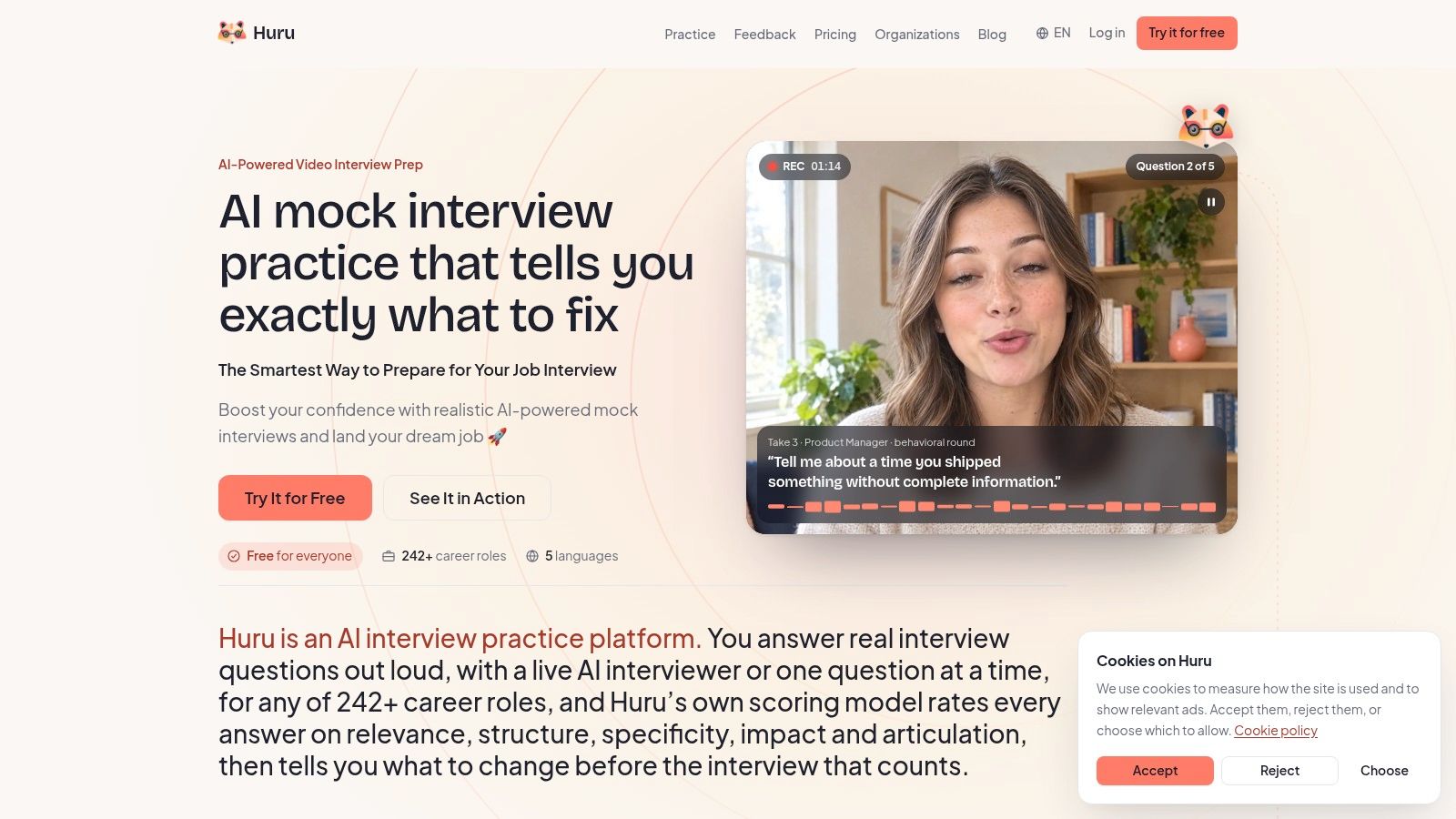
A vacancy-specific rehearsal is more useful than a generic confidence exercise when your interview is approaching. Huru offers free job-seeker practice designed for a role or job description, video responses, and feedback on both answer content and speaking delivery. Its library contains more than 50,000 questions, and its Chrome extension supports creating practice from job listings.
The practical advantage is relevance. You can start from the vacancy rather than spend your preparation time searching a broad question bank. Multiple-language support also gives you room to practice in the language you'll use.
Review content before delivery
Begin by checking whether your answer addresses the question. Only then review pacing and presentation. A fluent answer without a concrete example still leaves the interviewer guessing about your capability.
- Works well for: Candidates preparing for a specific vacancy who want video self-review without a subscription.
- Less useful for: Phone-screen rehearsal where visual delivery isn't part of the task.
- Feedback boundary: AI scoring is guidance, not a reliable prediction of an employer's assessment.
For your rehearsal plan, select a job requirement you haven't demonstrated clearly. Record an example, inspect the feedback, and repeat it with stronger evidence. Independent user-review information is limited, so judge the tool by whether its comments identify changes you can make, not by the apparent precision of its score.
3. Big Interview
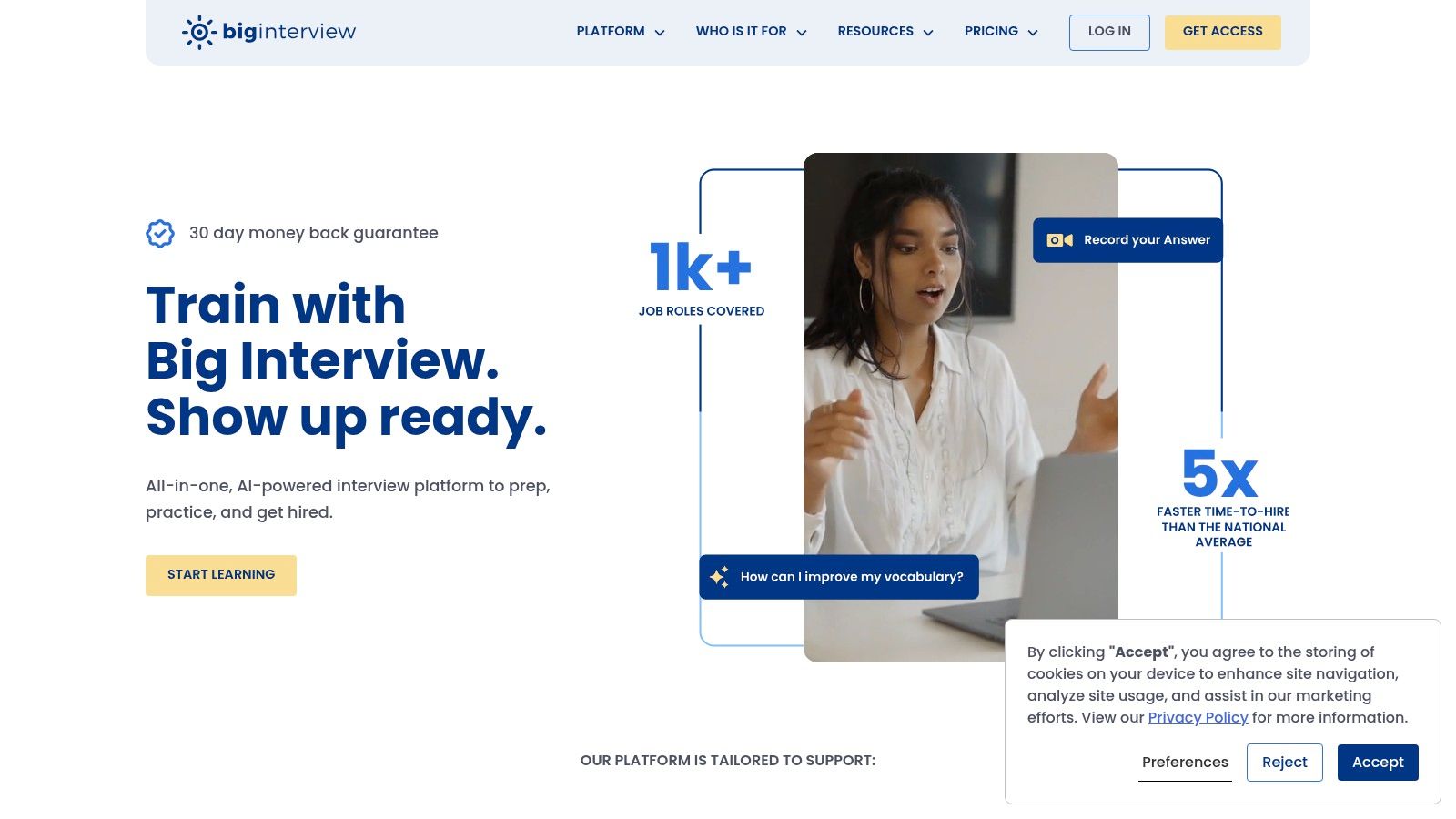
Big Interview suits candidates who need instruction as well as rehearsal. Big Interview combines video lessons, guided preparation, question sets, and a simulator. PracticeAI can use a job description and an optional resume to generate adaptive audio questions and follow-ups, with feedback on relevance, clarity, and confidence.
That combination helps when you don't know why an answer is weak. A simulator alone may identify a problem without teaching you how to rebuild the response. Lessons give you a method, while recorded practice lets you check whether you've applied it.
Use the lesson that fixes the problem
Don't work through the entire course just because it's available. Run a practice response first, identify the gap, and choose the relevant instruction.
For behavioral answers, STAR provides a useful structure. Amazon's interview guidance recommends Situation, Task, Action, and Result, emphasizing personal contribution and quantifiable outcomes.
- Advantage: Instruction and practice live together, with recordings you can review or share.
- Access consideration: Students and alumni may have institutional access through a college or career center.
- Trade-off: Access and AI interview allowances depend on the organization or plan; otherwise, paid access is required.
A session can reveal whether your explanation is organized. It can't establish that your example matches an employer's undisclosed rubric. Finish by checking the story against the actual job requirements.
4. Yoodli
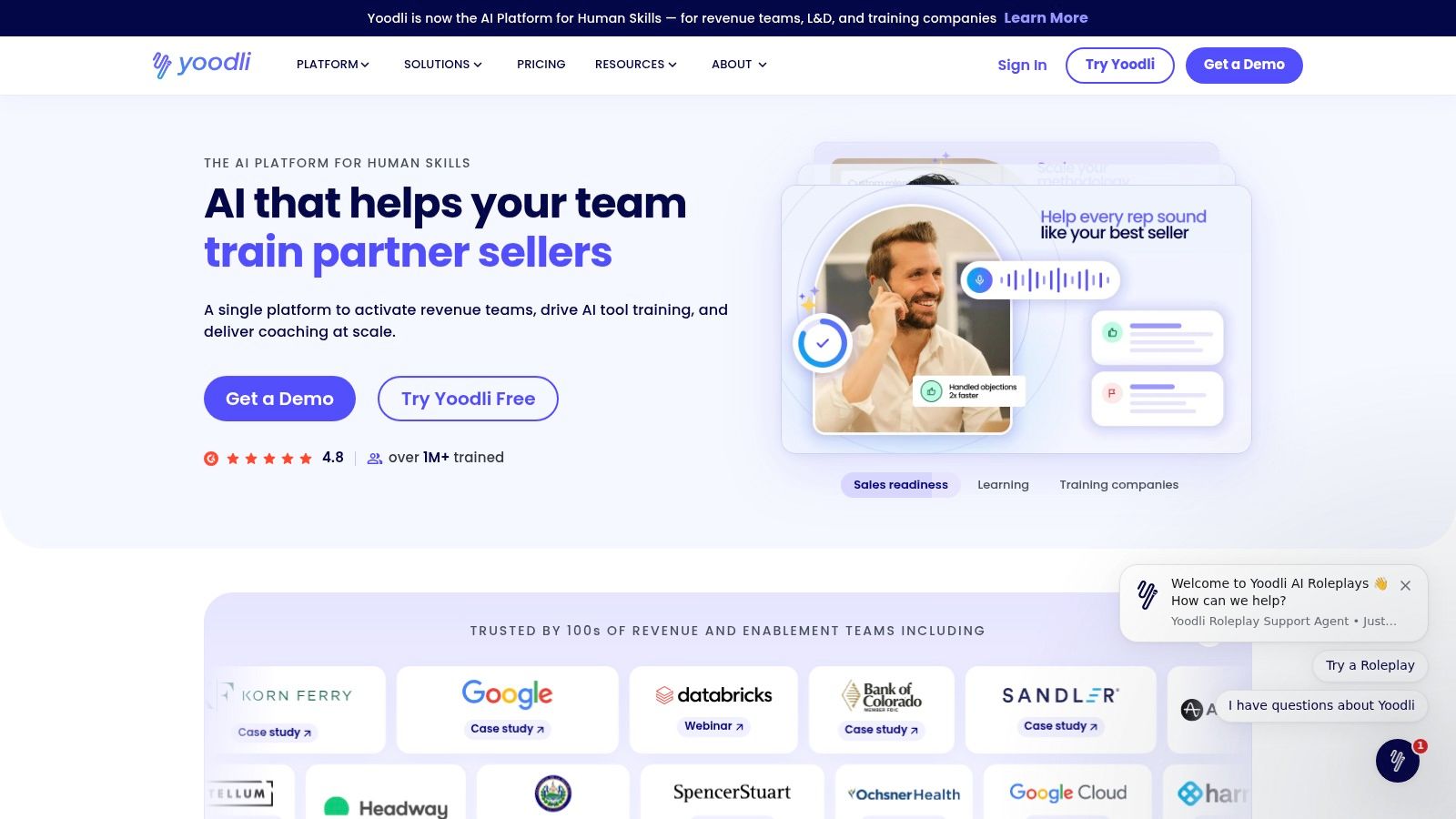
Your example may be strong while your delivery makes it difficult to follow. Yoodli addresses that problem through AI communication coaching and interview roleplays. You can set the role, company, and interviewer demeanor, supply questions, and respond to dynamic follow-ups.
Its broader communication focus is useful if your interview includes presenting a project or explaining a proposal. Recorded practice and speaking feedback let you inspect how you communicate, not just which points you include.
Don't remove every pause. Remove the explanation that makes the listener work unnecessarily hard.
Separate speaking habits from job ability
Use delivery feedback to improve intelligibility, not to imitate a single approved personality. Accent, eye contact, and spontaneous speed shouldn't become substitutes for evaluating whether you answered the question.
- Strong fit: Spoken rehearsal, follow-up handling, and communication practice beyond interviews.
- Starter limit: The Yoodli starter offering includes five roleplays total on its free plan.
- Purchase caution: Pro and Advanced prices are presented with annual billing, so inspect the billing basis before choosing access.
For a focused session, use an example you already understand. Change the interviewer demeanor and practice keeping your explanation clear without becoming defensive or excessively detailed.
The session can expose pacing and organization problems. It can't tell you whether an interviewer will prefer your natural communication style, and you shouldn't treat that uncertainty as a flaw to eliminate.
5. interviewing.io
A coding solution that works isn't the same as a coding interview answer. interviewing.io focuses on technical practice for software engineers, with anonymous sessions, free peer practice subject to availability, and paid sessions with experienced technical interviewers.
Human follow-ups are the main reason to choose it. A person can ask why you rejected an approach, change a constraint, or probe a shaky assumption. That makes the format a stronger match for technical interviews than a general behavioral question generator.
Rehearse the reasoning, not just the solution
Bring the habits you'll need in the session: clarify the problem, explain your approach, discuss alternatives, and check edge cases. If you get stuck, say what you know and what you're testing next.
- Experienced interviewer sessions: Useful for probing technical reasoning, but paid sessions carry a greater cost commitment than self-serve practice.
- Peer sessions: A free route to live practice, with scheduling and partner-fit constraints.
- Scope limitation: Primarily for technical interviews, not a general substitute for recruiter or leadership rehearsal.
Afterward, distinguish a knowledge gap from a communication gap. Not knowing an appropriate algorithm calls for study; knowing it but failing to explain the trade-off calls for another spoken attempt.
Ask for feedback tied to moments in the session. A specific comment about an unstated assumption is more actionable than a general impression that you need more confidence.
6. Aced (formerly Exponent)
Taking the interviewer's role can show you how difficult vague answers are to evaluate. Aced, formerly Exponent, combines technology and product-management preparation with peer mock interviews, courses, and question resources. Pramp's peer practice is now hosted within the platform's practice offering.
This is a specialized choice for candidates preparing for technical and product interview loops. Its paid tier adds AI mocks and AI feedback, while the free tier provides a way to try peer practice.
Make peer feedback specific
The value of a peer session depends partly on how you brief each other. Agree on the competency being tested before beginning, then save feedback until the answer or simulation is complete.
The U.S. Office of Personnel Management's structured-interview guidance associates greater structure with higher validity, rater reliability, and agreement. For practice, that supports consistent prompts and explicit criteria rather than an informal chat.
- Best use: Product cases, technical reasoning, and practicing both sides of an interview.
- Trade-off: Peers are candidates too, so their feedback and subject knowledge vary.
- Access boundary: Free peer practice doesn't include every paid learning or AI feature.
After the session, write down the question, the evidence you supplied, and what your partner couldn't assess. Redo the unclear portion rather than replacing the whole answer.
A peer's reaction tells you how your explanation landed with that person. It doesn't establish a company's hiring standard or confirm that a company-specific question will appear.
7. Career.io Interview Prep
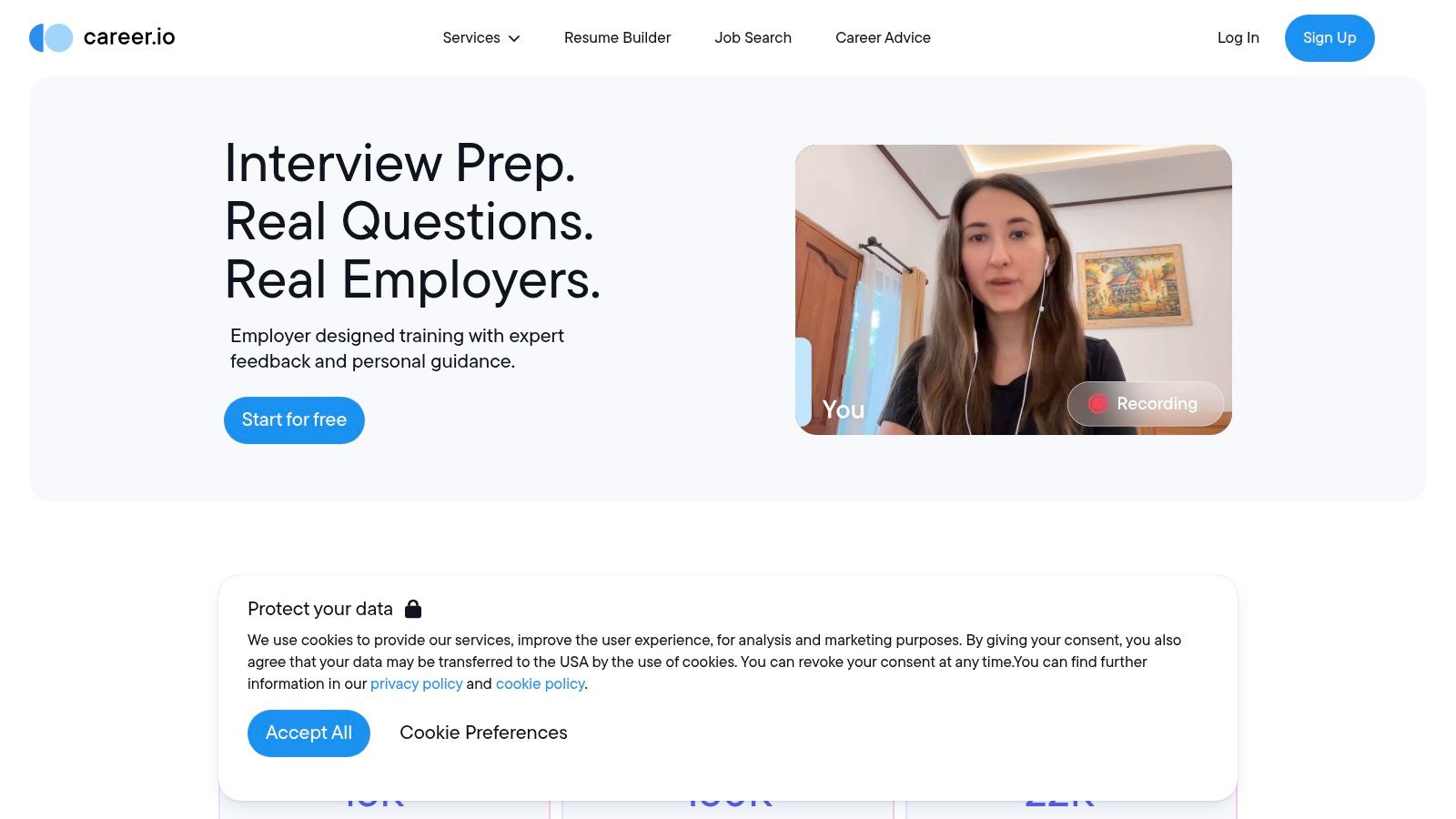
Choose this when you want recorded self-review within a broader career platform. Career.io Interview Prep offers role-specific questions, a question library covering many job titles, recorded responses, and personalized improvement suggestions.
The recording is valuable even when you disagree with a recommendation. You can replay the answer and check whether the opening was relevant, the example was specific, and the result was understandable. That makes your review less dependent on how confident you felt while speaking.
Watch without rewriting history
Review the recording before drafting a replacement answer. Note where you answered the question, not where you intended to answer it.
- Useful combination: Interview preparation alongside other career-search services.
- Commercial limitation: The public interview-prep page doesn't clearly state a standalone price.
- Evidence limitation: Claims about employer questions and platform outcomes are provider-reported, not independent measures of effectiveness.
For the next attempt, change the part that caused confusion. If your opening wandered through your employment history, begin with the relevant capability and move directly into supporting evidence.
Recorded practice can help you inspect a response carefully. It won't necessarily reproduce interruptions, shifting priorities, or a skeptical interviewer. If your next round is highly conversational, pair this format with a live mock instead of assuming a polished recording proves you're ready for follow-ups.
8. Interviews by AI
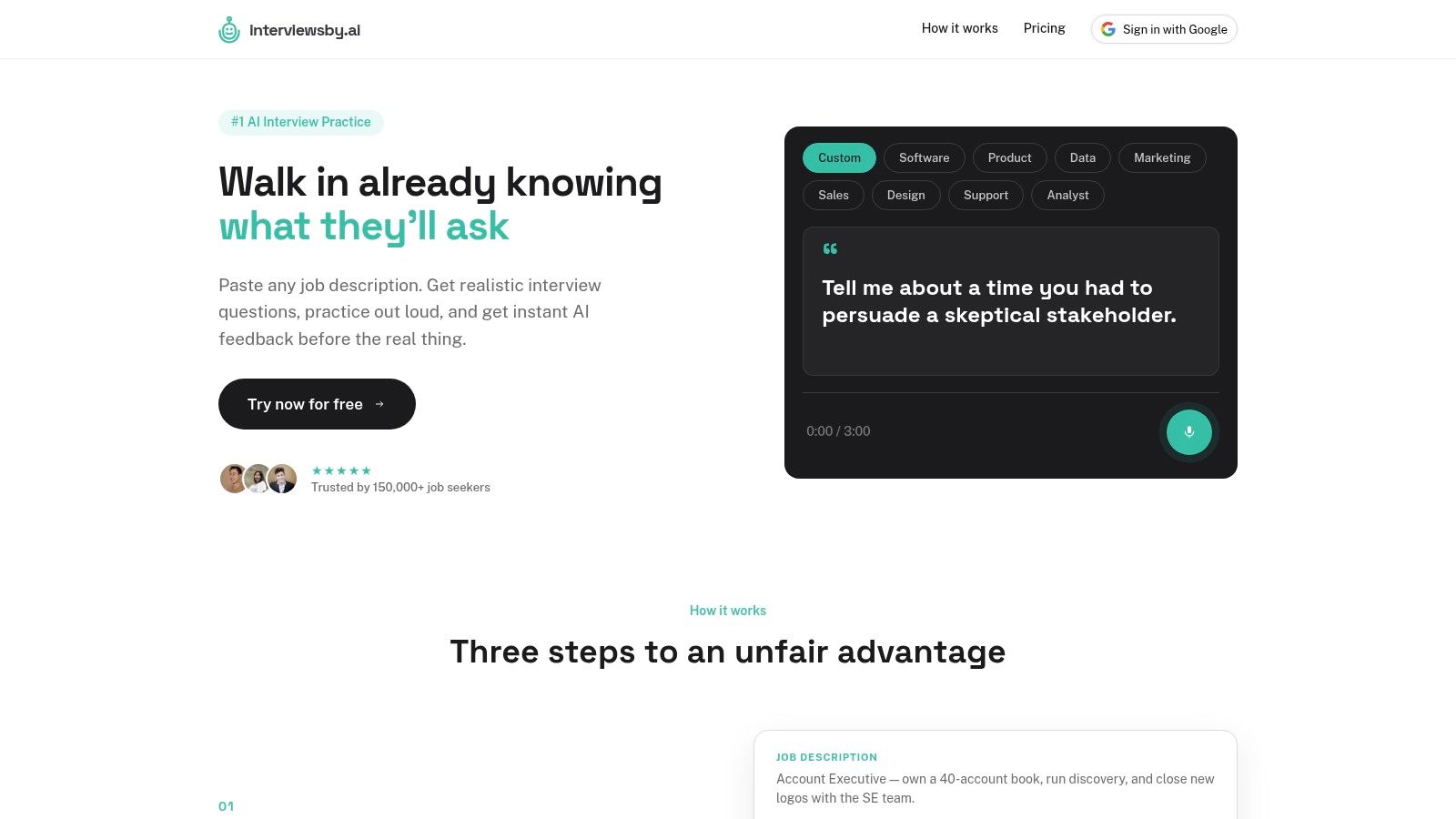
Sometimes your immediate problem is simpler than interview anxiety: you don't yet have a clear answer. Interviews by AI offers job-description-based questions or selected question sets, spoken or written responses, feedback, and sample-answer guidance.
The question-by-question format suits targeted drills. Written responses are especially useful when speaking aloud is inconvenient or when you need to separate choosing evidence from delivering it.
Use a model answer to inspect structure. Don't borrow achievements, judgments, or results you can't honestly explain.
Move from writing to retrieval
Start by identifying what the question asks you to demonstrate. Draft the relevant example, remove unnecessary context, then close the draft and answer aloud.
- Advantage: Low-friction practice without committing to a full course or video platform.
- Limitation: The free allowance is restricted, and the format is less conversational than tools with dynamic follow-ups.
- Missing perspective: Don't select it for video or body-language feedback; those aren't listed capabilities.
Sample answers can reveal a missing result or an unclear sequence. They can also tempt you into language that sounds polished but isn't yours.
A good session should leave you with an answer outline you can retrieve, not a paragraph you must remember word for word. If the written version is strong but the spoken attempt collapses, stop editing and spend your remaining preparation time speaking.
9. Terview AI
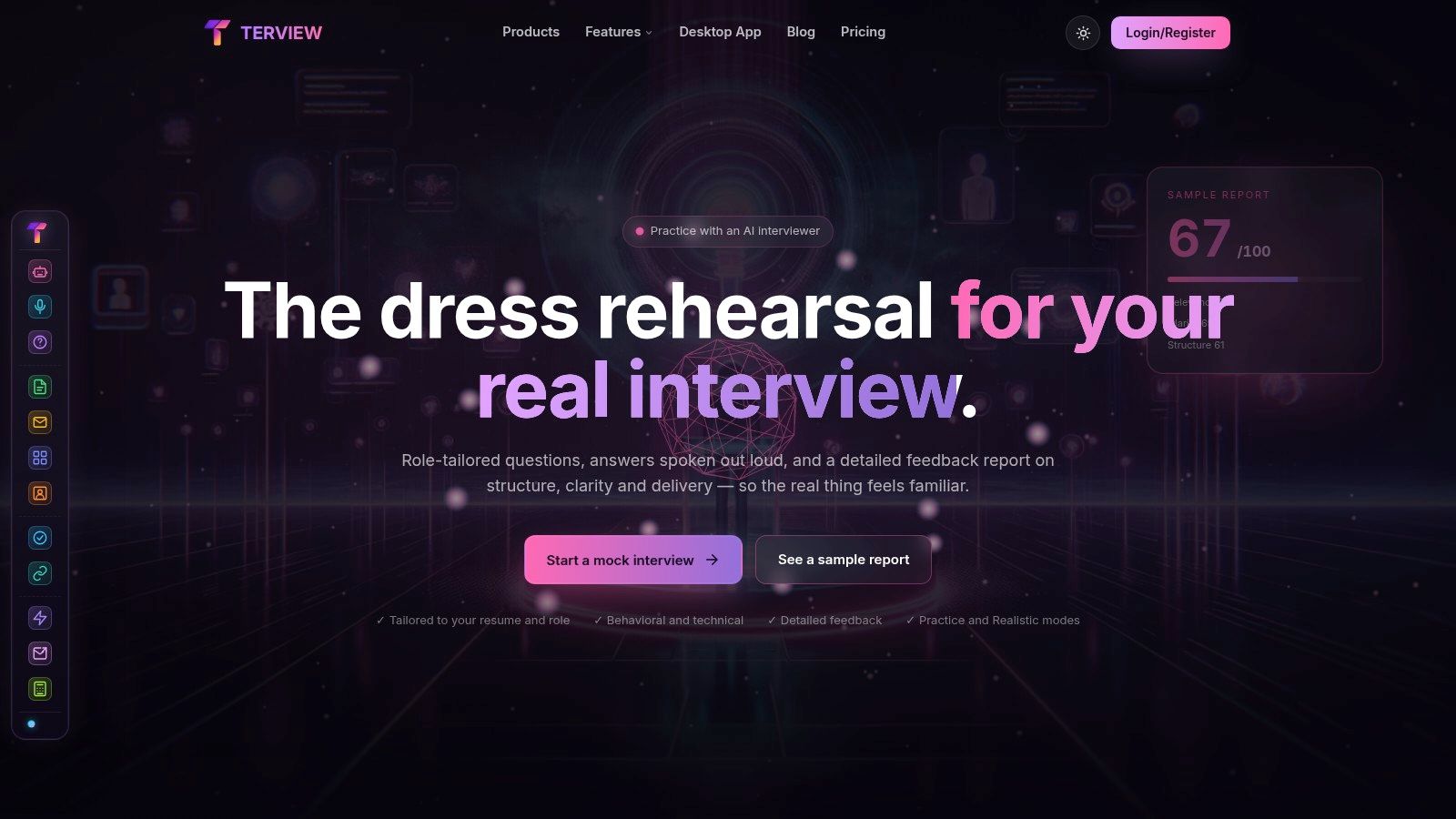
Terview AI lets you configure spoken practice by role, company, job description, interview stage, type, and difficulty. It provides follow-up questions, transcripts, answer-level scores, and feedback on content and delivery, with saved history subject to plan limits.
Its practical appeal is targeted review. You can inspect a difficult response rather than relying on a single overall impression. Stage settings also help you distinguish a recruiter-style explanation from a more detailed technical or hiring-manager answer.
Convert a score into a task
A score only helps when you can connect it to something you said. Look for the sentence that lacked evidence, the decision you didn't explain, or the result you omitted.
- Useful setup: Job-description and stage controls support focused rehearsal.
- Free-access limit: The Terview AI offering limits free practice to a few interviews of up to five questions each.
- Trade-off: Frequent practice can increase subscription spending, and AI scores remain estimates rather than employer judgments.
Before buying additional access, decide what repeated sessions will test. Repeating unchanged answers to chase a higher score isn't a useful plan.
Instead, preserve the question and compare attempts against the same criteria: relevance, personal contribution, reasoning, and outcome. The session can reveal whether you supplied stronger evidence. It can't show that a particular employer would make the same assessment.
10. Interview Practice AI
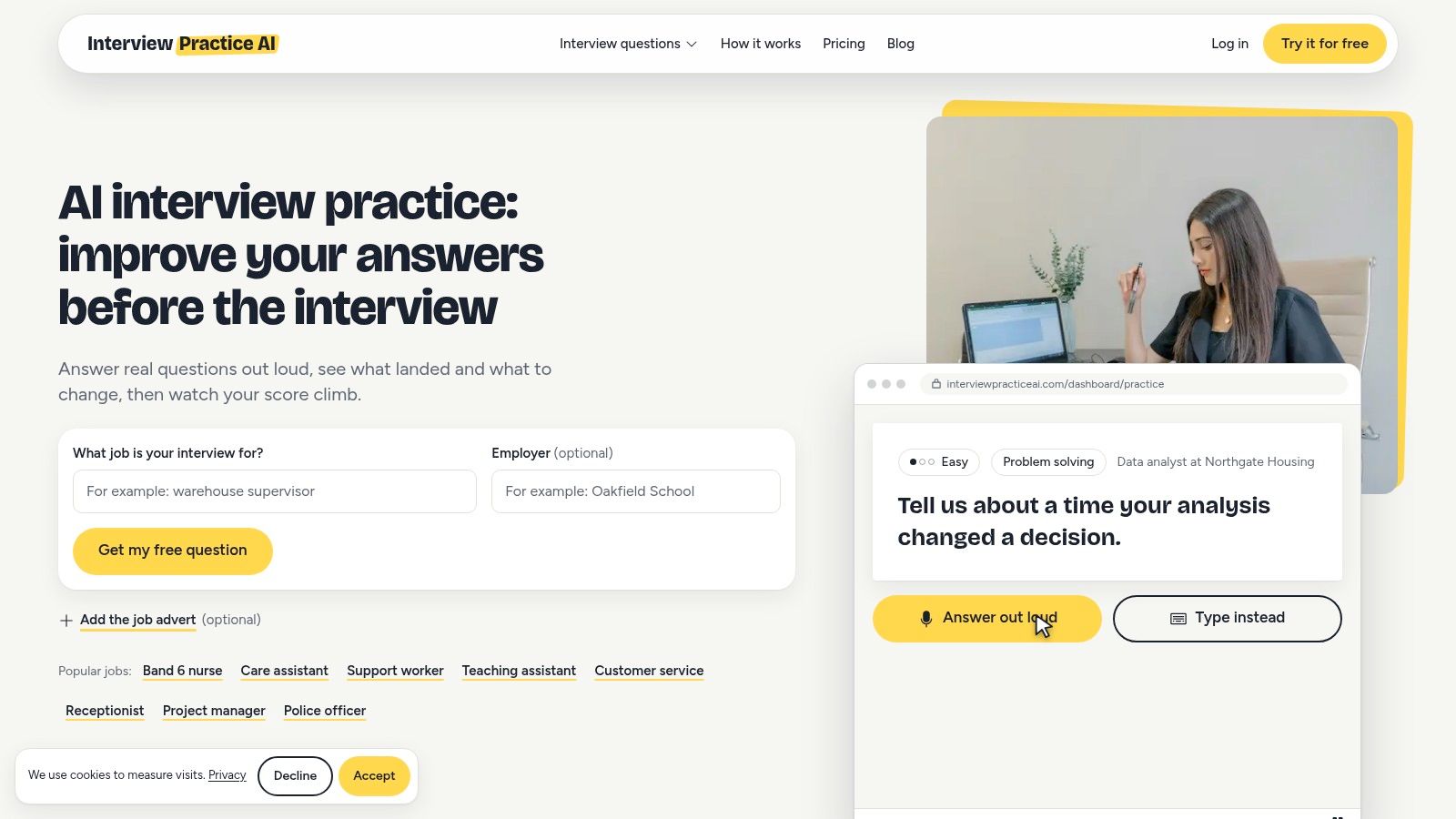
An interview deadline doesn't necessarily justify an ongoing subscription. Interview Practice AI offers job-specific questions, answer marking, model answers, read-aloud mocks, CV checks, and practice reports through time-limited, one-off paid passes rather than automatic monthly subscriptions.
Free practice lets you inspect the format before purchasing. The trade-off is expiry: paid passes last 14 or 60 days, with daily usage limits, including marked-answer limits, according to Interview Practice AI's access details.
Plan around the access window
This format fits a concentrated preparation period better than occasional practice spread across a long job search. Add the relevant job, test the feedback, and identify which answers need marking before committing.
- Strength: Job-specific drills and reports support focused preparation.
- Purchase consideration: One-off access avoids recurring monthly billing, but unused time still expires.
- Confidence boundary: Independent user-reputation information is limited, so evaluate the usefulness of the feedback yourself.
Use model answers to identify missing components, then rebuild the response around your own experience. A report that flags weak evidence is useful only if you can return with a more concrete example.
The session can help test answer coverage and organization. Read-aloud practice also gets you speaking, but it shouldn't replace handling an unexpected follow-up. End your preparation with an uninterrupted spoken rehearsal, not another round of polishing written responses.
How the 10 Practice Options Compare on Free Access, Format, and Feedback
| Item | Free option | Practice format | Feedback style | Best for |
|---|---|---|---|---|
| AI Mock Interview Practice | First mock interview is free | Spoken interview with AI follow-up questions | Saved transcript for review | Building confidence answering aloud |
| Huru | Listed job-seeker features are free | Role- or job-specific video interviews | Feedback on answer content and speaking delivery | Practicing for a specific vacancy |
| Big Interview | May be free through a college or career center | Lessons and adaptive audio practice based on a job description | Feedback on relevance, clarity, and confidence | Structured interview preparation |
| Yoodli | Starter plan includes five roleplays | AI roleplays with dynamic follow-ups and adjustable interviewer demeanor | Feedback on speaking and recorded practice | Interview and broader communication practice |
| interviewing.io | Free peer practice, subject to availability | Anonymous technical interviews with peers or experienced interviewers | Human interviewer or peer feedback | Software-engineering interview practice |
| Aced (formerly Exponent) | Free tier includes peer mock interviews | Peer practice for technical and product roles | Peer feedback; quality may vary | Tech and product interview preparation |
| Career.io Interview Prep | Standalone free access is not clearly stated | Recorded role-specific practice | Personalized insights and improvement suggestions | Interview prep within a broader career platform |
| Interviews by AI | Limited free allowance | Job-description-based spoken or written question drills | Feedback and sample answers | Quick, focused interview rehearsal |
| Terview AI | Free access is limited to a few interviews | Spoken role-specific interviews with follow-up questions | Per-answer scores and delivery and content feedback | Targeted practice with structured feedback |
| Interview Practice AI | Free mock interview to try | Read-aloud, job-specific mock interviews | Answer marking, model answers, and practice reports | Focused preparation without a recurring subscription |
Turn Each Practice Session Into Interview Progress
Choose a free session this week, record an answer to a role-specific question, and compare it with the transcript or feedback before trying again. Don't begin by asking whether you sounded impressive. Ask whether the listener could identify the problem, your responsibility, your decision, and the result.
Choose the format around the weakness. Use spoken AI practice when you freeze during follow-ups, written drills when your examples lack structure, and human technical practice when you need someone to challenge your reasoning. If your interview is close, a targeted rehearsal is more useful than exploring every platform.
Review evidence rather than chasing scores
Read your answer before looking at the tool's rating. Mark where you demonstrated the required competency and where you merely claimed to have it. Then compare your assessment with the feedback and investigate the disagreement.
The EEOC's guidance on employment tests and selection procedures says selection procedures should be validated for the particular position and purpose. A practice platform's rating isn't an employer's validated hiring cutoff, so don't interpret it as a probability of receiving an offer.
- Keep: Specific examples, clear personal actions, and honest outcomes.
- Change: Long setup, unexplained decisions, and claims without evidence.
- Retest: The weakest part of the answer, followed by a fresh question that checks whether the improvement transfers.
Make the final rehearsal realistic and accessible
Repeat with a different format so you can inspect the answer from another angle. A written response may expose missing logic; a spoken exchange may reveal that you can't retrieve the example under pressure. For technical roles, include a work sample or coding explanation and practice defending your choices, not just producing a correct result.
Use the equipment and communication format you expect on the day. Practice asking for clarification and taking a deliberate pause. If you need adjustments to the interview format, prepare that request separately rather than treating every processing or sensory barrier as a personal performance problem.
Finish with a complete run-through without stopping to edit. Afterward, write a short rehearsal plan naming the answer to improve, the evidence to add, and the format you'll use next. Your goal isn't a flawless script. It's being able to explain relevant experience clearly, respond when challenged, and recover when a question takes an unexpected turn.
Our Prepare tools include spoken mock interviews, resume building, headshots, and a Question Bank of real interview questions grouped by company. Visit ParakeetAI to try your first mock interview free, with no credit card needed, then use the transcript to choose what to rehearse next.