10 Best Mock Interview Practice Apps Compared (2026)
Which mock interview practice app will make you better at interviews, rather than just give you more questions to answer? The difference is whether you can hear what went wrong, identify a specific weakness, and deliver a stronger answer next time.
Rereading notes helps you recognize a good answer. Speaking out loud makes you produce one, including the awkward transitions, missing evidence, and explanations that sounded shorter in your head. An app is useful when it helps you work on those problems, not when it merely rewards fluent speech.
The options below are grouped by their strongest use: conversational AI interviewers, delivery coaching, structured preparation, and technical or peer practice. The comparisons cover practice formats, platform access, privacy considerations, and pricing models, with limitations alongside the benefits. These aren't interchangeable products, and an automated score isn't a hiring prediction.
Start with your bottleneck: If you can't choose a relevant example, speech analytics won't solve the problem. If your examples are strong but your answers ramble, another question bank probably won't help.
Choose a tool, run two or three sessions, then review the transcripts or recordings. Fix one weakness per practice cycle, such as explaining your individual contribution or answering the question before adding context. Item one also covers desktop access and video-call integration for candidates who want practice and live support within the same ecosystem.
1. AI Mock Interview Practice
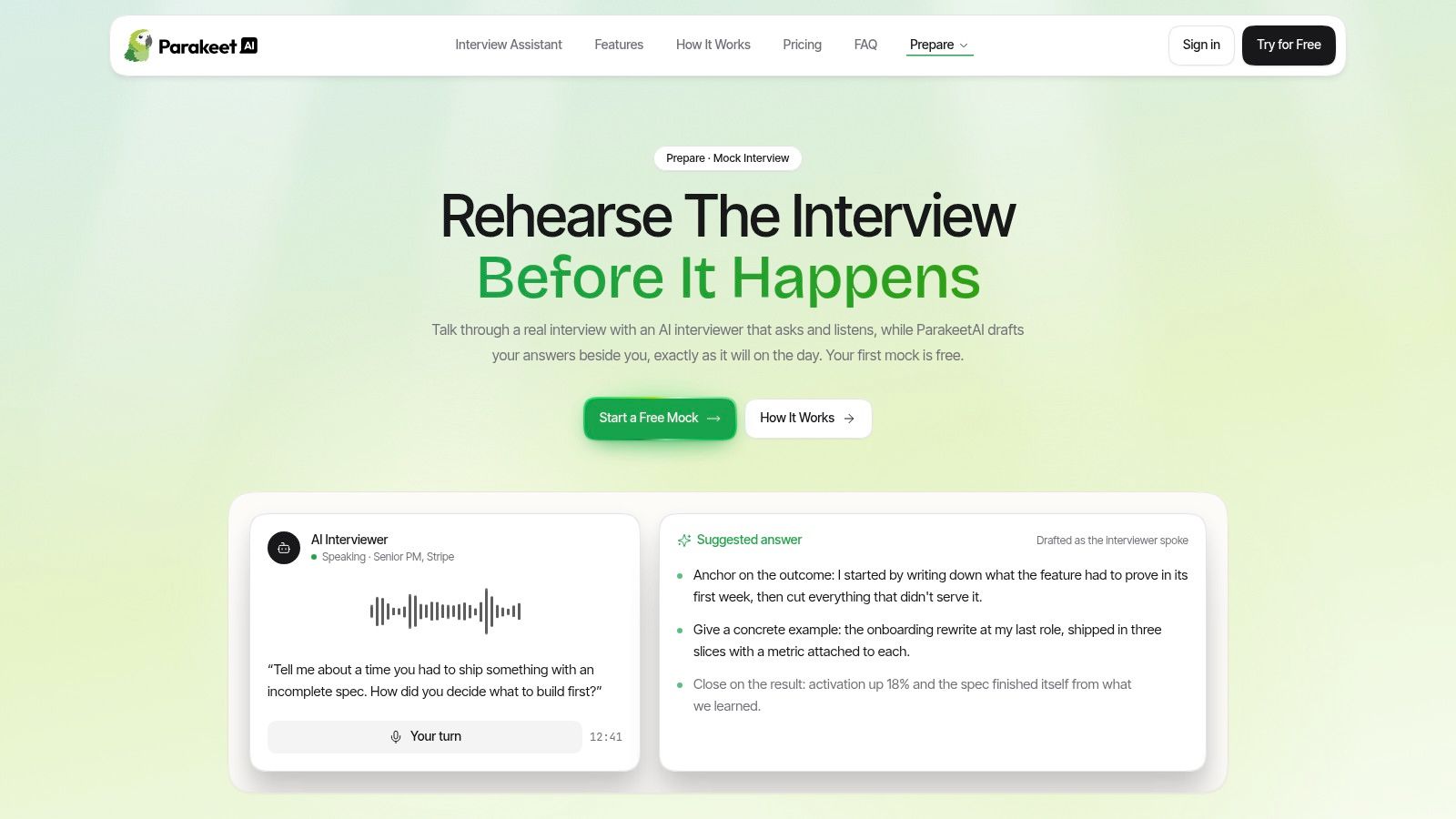
Best for conversational rehearsal followed by transcript review. ParakeetAI lets you speak with an AI interviewer that responds during the exercise, then revisit the conversation afterward. Follow-up questions give you practice responding to a conversation rather than reciting prepared answers.
The first mock interview is free and doesn't require a credit card. Use it to test whether the interaction encourages you to explain your decisions clearly, especially when the interviewer asks for detail you hadn't prepared.
Where it helps and where it stops
The transcript is the most practical review tool. Look for answers where you described the team's work without explaining your contribution, introduced a result without supporting evidence, or spent too long establishing context.
- Strengths: Spoken practice, conversational follow-ups, and a transcript you can review after the session.
- Limitations: The free offer covers one mock interview. An AI interviewer and transcript don't replace a coach who understands your profession.
- Access: The broader assistant works in desktop Chrome, Windows and macOS desktop apps, and a phone browser. For live video calls, the Session option connects by sharing the call tab rather than joining as a participant.
Keep practice and live assistance separate in your decision. During a real assessment, follow the employer's rules and don't present generated expertise as your own.
For preparation, open the AI Mock Interview tool, complete an uninterrupted attempt, and review it before repeating. Pricing varies by country, so use the current pricing page rather than assuming the free trial represents ongoing access.
2. Huru
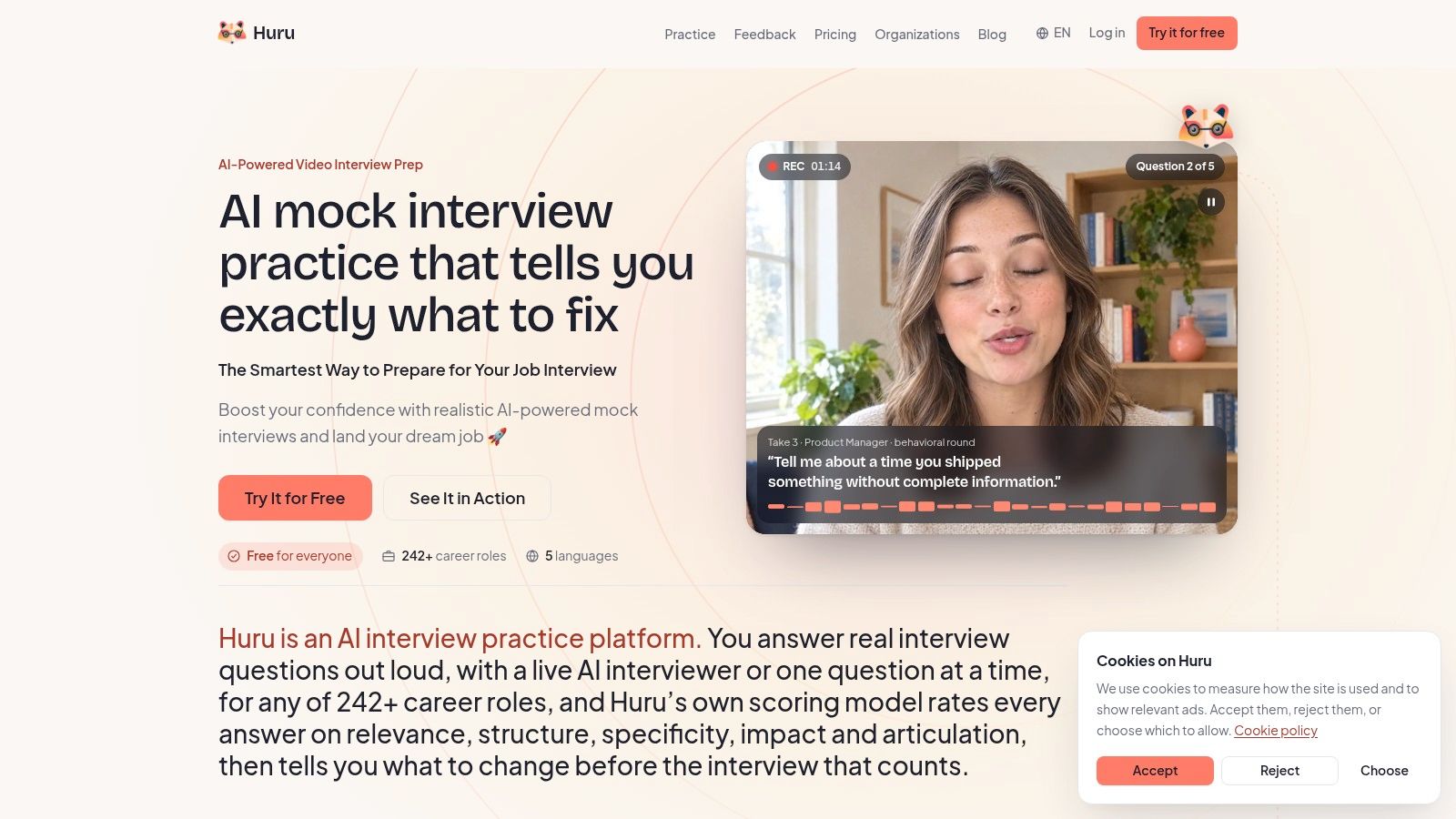
A recording can reveal something a transcript won't: how long you take to reach the point. Huru suits candidates who want repeated recorded practice, answer-level feedback, and a way to compare sessions.
According to Huru's website, its question library contains more than 50,000 interview questions, and job-seeker access currently includes free, unlimited mock interviews. Users can choose library questions or create custom interviews, then review recordings, feedback, and scores.
Use recordings before trusting scores
Huru works in a browser and offers an iOS app, multiple languages, and a Chrome extension that turns job listings into practice sessions. That makes it a practical choice for candidates who want role-specific preparation without limiting themselves to software-engineering interviews.
The trade-off is interpretation. AI feedback is coaching guidance, not a reliable forecast of an employer's judgment, and unclear audio can produce transcription mistakes that affect the feedback.
- What works: Repeat a comparable interview and check whether your answers become more specific and easier to follow.
- What doesn't: Chasing a higher score without listening to the recording or checking what the app transcribed.
- Missing support: Free job-seeker access doesn't include human coaching.
Before changing your answer because of a negative comment, inspect the underlying words. If the app misheard a technical term or dropped part of your explanation, correct that misunderstanding before treating the feedback as a genuine weakness.
3. Yoodli
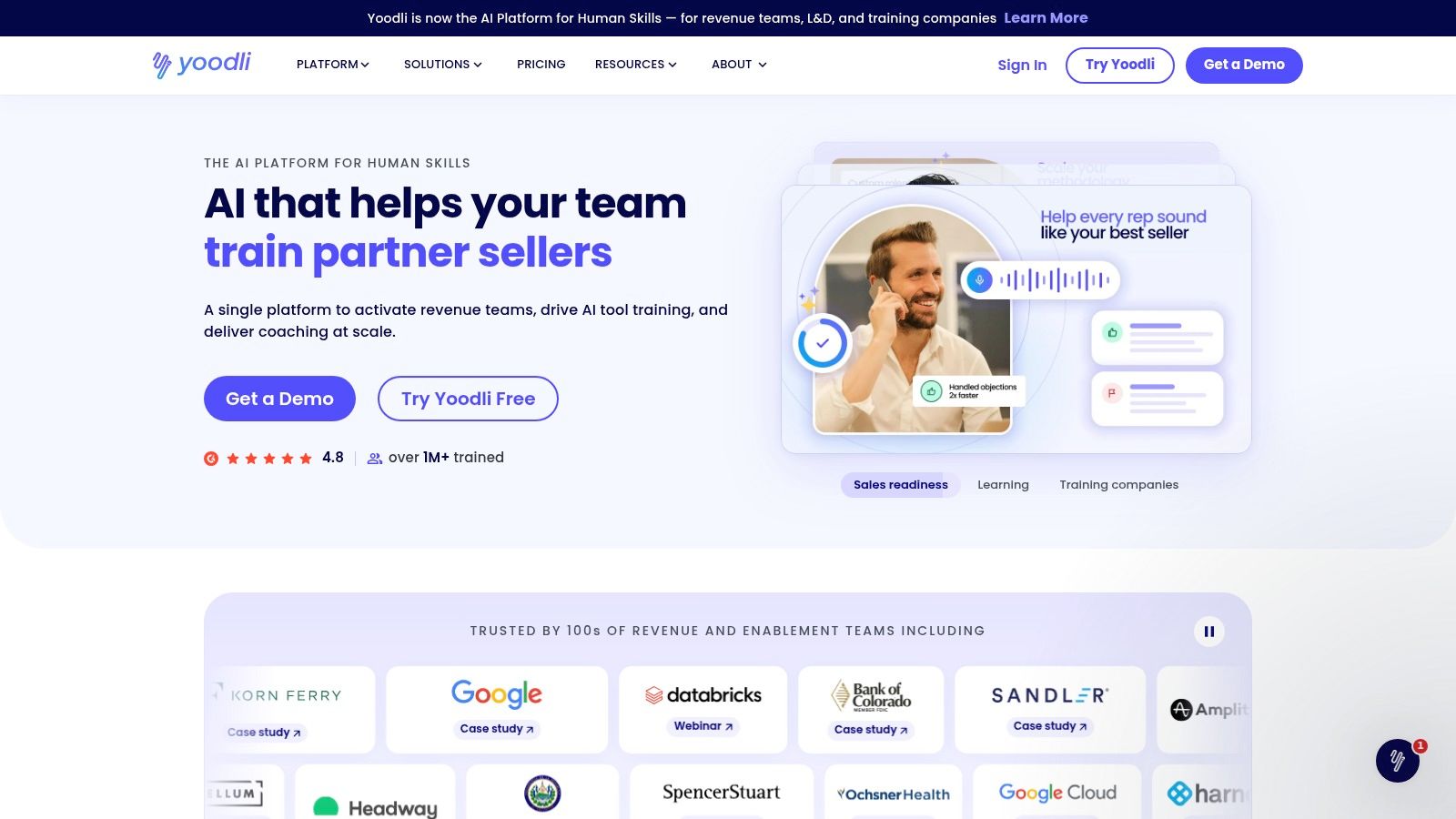
Yoodli belongs in the delivery-coaching category, not just alongside question generators. Its roleplays and recording feedback suit candidates whose main difficulty is pacing, concision, or sounding comfortable when explaining work.
Yoodli lists a free Starter plan with five roleplays total, plus Pro at $8 per month and Advanced at $20 per month, billed annually. Annual billing matters if you're preparing for a short interview window rather than seeking ongoing communication coaching.
Use its broader speech tools when the same habits affect presentations, meetings, and interviews. Uploaded recordings can also help you review an answer you've already practiced instead of generating another set of prompts.
Clear communication isn't the same as sounding like a different person. Keep the pauses that help you think, and remove the detours that make your answer harder to follow.
Don't confuse polish with evidence
A smoothly delivered answer can still lack a relevant example. Check what you said separately from how you said it: your decision, your contribution, and the outcome need to survive even when the delivery score looks encouraging.
Yoodli isn't a dedicated interview curriculum, and the free allowance is small. I recommend it when you already have credible stories but need help delivering them clearly, not when you're still deciding which experiences demonstrate the role's requirements.
4. Big Interview
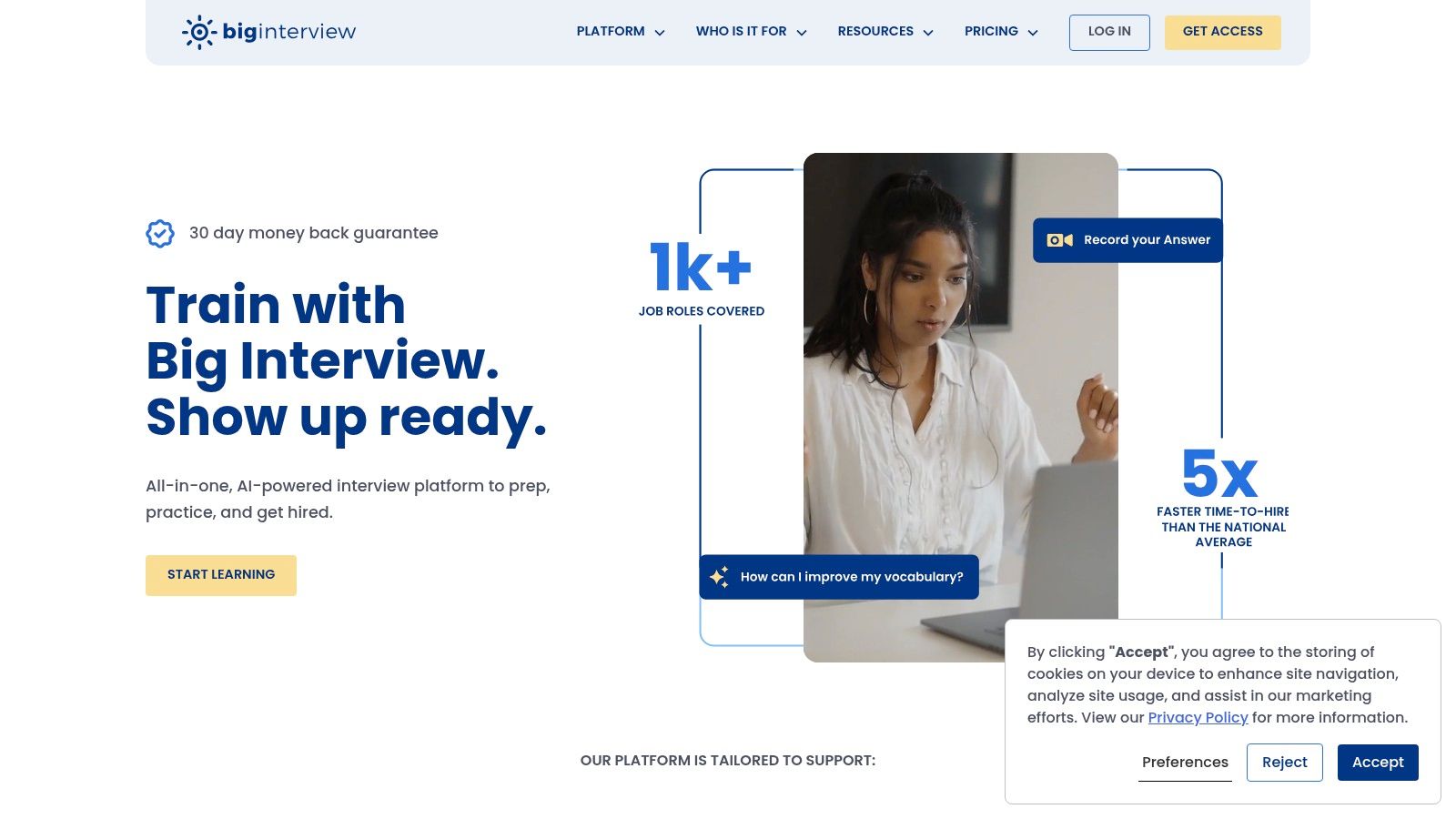
Big Interview is the structured-course option. It combines lessons, question libraries, answer-building tools, and practice, making it useful for beginners who need a preparation method before they need another simulation.
Big Interview's personal plans list $39 for 30 days, $99 for three months, and $299 for lifetime access, with a 30-day money-back guarantee. Access may also be available through a school, library, or workforce organization, so check your existing benefits before buying.
Its PracticeAI generates dynamic, audio-only questions using a job description and, optionally, your resume. Feedback addresses role alignment, clarity, and confidence, while the surrounding courses help you build answers rather than repeatedly improvising them.
Structure is useful, but stay selective
A meta-analysis published in the Journal of Applied Psychology found that structured interviews were more valid than unstructured interviews. That supports practicing against consistent, job-relevant criteria, although it doesn't establish that any particular app improves hiring outcomes.
- Choose it for guidance: Lessons and answer-building resources help when you don't know how to prepare.
- Account for the format: Audio-only practice won't rehearse camera framing or screen-based presence.
- Skip unnecessary coursework: Experienced candidates may need focused repetitions rather than a broad career-preparation platform.
For spoken rehearsal without the surrounding curriculum, compare the mock interview practice option. Choose based on whether you need instruction, repetition, or both.
5. Interviews by AI
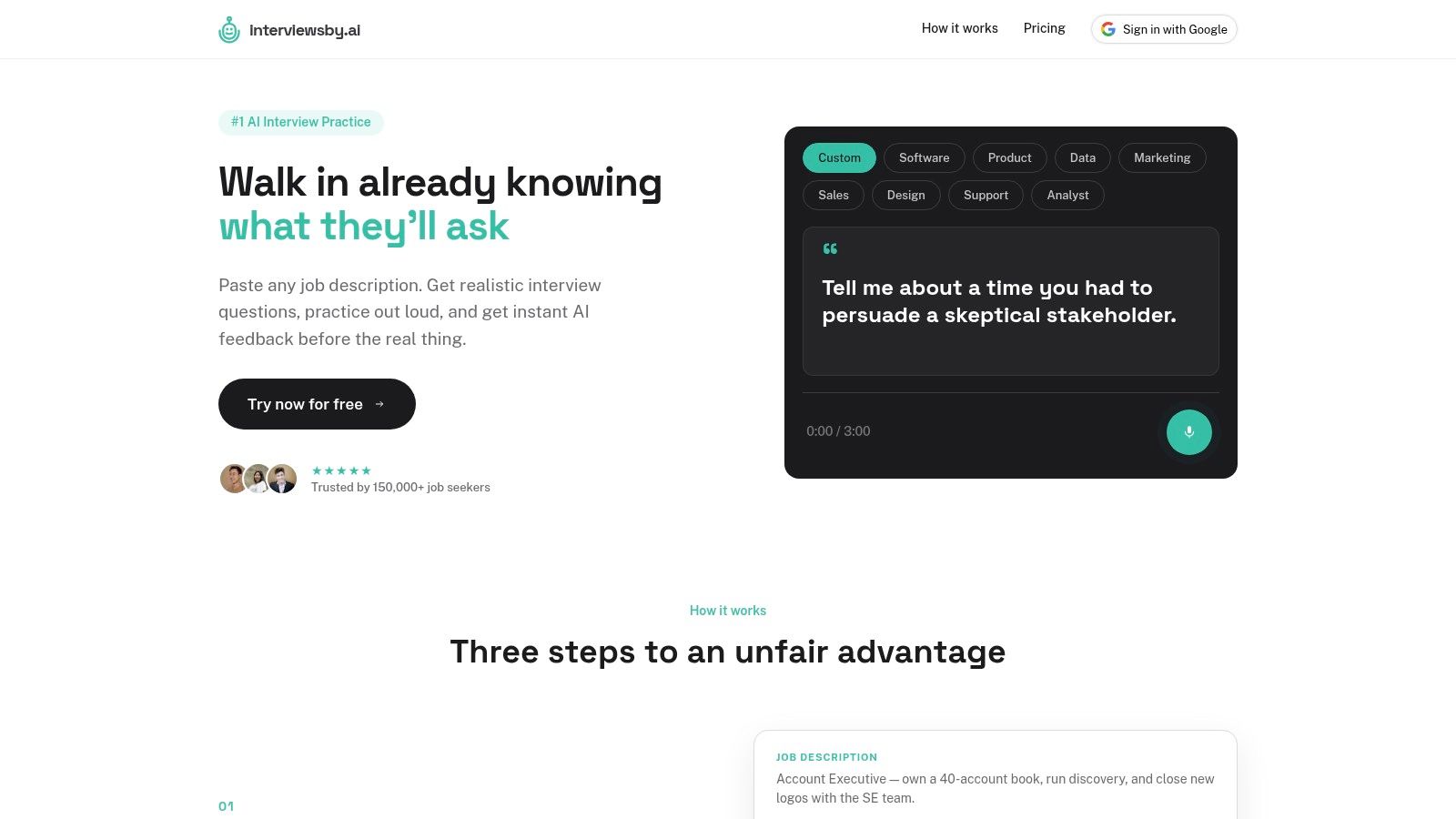
Sometimes you don't need a full interview. You need to repair the answer to a question you keep mishandling, such as explaining a career change or describing a disagreement.
Interviews by AI fits targeted, question-by-question practice. It generates questions from a role or job details, accepts voice or text answers, and provides immediate feedback.
Interviews by AI lists a free Basic plan with three questions per month, while Pro is $9 per month with unlimited questions and resume upload. The free tier requires no card, and month-to-month access can suit a concentrated preparation period.
Drill the answer, then test the conversation
Start with voice when your goal is interview readiness. Text can help you organize an example, but editing a paragraph isn't the same task as explaining it while someone waits.
- Good fit: Narrow drills, quick feedback, and rehearsing alternative examples for the same competency.
- Main constraint: The free allowance won't support extensive repetition.
- Important gap: Question-level practice doesn't fully test transitions, unexpected follow-ups, or how you distribute examples across an interview.
After improving an individual answer, place it back into a longer mock. Otherwise, you may become excellent at responding to a familiar prompt but struggle when an interviewer asks for the same evidence differently.
AI feedback also needs a reality check from someone who understands the target role, particularly when it recommends adding technical detail or changing the emphasis of an answer.
6. Skillora
Skillora is a broader AI-practice option for candidates preparing across behavioral and technical formats. It combines mock interviews, coding and system-design preparation, video recording, and personalized feedback.
Skillora's pricing page lists a free starting option, Premium at $20 per month, and Ultimate at $50 per month, with promotional discounts displayed. Check the regular subscription terms and included features rather than choosing solely because of a temporary offer.
The useful combination here is technical practice plus playback. A candidate can review not just the proposed solution, but how they explained assumptions, responded to uncertainty, and communicated trade-offs.
Review the reasoning, not just the result
For a system-design scenario, ask whether you clarified requirements before proposing components. For coding, check whether you explained the approach, tested edge cases, and corrected mistakes in a way another engineer could follow.
- Breadth: More interview formats than a behavioral-only question tool.
- Review value: Video playback helps you inspect both reasoning and delivery.
- Trade-offs: Feature access depends on the plan, and the listed subscriptions cost more than some basic question-practice options.
Review recording and data terms before uploading a resume, employer documents, or proprietary examples. Use anonymized scenarios when your strongest work involves confidential systems.
Skillora makes sense when you'll use its technical breadth. If you only need to sharpen an introduction and a few behavioral examples, a simpler tool may be easier to use consistently.
7. Talentee
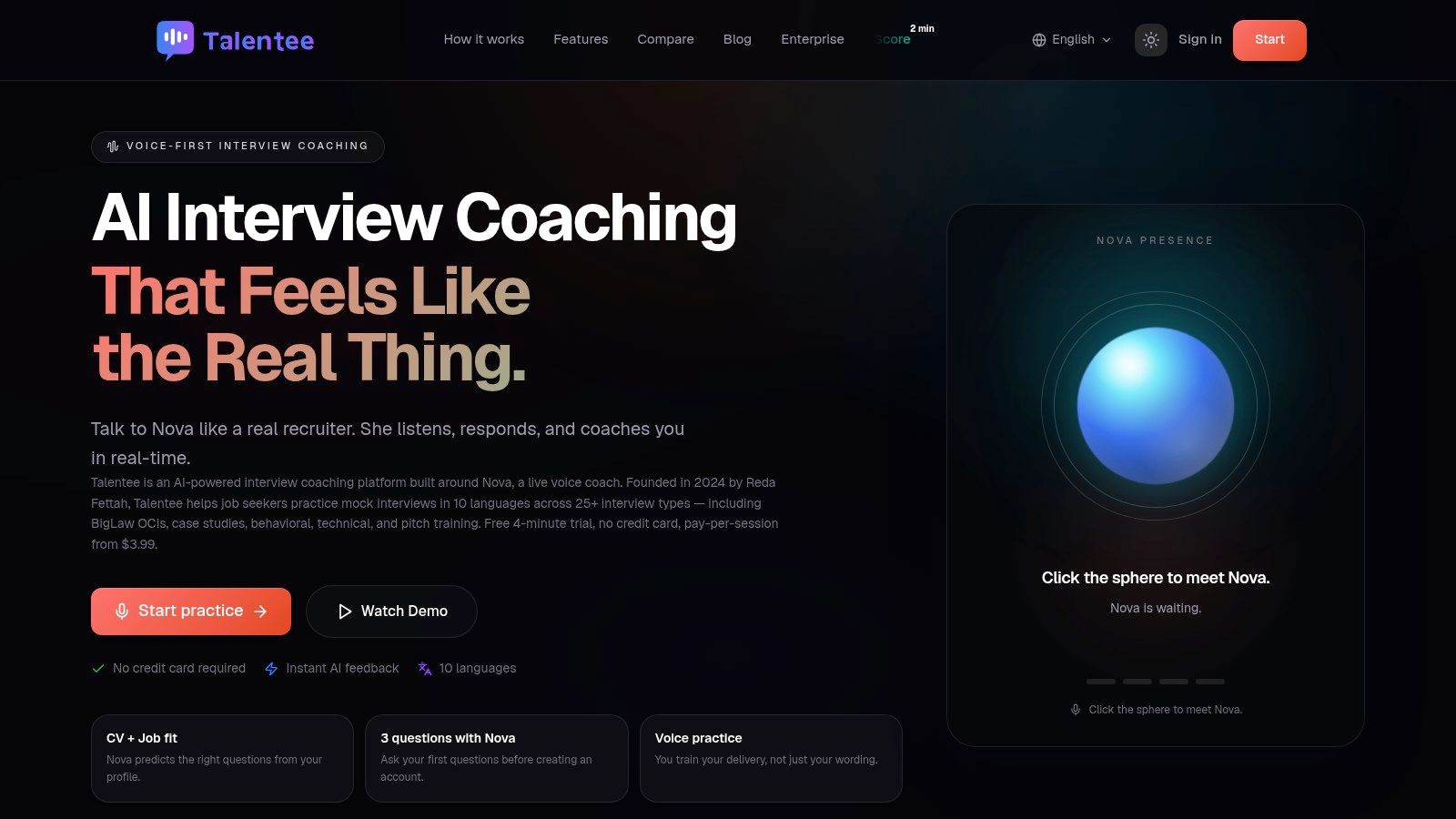
Talentee's Nova coach emphasizes voice-first conversation. It adapts practice to behavioral, technical, case, and internship interviews, using job and profile information to shape questions.
Talentee advertises a free four-minute trial without a credit card, paid sessions from $3.99, a $24.99 weekly pass, and support for 10 languages. Pay-per-session access avoids a monthly commitment, but repeated purchases can become expensive when you need extensive rehearsal.
Test whether the follow-ups are useful
A conversational interface is only valuable if it responds meaningfully to your answer. During the trial, notice whether Nova asks about the decision you described or moves to an unrelated prompt.
An academic study of an AI interview-practice system found that participants valued adaptive follow-ups and low-stakes repetition, but also said AI couldn't fully reproduce real interview pressure. That's a useful limitation to remember when a simulation begins to feel comfortable.
Budget before practicing: Decide how many complete sessions you intend to run, then compare that total with a pass or subscription. A low entry price isn't necessarily a low preparation cost.
Talentee suits candidates who want spoken interaction without immediately committing to ongoing access. Its short trial may not reveal how helpful feedback remains across repeated sessions, and company-reported outcome claims shouldn't substitute for independent evidence of improved hiring results.
8. Aced
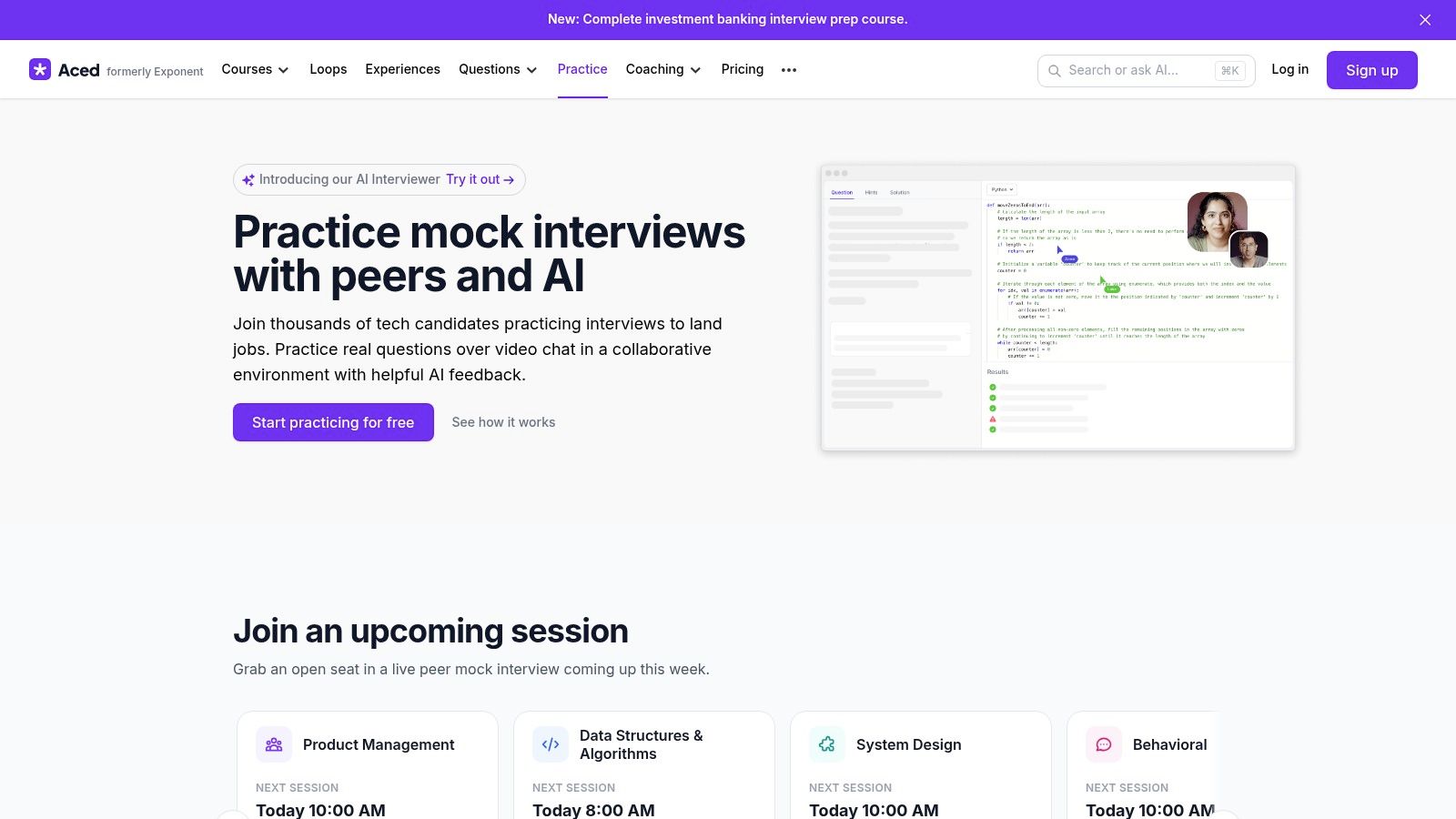
Aced, formerly Exponent, combines peer mock interviews, AI drills, and preparation courses. Its strongest distinction is the opportunity to practice with another job seeker rather than relying exclusively on generated questions.
Aced's practice platform offers free mock-interview practice, with membership providing access to additional courses and features. Shared video and a code editor make it particularly relevant to software-development and product-management preparation.
Taking turns interviewing can be valuable. Asking a question makes you notice whether the other person's answer contains enough evidence, which can sharpen your judgment when reviewing your own responses.
Peer quality is the trade-off
A human participant can interrupt naturally, request clarification, and react to an explanation that doesn't make sense. But a peer isn't automatically a skilled interviewer or a reliable judge of seniority.
- Agree on the round: Establish the role, topic, and feedback criteria before starting.
- Request specific feedback: Ask where your reasoning became difficult to follow, not whether you seemed good overall.
- Expect variability: Scheduling, preparation, and feedback quality depend on the other participant.
AI drills are useful between scheduled sessions, while peer practice tests whether your explanation works for another person. Aced is less compelling for candidates seeking broad, non-technical career coaching, and access to expanded courses or features may require membership.
Use peer comments as evidence to investigate, not as a definitive hiring verdict.
9. interviewing.io
interviewing.io is for technical depth rather than general interview confidence. Its preparation covers algorithms, computer science fundamentals, and system design, with both automated and human-led options.
interviewing.io offers a free AI interviewer for coding and system design, while paid mock interviews with experienced engineers start at $179. Exact cost and availability vary by subject and interviewer.
The anonymous format can make difficult practice feel less socially exposed. That helps if embarrassment stops you from attempting problems you haven't mastered, although lower pressure is different from reproducing the experience of a real assessment.
Spend human feedback where it matters
Use automated practice to expose recurring weaknesses before booking a paid session. Bring a specific uncertainty, such as whether your design trade-offs are convincing or whether you spend too long exploring approaches before committing.
- Strongest benefit: Experienced engineers can challenge reasoning that an automated summary may accept too easily.
- Cost limitation: Repeated human sessions can become a substantial preparation expense.
- Scope limitation: This isn't the natural first choice for general behavioral interviews outside technical hiring.
Don't use a paid mock to discover that you need more basic practice. Its value is greater when you can already complete the core task and need calibration on communication, depth, or decision-making.
Afterward, turn the feedback into drills you can repeat independently. Buying another session without addressing the previous feedback is an expensive way to rehearse the same weakness.
10. Hello Interview
A correct answer isn't always a well-explained answer. Hello Interview suits software candidates who need guided practice in a repeatable problem-solving process, not just another collection of prompts.
Its tracks cover system design, low-level design, AI-enabled coding, and behavioral interviews. Guided AI feedback sits alongside courses, a question library, and live-practice sessions with replays and detailed reports.
Hello Interview lists live practice interviews from $10 each, while Premium pricing depends on the term and current offer. Confirm the session format and included feedback before treating different practice options as equivalent.
Combine guidance with an unaided attempt
Step-by-step feedback can help you understand where an approach went wrong. It can also make a task feel easier than it will be without prompts, so complete an uninterrupted attempt after learning the method.
- Use guided practice: Work on requirement gathering, solution structure, and explaining trade-offs.
- Use replays: Compare what you intended to communicate with what you said.
- Treat scores cautiously: AI feedback is an approximation, not a hiring decision.
Hello Interview's technical specialization is an advantage for software-engineering preparation and a limitation for candidates in unrelated fields. Full access also costs more than basic question-practice apps.
The strongest use is a sequence: learn an approach, apply it without help, then ask for feedback on the reasoning. Don't mistake recognizing a guided solution for being able to produce one under pressure.
Mock interview practice apps at a glance
| Free option | Pricing model | Practice format | Best for |
|---|---|---|---|
| One free mock interview | Paid pricing not specified | Conversational AI interview with follow-up questions and transcript | Practicing spoken answers in a realistic exchange |
| Unlimited mock interviews for job seekers, currently free | Free job-seeker access; other pricing not specified | Recorded AI interviews with feedback and progress tracking | Broad role coverage and repeated practice |
| Starter plan with five roleplays total | Free plan; Pro at $8/month and Advanced at $20/month, billed annually | AI roleplays and feedback on recordings | Improving speaking delivery, pacing, and confidence |
| Free access may be available through an organization | $39 for 30 days, $99 for three months, or $299 for lifetime access | Audio-only AI practice plus lessons and career resources | Guided interview preparation and job-specific practice |
| Three questions per month on the Basic plan | Free Basic plan; Pro at $9/month | Voice or text answers with immediate AI feedback | Affordable, question-by-question practice |
| Free starting option | Premium at $20/month; Ultimate at $50/month | AI mock interviews with video, behavioral and technical practice | Practicing technical, coding, and behavioral interviews |
| Free four-minute trial | Paid sessions from $3.99 or a $24.99 weekly pass | Voice-based, adaptive AI interviews | Conversational practice across different interview types |
| Free mock-interview practice | Free practice; paid membership adds courses and features | Peer-to-peer video sessions, AI drills, and technical tools | Candidates targeting tech and product roles |
| Free AI interviewer | Free AI practice; paid human sessions start at $179 | AI coding and system-design practice or expert-led mock interviews | Technical candidates seeking human feedback |
| Free AI-guided practice | Live interviews from $10 each; Premium pricing varies | Guided technical and behavioral practice, plus live sessions with replays | Software-engineering interview preparation |
How to Pick Your App and Run a Real Practice Cycle
Choose a mock interview practice app by your current gap, not by the size of its feature list. Conversational tools help with spontaneous answers and follow-ups; delivery coaches help with pacing and concision; structured platforms help beginners build a method; technical and peer tools help test reasoning with realistic challenges.
Trial the format before subscribing. Confirm whether you need browser, mobile, or desktop access, and whether your target interview requires camera practice, shared coding, or voice-only answers. For pay-per-use tools, calculate the cost of your intended preparation cycle rather than comparing the smallest advertised purchase.
Protect your information and your own voice
Read recording, retention, deletion, and data-processing terms before uploading sensitive material. Remove client names, private metrics, and proprietary code from practice examples, and don't record another person without appropriate permission.
Separate job-relevant feedback from judgments about presentation style. An accent, a thoughtful pause, or limited eye contact doesn't by itself establish weak reasoning, and you shouldn't train yourself to satisfy an opaque confidence score.
AI suggestions must also remain truthful. Gartner's survey of job candidates found that only 26% trusted AI to evaluate applicants fairly, a reminder not to treat automated judgments as objective verdicts.
A two-week practice cycle
- Days one and two: Choose a target role, gather the job description, and complete a baseline mock without restarting weak answers.
- Days three through five: Review the recording or transcript. Select one weakness, then rehearse truthful examples that address it.
- Days six and seven: Run another mock with unfamiliar wording. Check whether the improvement survives a different question.
- Days eight through ten: Add a peer or role-informed reviewer, especially for technical reasoning or senior-level examples.
- Days eleven through thirteen: Simulate the intended interview setup, including the microphone, camera, screen sharing, and coding environment where relevant.
- Day fourteen: Compare your latest attempt with the baseline, prepare questions for the employer, and stop rewriting every answer.
Alongside practice, build a recruiter-friendly online presence so your public profiles support the experience you're describing.
If you want practice and live support in the same ecosystem, consider desktop and video-call integration as a separate requirement. Review the pricing page linked above, and use live assistance only where the interview rules permit it.
ParakeetAI offers spoken mock interviews with an AI interviewer and a transcript for reviewing your answers afterward, alongside a live interview assistant. Visit ParakeetAI to try your free mock interview, identify one answer that needs work, and rehearse a clearer version before your next interview.