
Questions to Ask a Potential Employer: 2026 Guide

Prepare a small set of strategic questions before every interview, plus at least one follow-up template you can deploy on the spot. That’s the standard US career-center guidance, and Harvard research backs the underlying logic: follow-up questions, not scripted ones, are the most powerful type you can ask because they signal active listening and genuine curiosity.
Before you walk in, mark your top three to four questions in case the conversation covers some of them naturally. Back these up with a reserve list of eight to ten total so you’re never scrambling.
- Prepare three to four priority questions to ask when prompted
- Back up with eight to ten in reserve in case early ones get answered organically
- Write one follow-up template: “You mentioned [X] — how does that affect [Y]?”
- Mark which questions are highest priority so you can pivot in real time
Table of Contents
- What are the right questions to ask a potential employer?
- Which questions hurt your chances?
- High-impact question themes with ready-to-use samples
- How to tailor questions by interviewer and stage
- Using AI to prepare and practice these questions
- What to ask at the offer stage
- Key Takeaways
- The question most candidates forget to ask
- Parakeet-ai helps you walk in ready
- Useful sources for deeper reading
What are the right questions to ask a potential employer?
The Case Western Reserve career center recommends preparing three to four thoughtful questions and waiting for the interviewer’s prompt, typically “Do you have any questions for me?” before launching into them. Don’t treat that moment like a rapid-fire checklist. One or two well-placed questions during the conversation itself, woven in naturally, often land better than saving everything for the end.
Practical advice for US interviews includes asking questions naturally during the conversation, avoiding dominating the end with too many questions, taking brief notes on interviewer phrasing for follow-ups, and always requesting their contact details before leaving to send a personalized thank-you.

Which questions hurt your chances?
Asking what the company does is the fastest way to signal you didn’t prepare. Behavioral research confirms that questions whose answers are on the company’s homepage make interviewers doubt your interest, not just your effort.
“Asking basic facts that are on the company site signals poor preparation. Ask deeper questions about values or challenges instead.” — Science of People, citing interview research
Timing mistakes are just as damaging. Bringing up salary or PTO in an early screening call puts the interviewer on the defensive before they’ve decided they want you. Save compensation questions for the offer stage or until the hiring manager raises the topic first.
If you’re using AI to generate question ideas, run a quick source-check before you use them. Ask yourself: Is this answer on their website? Does this phrasing sound scripted? A question that sounds like it came from a template, rather than genuine curiosity, is easy for experienced interviewers to spot. For a deeper look at questions that backfire in tech roles, the Parakeet-ai blog covers common phrasing traps by industry.
High-impact question themes with ready-to-use samples
The Muse frames the interview as a two-way street, a chance to run your own “vibe check” and catch the gap between what a job description promises and what the role actually delivers. These six themes cover the territory that matters most.
Role expectations and success metrics
- “What does success look like in this role at 90 days? At one year?”
- “What’s the single biggest priority for whoever takes this job in the first month?”
- “What kinds of challenges can I expect in this role?”
Team and manager dynamics
- “How does the team typically handle disagreement on priorities?”
- “What’s your management style when a project hits a roadblock?”
- “Who would I be working with most closely?”
Company priorities and challenges
- “What’s the biggest challenge the team is working through right now?”
- “Where do you see the company headed in the next few years?”
- “How has the company’s strategy evolved in response to recent industry shifts?”
Culture and belonging
- “What kind of person tends to thrive here?”
- “How do new hires typically get welcomed into the culture?”
Professional growth
- “Can I expect this role to evolve over time?”
- “How do employees usually grow with the company as it scales?”
Interviewer’s own experience (high-likability, research-backed)
- “What’s your favorite part about working here?”
- “What’s one thing about this company that people outside it often misunderstand?”
Follow-up template to use live: “You mentioned [X] — how does that affect [Y] day to day?” It converts any answer into a deeper conversation without sounding rehearsed.
How to tailor questions by interviewer and stage
Match the depth of your question to the person across the table. A recruiter can’t tell you how the engineering team resolves technical debt. A peer can’t speak to budget priorities. Ask the wrong question to the wrong person and you waste both your time.
| Interviewer | Best question focus | Sample question |
|---|---|---|
| Recruiter / HR | Process, timeline, team structure | “What does the hiring timeline look like from here?” |
| Hiring manager | Priorities, success metrics, challenges | “What’s the biggest priority for this role in Q3?” |
| Peer / team member | Day-to-day workflow, culture, collaboration | “How does the team usually communicate on a busy sprint?” |
| Senior leader | Vision, growth, company direction | “Where do you see the team in two years?” |
MIT’s career advising resources recommend saving compensation and benefits questions for later rounds. In a screening call, focus on role clarity and process. In a final-round or panel interview, you’ve earned the right to ask about performance reviews, growth paths, and offer specifics.
Using AI to prepare and practice these questions
AI speeds up research and rehearsal, but it has to produce questions that sound like you, not a template. Here’s a practical workflow.
- Generate a prioritized list. Paste the job description and company “About” page into your AI tool and prompt: “Based on this role and company, suggest five strategic questions I can ask the hiring manager that go beyond what’s on their website.”
- Rewrite for your voice. Take the output and prompt: “Rewrite these questions in a more conversational tone, as if I’m asking a colleague.” Read them aloud. If any sound stiff, cut or rephrase.
- Practice follow-ups in a mock session. Prompt your AI: “Pretend you’re a hiring manager. Answer my question, then I’ll practice a follow-up using the ‘You mentioned X’ template.” Repeat until the follow-up feels natural.
- Validate before using. For each AI-generated question, ask: Is this answer on their website? Does this phrasing reveal I actually read about them? If not, revise.
Parakeet-ai offers real-time assistance during interviews, generating live prompts and phrasing variations as the conversation unfolds. For preparation, tools like ChatGPT prompt structures can help you build and refine your question bank before the interview day.
Pro Tip: Record yourself asking your top three questions out loud. If you stumble, the phrasing is too complex. Simplify until it sounds like something you’d say in a normal conversation.
Privacy note: if you use real-time AI assistance during an interview, check the employer’s policies first. Using AI for preparation and rehearsal is universally recommended; live assistance during the interview itself is a judgment call that depends on the format and employer expectations.
What to ask at the offer stage
Once an offer is on the table, compensation and benefits questions are not just appropriate — they’re expected. The framing matters. Lead with fit, not just figures.
- “Can you walk me through the full compensation structure, including bonus and equity if applicable?”
- “What does the benefits package include, and when does coverage begin?”
- “What does the onboarding process look like for the first 30 days?”
- “How often are performance reviews conducted, and what does that process look like?”
- “What would success look like for me at the six-month and twelve-month marks?”
- “What’s the target start date, and is there flexibility there?”
These questions protect you. They surface mismatches between the offer letter and the actual experience before you accept, which is exactly the “shift shock” The Muse warns candidates to screen for. For additional questions to ask after an interview or during follow-up contact, the Parakeet-ai blog has stage-specific templates.
Key Takeaways
Preparing a small number of strategic questions plus a live follow-up template is an effective way to signal fit, preparation, and genuine curiosity in any US job interview.
| Point | Details |
|---|---|
| Prepare three to four priority questions | Back up with eight to ten total so you can pivot if early questions get answered naturally. |
| Follow-ups beat scripts | Use “You mentioned [X] — how does that affect [Y]?” to turn any answer into a deeper conversation. |
| Match questions to the interviewer | Recruiters get process questions; hiring managers get priority and metrics questions; peers get culture and workflow questions. |
| Save compensation for the offer stage | Asking about salary or PTO in a screening call signals the wrong priorities too early. |
| Parakeet-ai for preparation and live support | Parakeet-ai generates real-time question prompts and phrasing variations to keep you sharp throughout the interview. |
The question most candidates forget to ask
The follow-up question is the one that actually moves the conversation. Candidates spend hours rehearsing their answers and almost no time practicing what to say after the interviewer answers them. That’s the gap.
The best interview conversations I’ve seen don’t look like Q&A sessions. They look like two people figuring out whether a working relationship makes sense. The candidate who asks “You mentioned the team is going through a transition — what does that mean for whoever steps into this role?” gets more useful information in one question than the candidate who fires through a prepared list of five. Sincerity matters more than perfect wording. A slightly imperfect question asked with genuine curiosity beats a polished one that sounds like it came from a script.
The practical lesson: prepare your questions, then be willing to throw half of them out when the conversation takes you somewhere more interesting.
Parakeet-ai helps you walk in ready
Real interview preparation means more than reading a list of questions. It means knowing how to phrase them under pressure, how to pivot when the conversation shifts, and how to build a follow-up on the fly. Parakeet-ai is built for exactly that moment.
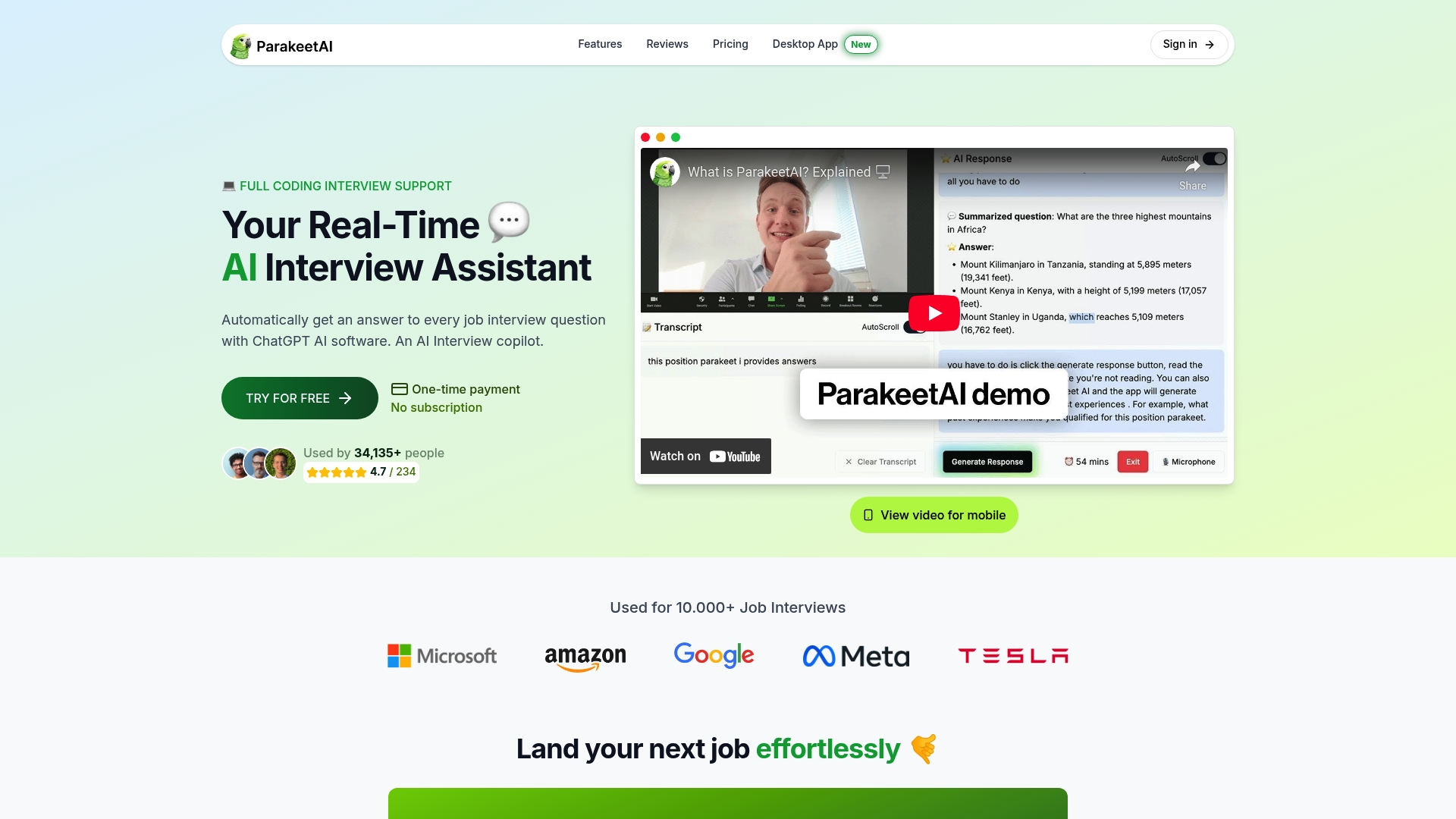
As a real-time AI interview assistant, Parakeet-ai listens to your interview and surfaces live prompts, phrasing variations, and follow-up suggestions as the conversation unfolds. For preparation, it helps you generate a prioritized question bank from the job description, rehearse your delivery in mock sessions, and refine phrasing until it sounds like you. Explore best interview questions to ask an employer on the Parakeet-ai blog, or go straight to parakeet-ai.com to see how the real-time assistant works before your next interview.
Useful sources for deeper reading
| Source | Why it’s useful |
|---|---|
| Case Western Reserve — Career Center | US career-center etiquette: the 3–4 question rule, timing, and follow-up contact guidance |
| MIT Career Advising & Professional Development | Stage-specific sample questions and compensation-timing advice from a top university |
| Science of People | Harvard-backed research on follow-up questions and what makes interviewers respond positively |
| The Muse — 51 Interview Questions | Two-way-street framing and culture “vibe check” guidance to avoid shift shock |
| Indeed | Large consolidated list with advice on preparing 8–10 and asking 3–4 depending on the interview |
| Parakeet-ai Blog | Situational guidance, sample lists, and AI-assisted preparation workflows for candidates |