
Quick interview prep: AI-powered guide for fast answers

Job interviews sneak up fast. Maybe you got a call yesterday for an interview tomorrow, or life got busy and you forgot to prepare. Either way, you need effective answers quickly. AI interview preparation tools now let you create personalized, confident responses in 30 to 60 minutes instead of spending days memorizing scripts or hiring expensive coaches.
Table of Contents
- Prerequisites: What You Need Before Starting Quick Interview Prep
- Prioritizing Common Interview Questions For Quick Prep
- Step-By-Step Quick Interview Preparation Workflow
- Common Mistakes And How To Avoid Them
- Expected Results And Outcomes From Quick Interview Prep
- Alternative Approaches And Tradeoffs
- Enhance Your Quick Interview Prep With Parakeetai
- Frequently Asked Questions
Key takeaways
| Point | Details |
|---|---|
| Focus on common questions | Preparing answers for the top 10 common interview questions covers about 80% of typical interviews. |
| Leverage AI for speed | AI tools generate tailored answers and provide real-time feedback, reducing prep time by 50% while improving relevance. |
| Practice naturally | Avoid robotic delivery by practicing answer variations aloud with AI feedback instead of memorizing rigid scripts. |
| Expect measurable results | Quick AI prep typically improves performance scores by 30% and reduces anxiety by about 25%. |
Prerequisites: What you need before starting quick interview prep
Before diving into AI-assisted preparation, you need a few basics in place to make the process smooth and effective. First, ensure you have a stable internet connection and a microphone-enabled device to interact with AI tools without frustrating interruptions. Your laptop, tablet, or smartphone works fine as long as the microphone picks up your voice clearly during practice sessions.
Familiarity with basic AI tools helps you navigate features quickly and avoid wasting precious prep time figuring out interfaces. You don’t need to be a tech expert, but knowing how to start a conversation with an AI assistant or follow simple prompts makes the workflow faster. Most AI interview assistant software is designed for ease of use, so a few minutes of exploration gets you comfortable.
Finally, understanding common interview question formats gives you a framework for focusing your AI assistance effectively. Behavioral questions usually start with “Tell me about a time when,” while situational questions ask “What would you do if.” Knowing these patterns helps you prioritize which questions to tackle first and how to structure your responses. This foundational knowledge transforms AI from a generic answer generator into a personalized coaching tool.
Here’s what you need:
- A reliable internet connection for uninterrupted AI tool access
- A device with a working microphone for voice practice and real-time feedback
- Basic familiarity with AI chat interfaces or voice assistants
- Awareness of common interview question types like behavioral and situational formats
Prioritizing common interview questions for quick prep
When time is tight, you can’t prepare for every possible question. Instead, focus on the questions interviewers ask most often across industries and roles. Research shows that preparing answers to the top 10 common questions addresses roughly 80% of what you’ll face in a typical interview. These include classics like “Tell me about yourself,” “What are your strengths and weaknesses,” and “Why do you want this job.”
Start by identifying which of these common questions apply directly to your target role. A software developer might prioritize technical problem-solving questions, while a marketing professional focuses on campaign strategy examples. AI tools excel at this customization because they analyze your resume, job description, and experience to generate answers tailored specifically to your situation rather than generic templates.
Using interview question generator tools speeds up this prioritization process dramatically. You input basic job details, and the AI suggests which questions are most likely based on industry trends and the specific position. This data-driven approach eliminates guesswork and ensures your limited prep time targets the highest-impact areas.

Once you’ve identified your priority questions, use AI to generate initial answer drafts quickly. These drafts give you a strong starting framework that you can then personalize with your own examples and speaking style. The goal is not to memorize AI-generated text word for word but to use it as a launchpad for developing authentic, confident responses.
Key prioritization steps:
- Identify the 10 most common questions for your industry and role level
- Match questions to specific job requirements from the posting
- Use AI to generate tailored answer frameworks for each priority question
- Focus on behavioral examples that showcase your unique accomplishments
Statistic spotlight: According to Indeed’s 2026 analysis, candidates who prepare answers to just 10 targeted questions perform significantly better than those who attempt to cover 30 or more questions superficially.
Step-by-step quick interview preparation workflow
Effective quick prep follows a clear sequence that maximizes AI efficiency while building your confidence through practice. Start by generating tailored answers for your prioritized questions using AI technology. Input your resume details, the job description, and specific questions, then let the AI create structured responses that highlight your relevant experience and skills. This first step typically takes 10 to 15 minutes and gives you solid answer foundations.
Next, practice these answers aloud with AI feedback to refine clarity and natural delivery. Speaking your responses out loud reveals awkward phrasing, filler words, and pacing issues that you’d never catch by reading silently. Many interview answer generator tools now include voice recognition that analyzes your delivery in real time, pointing out areas where you sound uncertain or rushed.
After initial practice, simulate mock interviews with real-time AI interaction to build confidence under pressure. This step mimics actual interview conditions where you must think and respond quickly without a script in front of you. The AI asks follow-up questions based on your answers, just like a real interviewer would, forcing you to stay sharp and adaptable.
Review AI analytics to identify weaker responses and focus improvement efforts strategically. Most platforms track metrics like response length, confidence markers in your voice, and content completeness. These insights show exactly which answers need more work, so you don’t waste time over-practicing responses you’ve already nailed.
Finally, repeat practice cycles targeting your weaknesses for efficient, measurable progress. The beauty of stepwise interview preparation is that each iteration builds on the last, creating rapid improvement in a short time frame.
Your quick prep workflow:
- Generate AI-tailored answers for 8 to 10 priority questions (10-15 minutes)
- Practice each answer aloud at least twice with AI voice feedback (15-20 minutes)
- Run a full mock interview with AI asking questions and follow-ups (10-15 minutes)
- Review performance analytics and identify your 2 to 3 weakest responses (5 minutes)
- Do focused practice on weak areas with additional variations (10-15 minutes)
Pro Tip: Record yourself during mock interviews and watch the playback. You’ll notice body language and verbal tics that AI analytics might miss, giving you an extra edge in presentation quality.
Common mistakes and how to avoid them
Even with AI tools accelerating your prep, certain pitfalls can undermine your effectiveness and authenticity. The biggest mistake is memorizing scripts rigidly instead of practicing natural variations. Overreliance on scripted responses creates robotic delivery that interviewers spot immediately, reducing your credibility. Instead, practice answering the same question three different ways, focusing on key points rather than exact wording.
Another common error is trying to prep while multitasking or in a distracting environment. Your brain needs focused, uninterrupted time to encode information effectively into memory. Dedicate 30 to 60-minute blocks where you silence notifications, close unnecessary tabs, and treat practice like the real interview. This concentrated approach improves retention dramatically compared to scattered 5-minute sessions between other tasks.
Many candidates also use generic AI-generated answers without customizing them to align with specific job requirements. Every role has unique priorities reflected in the job description. A customer service position values empathy and problem resolution, while a data analyst role emphasizes technical accuracy and communication of complex findings. Tailor your AI-generated answers by adding personal examples and terminology from the actual job posting.
Finally, some people ignore the anxiety management features built into modern AI interview tools. Nervousness sabotages even well-prepared candidates, but AI platforms now provide real-time calming feedback, breathing exercises, and confidence-building prompts during practice. Use these features actively rather than viewing them as optional extras.
Mistakes to avoid:
- Memorizing word-for-word scripts instead of internalizing key talking points
- Practicing in distracting environments or while doing other tasks
- Using generic AI answers without adding personal examples and job-specific details
- Skipping anxiety management tools and focusing only on content preparation
Pro Tip: After each practice answer, immediately paraphrase your response in completely different words. This exercise trains your brain to be flexible and conversational rather than locked into a memorized script.
Expected results and outcomes from quick interview prep
Realistic expectations help you gauge whether quick AI prep is right for your situation. Most candidates complete effective core question preparation within 30 to 60 minutes using AI assistance, which is dramatically faster than traditional methods requiring several hours or days. This time efficiency makes AI prep especially valuable when interviews arise suddenly or your schedule is packed.
Performance improvements are measurable and significant. Studies indicate that candidates following structured quick AI prep see roughly 30% improvement in interview performance scores compared to minimal or no preparation. These scores account for factors like answer relevance, clarity, confidence, and ability to handle follow-up questions. The improvement stems from both better content and increased delivery confidence.
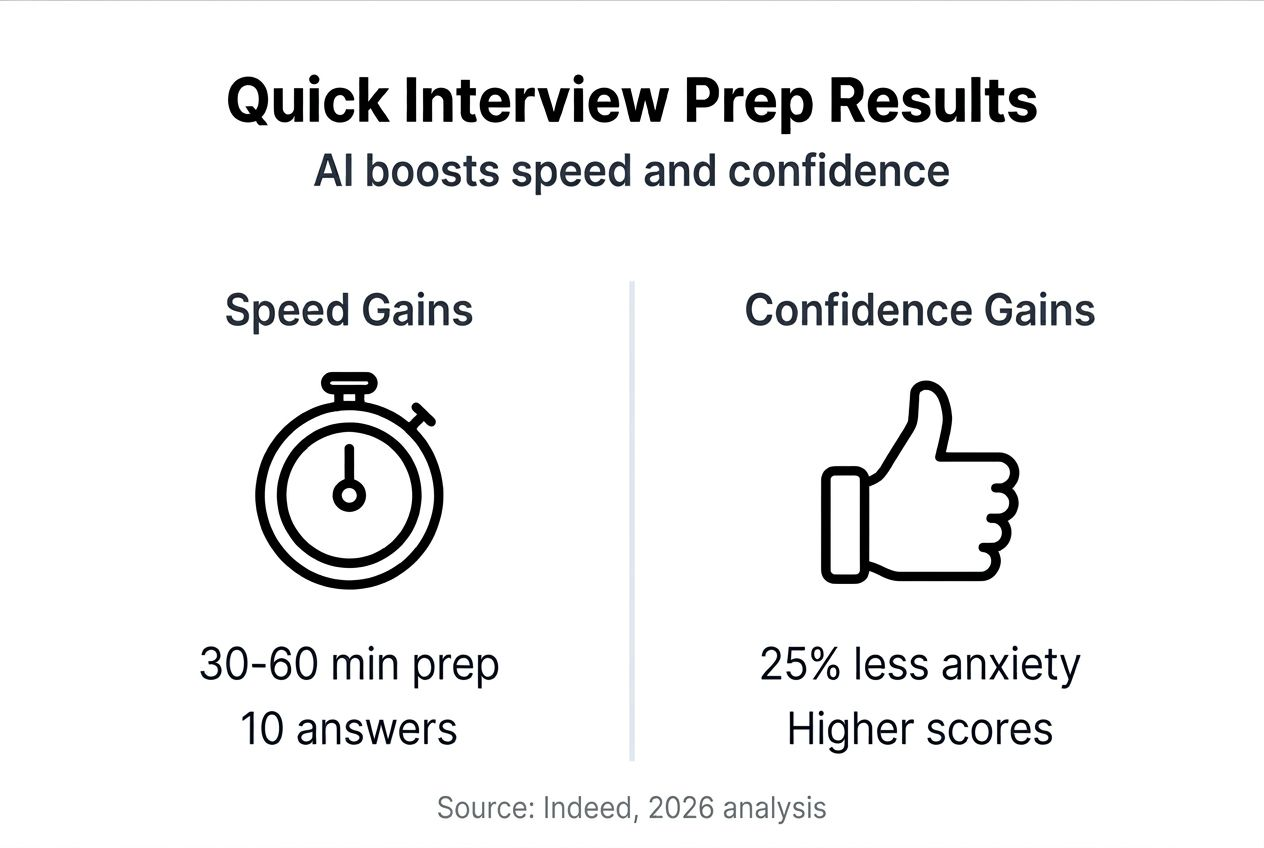
Anxiety reduction is another tangible benefit. Interview nervousness typically decreases by about 25% after AI-driven practice sessions that include real-time feedback and mock interview simulations. This reduction happens because repeated exposure to interview conditions through AI practice desensitizes you to the stress triggers, while positive feedback builds self-assurance. You walk into the actual interview having already “experienced” similar scenarios multiple times.
Overall confidence and readiness increase noticeably even in a single focused session. Candidates report feeling significantly more prepared and less caught off guard by common questions after following the adaptive interview preparation process. This psychological shift often matters as much as the content itself because confident delivery makes even average answers sound stronger.
| Metric | Typical Result | Time Investment |
|---|---|---|
| Core question prep | 8-10 questions covered | 30-60 minutes |
| Performance improvement | 30% score increase | Single focused session |
| Anxiety reduction | 25% decrease | 2-3 practice rounds |
| Confidence boost | Noticeable increase | Immediate after first mock |
Alternative approaches and tradeoffs
AI-driven quick prep is not the only option, and understanding alternatives helps you choose the best approach for your specific needs. Traditional interview coaching with human professionals provides deeper industry-specific insights and nuanced feedback that AI may miss. Experienced coaches understand unspoken cultural expectations in different fields and can offer strategic career advice beyond just answering questions. However, this depth comes at the cost of significantly more time and higher financial investment, with sessions typically ranging from $100 to $300 per hour.
AI prep offers rapid, tailored answer generation and real-time practice feedback at a fraction of the cost and time commitment. You get instant access 24/7 without scheduling appointments, and most platforms cost less than a single coaching session. The tradeoff is that AI may lack deep understanding of niche industries or highly specialized roles where human expertise adds critical value.
Many successful candidates combine both approaches strategically. They use AI tools for quick initial preparation and practicing common questions, then invest in one or two coaching sessions to refine answers for specialized or senior-level positions. This hybrid model balances speed and cost-effectiveness with the depth that human expertise provides.
Your choice depends on role complexity and available preparation time. Entry to mid-level positions in common fields like sales, customer service, or general business roles work extremely well with AI-only prep. Senior executive positions, highly technical specialized roles, or career transitions into unfamiliar industries benefit from at least some human coaching to navigate unique expectations.
| Approach | Pros | Cons | Best For |
|---|---|---|---|
| AI-driven prep | Fast (30-60 min), affordable, 24/7 access, data-driven feedback | May lack deep industry nuance, less strategic career guidance | Common roles, tight timelines, budget-conscious candidates |
| Traditional coaching | Deep industry insight, personalized strategy, nuanced feedback | Expensive ($100-300/hour), requires scheduling, time-intensive | Senior roles, niche industries, major career transitions |
| Hybrid approach | Balances speed with depth, cost-effective, comprehensive | Requires coordination, moderate time investment | Competitive positions, candidates with some prep time |
Enhance your quick interview prep with ParakeetAI
Ready to transform your interview preparation from stressful scrambling into confident readiness? ParakeetAI delivers AI-powered answer generation and real-time practice feedback designed specifically for job seekers facing tight timelines. Our platform analyzes your unique background and target role to create personalized responses that sound authentic, not robotic.
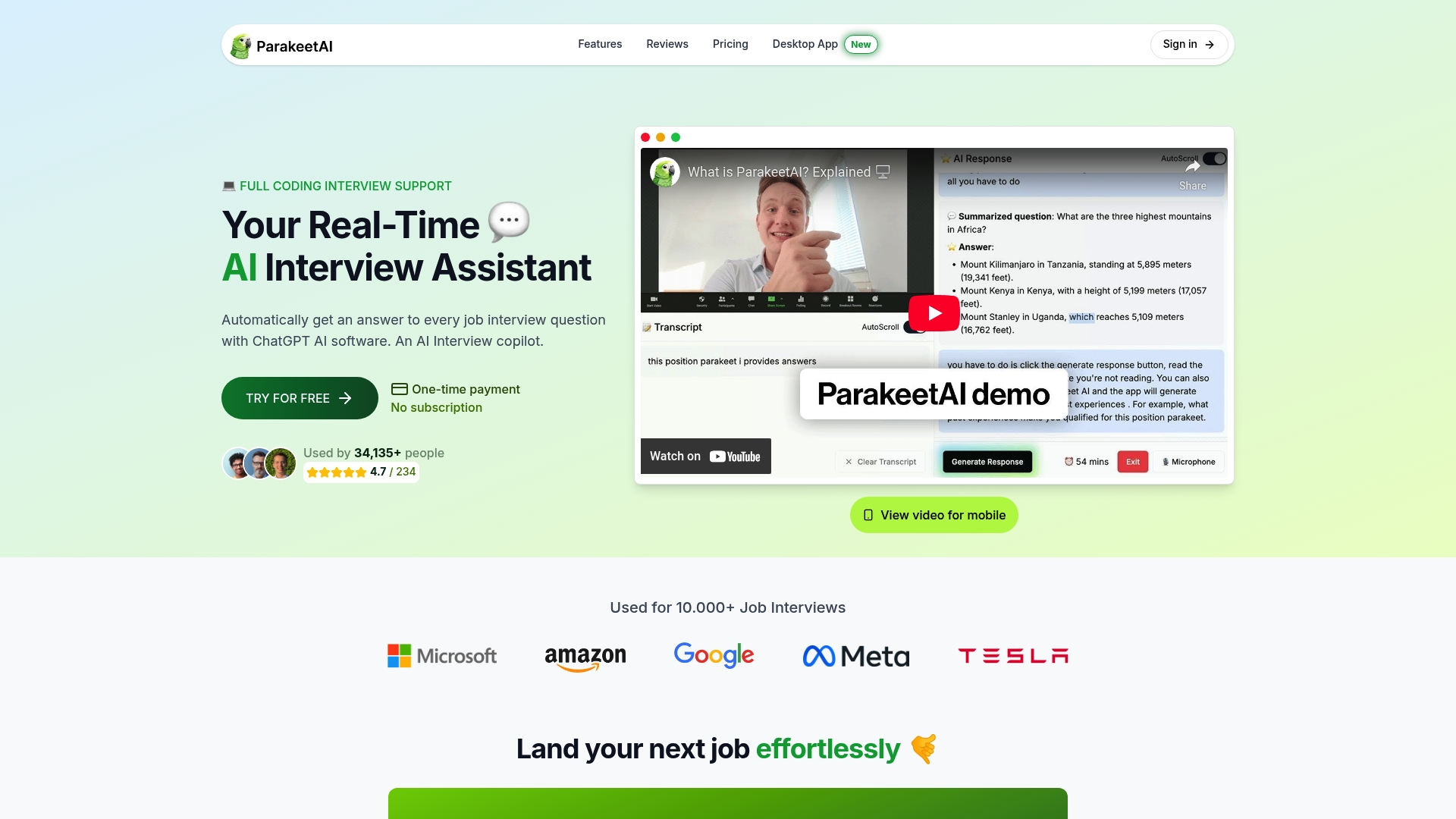
Users consistently report faster preparation times and measurably improved confidence after just one focused session. Whether you’re preparing for your first interview or your fiftieth, ParakeetAI’s AI job interview assistant adapts to your skill level and provides targeted feedback where you need it most. Discover how tailored AI coaching can give you the interview edge today by exploring the ParakeetAI platform.
Frequently asked questions
What is the most important question to prepare quickly?
Focus on “Tell me about yourself” first, as it opens most interviews and sets the tone for everything that follows. This question lets you control the narrative and highlight your most relevant qualifications immediately. Prepare a concise 60 to 90-second response covering your background, key achievements, and why you’re interested in this specific role.
How does AI speed up interview preparation?
AI analyzes your resume, the job description, and common question patterns to generate personalized answer frameworks in minutes instead of hours. Real-time feedback during practice identifies specific areas for improvement like pacing, filler words, or incomplete responses. This targeted approach eliminates wasted effort on areas you already handle well, focusing your limited time on actual weaknesses.
Can quick prep with AI reduce interview anxiety?
Yes, significantly. AI mock interviews simulate pressure environments repeatedly, desensitizing you to stress triggers through controlled exposure. The real-time calming feedback and iterative practice build familiarity with interview conditions, replacing fear of the unknown with confident readiness. Most candidates report about 25% reduction in nervousness after just two to three AI practice rounds.
What common mistakes should I avoid in fast interview prep?
Avoid memorizing rigid scripts by practicing natural answer variations with AI feedback instead. Robotic delivery undermines even perfect content, so focus on internalizing key points rather than exact wording. Dedicate focused, distraction-free time blocks to maximize retention, as multitasking during prep drastically reduces effectiveness and wastes your limited preparation window.