
What Is Actionable Interview Insights: A Job Seeker's Guide

TL;DR:Actionable interview insights are specific, evidence-based findings that identify clear behaviors to improve before future interviews. They focus on patterns, alignment with the role, behavioral specifics, and have defined next steps to enhance performance. Using tools like AI analysis and detailed evidence logs enables job seekers to turn feedback into targeted practice and quicker progress.
Actionable interview insights are specific, evidence-based findings from interviews that tell you exactly what to change, practice, or stop doing before your next interview. Unlike generic feedback such as “be more confident” or “improve your answers,” these insights link your actual behaviors to measurable outcomes and clear next steps. Understanding what is actionable interview insights separates job seekers who repeat the same mistakes from those who improve with every round. Tools like behavioral assessment techniques, interview ontology frameworks, and AI-powered conversation analytics have made it possible to extract this kind of precise, useful feedback from every interview you complete.
What makes interview insights actionable versus generic feedback?
An insight is only truly actionable when it specifies who should act, what they should do differently, under what conditions, and what the expected impact will be. That standard rules out most of the feedback job seekers receive. “You seemed nervous” is an observation. “You paused for more than five seconds when asked about conflict resolution, which caused the interviewer to redirect the question” is an insight you can work with.
The difference comes down to four criteria:
- Pattern, not anecdote. Recurring patterns across multiple interviews yield strategic recommendations. A single quote or one-off comment creates bias, not direction. If three separate interviewers redirected you on the same type of question, that is a pattern worth addressing.
- Alignment with the job. The insight must connect to a specific competency the employer is evaluating. Feedback about your storytelling structure matters more for a sales role than for a data analyst position.
- Behavioral specificity. Vague observations about attitude or energy cannot be practiced. Specific behaviors, such as answer length, use of the STAR method (Situation, Task, Action, Result), or eye contact during video calls, can be rehearsed and improved.
- A clear next step. Every genuine insight points to a preparation change, a new practice habit, or a question you need to answer differently next time.
Designing an interview ontology with specific coding dimensions is the highest-leverage move for generating this kind of insight. Generic tags like “communication” fail to produce anything testable. Granular tags like “answer structure,” “evidence quality,” or “question comprehension” allow you to form hypotheses and test them.
Pro Tip: After every interview, write down the three questions you felt least confident answering. That list is your pattern detector. If the same question type appears twice, you have found a real insight.

How can job seekers collect and analyze interview insights effectively?
Collecting useful feedback requires a system, not just good memory. Most job seekers debrief by replaying the interview in their head on the drive home. That process is unreliable. Emotions distort recall, and the details that matter most fade within hours.
Here is a practical collection and analysis process:
- Record mock interviews. Practice with a friend, a career coach, or an AI-powered interview tool and record the session. Reviewing a transcript reveals patterns your memory will miss, including filler words, incomplete answers, and missed follow-up opportunities.
- Build an evidence ledger immediately after each interview. An evidence ledger captures quotes, timestamps, and context right after the conversation ends. This makes your insights auditable and defensible, not just impressionistic.
- Tag your notes with specific dimensions. Label each observation by competency area: communication, technical knowledge, behavioral response, or question comprehension. This is the interview ontology principle applied at a personal level.
- Use affinity mapping to find themes. Group similar observations together across multiple interviews. When three tagged notes cluster around “I didn’t give a concrete example,” that cluster is an insight.
- Ask deeper follow-up questions during mock sessions. Probing questions like “What happened next?” uncover the reasoning behind your responses and reveal where your thinking breaks down under pressure.
AI-based interview analysis compresses qualitative synthesis time by up to 80% compared to manual coding. That means what used to take hours of transcript review can surface in minutes. For job seekers running multiple applications simultaneously, that speed matters.
Pro Tip: Perform a 10-minute synthesis immediately after every interview. Write what went well, what felt uncertain, and what question caught you off guard. Do it before you check your phone. The best practitioners treat this as non-negotiable.
What are the benefits of applying interview insights for job seekers?
Applying structured feedback from interviews produces concrete, measurable gains. The benefits are not abstract. They show up in your confidence, your answer quality, and your ability to read what an interviewer actually wants.
The core benefits include:
- Faster improvement between rounds. Job seekers who track patterns across interviews close skill gaps faster than those who rely on intuition alone. You stop preparing for everything and start preparing for what actually matters.
- Better alignment with employer expectations. Insights tied to specific job competencies help you tailor your preparation to what the role demands. A behavioral assessment framework tells you whether the employer prioritizes leadership stories, technical problem-solving, or collaborative decision-making.
- Higher confidence during live interviews. Confidence comes from preparation that is specific, not general. When you know you have practiced the exact question types that tripped you up before, you walk in with a real foundation.
- Reduced wasted preparation time. Generic preparation, such as memorizing answers to 100 possible questions, produces diminishing returns. Targeted preparation based on real feedback is more efficient and more effective.
AI-powered coaching improves interviewer consistency scores by 41%, compared to 12% from standard training. That figure comes from programs at three technology companies observed over six months. The gap between 41% and 12% shows what structured, evidence-based feedback does that generic advice cannot.
Structured interview intelligence platforms also reduce regrettable attrition rates among new hires by 22%. That statistic reflects better matching between candidates and roles, which starts with better insight on both sides of the table. For job seekers, that means the feedback you generate and apply does not just help you get the job. It helps you get the right job.
Exploring AI career tools designed for job seekers can help you access structured feedback faster and apply it more consistently across your applications.
How to transform interview feedback into practical next steps?
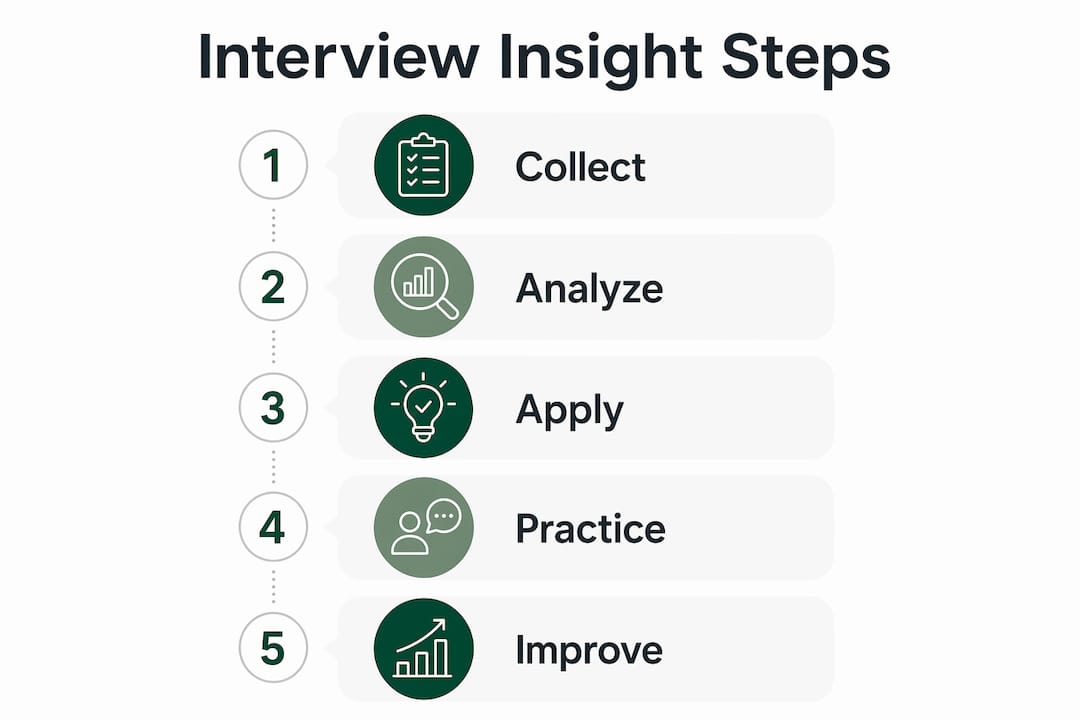
Collecting insights is only half the work. The second half is converting them into specific actions you can test, measure, and refine. Most job seekers stop at the observation stage. The ones who improve fastest treat every insight as a hypothesis.
Here is a framework for turning feedback into progress:
- Frame each insight as a “How might I” question. Testable hypotheses anchored to specific goals drive real change. “How might I give a more concrete example when asked about conflict?” is testable. “Be better at conflict questions” is not.
- Prioritize by impact and frequency. Not all gaps are equal. Focus first on the competencies that appear most often in job descriptions for your target roles and where your feedback shows the clearest weakness.
- Design a small experiment. Pick one behavior to change in your next mock interview. Practice only that change. Measure whether the feedback improves. This is faster than trying to fix everything at once.
- Document your iterations. Keep a simple log: what you changed, what the result was, and what you will try next. This turns your preparation into a learning cycle rather than a one-time event.
- Link each action to a job-relevant skill. Every preparation change should connect back to a competency the employer values. If the insight is about storytelling structure, the action is practicing the STAR method on three specific examples from your work history.
| Feedback type | Actionable next step |
|---|---|
| Vague answers under pressure | Practice STAR method with a timer set to 90 seconds |
| Missing concrete examples | Build a story bank of 10 work situations mapped to common competencies |
| Weak opening statements | Write and rehearse a 60-second professional summary out loud |
| Hesitation on technical questions | Identify knowledge gaps and complete one targeted learning module per week |
Framing findings as testable hypotheses with confidence levels and contradicting evidence produces the most rigorous preparation. If you believe your STAR answers are strong but feedback says otherwise, that contradiction is your most valuable data point.
Key Takeaways
Applying specific, pattern-based interview insights to targeted preparation changes is the most direct path to consistent improvement across every interview round.
| Point | Details |
|---|---|
| Define the insight precisely | An insight must specify the behavior, the condition, and the expected impact to be useful. |
| Find patterns, not anecdotes | Recurring observations across multiple interviews produce reliable direction; single quotes do not. |
| Build an evidence ledger | Capture quotes, context, and timestamps immediately after each interview to preserve accuracy. |
| Frame feedback as hypotheses | Turn each insight into a “How might I” question and test one change at a time. |
| Use AI tools to speed analysis | AI-based analysis compresses synthesis time significantly, freeing you to act on insights faster. |
Why most interview feedback stays useless (and how to fix that)
The uncomfortable truth about interview feedback is that most of it is designed to protect the person giving it, not to help the person receiving it. Vague comments like “we went with someone who was a stronger fit” are legally safe and practically worthless. Job seekers who wait for employers to hand them useful feedback will wait forever.
The fix is to generate your own insights. That means treating every interview as a data collection event, not just a performance. Record your mock sessions. Write your evidence ledger within 10 minutes of finishing a real interview. Tag your observations by competency. Look for the pattern that shows up twice before you act on it.
I have seen job seekers spend weeks preparing for interviews using the same generic approach and getting the same results. The ones who break that cycle are the ones who get specific. They know which question type trips them up. They know whether their answers run too long or too short. They know which competency they need one more strong example for.
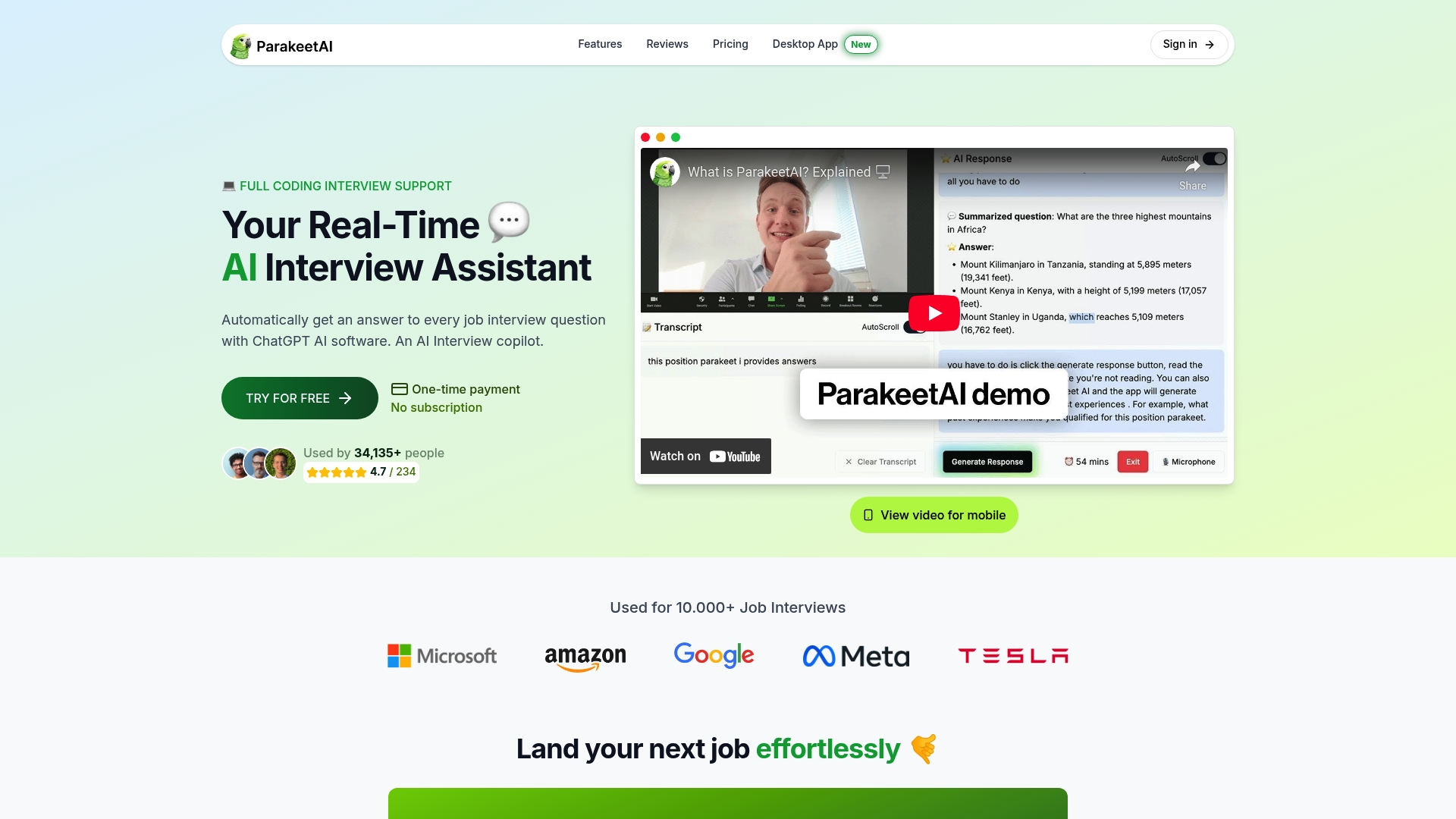
AI tools have made this process faster and more accessible. Parakeet-ai, for example, listens to your interview in real time and provides answers to every question as it happens. That kind of real-time interview support changes the feedback loop entirely. You are no longer reconstructing what happened from memory. You have a live record to analyze.
The motivation benefit is real too. Structured improvement paths give you something concrete to work toward. Vague anxiety about “doing better” is exhausting. Knowing you are practicing one specific skill this week is manageable and measurable.
— Jure
How Parakeet-ai helps you turn every interview into a learning opportunity
Job seekers who want structured, evidence-based feedback from every interview now have a direct path to it. Parakeet-ai is a real-time AI interview assistant that listens to your interview as it happens and automatically provides answers to every question using AI.
Beyond live support, Parakeet-ai gives you a record of your interview performance that you can review, analyze, and build on. That record is the foundation for the kind of pattern-based insights this guide describes. You stop guessing what went wrong and start working from real data. Visit Parakeet-ai to see how real-time AI assistance can sharpen your preparation and your performance in every interview round.
FAQ
What is the definition of actionable interview insights?
Actionable interview insights are specific, evidence-based findings from interviews that point to clear behaviors to change or practice. They differ from generic feedback by specifying who should act, what to do differently, and what the expected outcome is.
How do I collect useful insights from my own interviews?
Build an evidence ledger immediately after each interview by writing down specific questions, your responses, and how the interviewer reacted. Review recordings of mock interviews and tag observations by competency to find recurring patterns.
How do AI tools help generate interview insights?
AI-based analysis compresses qualitative synthesis time by up to 80% compared to manual review. Tools like Parakeet-ai capture interview performance in real time, giving you a structured record to analyze after each session.
What is the STAR method and why does it matter for interview insights?
The STAR method (Situation, Task, Action, Result) is a behavioral interview framework that structures answers around concrete evidence. Insights tied to STAR compliance are specific enough to practice and measure, making them genuinely useful for preparation.
How many interviews do I need before insights become reliable?
Patterns across multiple interviews produce reliable insights. A single observation is anecdotal. When the same feedback appears in two or more separate sessions, it is a signal worth acting on.