
Why Digital Job Assessments Beat Traditional Hiring

TL;DR:Digital assessments objectively measure candidate skills and outperform resumes in predicting job success.They standardize scoring and reduce bias, leading to fairer and more accurate hiring decisions.
Digital job assessments are structured, standardized evaluations that measure candidate skills, cognitive ability, and behavioral traits using objective scoring. They outperform traditional resumes and unstructured interviews on every measurable dimension of hiring accuracy. Resumes carry validity coefficients as low as 0.10, meaning they explain less than 1% of on-the-job success. That single number explains why digital job assessments have moved from a nice-to-have to a core part of evidence-based recruitment. For HR professionals and hiring managers, the question is no longer whether to adopt them. The question is how to do it well.
Why digital job assessments outperform resumes and interviews
The core problem with resume-based hiring is that resumes are marketing documents, not tests. 44% of HR professionals report encountering fake or embellished applications, and AI-generated content has made the problem worse. A candidate can describe themselves as a “strategic leader” without ever having led a team. A digital assessment forces them to demonstrate the skill instead.
Cognitive ability tests achieve validity coefficients of 0.51 when predicting job performance. That is more than double the predictive power of a resume. Structured assessments also score behavioral traits and role-specific skills using standardized rubrics, which removes the subjectivity that plagues unstructured interviews.
Bias reduction is another measurable gain. When every candidate answers the same questions under the same conditions, the scoring process becomes independent of a recruiter’s first impression. Digital platforms go further by separating the assessment stage from the interview stage, so hiring managers evaluate evidence before they meet the person. That sequence matters because it prevents the halo effect from distorting the data.
The benefits of digital assessments also show up in types of interview assessments that combine cognitive tests, situational judgment exercises, and skills simulations. Each layer adds predictive power. Together, they build a candidate profile that a resume simply cannot match.
- Cognitive ability tests predict performance across a wide range of roles, particularly those requiring problem-solving and learning speed.
- Situational judgment tests present realistic work scenarios and measure how candidates prioritize and respond.
- Skills simulations ask candidates to complete actual job tasks, such as writing a report or analyzing a data set.
- Personality and behavioral assessments identify work style, communication preferences, and cultural alignment.
- Structured scoring rubrics ensure every assessor applies the same criteria, reducing inter-rater variability.
Pro Tip: When interpreting assessment results, always compare scores against a validated benchmark for the specific role, not a generic population average. A score that looks average in the general pool may be exceptional for a niche technical position.
How digital assessments speed up hiring and scale across locations
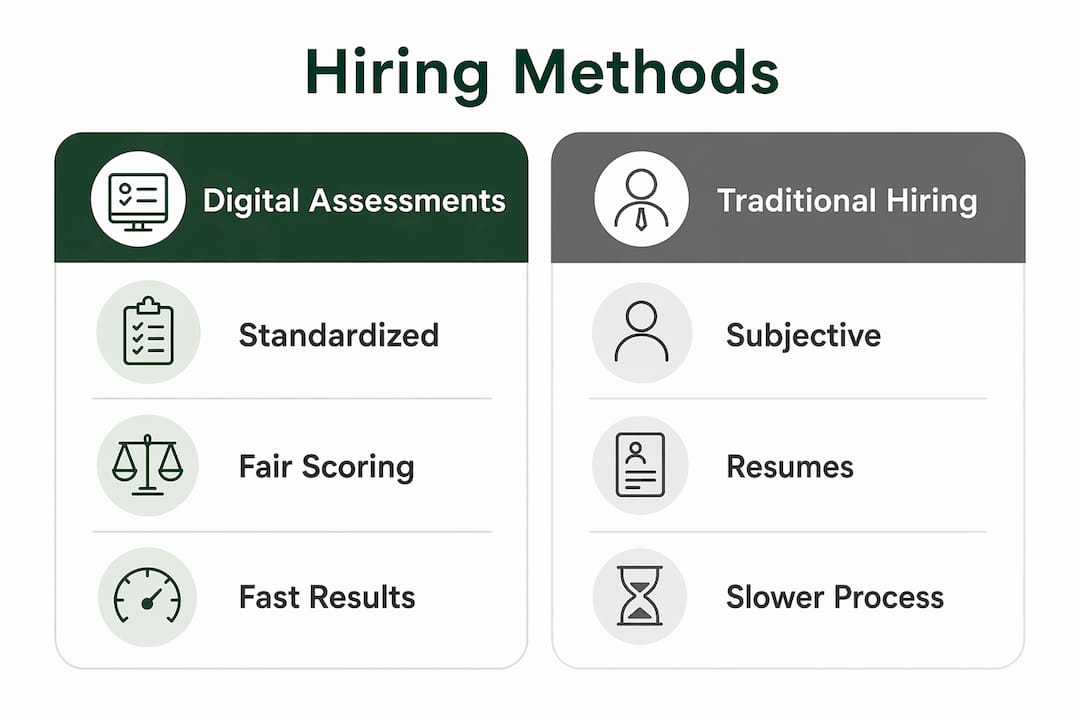
Paper-based assessments create delays, inconsistency, and high hidden costs. Scheduling conflicts, manual marking errors, and fragmented data across offices all slow the process down. Digital platforms eliminate each of these friction points through automation.
The operational gains are concrete and sequential:
- Automated scheduling sends assessment invitations immediately after a candidate applies, cutting days off the early screening stage.
- Centralized scoring replaces manual marking with algorithmic evaluation, removing human error from data entry.
- Unified candidate profiles store all assessment results in one place, so every hiring manager on the team sees the same data.
- Consistent evaluation across locations means a candidate in Chicago and a candidate in Dallas complete identical assessments under identical conditions.
- Faster shortlisting lets recruiters filter by score thresholds before spending time on phone screens or interviews.
Candidate experience also improves when assessments move online. Candidates complete tests at a time that suits them, receive immediate feedback, and engage with a process that signals the employer takes evaluation seriously. That transparency supports employer branding. Candidates who feel respected during the hiring process are more likely to accept offers and recommend the company to peers.
Digital assessments reduce manual work and improve data tracking across multiple locations, a finding that holds across markets from North America to MENA. The underlying logic is the same everywhere: automation replaces repetitive human tasks, and centralized data replaces scattered spreadsheets.

Pro Tip: Build a score threshold into your applicant tracking system so only candidates who meet the minimum assessment benchmark advance to the interview stage. This single change can cut interview volume by 30–50% without sacrificing quality.
How to integrate digital assessments into your talent ecosystem
Digital assessments deliver the most value when they sit inside a structured hiring funnel, not when they operate as standalone tools. A single cognitive test at the top of the funnel is useful. That same test combined with a skills simulation, a structured interview, and a behavioral assessment creates a hiring process with genuine predictive power.
Effective organizations use assessment data across recruitment, leadership development, and performance management. That means the data collected during hiring does not disappear after an offer is accepted. It feeds into onboarding plans, identifies early development needs, and informs succession planning decisions years later. Assessment data becomes an asset, not a one-time transaction.
For senior and leadership roles, digital assessment centers provide the most rigorous evaluation. These centers last one to two days and use multi-exercise formats that replicate real job tasks, including group simulations, written exercises, and presentations. Virtual versions of these centers remove geographic barriers and automate coordination, making them practical for global organizations.
Integrating digital assessment insights with talent management systems prevents data silos and builds sustainable leadership pipelines. The practical step is connecting your assessment platform to your HRIS so that scores, competency ratings, and development flags flow automatically into employee records. That connection turns a hiring tool into a long-term talent intelligence system.
Change management is the most common barrier to adoption. Hiring managers who have relied on gut instinct for years often resist structured scoring. The solution is not to mandate the tool but to show the data. When a team sees that candidates who scored in the top quartile on a cognitive assessment outperform those hired on interview impression alone, the resistance fades quickly.
- Connect assessment platforms to your HRIS for automatic data transfer.
- Use assessment results in onboarding conversations, not just hiring decisions.
- Build competency frameworks that align assessment criteria with performance review criteria.
- Train assessors on structured scoring before launching any digital assessment center.
- Review assessment validity annually to confirm alignment with evolving job requirements.
Common mistakes HR teams make with digital assessments
The most expensive mistake is treating a digital assessment as a digitized paper test. True success requires digital-first workflows designed around real-time data capture and automated coordination, not a PDF uploaded to a portal. When organizations simply replicate their paper process online, they capture none of the operational benefits and frustrate candidates with a clunky experience.
Technology without pedagogy is the second failure mode. Digital assessment effectiveness depends on embedding evaluations in sound frameworks that emphasize formative feedback and competency evaluation. A platform that scores candidates but never explains what the scores mean produces data that hiring managers cannot act on. The assessment must connect to a clear competency model and a defined scoring interpretation guide.
Anchoring bias in group debrief sessions is a specific risk that digital platforms can prevent. Assessors should score candidates independently in real time before any group discussion takes place. When one senior assessor shares their opinion first, every other rating in the room shifts toward that view. Independent scoring inside a shared platform eliminates that dynamic entirely.
Candidate communication is frequently underestimated. Candidates who receive no explanation of what an assessment measures, how long it takes, or how results will be used disengage at higher rates. Clear pre-assessment briefings reduce drop-off and improve the quality of responses because candidates understand what is being evaluated.
Pro Tip: Always validate your assessment against the specific job role before deploying it at scale. A cognitive test validated for software engineers may not predict success for sales managers. Job-relevant validation is not optional. It is the foundation of a defensible, fair process.
Key Takeaways
Digital job assessments are the most accurate, fair, and operationally efficient method available for evaluating candidates, and organizations that integrate them into structured hiring funnels see measurable gains in hire quality and process speed.
| Point | Details |
|---|---|
| Validity advantage | Cognitive assessments predict job performance at 0.51 validity, more than double the predictive power of resumes. |
| Bias reduction | Standardized scoring and independent assessor ratings remove subjectivity from candidate evaluation. |
| Operational efficiency | Automated workflows eliminate manual marking, reduce cost-per-hire, and enable consistent evaluation across locations. |
| Ecosystem integration | Assessment data connected to your HRIS supports succession planning and leadership development beyond the initial hire. |
| Avoid digitized paper traps | Digital-first workflows, not digitized paper processes, unlock the full benefits of online assessment platforms. |
What I’ve learned from watching teams adopt digital assessments
Most hiring teams approach digital assessments with the wrong question. They ask, “Which platform should we buy?” The right question is, “What decisions do we need this data to support?” The platform choice is secondary. The competency framework, the scoring rubric, and the integration with downstream talent processes are what determine whether the investment pays off.
I have watched organizations deploy well-regarded assessment platforms and see no improvement in hire quality because the scores sat in a separate system that nobody checked after the offer was signed. The data existed. Nobody used it. That is a process failure, not a technology failure.
The teams that get the most value from digital assessments share one habit: they review assessment scores alongside six-month performance ratings and look for patterns. When a specific test score consistently predicts high performance in a role, they raise the threshold. When a score shows no correlation, they remove that test and replace it with something more relevant. That feedback loop is what separates evidence-based hiring from hiring theater.
The shift toward digital interviewing is accelerating in 2026, and AI integration is making assessments faster and more adaptive. But the fundamentals have not changed. Objective data beats subjective impression. Structured processes beat unstructured ones. The organizations that internalize those two facts and build their hiring around them will consistently outperform those that rely on resumes and gut feel.
— Jure
How Parakeet-ai supports smarter hiring decisions
Parakeet-ai is built for hiring teams that want objective, structured evaluation at every stage of the candidate process.
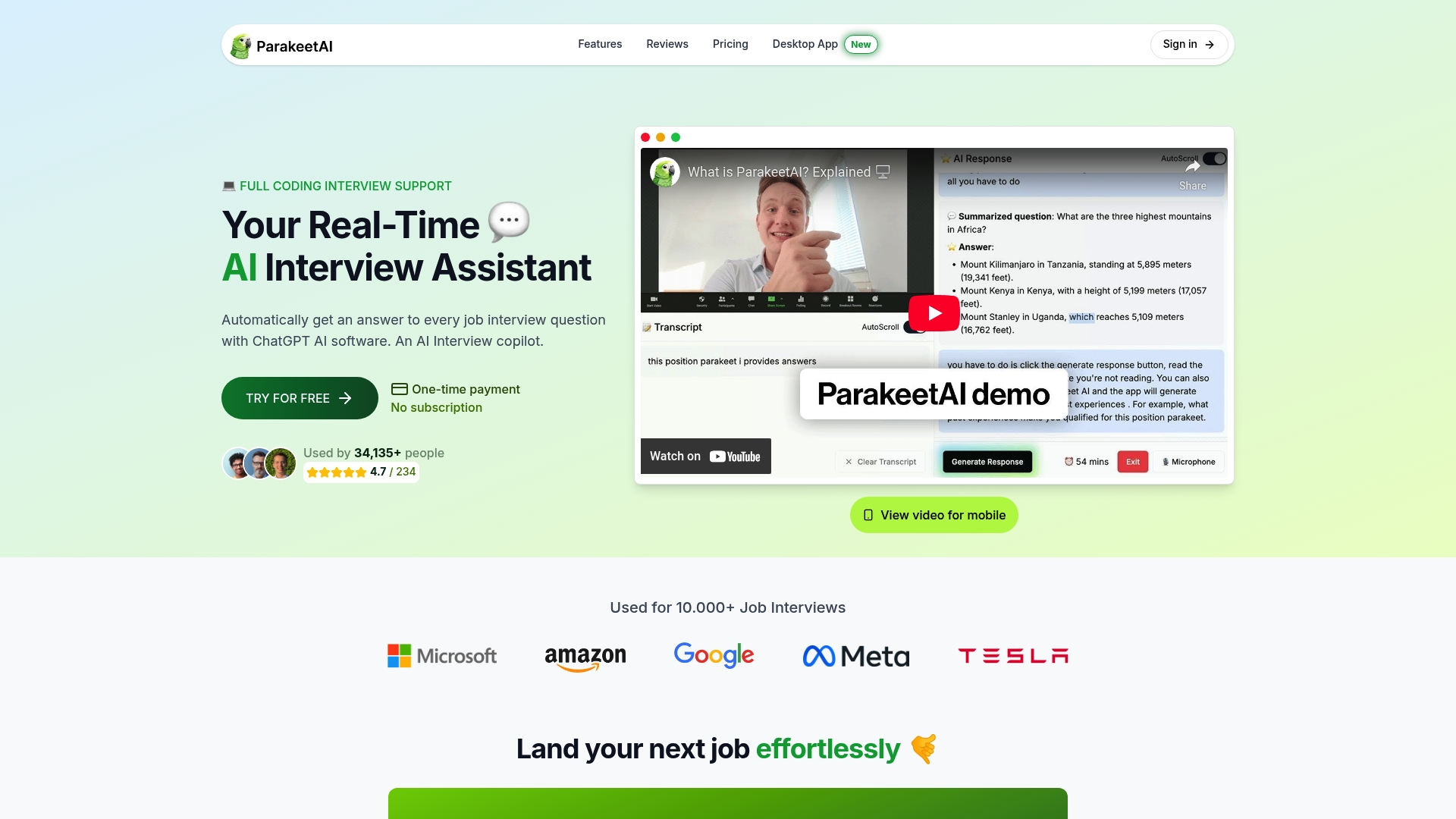
The platform combines real-time AI support with structured assessment workflows, giving hiring managers consistent data on every candidate they evaluate. Centralized candidate profiles mean your whole team works from the same information, and automated scoring removes the manual work that slows decisions down. If you are ready to move beyond resume screening and build a hiring process grounded in evidence, Parakeet-ai gives you the tools to do it. The platform is designed for HR professionals who need accuracy, speed, and fairness in every hiring decision they make.
FAQ
What are digital job assessments?
Digital job assessments are standardized, online evaluations that measure candidate skills, cognitive ability, and behavioral traits using objective scoring. They replace or supplement resumes and unstructured interviews with evidence-based data.
Why do digital assessments predict job performance better than resumes?
Cognitive ability tests achieve validity coefficients of 0.51, compared to as low as 0.10 for resumes. Resumes are self-authored documents; assessments measure actual capability under controlled conditions.
How do digital assessments reduce hiring bias?
Standardized questions, consistent scoring rubrics, and independent assessor ratings remove the subjectivity that drives bias in traditional interviews. Candidates are evaluated on the same criteria regardless of background or presentation style.
What is a digital assessment center?
A digital assessment center is a multi-exercise evaluation format, typically lasting one to two days, that replicates real job tasks through virtual simulations, group exercises, and written assignments. It is most commonly used for senior and leadership roles.
How should HR teams integrate digital assessments into their hiring process?
Digital assessments work best inside a structured hiring funnel that combines cognitive tests, skills simulations, and structured interviews. Connecting assessment data to your HRIS extends its value into onboarding, performance management, and succession planning.