
Why Use AI for Response Accuracy: A 2026 Guide

TL;DR:AI response accuracy measures how often AI provides correct, relevant, and contextually appropriate answers. It outperforms humans in consistency and speed, especially in high-volume or high-stakes situations. Ongoing maintenance, data updates, and techniques like Retrieval-Augmented Generation are essential to sustain and improve accuracy.
AI response accuracy is defined as the degree to which an AI system delivers correct, relevant, and contextually appropriate answers to a given question. This matters because wrong answers cost real money and real opportunities. Chatbot accuracy for customer intent understanding reached 94% in 2026, up from 67% in 2022. That 27-point jump in four years shows how fast the technology has matured. Understanding why use AI for response accuracy starts with recognizing that AI does not get tired, does not rush, and does not guess the way humans do under pressure. Tools like Parakeet-ai apply this principle directly to high-stakes scenarios like job interviews, where every answer carries weight.
Why use AI for response accuracy: how AI outperforms humans
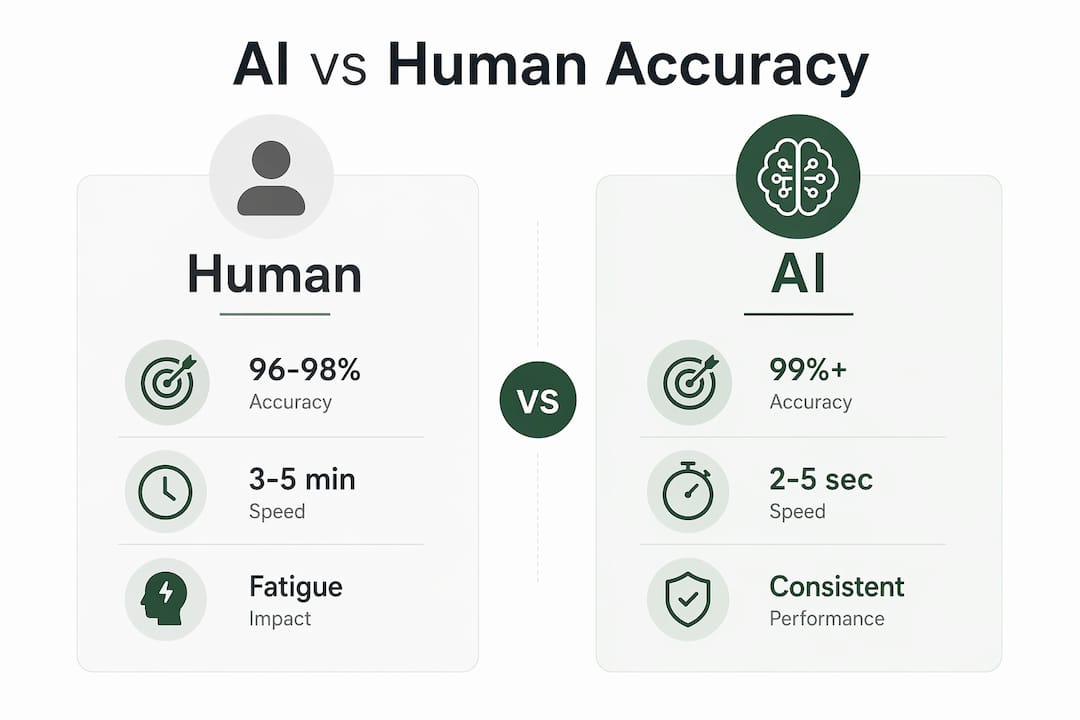
AI achieves higher accuracy than humans through architecture, not effort. AI-based data entry achieves over 99% accuracy while human accuracy ranges from 96% to 98% and degrades further with fatigue. That gap sounds small until you calculate the cost of rework across thousands of transactions.

The key difference is consistency. Human performance dips after hours of repetitive work. AI maintains a consistent accuracy baseline regardless of volume, eliminating the invisible costs of fatigue-related errors. A customer service team handling 10,000 queries a day cannot sustain peak accuracy. An AI system can.
Speed compounds the advantage. Manual data entry takes 3–5 minutes per document. AI completes the same task in 2–5 seconds. That speed does not come at the expense of quality. It comes from removing the bottlenecks that cause human error in the first place.
The cost of deploying high-accuracy AI has also collapsed. Deployment costs dropped over 80x between november 2022 and october 2025, with query costs falling from $10 per million tokens to $0.07. That shift makes enterprise-grade accuracy available to organizations that could not afford it three years ago. The AI adoption in HR sector is one clear example of how that cost reduction is reshaping who can access accurate AI tools.
Pro Tip: When evaluating AI accuracy for your use case, compare error rates at scale, not just in demos. A system that performs at 99% accuracy on 100 queries may behave differently at 100,000.
Accuracy comparison: AI vs. human performance
| Metric | Human performance | AI performance |
|---|---|---|
| Data entry accuracy | 96–98% | 99%+ |
| Speed per document | 3–5 minutes | 2–5 seconds |
| Accuracy under fatigue | Degrades significantly | Stable |
| Cost per million tokens | N/A | $0.07 (2025) |
What are the biggest challenges in AI response accuracy?
AI accuracy is not a solved problem. Three issues cause the most damage in real deployments: hallucinations, knowledge base rot, and intent misreading.
Hallucinations occur when an AI produces a confident, fluent answer that is factually wrong. 75% of users feel frustrated with wrong AI answers, and 56% abandon the interaction without complaining. That silent exit is the dangerous part. You do not know the damage until it shows up in churn data or failed interviews.
- Hallucinations: The model generates plausible-sounding but incorrect information, especially when the question falls outside its training data.
- Knowledge base rot: Outdated source data causes the AI to return answers that were once correct but are no longer valid. Monthly updates and feedback loops can improve chatbot accuracy from around 70% to 85–90% within two weeks.
- Intent misreading: The AI answers the literal question rather than the actual need behind it. A candidate asking “how should I answer behavioral questions?” wants a framework, not a definition of behavioral interviews.
- Bias in training data: Models trained on skewed datasets reproduce those skews in their outputs. This is particularly consequential in interview evaluation, where bias in AI interview systems can disadvantage qualified candidates.
Industry experts identify knowledge base rot and bias as the primary risks to sustained AI accuracy. Both require active management, not one-time fixes.
Pro Tip: Set a calendar reminder to audit your AI system’s knowledge base every 30 days. Stale data is the most common cause of accuracy decline in production deployments.
How can you improve AI response accuracy?
The most effective method for improving AI accuracy is Retrieval-Augmented Generation, known as RAG. RAG-based systems achieve 95–98% accuracy by grounding answers in internal documentation rather than relying on probabilistic guesses from training data alone. The model retrieves verified information first, then generates a response based on that retrieved content.
Here are the four techniques that produce the most consistent accuracy gains:
- Deploy RAG with semantic search. RAG architecture combines external knowledge retrieval with language model generation to reduce hallucinations. Semantic search surfaces the most relevant content rather than just keyword matches, which matters when questions are phrased in unexpected ways.
- Add source citations to every response. Transparency builds trust and creates an audit trail. When an AI cites its source, users can verify the answer. That verification step catches errors before they cause harm.
- Apply context engineering. Context engineering optimizes model inputs by stripping noise and enforcing explicit output constraints. A clean, focused prompt produces a focused answer. Vague inputs produce vague outputs. This technique is especially useful in customer service, where query types are predictable and prompts can be templated.
- Build continuous monitoring and human handoffs. No AI system should operate without a review loop. Set accuracy thresholds. When confidence drops below a defined level, route the query to a human agent. Track re-contact rates and customer satisfaction scores, not just resolution rates.
“Relying solely on resolution rates can be misleading. True AI accuracy should be assessed by multidimensional signals including customer satisfaction and repeat contacts.” — The Role of AI in Answer Evaluation: 2026 Guide
Context engineering deserves special attention because it is often overlooked. Most teams focus on the model and ignore the input. Clear output contracts enable automated validation and reduce token waste. That means faster, cheaper, and more accurate responses without changing the underlying model at all.
What are the real-world benefits of AI-driven response accuracy?
The benefits of AI in accuracy show up differently depending on the application. In customer service, the gains are operational. In job interviews, they are evaluative. Both are significant.
Customer service
- Error reduction at scale. Organizations deploying AI workflows report 60–80% reductions in error rates compared to manual equivalents. That reduction translates directly into lower support costs and fewer escalations.
- Faster resolution. AI processes queries in seconds. Human agents take minutes. The speed difference matters most during peak periods when queue length drives customer frustration.
- Consistent quality. A human agent on hour eight of a shift answers differently than on hour one. AI does not have that problem. Every customer gets the same quality of response regardless of when they contact support.
- Reduced handle time. Inaccurate bots increase average support handle time by 21%. Accurate AI does the opposite. It resolves queries faster and reduces the volume that reaches human agents.
Job interview evaluation
The interview context is where AI accuracy becomes genuinely multidimensional. AI systems achieve multidimensional accuracy assessments that go beyond simple right-or-wrong scoring. They evaluate relevance, structure, tone, and alignment with the role’s requirements simultaneously.
Parakeet-ai applies this approach in real time. The system listens to interview questions as they are asked and generates accurate, contextually grounded answers instantly. That capability removes the cognitive load of recalling the perfect response under pressure, which is where most candidates lose accuracy in their own answers.
| Application | Key accuracy benefit | Measurable outcome |
|---|---|---|
| Customer service | Consistent, fast responses | 60–80% error rate reduction |
| Job interviews | Multidimensional answer evaluation | Higher relevance and role alignment |
| Data processing | No fatigue-related degradation | 99%+ sustained accuracy |
| Decision support | Intent alignment on complex queries | Better outcomes in high-stakes scenarios |
Latest AI models improve accuracy through intent alignment, adapting to complex, multipronged questions rather than returning static facts. This matters in interviews and strategic planning, where the “why” behind a question shapes the right answer. Organizations investing in AI productivity gains across sectors are seeing this play out in measurable ROI.
Key Takeaways
AI response accuracy delivers consistent, measurable improvements over human performance by combining architectural consistency, retrieval-grounded generation, and continuous feedback loops across customer service and interview evaluation contexts.
| Point | Details |
|---|---|
| AI outperforms humans at scale | AI maintains 99%+ accuracy without fatigue, while human accuracy degrades from 96–98% under volume. |
| RAG is the top accuracy method | RAG-based systems achieve 95–98% accuracy by grounding responses in verified source documents. |
| Knowledge base rot is the biggest risk | Outdated data silently degrades accuracy; monthly updates can lift performance from 70% to 85–90%. |
| Multidimensional metrics matter | Resolution rate alone misleads; track customer satisfaction and re-contact rates for true accuracy. |
| Context engineering multiplies gains | Clean, constrained prompts improve output quality without changing the underlying model. |
The accuracy gap nobody talks about
I have spent years watching organizations celebrate their AI deployments, then quietly struggle six months later when accuracy starts slipping. The problem is almost never the model. It is the maintenance culture around the model.
Teams treat AI accuracy as a launch metric rather than an ongoing operational responsibility. They measure accuracy at go-live, hit a good number, and move on. Then the knowledge base ages. The query patterns shift. The world changes. And the AI keeps answering based on data that no longer reflects reality.
The technical solutions exist. RAG works. Context engineering works. Human-in-the-loop oversight works. What does not work is deploying these tools once and assuming the job is done. Accuracy is a process, not a feature.
I am genuinely optimistic about where AI accuracy is heading. The cost collapse between 2022 and 2025 was extraordinary. The intent alignment improvements in current models are real. But the organizations that will actually benefit are the ones that build review cycles, audit their knowledge bases, and treat accuracy as a living metric. The ones that do not will keep wondering why their AI “stopped working” when the truth is it never stopped. It just kept answering questions with outdated information, and nobody noticed until the damage was done.
— Jure
How Parakeet-ai puts AI accuracy to work in interviews
Accurate AI answers matter most when the stakes are highest. Job interviews are exactly that kind of moment.
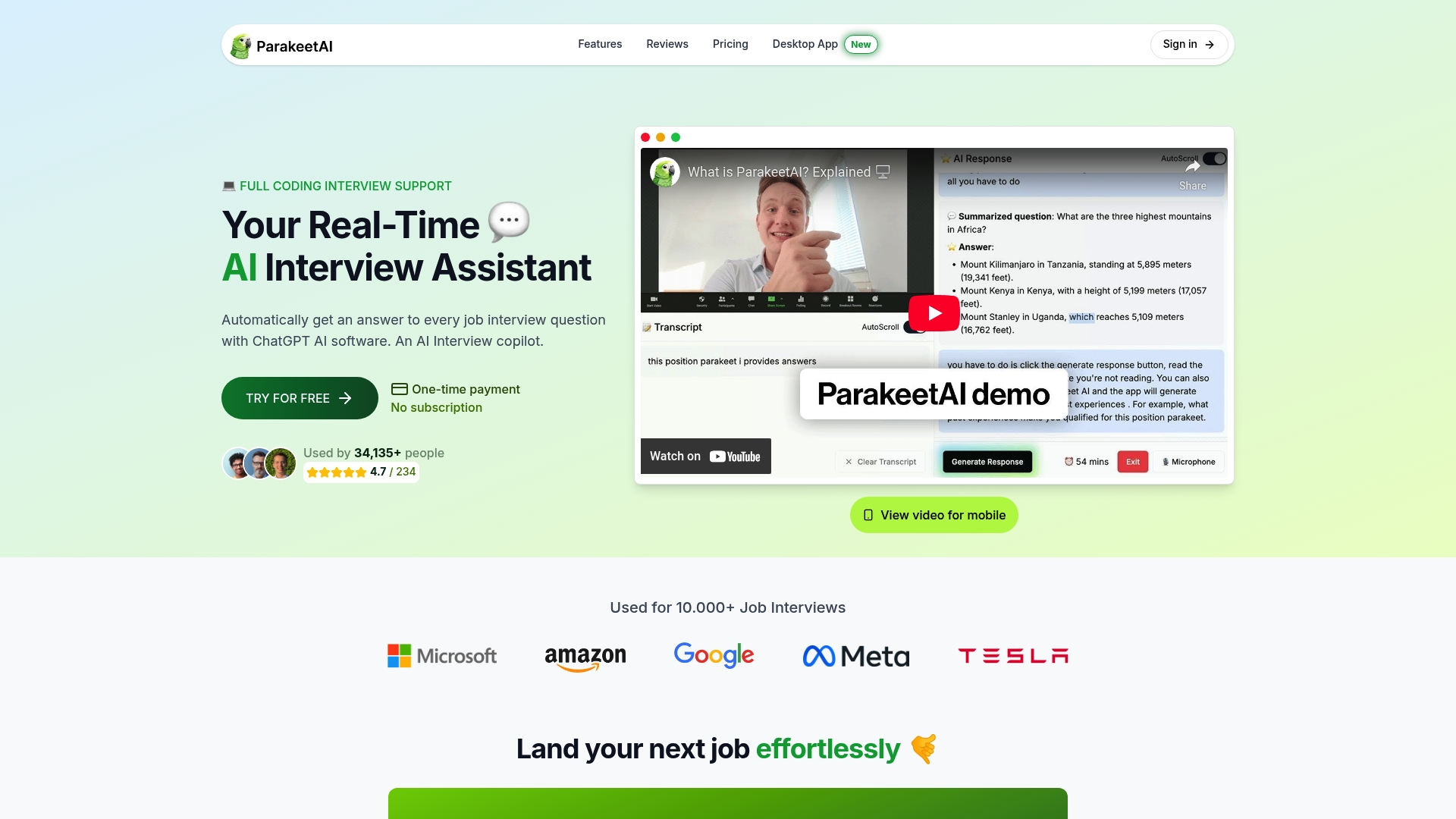
Parakeet-ai is a real-time AI interview assistant that listens to your interview and automatically generates accurate, contextually grounded answers to every question as it happens. The system applies the same principles covered in this article: retrieval-grounded responses, intent alignment, and multidimensional relevance. You do not have to recall the perfect answer under pressure. Parakeet-ai surfaces it for you in real time. Candidates who want to show up to interviews with the accuracy advantage AI provides can explore Parakeet-ai and see how the tool works in practice.
FAQ
What is AI response accuracy?
AI response accuracy is the measure of how often an AI system delivers correct, relevant, and contextually appropriate answers. Chatbot accuracy for customer intent understanding reached 94% in 2026, up from 67% in 2022.
Why does AI achieve higher accuracy than humans?
AI does not experience fatigue, which means its accuracy does not degrade over volume. Human data entry accuracy ranges from 96–98% and declines with repetition; AI sustains over 99% consistently.
What causes AI to give wrong answers?
The two main causes are hallucinations, where the model generates confident but incorrect information, and knowledge base rot, where outdated source data produces answers that are no longer valid.
How does RAG improve AI response accuracy?
Retrieval-Augmented Generation grounds AI responses in verified external documents rather than relying on training data alone. RAG-based systems achieve 95–98% accuracy by limiting the model to reliable, current source material.
How does Parakeet-ai use AI for response accuracy in interviews?
Parakeet-ai listens to interview questions in real time and generates accurate, role-relevant answers instantly. The system applies intent alignment and contextual grounding to deliver responses that match what interviewers are actually asking.