How to Prepare for an Interview: Your 2026 Guide

TL;DR:Thorough interview preparation involves research, practicing answers, logistical planning, and thoughtful questioning.It enhances confidence, transforms conversations into genuine exchanges, and significantly improves your chances of success.
Effective interview preparation is a structured process that combines targeted research, practiced communication, and deliberate logistics planning. Job seekers who know how to prepare for an interview before they walk in the door perform measurably better than those who rely on instinct alone. The difference between a forgettable candidate and a compelling one almost always comes down to preparation depth. This guide covers every stage of the interview preparation process, from researching the company to sending a follow-up email that keeps you top of mind.
How to prepare for an interview: start with deep company research
Research is the foundation of every strong interview. Without it, your answers sound generic and your questions sound uninformed. With it, you can connect your experience directly to what the company actually needs.
Start with the company’s website, LinkedIn page, recent press releases, and any news coverage from the past six months. Look for the company’s stated values, recent product launches, leadership changes, and growth priorities. These details give you material to reference naturally during the conversation.
- Company website: Read the “About,” “Mission,” and “Careers” pages carefully. Note the language they use to describe their culture.
- LinkedIn: Follow the company page and check recent posts. Look at the profiles of people in similar roles to understand career paths.
- News and press: Search the company name in Google News. Recent funding rounds, acquisitions, or product launches are excellent conversation starters.
- Job description: Map every requirement to a specific experience you have. Identify any skill gaps and prepare a brief, honest response for each one.
Researching interviewers’ backgrounds allows you to build genuine rapport and ask informed questions. That shift in dynamic, from interrogation to conversation, changes the entire tone of the meeting.
Pro Tip: Search your interviewer’s name on LinkedIn before the interview. Note a recent article they shared, a project they led, or a mutual connection. Referencing it naturally during introductions signals that you treat this as a real professional exchange, not a performance.

What are the best methods for practicing interview answers?
Practicing answers out loud is the single most underused preparation step. Most job seekers rehearse silently in their heads, which feels complete but reveals nothing about pacing, clarity, or whether the story actually lands.
The STAR method is the standard framework for behavioral and situational questions. STAR stands for Situation, Task, Action, and Result. The critical mistake most candidates make is spending too much time on Situation and Task. Effective STAR answers dedicate 70–80% of the response to Action and Result. Interviewers already understand context quickly. What they want to hear is what you specifically did and what changed because of it.
Here is a step-by-step approach to building your answer bank:
- List your top five stories. Choose experiences that demonstrate leadership, problem-solving, collaboration, failure and recovery, and measurable impact. These five cover the vast majority of behavioral questions.
- Write each story in STAR format. Keep Situation and Task to two or three sentences combined. Spend the rest on your specific actions and the outcome.
- Tie results to numbers. “I improved the process” is weak. “I cut processing time by three days” is memorable. Map your experiences to the job description and quantify wherever possible.
- Practice each answer aloud. Time yourself. Most strong answers run 90 seconds to two minutes. Anything longer loses the interviewer.
- Do one full mock interview the day before. Out-loud rehearsals reveal timing problems and content gaps that silent thinking cannot catch. Record yourself or ask a friend to listen and give feedback.
Pro Tip: After each practice answer, ask yourself: “Did I say what I actually did, or did I describe what the team did?” Interviewers want to hear “I,” not “we.” Specificity is what separates a strong candidate from a vague one.
For technical roles, the preparation process has additional layers. Technical interview prep requires practicing problem-solving under time pressure, not just reviewing concepts.
What logistical and mental preparations improve interview day performance?
Your pre-interview state directly influences your confidence and how you come across before you say a single word. Outfit, arrival timing, and mental readiness all shape your demeanor in ways you cannot fully control in the moment.
Address logistics the day before, not the morning of. Scrambling for directions or testing a video platform five minutes before the call creates anxiety that bleeds into your answers.
- Attire: Choose clothing one level above the company’s standard dress code. If the culture is business casual, wear business professional. If it is casual, wear business casual. When in doubt, err toward formal.
- Arrival timing: Plan to arrive 10–15 minutes early for in-person interviews. Use the extra time to observe the office environment and settle your nerves, not to review notes frantically.
- Virtual interviews: Test your camera, microphone, lighting, and internet connection the evening before. Close unnecessary browser tabs and silence your phone. A clean, neutral background signals professionalism.
- Mental readiness: Physical movement before an interview, even a 10-minute walk, reduces cortisol and sharpens focus. Avoid reviewing your notes obsessively in the final hour. Trust your preparation.
The goal of logistics planning is simple: remove every variable that could create stress on the day itself. When the practical details are handled, your mental energy stays where it belongs, on the conversation.
How can you prepare thoughtful questions to ask the interviewer?
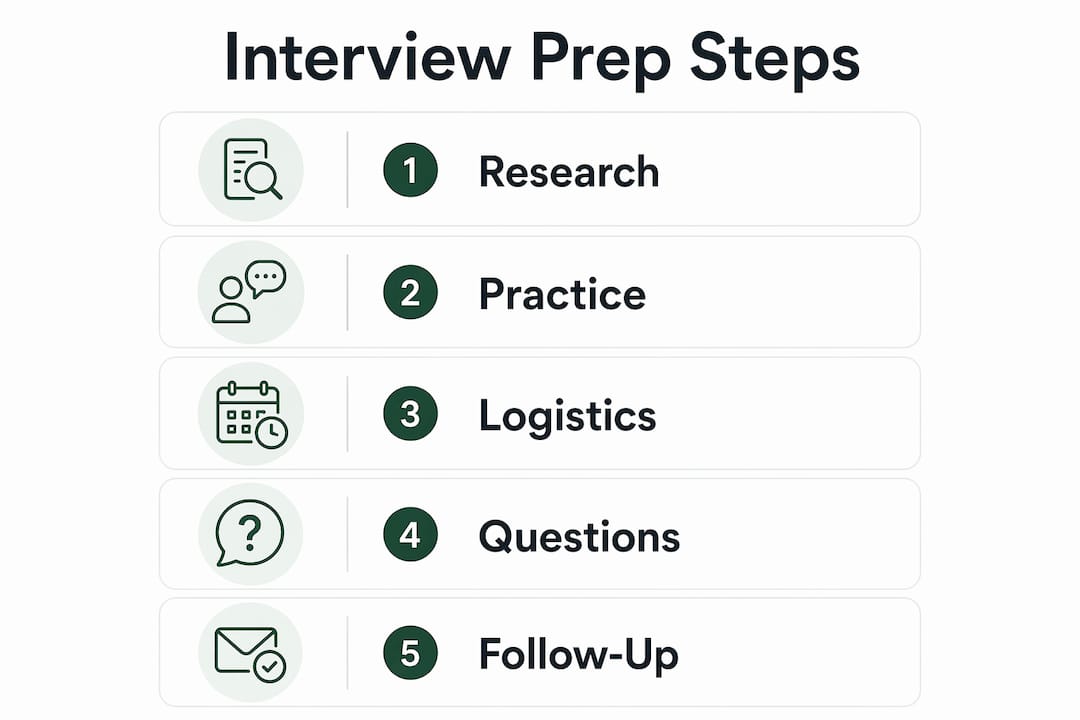
Asking strong questions is not a formality. It signals genuine interest, demonstrates that you have done your research, and gives you real information to evaluate whether the role is right for you. Interviews function best as two-way conversations where both sides assess fit.
Prepare 3–5 questions for the employer before every interview. Tailor at least two of them to what you learned during your research.
Strong question categories include:
- Role expectations: “What does success look like in this role after 90 days?” This tells you exactly what the hiring manager prioritizes.
- Team dynamics: “How does this team typically handle disagreements or competing priorities?” This reveals culture more honestly than any careers page.
- Challenges: “What is the biggest challenge the person in this role will face in the first six months?” This shows you think practically, not just optimistically.
- Interviewer experience: “What has kept you at this company?” This builds rapport and gives you an authentic perspective on the culture.
Avoid asking about salary, vacation, or benefits in a first-round interview unless the interviewer raises it. Those questions signal that your primary interest is compensation, not the role itself. Save them for later rounds or the offer stage.
For a broader list of strong options, questions to ask employers organized by category can help you build a bank you can draw from across multiple interviews.
What are best practices for post-interview follow-up?
A thank-you email is not optional. It is a professional signal that you take the process seriously and respect the interviewer’s time. Send a brief, specific thank-you email within 24 hours of every interview.
The email should be short, three to four sentences at most. Generic thank-you notes are worse than none because they confirm you had nothing specific to say. A strong follow-up references one concrete topic from the conversation and reiterates your enthusiasm for the role.
- Send to each interviewer separately. If you met with three people, send three distinct emails. Do not copy everyone on one message.
- Reference something specific. Mention a topic you discussed, a challenge they described, or a question they asked that made you think. This proves you were present and engaged.
- Address any gap. If a question caught you off guard and you gave a weak answer, the follow-up email is your chance to add a stronger response briefly and professionally.
Pro Tip: Write your thank-you email draft immediately after the interview, while the details are fresh. You do not have to send it right away, but capturing the specifics in the moment makes the final version far stronger.
Key Takeaways
Consistent, structured preparation is the most reliable way to perform well in a job interview, covering research, practice, logistics, questions, and follow-up.
| Point | Details |
|---|---|
| Invest the right amount of time | Spend 3–4 hours on first-round prep and 6–8 hours for final or panel interviews. |
| Use the STAR method correctly | Focus 70–80% of each answer on your specific actions and measurable results. |
| Handle logistics the day before | Confirm attire, arrival plan, and technology the evening before to reduce day-of stress. |
| Prepare tailored questions | Bring 3–5 specific questions based on your research to show genuine interest and assess fit. |
| Follow up within 24 hours | Send a personalized thank-you email to each interviewer referencing a specific conversation point. |
What I have learned from watching candidates prepare the wrong way
Most candidates treat interview preparation as content review. They reread their resume, rehearse a few answers in their head, and call it done. That approach produces interviews that feel flat, even when the candidate is genuinely qualified.
The biggest shift I have seen in candidates who perform well is that they prepare their state, not just their content. They handle the logistics early, they practice out loud until the stories feel natural, and they walk in having already decided they belong in the room. That confidence is not arrogance. It is the result of thorough preparation.
The second thing I have noticed is that researching the interviewer specifically changes the dynamic more than any other single step. When you know that your interviewer recently led a product launch or wrote an article on a topic relevant to the role, you can ask a question that shows you see them as a professional, not just a gatekeeper. That shift turns an interrogation into a conversation, and conversations produce better outcomes for both sides.
The mistake I see most often in STAR answers is spending three minutes on context and thirty seconds on what the candidate actually did. Interviewers do not need the full backstory. They need to see your judgment and your impact. Cut the setup ruthlessly and spend your time on the part that only you can tell.
— Jure
Parakeet-ai: real-time support when it matters most
Preparation builds your foundation, but even the most prepared job seekers face unexpected questions in the room. Parakeet-ai is a real-time AI interview assistant that listens to your interview and automatically generates answers to every question as it happens.
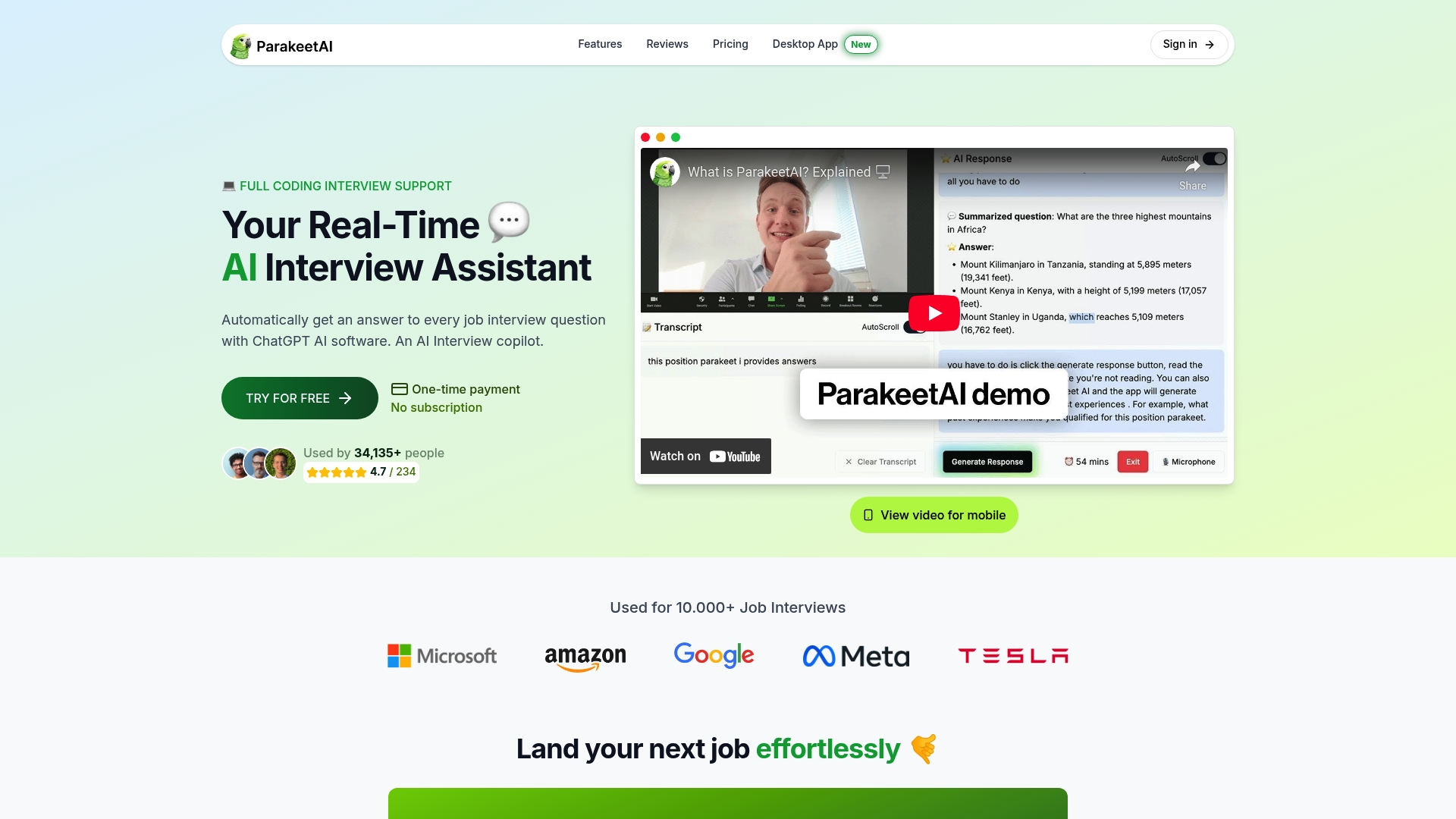
Job seekers use Parakeet-ai to practice with AI-generated questions tailored to their specific role and industry, receive instant feedback on their answers, and access sample responses built around proven frameworks. Whether you are preparing for a first-round screen or a final panel interview, Parakeet-ai gives you a preparation partner that works at your pace and adapts to your target role. You can also explore job interview tips on the Parakeet-ai blog to sharpen your approach before the big day.
FAQ
How many hours should I spend preparing for an interview?
Spend 3–4 hours preparing for a first-round interview and 6–8 hours for a final or panel interview. The later the stage, the more tailored and detailed your preparation should be.
What is the STAR method for interview answers?
STAR stands for Situation, Task, Action, and Result. Strong STAR answers spend 70–80% of the response on the Action and Result, keeping the Situation and Task brief.
How early should I arrive for an in-person interview?
Arrive 10–15 minutes before your scheduled interview time. This gives you a buffer for unexpected delays and a few minutes to observe the environment and compose yourself.
Should I send a thank-you email after every interview?
Send a brief, specific thank-you email to each interviewer within 24 hours. Reference one concrete topic from the conversation to make the message personal and memorable.
What questions should I ask at the end of an interview?
Prepare 3–5 questions focused on role expectations, team dynamics, and company challenges. Avoid asking about salary or benefits in a first-round interview unless the interviewer raises the topic first.