
EQ Interview Questions: Top 12 for Job Seekers in 2026

TL;DR:Emotional intelligence interview questions assess how candidates recognize, manage, and utilize emotions at work.Preparing specific stories with the STAR method, emphasizing emotional detail, improves performance.
Emotional intelligence (EQ) interview questions are designed to evaluate how candidates recognize, manage, and leverage emotions in workplace settings. EQ predicts 58% of job performance and is considered twice as important as IQ for long-term career success. That makes these questions far more than a formality. Structured behavioral interviews using EQ-focused questions show a predictive validity coefficient of .51, ranking them among the most reliable hiring tools available. Job seekers who understand what these questions test, and how to answer them well, gain a measurable edge in any interview.
1. What are the top EQ interview questions you will face?
The 12 questions below are organized by the four core EQ domains: self-awareness, self-management, social awareness, and relationship management. Knowing which domain each question targets helps you prepare the right kind of story.
Self-awareness questions
- “Describe a time when you received critical feedback. How did you react?” This question tests whether you can separate your ego from your work and process criticism without becoming defensive.
- “Tell me about a moment when your emotions affected your professional judgment.” Interviewers want to see that you recognize your own emotional triggers, not that you claim to have none.
- “How do you know when you are stressed, and what do you do about it?” This probes your ability to read your own internal signals before they affect your output.
Self-management questions
- “Give me an example of a time you stayed calm under pressure.” The focus is on the specific action you took, not just the outcome.
- “Tell me about a goal you set and failed to reach. What happened next?” Strong candidates show they can regulate disappointment and redirect it into learning.
Social awareness questions
- “Describe a situation where you had to read the room and adjust your communication style.” This reveals whether you pick up on unspoken group dynamics.
- “Tell me about a time you noticed a colleague was struggling before they said anything.” Empathy in action is what interviewers are measuring here.
Relationship management questions
- “Walk me through a conflict you had with a coworker and how you resolved it.” This is one of the most common interview questions for emotional skills and tests your ability to manage tension without damaging the relationship.
- “Describe a time you had to influence someone who did not report to you.” This tests lateral leadership and persuasion without authority.
- “Tell me about a time you delivered difficult news to a team member.” Interviewers want to see compassion paired with clarity.
- “Give an example of when you built trust with a skeptical stakeholder.” This question targets long-term relationship building, not just short-term conflict resolution.
- “Describe a time you supported a teammate through a setback.” This closes the loop on empathy by showing you translate awareness into concrete support.
Pro Tip: Tailor your story selection to the role. A customer-facing job calls for empathy and social awareness examples. A leadership role calls for conflict resolution and influence stories.
2. How to answer EQ interview questions using the STAR method

The STAR method (Situation, Task, Action, Result) is the standard framework for answering behavioral interview questions, and it works especially well for EQ questions. The key is knowing where to spend your time. The Action phase should take about 60% of your total response. That is where you show your decision-making process, not just what happened.
For EQ questions specifically, the Action phase needs emotional detail. Name the emotion you felt. Describe the moment you paused. Then explain the deliberate choice you made to redirect that impulse toward a productive outcome. Top-performing answers explicitly name emotions felt, describe intentional pauses, and show a deliberate choice to redirect emotional impulses toward constructive professional action. Generic answers like “I stayed calm and handled it” tell the interviewer nothing useful.
The Result phase should be specific. Quantify the outcome where possible. If you cannot use a number, describe a clear behavioral change or relationship shift. Strong EQ answers end with outcome-oriented results that demonstrate learning and growth from setbacks or challenges. That final sentence is what makes your story memorable.
| Answer trait | Weak example | Strong example |
|---|---|---|
| Emotion naming | “I was a bit frustrated” | “I felt genuinely angry and noticed my jaw tighten” |
| Pause description | Absent | “I took a breath before responding” |
| Action detail | “I handled the situation” | “I asked three clarifying questions before sharing my view” |
| Result specificity | “It worked out fine” | “The client renewed the contract and cited our communication” |
| Growth reflection | Absent | “I now set a personal rule to wait 24 hours before escalating” |
Pro Tip: Avoid rehearsing a single polished script. Interviewers can tell. Instead, practice the emotional arc of 5 to 6 real stories so you can adapt them to different questions on the fly.
3. Which questions reveal conflict resolution and empathy skills?
Conflict and empathy questions are the most revealing EQ assessment tools in any interview. They force candidates to show how they behave when emotions are highest. Hiring experts emphasize that these questions are rigorous tests of professional maturity, requiring candidates to truthfully reveal emotional reactions and then demonstrate controlled, productive responses.
The most common questions in this category include:
- “Tell me about a time you disagreed with your manager’s decision.”
- “Describe a situation where a colleague’s behavior affected team morale.”
- “How have you handled a situation where a team member was not pulling their weight?”
- “Tell me about a time you had to advocate for someone else’s idea over your own.”
Strong responses to these questions share four traits:
- They acknowledge the other person’s perspective before presenting your own.
- They describe a specific action you took to de-escalate or connect, not just a general attitude.
- They show personal ownership. Effective EQ responses demonstrate personal ownership of failures with clear learning adjustments, showcasing emotional maturity and growth.
- They end with a relationship outcome, not just a task outcome. Did the working relationship improve? Did trust increase?
The empathy questions are trickier because they require you to show awareness without making the story about yourself. Keep the focus on what you observed, what you did, and what changed for the other person.
4. How to adapt your answers for different industries and roles
EQ expectations vary significantly across industries and job levels. A software engineering manager faces different emotional demands than a frontline customer service rep. Adapting your examples to match the role’s actual context makes your answers far more credible.
| Role category | Primary EQ focus | Example question to prepare |
|---|---|---|
| Leadership or management | Conflict resolution, influence, team motivation | “Tell me about a time you had to make an unpopular decision.” |
| Individual contributor | Self-management, collaboration, receiving feedback | “Describe a time you disagreed with a team direction but still executed.” |
| Customer-facing roles | Empathy, patience, de-escalation | “Tell me about a difficult customer interaction and how you resolved it.” |
| Remote or distributed teams | Async communication, cultural awareness, trust-building | “How have you built rapport with colleagues you have never met in person?” |
For tech management roles, EQ questions often focus on how you handle ambiguity and keep teams aligned under pressure. For customer-facing roles, the emphasis shifts to empathy and patience under frustration. For multicultural or remote teams, interviewers look for cultural sensitivity and the ability to read tone in written communication.
The principle is the same across all roles: pick stories where the emotional challenge matches the emotional demands of the job you are applying for. A story about managing a difficult client lands better in a sales interview than a story about resolving a code review dispute.
Pro Tip: Research the company’s values before the interview. If they list “psychological safety” or “radical candor” as core values, those are direct signals about which EQ competencies they prioritize most.
For candidates in tech, understanding emotional AI in interviews is increasingly relevant as more companies use AI-assisted evaluation tools during the hiring process.
Key Takeaways
Mastering EQ interview questions requires specific, emotionally grounded stories, a structured STAR response with 60% focus on action, and examples tailored to the role’s actual emotional demands.
| Point | Details |
|---|---|
| EQ predicts job performance | EQ accounts for 58% of job performance, making these questions high-stakes for hiring decisions. |
| STAR method with emotional depth | Spend 60% of your answer on the Action phase and name specific emotions, not just outcomes. |
| Avoid generic answers | The biggest failure in EQ questions is giving vague, platitude-like responses instead of specific stories. |
| Tailor examples to the role | Match your story’s emotional context to the actual demands of the job and industry. |
| EQ is trainable | Consistent practice over 12–18 months produces measurable EQ improvements, so preparation pays off long-term. |
Why EQ questions are harder than they look
Candidates consistently underestimate EQ questions. They walk in thinking these are the “easy” questions, the ones where you just talk about feelings for a minute and move on. That assumption is wrong, and it costs people jobs.
EQ questions are demanding evaluations of professional maturity and emotional management. They are not asking whether you have emotions. They are asking whether you can recognize, regulate, and redirect them under real pressure. That is a much harder thing to fake than technical knowledge.
What I have seen work consistently is emotional ownership. The candidates who stand out do not sanitize their stories. They say “I was genuinely frustrated” or “I felt blindsided by that feedback.” Then they show exactly what they did with that feeling. That combination of honesty and control is what interviewers are actually scoring.
The other thing worth knowing: EQ can be significantly improved through consistent, deliberate practice over 12–18 months. That means the work you do before this interview is not just for this interview. Emotion journaling, active listening practice, and positive psychology principles all build the real-world EQ that makes your interview stories authentic rather than rehearsed. Authenticity is the one thing no script can replicate.
— Jure
Parakeet-ai and your next EQ interview
Preparing for EQ interview questions takes more than reading a list. You need to practice delivering emotionally grounded stories under pressure, in real time, without losing your structure.
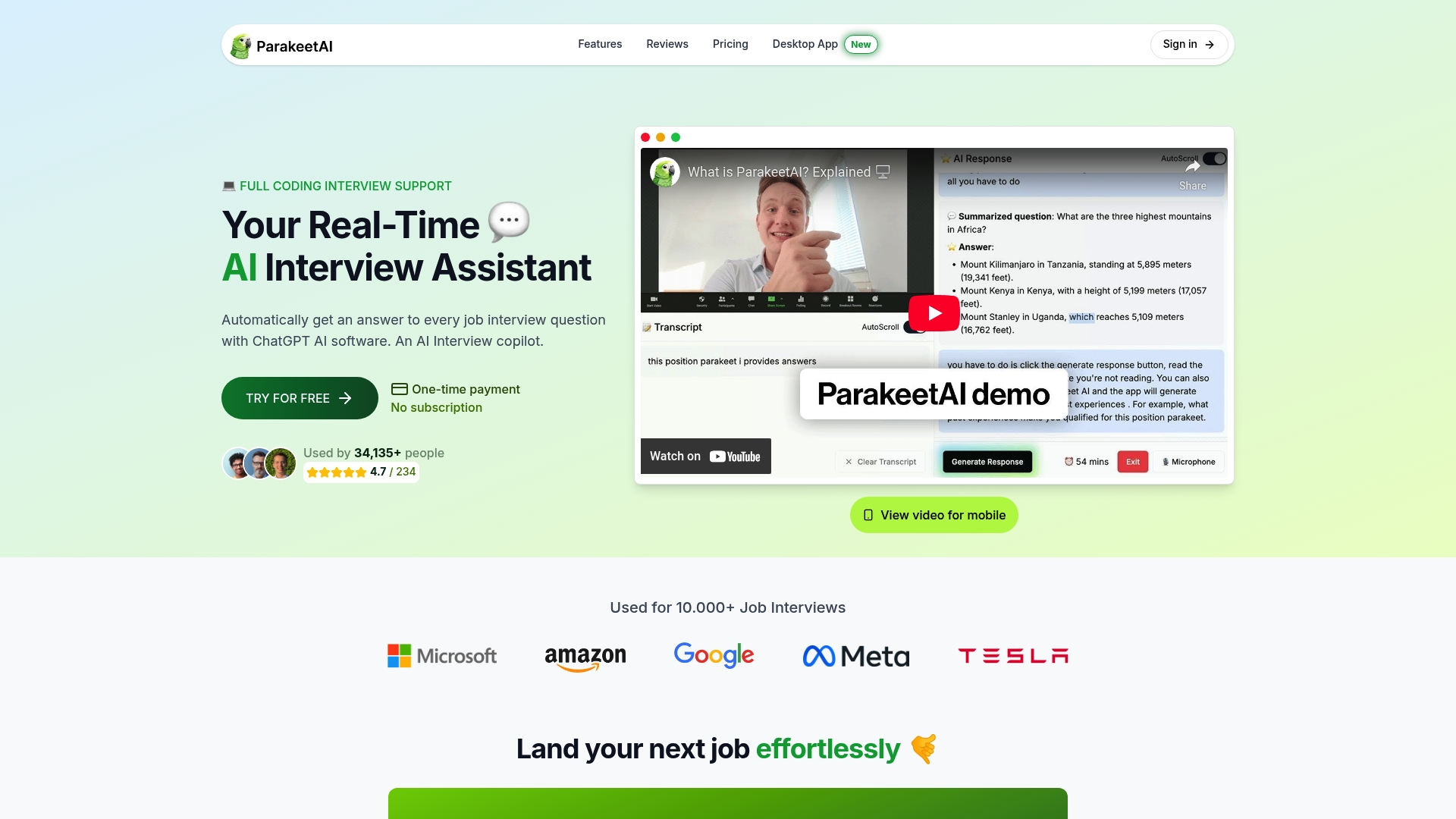
Parakeet-ai is a real-time AI interview assistant that listens to your interview and automatically provides answers to every question using AI. For EQ preparation specifically, it helps you practice STAR-structured responses, refine your emotional language, and build confidence before the actual interview. Job seekers who prepare with Parakeet-ai go into behavioral interviews with sharper stories and faster recall. If you have an interview coming up, that preparation time matters more than you think.
FAQ
What are EQ interview questions?
EQ interview questions are behavioral questions designed to assess a candidate’s emotional intelligence, including self-awareness, empathy, and the ability to manage emotions under pressure. They typically ask for specific real-life examples rather than hypothetical answers.
How do I prepare for EQ interview questions?
Prepare 5 to 6 real stories from your work history that involve emotional challenges, using the STAR method with 60% of your answer focused on the specific actions you took. Practice naming the emotions you felt and describing the deliberate choices you made.
Why do employers ask questions about emotional intelligence?
EQ predicts 58% of job performance and is considered twice as important as IQ for long-term career success, which makes it a high-priority signal for hiring managers evaluating leadership and collaboration potential.
What is the biggest mistake candidates make on EQ questions?
The biggest failure is giving generic, platitude-like answers instead of specific, emotionally grounded stories. Saying “I stayed calm and resolved it” without detail tells the interviewer nothing about your actual emotional process.
Can EQ be improved before an interview?
Yes. EQ can be significantly improved through consistent daily practice over 12–18 months. Short-term preparation through interview success training and emotion journaling can also sharpen your self-awareness and story recall before a specific interview.