
What Is Context-Aware Interviewing? A 2026 Guide

TL;DR:Context-aware interviewing is an adaptive approach that adjusts questions in real time based on candidate responses and organizational context. It improves hiring efficiency, candidate satisfaction, and reduces regrettable attrition by making interviews more targeted and evidence-based.
Context-aware interviewing is defined as an adaptive evaluation method that adjusts questions and assessments in real time based on a candidate’s responses, the job’s specific requirements, and the organization’s cultural principles. Unlike static interview scripts, this approach treats every conversation as a living process where each answer shapes the next question. AI technologies, including large language models (LLMs) and retrieval-augmented generation (RAG), now power many of these systems, giving interviewers a real-time cognitive partner rather than a fixed checklist. The result is a more accurate read on candidate fit and a faster path to confident hiring decisions.
What is context-aware interviewing at its core?
Context-aware interviewing, also called adaptive interviewing in academic literature, is built on three foundational principles: dynamic questioning, curated contextual data, and human-AI collaboration. Each principle works together to replace gut-feel evaluation with evidence-based assessment.

Dynamic questioning means the interview does not follow a predetermined script. Instead, the system generates follow-up questions based on what the candidate just said. LLM-based adaptive questioning outperforms static templates, scoring 3.36 versus 1.65 in independent human evaluations. That gap reflects how much more relevant and probing a question becomes when it responds to the actual conversation rather than a generic prompt.
Contextual data inputs are the raw material the AI uses to stay relevant. These inputs include job descriptions, competency matrices, cultural principles, and even historical hiring manager preferences. Providing historical hiring data as context enhances AI relevance and reduces friction in decision-making. Without this data, the AI defaults to generic questions that could apply to any role at any company.
Human-AI collaboration keeps the interviewer in control. The AI suggests probing questions; the human decides whether to ask them. This mixed-initiative design preserves the nuanced judgment that no algorithm can fully replicate.
Pro Tip: Before your first context-aware interview session, write a one-page document that defines your top five competencies with behavioral indicators. That document becomes the AI’s instruction set and directly determines the quality of its question suggestions.
How does context-aware interviewing improve hiring outcomes?
The efficiency gains from context-aware interview systems are measurable and significant. Organizations using AI-integrated systems report a 40–60% reduction in scorecard completion time, with interview duration dropping from 45–60 minutes to 15–20 minutes per session. That time saving compounds across a full hiring cycle, freeing recruiters to focus on relationship-building rather than note-taking.
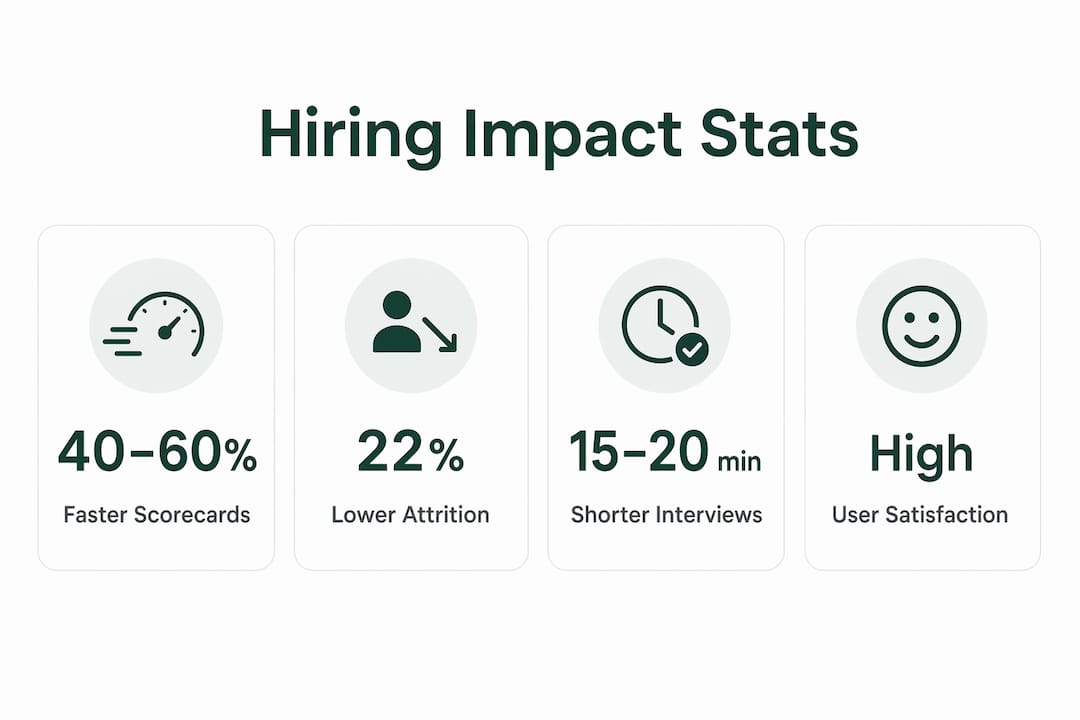
Candidate and interviewer satisfaction also improves. Adaptive AI interviewers achieve average user engagement scores of 4.33 out of 5. High satisfaction scores matter because they signal that candidates feel heard and assessed fairly, which protects employer brand.
The most striking outcome is retention. Regrettable attrition rates drop by 22% when organizations adopt context-aware interview methods. Regrettable attrition, meaning the loss of employees you wanted to keep, is one of the most expensive problems in talent management. A 22% reduction translates directly to lower replacement costs and stronger team continuity.
Interview intelligence platforms also convert unstructured interview conversations into searchable, analyzable datasets. These datasets link candidate responses to downstream performance outcomes, giving hiring teams the data they need to refine their process over time.
| Outcome | Result |
|---|---|
| Scorecard completion time | 40–60% reduction |
| Interview duration | 15–20 minutes (down from 45–60) |
| Candidate satisfaction score | 4.33 out of 5 average |
| Regrettable attrition reduction | 22% lower |
What sets context-aware interviewing apart from other AI interview tools?
Most AI tools in recruiting focus on tasks that happen before or after the interview: resume screening, scheduling, or post-interview sentiment analysis. Context-aware interviewing operates during the conversation, which is where evaluation accuracy is actually determined.
The key distinction is the AI’s role. AI in context-aware interviews acts as a cognitive co-pilot, suggesting probing questions rather than replacing human judgment. The interviewer remains the decision-maker at every step. This is fundamentally different from fully automated asynchronous tools that score candidates without a human in the loop.
A second distinction is the source of the AI’s intelligence. Generic AI tools draw on broad training data. Context-aware systems draw on your organization’s specific documents: team charters, competency frameworks, and past performance reviews. Retrieval-augmented generation blends live conversation data with these internal records, producing questions that are calibrated to your actual hiring bar, not an industry average.
AI-powered interviewers also generate expertise-aligned questions using locally hosted LLMs, which keeps candidate data private. That architecture matters for organizations operating under strict data governance requirements.
Pro Tip: When evaluating any AI interview tool, ask one question: does it use your internal documents as context, or does it rely solely on its general training data? The answer tells you whether the tool is truly context-aware or just a smarter template engine.
How to conduct context-aware interviews effectively
For HR professionals and interviewers
The first step is building your single source of truth document. This is a structured file containing your cultural principles, role-specific competency definitions, and behavioral indicators for each competency level. Without it, AI models risk flattening nuance and producing generic questions that miss what actually matters for the role.
Follow this sequence for a well-run context-aware interview:
- Upload your context document before the session begins. Include the job description, competency matrix, and any team-specific cultural principles.
- Set the AI to mixed-initiative mode. This means the AI surfaces suggested follow-up questions on demand rather than running the conversation automatically.
- Open with a structured behavioral question tied to your top competency. Let the candidate’s answer drive what the AI suggests next.
- Review AI-generated probing questions before asking them. Discard any that feel off-target. The AI assists; you decide.
- Complete the scorecard immediately after the interview while the AI’s transcript and behavioral signal analysis are fresh. This is where the 40–60% time saving becomes real.
Pro Tip: Calibrate your context document quarterly. As your team evolves and your culture shifts, the competency definitions that made sense six months ago may no longer reflect what you actually need. Stale context produces stale questions.
For job seekers
Context-aware interviewing changes what you should expect in an interview. Questions will not follow a predictable sequence. The interviewer may pause briefly to review an AI suggestion before asking a follow-up. That pause is not hesitation. It is the system working as designed.
The best response strategy is the STAR method: Situation, Task, Action, Result. Structured answers give the AI more signal to work with, which tends to generate follow-up questions that let you go deeper on your strongest examples. Vague answers produce vague follow-ups, and you lose the chance to differentiate yourself.
Context-aware interviewing shifts focus from whether a candidate is generally good to whether they fit the organization here and now. That means your answers should reference the company’s stated values and the specific team context whenever possible. Generic answers about “working well in teams” land flat. Specific answers tied to the company’s published principles land precisely where the evaluation criteria sit.
Key Takeaways
Context-aware interviewing is the most evidence-backed method available for improving both interview efficiency and hiring accuracy at the same time.
| Point | Details |
|---|---|
| Core definition | Adaptive interviewing adjusts questions in real time based on candidate responses and organizational context. |
| Efficiency gains | AI-integrated systems cut scorecard completion time by 40–60% and shorten interviews to 15–20 minutes. |
| Retention impact | Organizations see a 22% reduction in regrettable attrition after adopting context-aware methods. |
| Human control | Mixed-initiative design keeps the interviewer in charge; AI suggests, humans decide. |
| Context quality matters | A precise competency matrix and cultural principles document directly determines AI question quality. |
Why I think most organizations are missing the point on AI interviews
Most hiring teams I have observed treat AI interview tools as a productivity shortcut. They want faster scheduling, faster scorecards, and faster decisions. That framing is not wrong, but it misses the deeper value.
The real shift that context-aware interviewing enables is moving from impression-based hiring to evidence-based hiring. When an AI co-pilot surfaces a probing question you would not have thought to ask, and the candidate’s answer reveals a critical gap or an unexpected strength, that is not automation. That is better thinking.
The organizations that get the most from this approach are the ones that invest in their context documents first. They treat the competency matrix as a living artifact, not a one-time HR exercise. They update it when the team changes, when the role evolves, and when post-hire performance data reveals that their evaluation criteria were off.
The organizations that struggle are the ones that plug in an AI tool and expect it to know what “culture fit” means at their company. It does not. It knows what you tell it. That is not a limitation of the technology. It is a feature that rewards preparation.
AI will not replace the human judgment that makes a great interviewer great. What it will do, when used correctly, is give that judgment better raw material to work with. That is the version of AI-assisted interviewing worth building toward.
— Jure
How Parakeet-ai supports context-aware hiring
Parakeet-ai is a real-time AI interview assistant that listens to your interview and automatically provides answers and question prompts as the conversation unfolds. For HR professionals building a context-aware interview practice, that means less time scrambling for follow-up questions and more time actually listening to candidates.
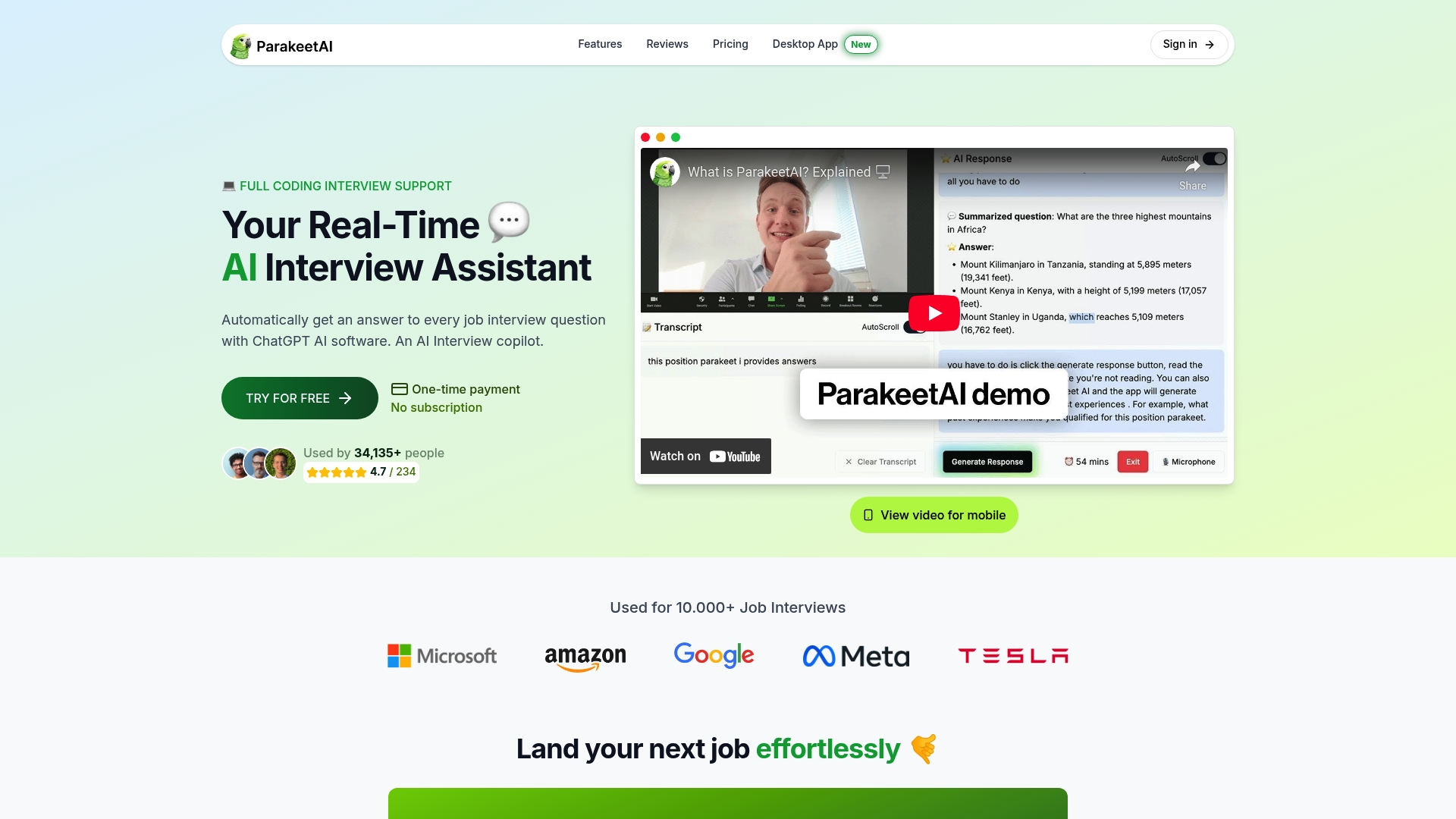
Parakeet-ai works during the live interview, not just before or after it. The platform captures conversation data, surfaces relevant probing questions, and helps interviewers stay focused on evaluation rather than note-taking. For job seekers, understanding how AI interview technology works in real time removes the uncertainty from adaptive interview formats. Explore what Parakeet-ai can do for your next interview at parakeet-ai.com.
FAQ
What is context-aware interviewing in simple terms?
Context-aware interviewing is an interview method that adapts its questions in real time based on what the candidate says and the specific requirements of the role and organization. It replaces fixed question scripts with dynamic, evidence-driven conversations.
How does adaptive interviewing differ from a standard structured interview?
A standard structured interview uses the same questions for every candidate. Adaptive interviewing adjusts follow-up questions based on each candidate’s actual responses, producing a more accurate and personalized evaluation.
What role does AI play in context-aware interview techniques?
AI acts as a cognitive co-pilot, suggesting probing questions in real time while the human interviewer retains full control over what gets asked and how the conversation flows.
What should job seekers know about context-aware interviews?
Expect non-linear questioning and be ready for specific follow-ups on your answers. Using the STAR method and referencing the company’s stated values gives you the best chance of performing well in an adaptive format.
How do HR teams get started with context-aware interviewing?
Start by building a single source of truth document that defines your competencies and cultural principles, then upload it to your AI interview platform before each session. That document is the foundation the entire system depends on.