
Interview Pattern Detection: A Complete 2026 Guide

TL;DR:Most candidates focus on solving many problems rather than internalizing core patterns. Recognizing and verbalizing 15–20 key algorithmic patterns improves interview success and reduces cognitive load. AI tools support real-time pattern detection, enhancing both candidate preparation and hiring accuracy.
Interview pattern detection is the cognitive skill of recognizing the fundamental structures and recurring patterns underlying interview questions and problems. Both job seekers and hiring managers use this skill to cut through surface-level noise and focus on what a question is actually testing. Research analyzing 1,000 questions from FAANG companies found that 15–20 core algorithmic patterns cover 90%–94% of coding interview problems at major tech firms. That single finding reframes how you should prepare. Instead of grinding through hundreds of random problems, you map questions to a finite set of known structures and build transferable reasoning.
What is interview pattern detection and why does it matter?
Interview pattern detection is the process of identifying the underlying algorithmic or cognitive structure that defines a given interview problem. The industry term for this broader concept is pattern recognition, a field studied extensively in computer science and cognitive psychology. In interview contexts, pattern recognition means mapping a new problem to a known class of solutions rather than solving it from scratch every time.
The practical payoff is significant. About 90%–95% of technical interview questions fall into a finite set of algorithmic classes. The remaining problems typically involve multi-pattern compositions or open-ended design challenges. Knowing this, a candidate who has mastered 15–20 core patterns walks into most interviews with a ready-made mental catalog.
Pattern detection also applies outside of coding. In behavioral interviews, hiring managers use interview pattern analysis to spot recurring themes across candidate responses, such as consistent avoidance of accountability or repeated examples of cross-functional leadership. In qualitative research settings, the same logic applies: identifying structural similarities across answers reveals what a dataset is actually saying.
Pattern detection is fundamentally about abstracting noisy data into structural representations mapped to known algorithms or frameworks. That definition applies equally to a software engineer decoding a graph traversal problem and a recruiter noticing that every strong candidate mentions the same leadership challenge.
What are the most common interview patterns?
Core algorithmic patterns in technical interviews
The most frequently tested algorithmic patterns in technical interviews include Two Pointers, Sliding Window, Binary Search, Breadth-First Search (BFS), Depth-First Search (DFS), and Dynamic Programming. Each pattern has a distinct set of problem signals that indicate its presence.
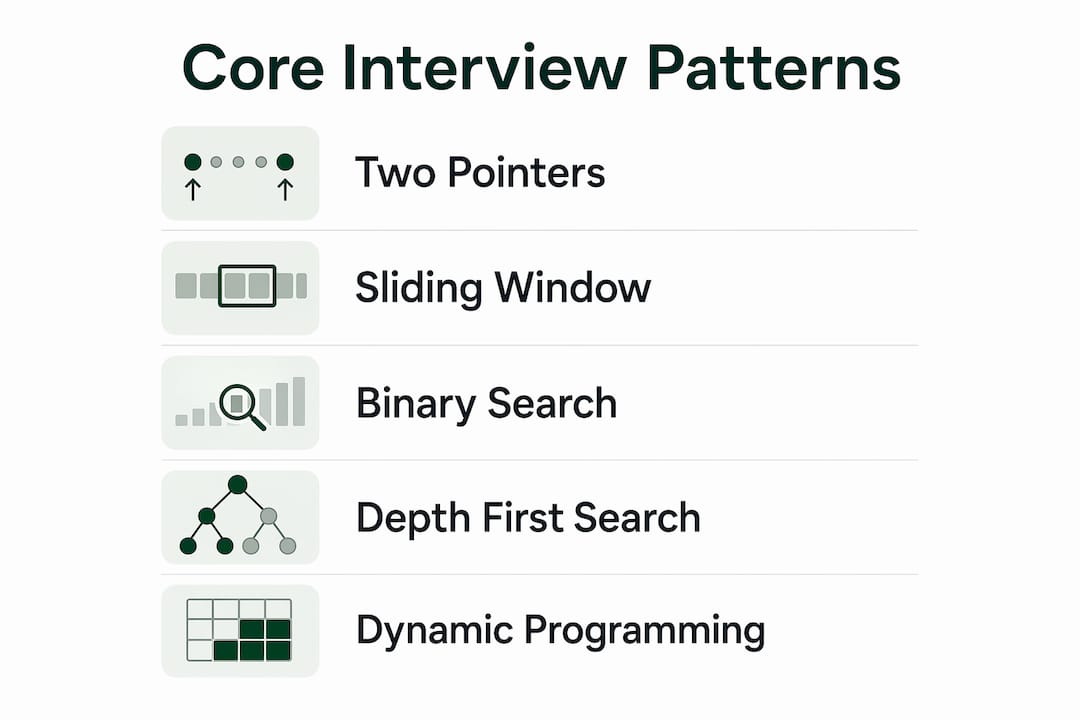
Two Pointers appears when a problem involves a sorted array and asks you to find pairs or subarrays meeting a condition. Sliding Window shows up when the problem asks for a maximum or minimum subarray of a fixed or variable size. Binary Search applies whenever the input is sorted and the problem asks you to find a target efficiently. BFS and DFS signal graph or tree problems where you need to visit nodes in a specific order. Dynamic Programming appears when a problem has overlapping subproblems and asks for an optimal value.
| Pattern | Typical problem signal | Frequency at major tech firms |
|---|---|---|
| Two Pointers | Sorted array, pair conditions | High |
| Sliding Window | Subarray min/max, fixed size | High |
| BFS/DFS | Graph traversal, tree paths | Very High |
| Dynamic Programming | Optimal substructure, overlapping subproblems | High |
| Binary Search | Sorted input, target finding | Moderate to High |
Behavioral and qualitative pattern signals
Behavioral interview pattern identification works differently. Hiring managers listen for structural themes across STAR (Situation, Task, Action, Result) responses. A candidate who always describes situations where they acted alone, never mentioning team input, reveals a pattern worth probing. A candidate who consistently frames results in vague terms without metrics signals a different pattern.
Pro Tip: Listen for what candidates omit as much as what they say. Repeated omissions of team context or measurable outcomes are patterns just as meaningful as what they include.
Linguistic clues also matter. Phrases like “I always” or “I never” in behavioral answers often signal overconfidence or a blind spot. Structural clues in technical problems, such as the phrase “find all possible” or “return the minimum,” directly point to specific algorithmic families.
How can you detect and verbalize interview patterns effectively?
Jumping into coding too soon without identifying the pattern is the single most common failure in technical interviews. Candidates who skip the detection phase end up refactoring mid-solution, losing time and signaling poor problem-solving discipline to the interviewer.

The fix is a structured detection process before any code is written. Start by stripping the problem narrative down to its core constraints. Ignore the story wrapper and ask: what is the input type, what is the output type, and what constraint makes this hard? Those three answers almost always point to a pattern family.
Analysis of 600+ interviews shows that allocating the first 5 minutes to defining a high-level approach and the next 5 minutes to mid-level design reduces failures caused by premature coding. That 10-minute investment before writing a single line of code consistently separates strong performers from average ones.
Once you identify a pattern, say it out loud. Verbalizing the detected pattern within the first 90 seconds creates immediate interviewer buy-in and opens a channel for real-time guidance. Interviewers who hear “this looks like a Sliding Window problem because the input is an array and we need a contiguous subarray” can confirm or redirect immediately. That saves both parties from wasted effort.
Pattern verification checklist
Before committing to a pattern, run through these checks:
- Does the pattern fit the input type and size constraints?
- Does it handle all edge cases, including empty inputs and single elements?
- Does the expected time complexity match what the problem implies?
- Can you name at least one similar problem you have solved with this pattern?
- Does the pattern produce the correct output type?
Candidates who skip this verification commonly waste valuable time on incorrect approaches. A repeatable checklist turns pattern detection from an intuition into a discipline.
Pro Tip: If two patterns seem equally plausible, sketch the data flow for each on paper or a whiteboard. The one that requires fewer transformations is almost always correct.
What role does AI play in interview pattern detection?
AI-powered tools can identify coding pattern types during live or mock interviews, giving both candidates and hiring managers real-time feedback on pattern recognition accuracy. This shifts interview analysis from a purely retrospective activity into an in-the-moment coaching process.
For behavioral and qualitative interviews, the impact is equally significant. AI can detect recurring themes across large interview datasets without requiring a manual initial coding phase. OpenAI’s ChatGPT, for example, has been tested in formal research protocols for thematic analysis of qualitative interview data, organizing central themes faster and more consistently than manual review. That capability matters for hiring teams processing dozens of candidate interviews per week.
The benefits of AI-assisted pattern recognition include:
- Faster theme extraction from behavioral interview transcripts
- Reduced interviewer bias through consistent pattern labeling
- Real-time prompts that help candidates stay on track during live sessions
- Systematic documentation of pattern frequency across candidate pools
- Improved fairness by applying the same detection criteria to every candidate
Parakeet-ai takes this further by listening to live interviews and automatically surfacing relevant answers and pattern cues as questions are asked. For candidates, that means real-time support during high-pressure moments. For hiring teams exploring AI-powered interview tools, it means a more consistent and documented evaluation process.
Ethical considerations apply. AI pattern detection tools should augment human judgment, not replace it. Hiring decisions based solely on AI-detected patterns without human review create legal and fairness risks. The most effective approach pairs AI speed with human interpretation.
How can you apply pattern detection to improve interview outcomes?
For job seekers
Practicing by pattern, working through 3–5 problems per pattern category, builds transferable reasoning far more effectively than random problem selection. Random practice produces familiarity with specific problems. Pattern-based practice produces a mental framework that transfers to new problems.
Start with the highest-frequency patterns: BFS/DFS, Dynamic Programming, and Two Pointers. Solve 3 problems in each category before moving to the next. After each problem, write one sentence naming the pattern and the constraint that revealed it. That habit accelerates pattern recognition speed over time.
For behavioral interviews, review your own past experiences through a pattern lens. Identify 5–7 stories that each demonstrate a distinct competency pattern: leadership, conflict resolution, technical decision-making, failure and recovery, and cross-functional collaboration. Map each story to the STAR structure before the interview, not during it.
For hiring managers
Hiring managers can use interview assessment workflows to design questions that consistently test core competency patterns across all candidates. A question bank organized by pattern ensures that every candidate faces the same underlying challenges, even when surface-level questions vary.
When a candidate’s response falls outside the expected pattern, probe rather than penalize. Ask “Can you walk me through how you approached that decision?” to surface whether the candidate has a different but valid pattern or genuinely lacks the competency. Pattern detection in hiring is a diagnostic tool, not a pass/fail filter.
Pro Tip: Track which patterns your top performers demonstrate most consistently. That data builds a competency profile that makes future hiring decisions faster and more defensible.
Continuous improvement comes from closing the feedback loop. After each hiring cycle, review which detected patterns correlated with strong 90-day performance. Adjust your question bank and evaluation rubric accordingly. Pattern detection gets sharper with data.
Key takeaways
Interview pattern detection works because it maps unfamiliar problems to known structures, reducing cognitive load and improving both candidate performance and hiring accuracy.
| Point | Details |
|---|---|
| Core patterns cover most problems | 15–20 algorithmic patterns account for 90%–94% of coding interview questions at major tech firms. |
| Verbalize patterns early | Naming the pattern within 90 seconds creates interviewer buy-in and prevents wasted effort. |
| Verify before committing | Check that a pattern fits input type, edge cases, and time complexity before coding. |
| AI accelerates detection | Tools like Parakeet-ai provide real-time pattern cues during live interviews for both candidates and hiring teams. |
| Practice by pattern, not volume | Solving 3–5 problems per pattern builds transferable reasoning faster than random problem grinding. |
Pattern detection is the skill most candidates overlook
Most candidates I talk to prepare by volume. They solve 200 problems and hope familiarity carries them through. It rarely does. The candidates who consistently perform well in technical interviews are not the ones who have seen the most problems. They are the ones who have internalized the fewest patterns most deeply.
The same blind spot shows up on the hiring side. Interviewers who evaluate candidates without a pattern framework end up making gut-feel decisions that are hard to defend and even harder to replicate. I have seen hiring teams reject strong candidates because their solution looked unfamiliar, when in fact it was a perfectly valid application of a less common pattern.
Cultural considerations add another layer. Candidates from educational backgrounds that emphasize rote memorization over structural reasoning often struggle with pattern detection not because they lack ability, but because they were never taught to abstract. Hiring managers who recognize this can probe more effectively and avoid false negatives.
The interplay between human judgment and AI assistance is where things get genuinely interesting in 2026. AI tools surface patterns faster than any human reviewer. But they cannot yet judge whether a candidate’s off-pattern response reflects creative thinking or a fundamental gap. That distinction still requires a human in the loop.
Pattern detection as a skill will keep evolving as interview formats change. System design questions, behavioral case studies, and take-home projects all have their own pattern families. The candidates and hiring managers who stay ahead are the ones who treat pattern detection as a continuous practice, not a one-time preparation task.
— Jure
Parakeet-ai and real-time pattern support
Parakeet-ai is a real-time AI interview assistant that listens to your interview and automatically provides answers and pattern cues as each question is asked. For candidates working on technical interview prep, it surfaces the relevant pattern and approach the moment a problem is presented, reducing the cognitive pressure of live detection.
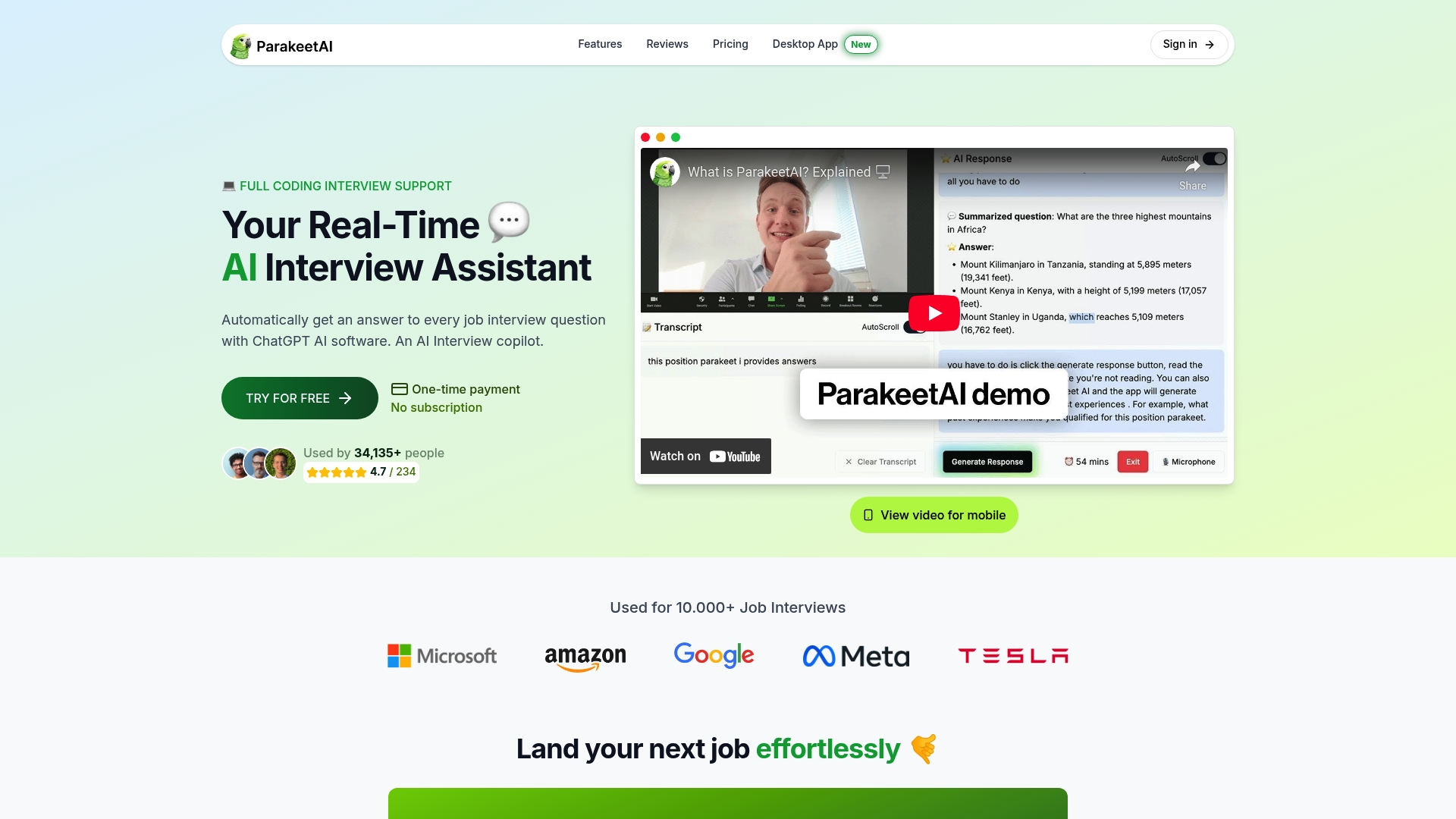
For hiring teams, Parakeet-ai supports consistent evaluation by flagging behavioral themes and response patterns across candidate sessions. The platform integrates into existing interview workflows without requiring technical setup. Whether you are preparing for your next FAANG round or building a fairer hiring process, Parakeet-ai gives you a real-time edge grounded in pattern detection research.
FAQ
What is interview pattern detection?
Interview pattern detection is the skill of identifying the underlying algorithmic or cognitive structure of an interview question before attempting to solve or evaluate it. It applies to both technical coding problems and behavioral interview responses.
How many patterns do I need to know for technical interviews?
15–20 core algorithmic patterns cover 90%–94% of coding interview questions at major tech firms. Mastering this finite set is more effective than attempting to memorize individual solutions.
When should I verbalize the pattern during a live interview?
Name the pattern within the first 90 seconds of receiving a problem. Doing so creates interviewer buy-in and opens a channel for real-time feedback before you commit to an approach.
Can AI tools help with interview pattern detection?
Yes. AI tools can identify coding pattern types in real-time during mock or live interviews and detect recurring themes in behavioral interview data. Parakeet-ai, for example, listens to live interviews and surfaces relevant pattern cues automatically.
How should hiring managers use pattern detection in evaluations?
Hiring managers should organize their question banks by competency pattern and probe off-pattern responses rather than penalizing them. Consistent pattern-based evaluation reduces bias and produces hiring decisions that are easier to document and defend.