
Conversational Analytics for Interviews: HR Guide

TL;DR:Conversational analytics uses AI to analyze interview conversations, improving hiring decisions through data. It tracks behavioral signals, structural patterns, and outcomes to enhance evaluator consistency and reduce bias. Implementing these tools requires careful integration, interviewer coaching, and candidate consent to maximize benefits.
Conversational analytics for interviews is the AI-driven process of analyzing candidate conversations to extract behavioral, linguistic, and structural data that improves hiring decisions. The industry term for this practice is interview intelligence, and it combines three core components: automated transcription, behavioral signal analysis, and outcome correlation. Data-driven interview analytics produced a 41% improvement in evaluator consistency over six months, compared to just 12% with traditional rubric training. That gap shows how much structured analysis outperforms gut-feel evaluation. Platforms like those built on Eightfold AI’s technology and InCruiter’s interview intelligence framework have made this approach practical for HR teams at every scale.
What is conversational analytics for interviews?
Conversational analytics for interviews is defined as the systematic use of AI to capture, measure, and interpret the spoken exchange between an interviewer and a candidate. It goes well beyond transcription. The technology tracks who said what, when, and how, then maps those patterns to evaluation quality and hiring outcomes.

The process starts with real-time transcription and speaker attribution. The system separates the interviewer’s voice from the candidate’s voice and timestamps every exchange. From that foundation, behavioral signal analysis begins. The AI measures variables like talk-time distribution, question frequency, speaking pace, pauses, and interruptions. These signals reveal how the interview was conducted, not just what was said.
The third layer is outcome correlation. Interview intelligence must move beyond transcription and sentiment tagging to include correlation with post-hire performance and retention. Without that link, analytics stays descriptive rather than predictive. When you connect interview behavior data to actual hiring outcomes, the system becomes a feedback loop that gets sharper over time.
Closed-loop conversational analytics systems integrate conversation capture and analysis in one platform, eliminating the friction of exporting transcripts to separate tools. That integration is what separates entry-level transcription apps from true interview intelligence platforms.
What are the key benefits of using conversational analytics in hiring?
The benefits of conversational analytics go beyond convenience. They change the quality of decisions your team makes.
- Evaluator consistency improves measurably. Traditional rubric training produces a 12% consistency gain. Analytics-driven evaluation produces 41%. That difference matters when you are comparing candidates across multiple interviewers or locations.
- Bias becomes visible and addressable. Interviewers often lack self-awareness about how much they talk or which candidates they question more thoroughly. Analytics surfaces these patterns. Once a hiring manager sees that they spoke 65% of the time in interviews with certain candidate profiles, the behavior becomes correctable.
- Scale becomes manageable. AI can identify patterns across hundreds of interviews simultaneously, enabling evidence-based comparisons that humans cannot manage alone. A recruiter reviewing 200 interview transcripts manually will miss patterns that a well-configured analytics platform catches in seconds.
- Interviewer coaching becomes targeted. Generic feedback like “ask better questions” is hard to act on. Analytics tells an interviewer exactly how many questions they asked, what types they were, and how candidates responded. That specificity makes coaching stick.
- Candidate experience improves. When interviewers are coached using real data, conversations become more balanced and structured. Candidates report higher satisfaction in interviews where they feel heard and given adequate speaking time.
- ROI becomes measurable. Correlating interview analytics with retention and quality-of-hire gives leadership concrete evidence that the investment in better interviewing pays off.
Pro Tip: Start by auditing your current talk-to-listen ratios across your last 20 interviews before adopting any new platform. The baseline data will make your ROI case much stronger when you present it to leadership.
Which metrics does conversational analytics track in interviews?
The metrics that matter most fall into four categories: structure, behavior, content, and outcomes.
Structure metrics
Talk-to-listen ratio is the most cited structural metric. The optimal ratio in interviews is 20/80, meaning the interviewer speaks 20% of the time and the candidate speaks 80%. Most interviewers exceed their share without realizing it. Analytics flags this in real time or post-interview, depending on the platform.
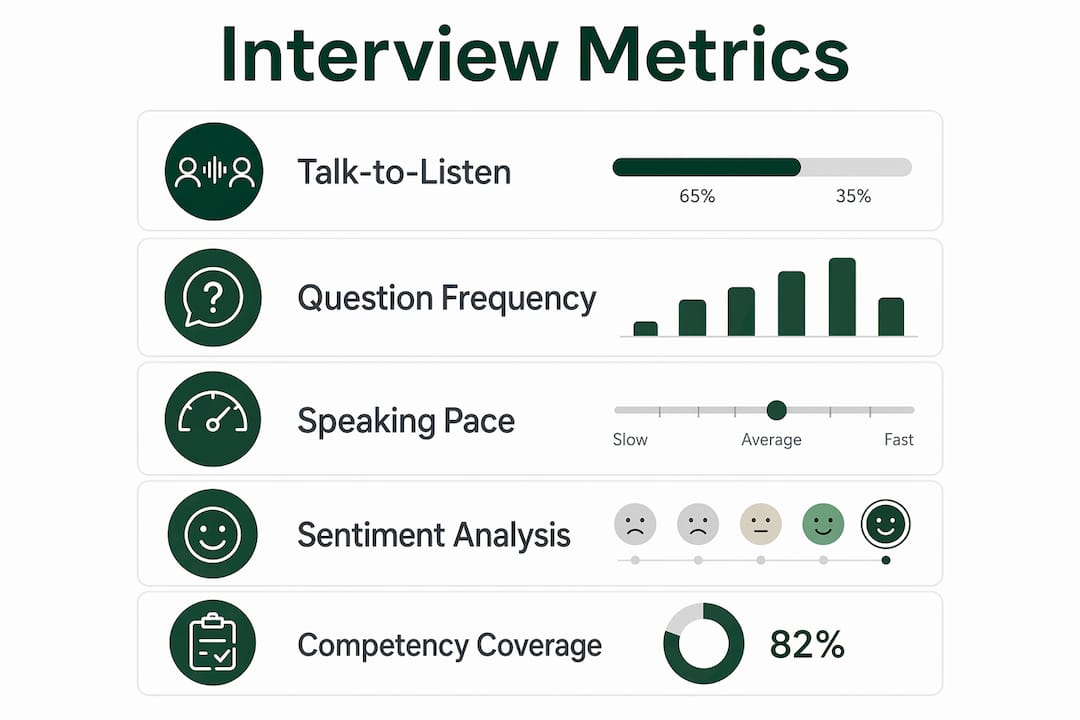
Question frequency is the second structural metric. The number of questions an interviewer asks is the most predictive metric for meeting quality, correlating directly with candidate engagement and information flow. An interview with five questions produces far less usable data than one with twelve.
Behavior metrics
Speaking pace, pause length, and interruption frequency reveal how comfortable both parties are in the conversation. A candidate who speaks very quickly or pauses frequently may be under unusual stress. An interviewer who interrupts repeatedly may be signaling impatience or bias. These signals do not replace judgment, but they add context that note-taking misses entirely.
Sentiment analysis tracks emotional tone across the conversation arc. It identifies moments where the tone shifts, which can indicate a question that landed poorly or a topic that created unexpected tension.
Content and outcome metrics
Competency coverage tracks whether the interview addressed all required evaluation dimensions. If a structured interview is supposed to cover five competencies and the transcript shows only three were explored, that is a data gap. Outcome tracking closes the loop by linking interview scores and behavioral signals to post-hire performance, retention rates, and time-to-productivity.
Pro Tip: Do not treat sentiment scores as standalone signals. Always read them alongside talk-time and question-frequency data. A negative sentiment spike paired with a long candidate response often means the question was challenging but productive, not that the interview went badly.
How can HR teams implement conversational analytics effectively?
Adoption works best when it follows a clear sequence rather than a wholesale platform switch.
- Audit your current process first. Map where interview data currently lives, how evaluators record notes, and what happens to that data after a hiring decision. Most teams discover significant gaps before they even look at analytics tools.
- Choose a platform that integrates with your applicant tracking system. Standalone analytics tools that require manual transcript uploads create friction and reduce adoption. Look for platforms that connect directly to your existing HR workflow so data flows without extra steps.
- Start with post-interview analysis before moving to real-time. Real-time analytics is powerful, but it requires interviewers to adapt their behavior while conducting a conversation. Post-interview analysis lets your team build familiarity with the metrics first, then layer in live feedback once they are comfortable.
- Use analytics for interviewer coaching, not just candidate evaluation. Analytics-driven feedback reveals interviewer behavior like disproportionate talk time and unbalanced questioning. Build a monthly coaching cadence where interviewers review their own data with a manager or HR partner.
- Address privacy and compliance before launch. Candidates must be informed that their interview is being recorded and analyzed. In many jurisdictions, explicit consent is required. Work with your legal team to build consent language into your scheduling workflow before the first interview is recorded.
- Balance AI insights with human judgment. AI-powered interview tools surface patterns, but they do not make hiring decisions. The final call belongs to a human who can weigh context, culture fit, and factors the model has not been trained to assess.
Enterprise AI platforms can conduct over 1 million interviews per hour autonomously with tailored conversations. That scale is useful for high-volume screening, but it does not replace the structured, human-led interview for senior or complex roles.
Key Takeaways
Conversational analytics transforms interview data into measurable signals that improve evaluator consistency, reduce bias, and connect hiring behavior directly to post-hire outcomes.
| Point | Details |
|---|---|
| Core definition | Interview intelligence combines transcription, behavioral analysis, and outcome correlation. |
| Consistency gain | Analytics-driven evaluation improves evaluator consistency by 41%, versus 12% with rubric training. |
| Most predictive metric | Question frequency is the strongest predictor of interview quality and candidate engagement. |
| Optimal talk ratio | The 20/80 talk-to-listen ratio maximizes candidate speaking time and information quality. |
| Implementation priority | Connect analytics to your ATS and use post-interview data for interviewer coaching before adding real-time features. |
Why analytics changed how I think about interview quality
The first time I reviewed talk-time data from a structured interview panel, the numbers were uncomfortable. One interviewer, widely regarded as the team’s best, was speaking 58% of the time in every single interview. The candidates were barely getting a word in. His evaluations were consistently high, but the data showed he was assessing his own talking, not the candidates’ answers.
That experience reshaped how I think about [interview fairness](https://blog.parakeet-ai.com/tag/role-of-ai-for-interview fairness). Bias in interviews is rarely malicious. It is usually structural. Interviewers talk too much because no one has ever shown them a number. They ask the same three questions to every candidate because no one has ever mapped their question diversity. Analytics does not fix these problems automatically, but it makes them impossible to ignore.
The risk I see most often is over-correction. Teams adopt analytics and start treating every metric as a mandate. An interviewer who asks 14 questions is not automatically better than one who asks 9 deeply probing ones. The data gives you a starting point for a conversation, not a verdict. The best hiring managers I have worked with use analytics the way a good coach uses game film: to see what they could not see in the moment, then make deliberate adjustments.
The teams that get the most from real-time interview analysis are the ones that pair the data with genuine curiosity about their own behavior. The technology surfaces the pattern. The human decides what to do with it.
— Jure
How Parakeet-ai supports smarter interview conversations
Parakeet-ai is a real-time AI interview assistant that listens to your interview and automatically generates answers to every question as it happens. For HR teams exploring conversational data analysis for interviews, it offers a direct way to see how AI can support both the candidate and the evaluation process simultaneously.
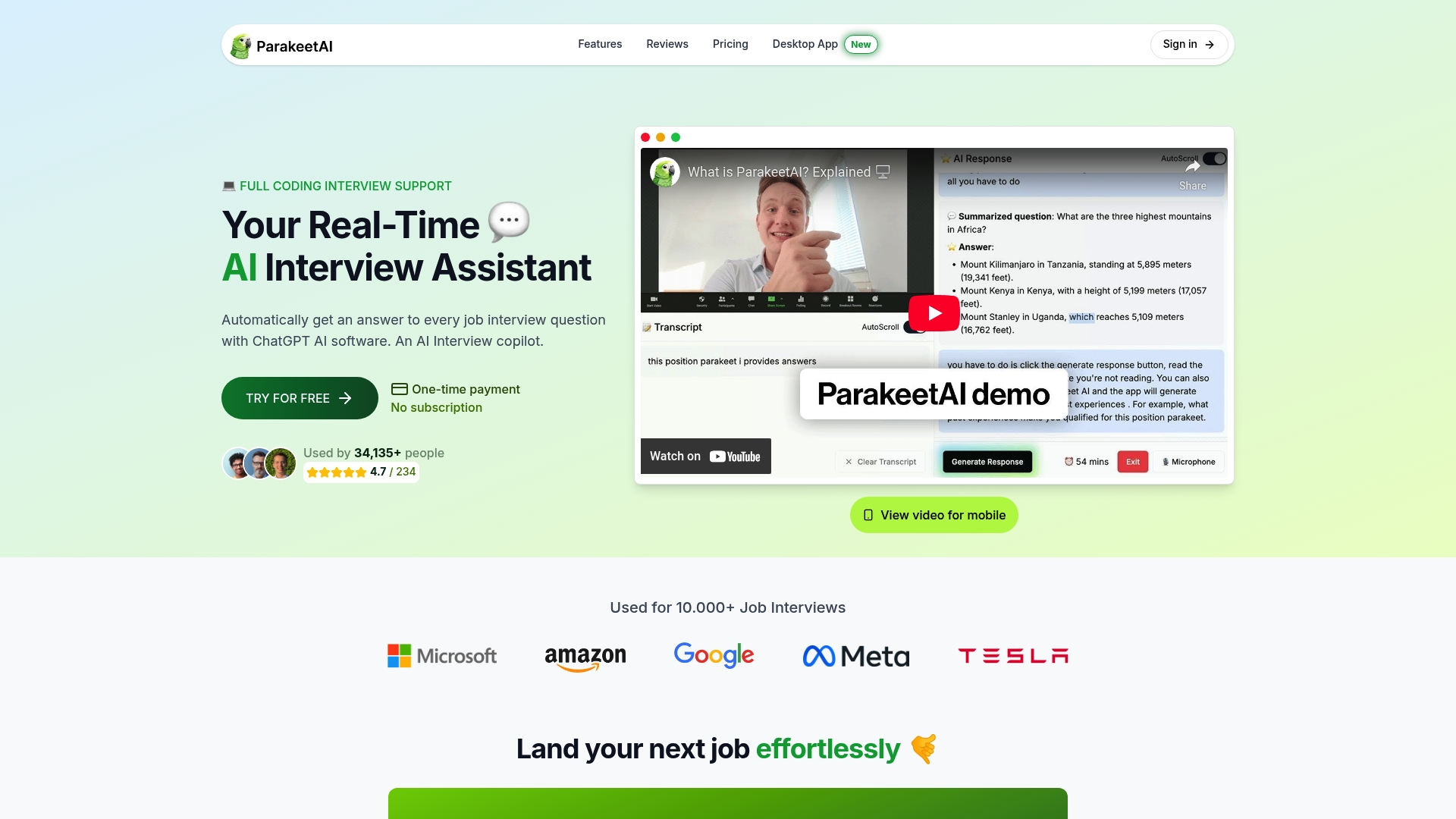
Parakeet-ai works during live interviews, providing instant, context-aware responses that help candidates articulate their experience clearly. That clarity produces richer, more consistent responses for evaluators to assess. If your team is ready to see how AI fits into your interview workflow, visit Parakeet-ai to learn more about the platform’s capabilities and get started.
FAQ
What is conversational analytics for interviews?
Conversational analytics for interviews is the AI-driven analysis of interview dialogues to extract behavioral signals, structural patterns, and outcome data that improve candidate evaluation and interviewer effectiveness.
How does conversational analytics differ from simple transcription?
Transcription captures words. Conversational analytics measures behavioral signals like talk-time ratio, question frequency, speaking pace, and sentiment, then correlates those signals with hiring outcomes.
What is the ideal talk-to-listen ratio in a job interview?
The optimal ratio is 20/80, meaning the interviewer speaks 20% of the time and the candidate speaks 80%. Analytics platforms track this metric in real time or post-interview to flag imbalances.
Can conversational analytics reduce interviewer bias?
Analytics surfaces patterns like disproportionate talk time and uneven questioning across candidate groups, making bias visible and correctable through targeted coaching rather than generic training.
Do candidates need to consent to interview analytics?
In most jurisdictions, candidates must be informed and provide explicit consent before an interview is recorded and analyzed. Build consent language into your scheduling workflow before deploying any analytics platform.