
What Is AI Language Comprehension? A 2026 Guide

TL;DR:AI language comprehension enables AI systems to interpret human intent, context, and meaning beyond mere text processing.It relies on transformer architecture and human feedback to produce contextually relevant responses, but does not mirror human understanding.
AI language comprehension is the ability of an AI system to interpret human language by analyzing intent, context, and meaning, not just processing raw text. This capability sits at the heart of tools like ChatGPT, Claude, and Google Gemini. The formal industry term for this field is natural language understanding (NLU), a subfield of the broader natural language processing (NLP) discipline. Understanding what is AI language comprehension matters because it explains why AI assistants can answer nuanced questions, summarize documents, and hold conversations that feel genuinely responsive.
What is AI language comprehension and how does it differ from NLP?
NLU is a specialized AI subfield focused on extracting deep semantic meaning, including intent, tone, and context, from human language. NLP, by contrast, handles the mechanical side: tokenization, parsing, and translation. Think of NLP as the plumbing and NLU as the reasoning that happens once the water flows.

The distinction matters in practice. An NLP system can identify that a sentence contains a question mark. An NLU system determines what the person actually wants to know and why. NLU pipelines integrate world knowledge to resolve ambiguity and interpret pragmatics within context, covering components like lexical semantics, entity recognition, intent classification, and sentiment detection.
Most modern AI tools combine both. When you type a question into a chat assistant, NLP tokenizes your input and NLU interprets your intent. The result feels like comprehension, even if the underlying process is fundamentally different from how a human reads and understands.
How does AI comprehend language?
The answer starts with transformer architecture, introduced in 2017. Transformers changed AI language models by enabling them to analyze entire input sequences simultaneously rather than word by word.
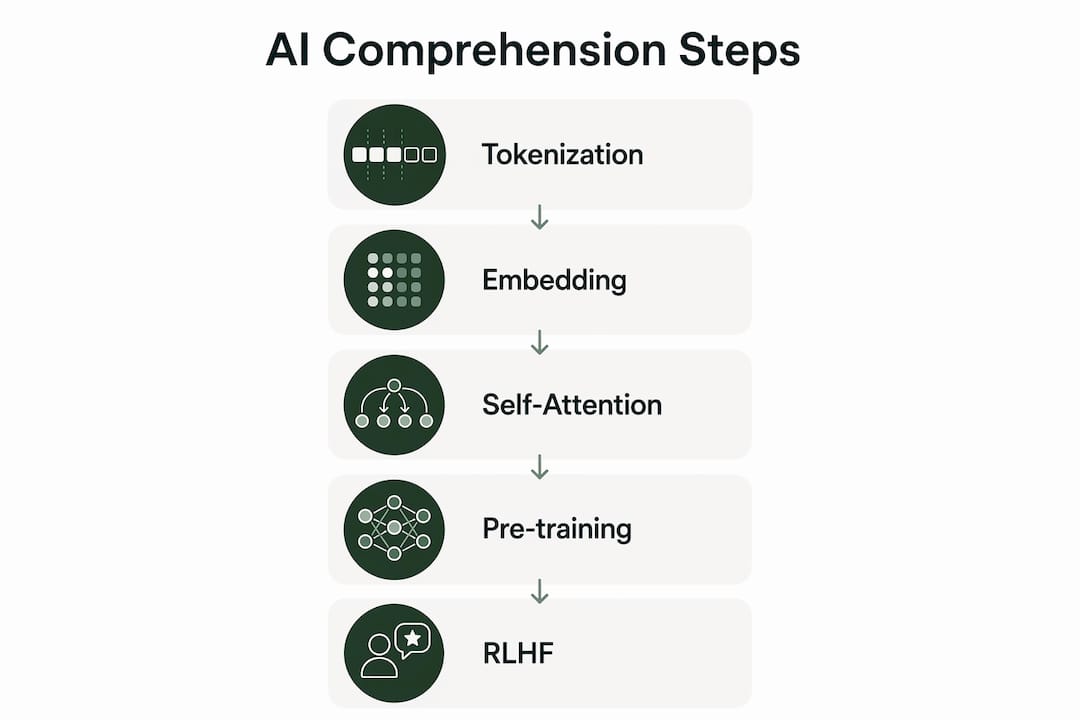
The self-attention mechanism
Self-attention lets models weigh the importance of every word relative to every other word in a sentence. This solves a classic problem: resolving pronoun references. In the sentence “The manager told the intern she was promoted,” self-attention determines whether “she” refers to the manager or the intern by weighing surrounding context. That kind of resolution was nearly impossible for older sequential models.
Tokenization and embeddings
Before a model reads your text, it breaks it into tokens. Tokens are not always full words. Tokenization is frequency-based, not purely linguistic, so rare or technical terms get split into multiple fragments. A word like “immunohistochemistry” might become four or five tokens. That fragmentation reduces the model’s accuracy on specialized vocabulary, which is a real limitation in medical, legal, and technical domains.
After tokenization, each token is converted into a numerical vector called an embedding. Embeddings place words with similar meanings close together in mathematical space. The word “happy” sits near “joyful” and far from “furious.” This spatial relationship is how the model learns semantic similarity without being explicitly taught definitions.
Training: from pre-training to RLHF
AI language models learn in stages:
- Pre-training: The model reads billions of text documents and learns to predict the next token. This builds broad language knowledge.
- Instruction tuning: The model is fine-tuned on curated question-and-answer pairs to follow instructions more reliably.
- Reinforcement learning from human feedback (RLHF): Human raters rank model responses. RLHF leverages human rankings to guide the AI toward clearer, safer, and more helpful outputs.
RLHF is the stage that makes a model feel genuinely helpful rather than just statistically plausible. Without it, models produce fluent but often unhelpful or unsafe responses.
Pro Tip: When you notice an AI assistant giving a more careful or balanced answer than you expected, RLHF is usually the reason. It is the training layer most responsible for aligning AI behavior with human expectations.
How does AI comprehension compare to human understanding?
The gap between AI language processing and human understanding is wider than most people realize.
AI models are sophisticated statistical pattern-matchers rather than cognitive agents. They learn the structural shapes of correct answers from large text corpora without any grasp of the underlying reality. A model does not know what a chair is. It knows that “chair” appears near “sit,” “furniture,” and “legs” with high frequency.
This distinction explains several behaviors that confuse new users:
- Hallucination: The model generates a confident, fluent answer that is factually wrong. It optimizes for next-token prediction probabilities rather than verifying factual correctness.
- Bluffing: When a model lacks information, it fills the gap with plausible-sounding text instead of admitting uncertainty.
- No persistent memory: AI models process dialogue as complete conversation blocks per input. They do not remember previous sessions. Context degrades or disappears in long threads once the token limit is reached.
“The model does not understand your question the way a colleague does. It predicts the most statistically appropriate response given your input and its training data.”
Human language comprehension draws on lived experience, embodied knowledge, emotional memory, and real-time social cues. AI language understanding draws on text patterns alone. The outputs can look similar. The processes are fundamentally different.
What are the hardest challenges in AI language comprehension?
Several problems remain genuinely unsolved, even in the most advanced models available in 2026.
Figurative language is the clearest example. Handling metaphors and idioms remains a significant challenge because the intended meaning conflicts with the literal statistical probability. When someone says “break a leg,” the model must override the literal meaning entirely. Most models handle common idioms well because they appear frequently in training data. Novel or culturally specific figurative language still trips them up.
Bias and explainability present a different class of problem. Language understanding capability is classified by NIST as high-impact AI, requiring bias mitigation and explainability in critical decision environments. When an AI system influences hiring, lending, or medical triage, unexplained outputs are not acceptable. Current models are not natively explainable. Researchers are building separate interpretability tools to address this.
Rare and technical vocabulary creates accuracy gaps. Because tokenization is frequency-based, domain-specific terms in law, medicine, and engineering get fragmented. The model’s comprehension of those terms is weaker than its comprehension of everyday language.
Context length limits affect conversation quality. Once a conversation exceeds the model’s context window, earlier parts of the exchange are dropped. The model cannot refer back to what was said at the start of a long session.
Pro Tip: When using AI for technical or domain-specific tasks, define key terms explicitly in your prompt. The model handles specialized vocabulary better when the definition appears in the same input.
Where is AI language comprehension used today?
Practical applications include chat assistants, interview evaluation tools, transcription analysis, and conversational bots that improve communication and decision-making across industries.
| Application | What AI language comprehension does |
|---|---|
| Chat assistants (ChatGPT, Claude) | Interprets user intent and generates contextually relevant responses |
| Customer support bots | Classifies customer intent and routes or resolves queries automatically |
| Interview AI tools | Listens to spoken questions and generates relevant, real-time answers |
| Transcription and analysis | Converts speech to text and extracts sentiment, topics, and key entities |
| Search engines | Matches query intent to relevant content beyond keyword matching |
The role of AI assistants in interviews is one of the fastest-growing applications. Real-time interview tools listen to spoken questions and surface relevant answers instantly, reducing the cognitive load on candidates under pressure.
The ethical dimension of these applications is real. When AI comprehension influences hiring decisions or customer outcomes, the stakes for accuracy and fairness rise sharply. Bias in training data translates directly into biased outputs, and those outputs affect real people.
Key Takeaways
AI language comprehension works through transformer architecture, statistical pattern matching, and multi-stage training, but it does not replicate human cognition and carries real limitations in figurative language, bias, and memory.
| Point | Details |
|---|---|
| NLU vs. NLP | NLU extracts intent and meaning; NLP handles tokenization and parsing. |
| Transformer architecture | Self-attention lets models resolve meaning across entire sentences simultaneously. |
| RLHF alignment | Human feedback training is what makes AI responses feel helpful rather than just fluent. |
| Hallucination risk | Models optimize for probable next tokens, not factual accuracy, so confident errors are common. |
| Real-world applications | Interview tools, chat assistants, and transcription software all rely on AI language comprehension. |
The gap nobody talks about enough
Most articles about AI language comprehension focus on what these models can do. I find the more useful question is: what do they actually know versus what do they appear to know?
I have spent years watching people interact with AI tools and consistently overestimate the depth of understanding behind a fluent response. A model that answers a nuanced interview question well is not demonstrating wisdom. It is demonstrating that similar questions appeared in its training data and that RLHF shaped the output toward something humans rated highly. That is genuinely impressive engineering. It is not comprehension in the way humans mean the word.
The practical implication is this: treat AI language outputs as a well-informed first draft, not a final judgment. The explainability challenges in conversational AI are not minor footnotes. They are the reason you should always verify AI outputs in high-stakes situations. The models are getting better fast. The gap between fluency and genuine understanding is narrowing. But it has not closed, and pretending it has creates real risk.
— Jure
How Parakeet-ai puts AI language comprehension to work
AI language comprehension is not just a research concept. It is the engine behind tools that help people perform better in real situations.
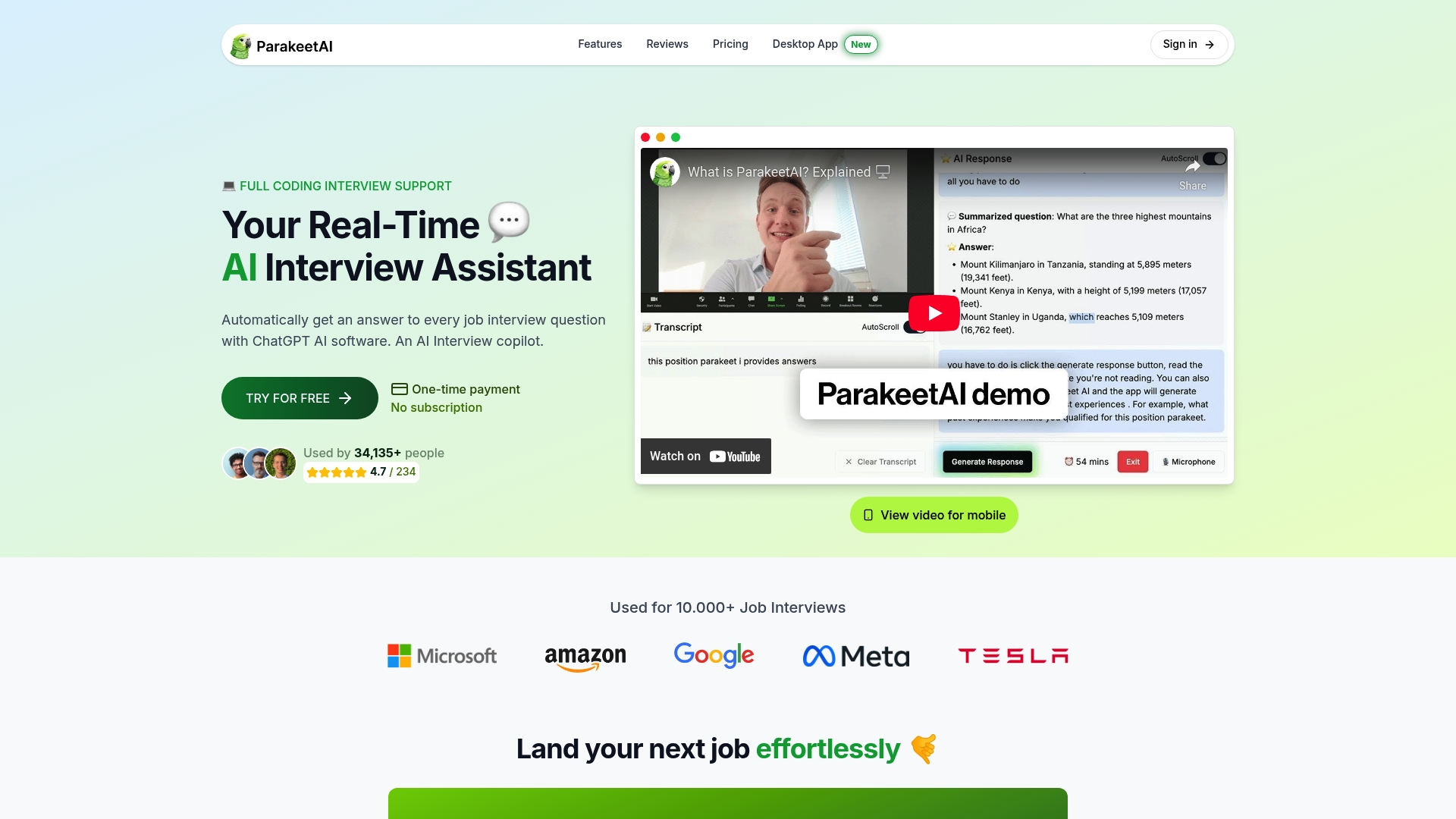
Parakeet-ai is a real-time AI job interview assistant that listens to your interview as it happens and automatically generates answers to every question using AI. It applies the same NLU and transformer-based technology covered in this article to parse spoken questions, identify intent, and surface relevant responses in seconds. For anyone preparing for technical interviews or high-pressure conversations, that kind of real-time interview support turns abstract AI capability into a concrete advantage. Parakeet-ai handles the language comprehension layer so you can focus on communicating clearly and confidently.
FAQ
What is AI language comprehension in simple terms?
AI language comprehension is the ability of an AI system to interpret the meaning, intent, and context of human language, not just recognize the words. It is the technology behind chat assistants and voice tools that respond to what you actually mean.
What is the difference between NLP and NLU?
NLP covers the mechanical processing of text, including tokenization, parsing, and translation. NLU is a subfield of NLP focused on extracting deeper meaning such as intent, sentiment, and pragmatic context.
Why do AI models hallucinate?
AI models optimize for next-token prediction rather than factual accuracy. When the model lacks reliable training data for a specific claim, it generates a statistically plausible response that may be factually wrong.
Can AI truly understand language like a human?
No. AI models are statistical pattern-matchers trained on large text corpora. They produce fluent, contextually appropriate responses without the lived experience, embodied knowledge, or genuine cognition that underlies human language understanding.
What is AI question recognition?
AI question recognition is the process by which an AI system identifies that an input is a question, classifies its type and intent, and selects an appropriate response strategy. It is a core component of NLU pipelines used in chat assistants and interview tools.