
Why Real-Time Candidate Support Wins the Hiring Race

TL;DR:Real-time candidate support provides instant, personalized communication throughout the hiring process. It reduces candidate drop-off rates and improves engagement by responding within one hour and automating scheduling and updates.
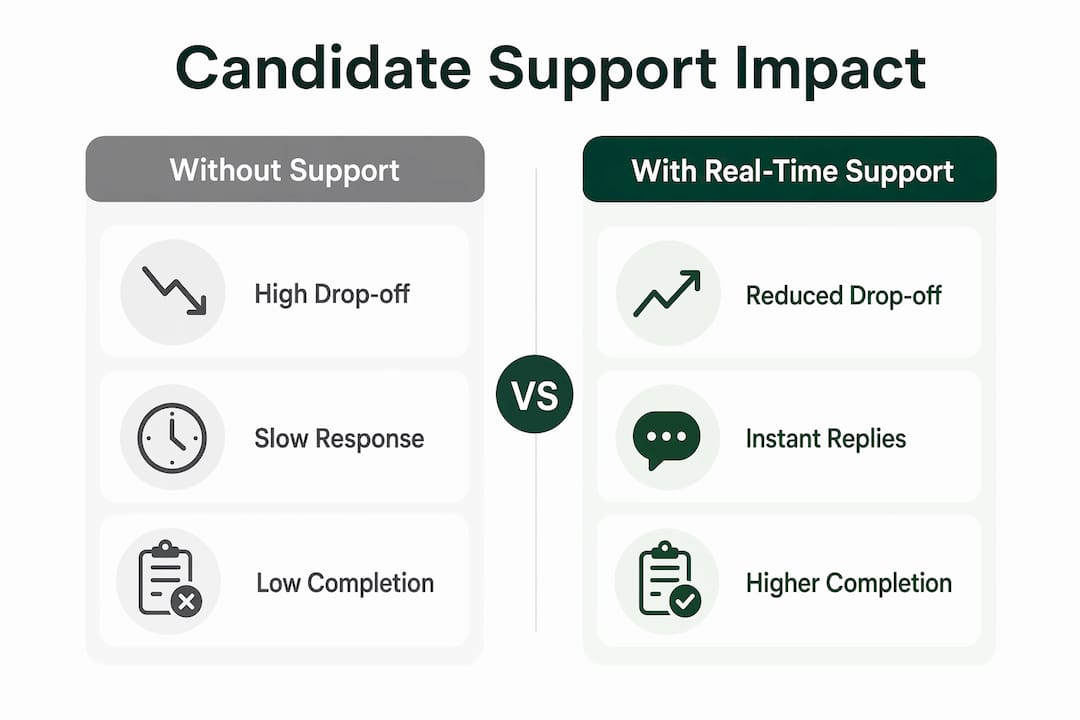
Real-time candidate support is the practice of delivering instant, personalized communication to job applicants throughout every stage of the hiring process. Research shows that responses within one hour boost candidate completion rates by 20–30%, while delays beyond two weeks trigger drop-off rates of 47–52%. That gap is not a minor inconvenience. It is the difference between a filled role and a restarted search. Tools like conversational AI platforms and automated applicant tracking system (ATS) integrations now make this level of responsiveness achievable at scale, and firms like Aptitude Research have documented the measurable hiring gains that follow.
Why real-time candidate support changes hiring outcomes
Real-time candidate support is defined in recruitment as any system or process that gives applicants immediate, relevant responses without requiring recruiter intervention for every touchpoint. The industry also calls this “always-on candidate engagement,” and both terms describe the same core shift: moving from batch email updates to continuous, triggered communication.
The business case is direct. Switching from manual emails to real-time chat improves response rates by 30–50%. That improvement compounds across a hiring funnel. Fewer candidates go dark between application and interview, fewer offers are declined due to poor communication, and recruiters spend less time chasing status updates.
Conversational AI platforms deliver 24/7 replies in any language, with average response times around 90 seconds. That speed produces a 2.5x increase in qualified candidate flow for teams that deploy it. Speed alone does not explain the gain. Candidates who receive fast, relevant answers feel respected, and that feeling drives continued engagement.
What are the main benefits of real-time candidate support?
The benefits of real-time candidate support fall into three clear categories: speed, efficiency, and candidate satisfaction.
Speed gains:
- Real-time scheduling tools eliminate 3–7 days of email exchanges, syncing calendars in under 3 seconds.
- Interview no-shows drop by 50% when automated reminders are part of the scheduling flow.
- Candidates who self-schedule their own interview slots show 25–30% lower no-show rates due to a commitment effect. When candidates choose their own time, they show up.
Efficiency gains:
- High-performing recruiting teams cut routine outreach tasks by up to 60% using real-time automation.
- Automated screening tools reduce initial screening time by up to 75%, freeing recruiters for higher-value conversations.
- Automated screening and scheduling reduce time-to-hire by approximately 30%.
Satisfaction gains:
- Status updates within 48 hours significantly improve candidate experience scores. Candidates value transparency about next steps more than they value immediate results.
- Consistent, branded communication builds trust across the funnel.
| Metric | Without real-time support | With real-time support |
|---|---|---|
| Candidate drop-off rate | 47–52% after 2-week delay | 20–30% lower with 1-hour response |
| Scheduling time | 3–7 days of email back-and-forth | Under 3 seconds via calendar sync |
| Recruiter time on routine tasks | High, limits strategic work | Reduced by up to 60% |
| Interview no-show rate | Baseline | Cut by up to 50% |
| Time-to-hire | Standard cycle | Reduced by ~30% |
Pro Tip: Track candidate drop-off by funnel stage before and after deploying real-time tools. A 10-point drop-off reduction at the scheduling stage translates directly into fewer requisitions reopened, which is your clearest ROI signal.
How does real-time support improve the hiring process operationally?
The operational engine behind real-time candidate support is ATS integration. When a real-time system pulls live data from platforms like Greenhouse, Lever, or Workday, it can send context-aware updates that reflect exactly where a candidate stands. Generic “we received your application” messages erode trust. Stage-specific messages that reference the actual role and next step build it.

Conversational AI handles the high-volume, low-complexity interactions that previously consumed recruiter hours. A candidate asks about dress code, parking, or interview format at 11 p.m. The AI answers in 90 seconds. The recruiter sees a clean log in the morning. No email thread, no delay, no candidate left wondering.
Pro Tip: Avoid over-automating the first human touchpoint. The first live conversation a candidate has with your team sets the emotional tone for the entire process. Protect that moment from automation.
Traditional vs. real-time support workflows look like this in practice:
| Stage | Traditional process | Real-time process |
|---|---|---|
| Application received | Manual confirmation email, 24–48 hours | Instant automated confirmation with next steps |
| Screening scheduled | 3–7 email exchanges over days | Self-scheduling link sent instantly, booked in minutes |
| Status update | Recruiter sends batch update weekly | Triggered update sent within hours of status change |
| Interview reminder | Single email day before | Automated reminders at 48 hours and 2 hours prior |
| Post-interview feedback | Ad hoc, often delayed | Automated acknowledgment with timeline set within 48 hours |
Interview automation tools now handle logistics end to end, from initial screening through scheduling confirmation. That frees recruiters to focus on what automation cannot replicate: reading a candidate’s hesitation, adjusting a pitch, or building genuine rapport.
What are the challenges in balancing automation with human touch?
Over-automation is the most common mistake recruiting teams make when deploying real-time support. Candidates who receive only templated messages, chatbot responses, and automated rejections report feeling processed rather than considered. That perception damages employer brand even when the hiring decision was fair.
The right model assigns tasks by type, not by volume. AI handles logistics. Humans handle emotion.
- AI-appropriate tasks: FAQ responses, scheduling, status triggers, reminder sequences, initial screening questions.
- Human-appropriate tasks: Offer negotiation, final-round feedback, rejection calls for senior candidates, any conversation where the candidate’s emotional state matters.
“Real-time support aims to remove friction, not replace human recruiters. Candidates need timely, stage-relevant information that signals respect. The human recruiter’s job is to show up fully for the moments that actually require a person.” — AI Candidate Experience
Fragmented tools create communication black holes when systems do not share data. A candidate who receives a scheduling link from one platform and a rejection notice from another on the same day loses all trust in the process. Real-time support systems that act as orchestrators, pulling from a single source of truth, prevent that failure.
The practical fix is a clear escalation rule: any candidate interaction that involves compensation, timeline changes, or negative news routes to a human recruiter within four business hours. Automation handles everything else.
How can recruiters implement real-time candidate support effectively?
Effective implementation follows a clear sequence. Rushing to deploy tools without workflow alignment produces the fragmentation problem described above.
- Audit your current communication gaps. Map every touchpoint from application to offer. Identify where candidates wait more than 24 hours for a response. Those gaps are your highest-priority automation targets.
- Select tools that integrate with your existing ATS. A real-time support tool that cannot read your ATS data will send generic messages. Generic messages do not improve candidate experience. Platforms built for AI-powered recruitment typically offer native ATS connectors for Greenhouse, Lever, iCIMS, and Workday.
- Deploy self-scheduling before anything else. Self-scheduling delivers the fastest, most measurable ROI. Candidates book their own slots, no-shows drop by 25–30%, and recruiters recover hours per week immediately.
- Set communication timelines and publish them. Tell candidates upfront: “You will hear from us within 48 hours of each stage.” Then automate that commitment. Transparency about next steps within 48–72 hours matters more to candidates than speed of final decisions.
- Train recruiters on high-touch moments. Automation handles volume. Recruiters handle value. Run quarterly calibration sessions where your team reviews which automated messages candidates responded to positively and which triggered disengagement.
- Monitor drop-off by stage, not just overall. A 15% drop-off at the scheduling stage points to a friction problem. A 15% drop-off after the final interview points to a different issue entirely. Stage-level data tells you where to intervene.
Pro Tip: Review your recruitment best practices annually. Candidate expectations shift, and a communication timeline that felt generous in 2024 may feel slow in 2026.
The teams that implement real-time support most successfully treat it as a system design problem, not a technology purchase. The tools are available. The discipline is in the workflow.
Key takeaways
Real-time candidate support is the single highest-leverage change a recruiting team can make to reduce drop-off, cut time-to-hire, and improve candidate satisfaction simultaneously.
| Point | Details |
|---|---|
| Speed drives completion | Responding within one hour boosts completion rates by 20–30%; delays over two weeks cause 47–52% drop-off. |
| Automation cuts recruiter workload | Real-time tools reduce routine outreach tasks by up to 60%, freeing time for strategic work. |
| Self-scheduling reduces no-shows | Candidates who choose their own slots show 25–30% lower no-show rates due to the commitment effect. |
| ATS integration prevents confusion | Context-aware updates from integrated systems build trust; fragmented tools create communication black holes. |
| Human touch stays critical | AI handles logistics; human recruiters must own offer negotiation, rejections, and high-stakes conversations. |
The moment I stopped treating speed as a nice-to-have
I spent years watching recruiting teams obsess over sourcing and ignore the middle of the funnel. The assumption was that if a candidate applied, they were committed. The data says otherwise. A two-week silence after an application is enough to lose nearly half your pipeline.
What changed my thinking was watching a mid-size logistics company cut its time-to-hire by roughly 30% not by sourcing more candidates, but by fixing its response time. They deployed self-scheduling and automated status triggers. Recruiters did not change their interview process at all. They just stopped making candidates wait. The results were immediate and measurable.
The harder lesson is about restraint. The temptation after seeing those results is to automate everything. That is where teams go wrong. I have seen candidates ghost final-round interviews because every interaction they had with a company felt like a chatbot. The real-time interview insights that matter most still come from a human paying attention in the room.
The recruiters who get this right think of automation as infrastructure, not strategy. They use it to clear the path so that when a human shows up, the candidate is ready to engage. That combination, fast logistics and genuine human presence at the right moments, is what separates the hiring teams that consistently close top candidates from those that wonder why offers keep getting declined.
— Jure
Parakeet-ai and real-time support for your hiring workflow
Parakeet-ai is built for the moments when candidates need immediate, accurate support and recruiters cannot be in every conversation at once.
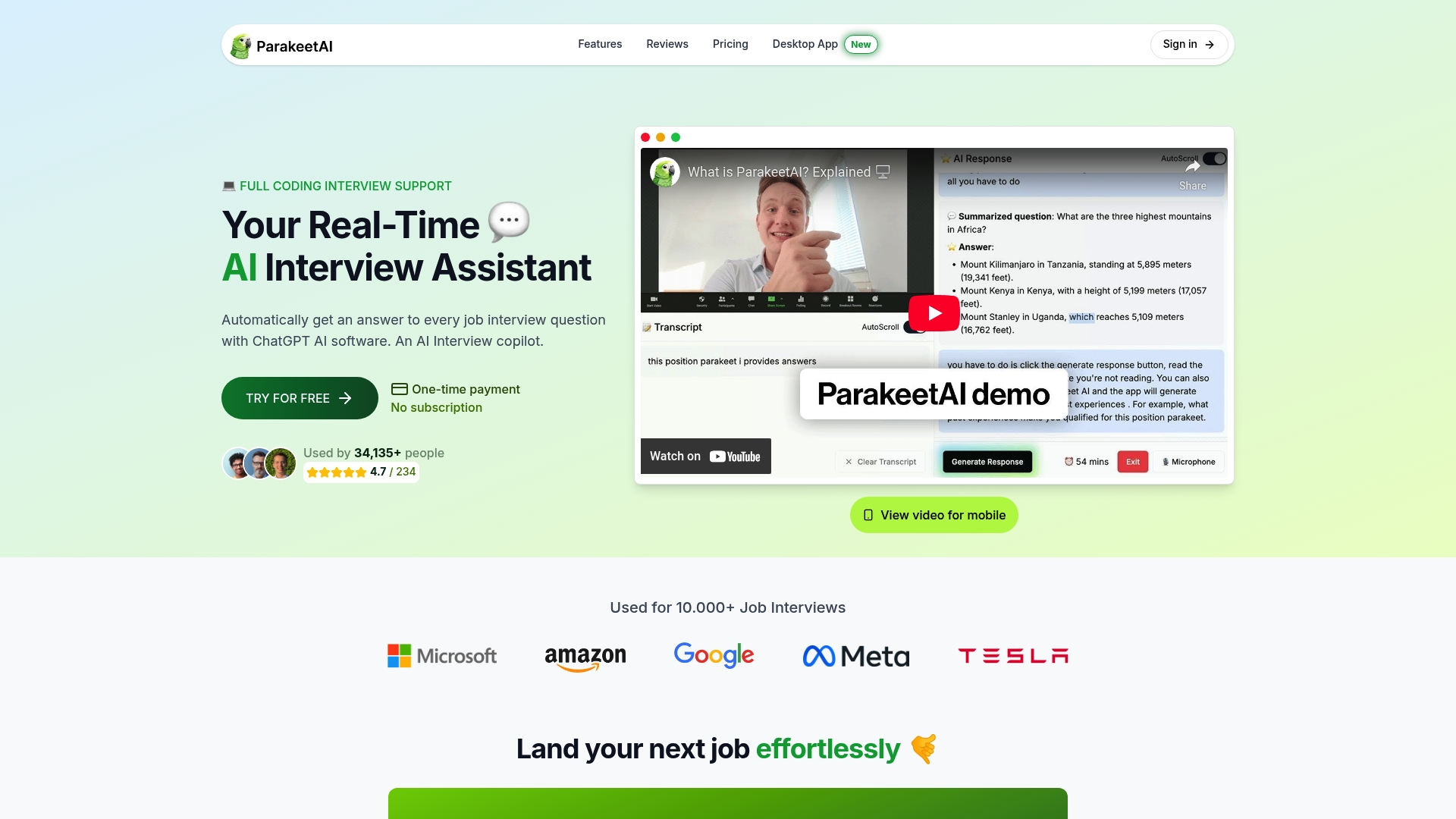
Parakeet-ai listens to interviews in real time and provides AI-generated answers to candidate questions as they happen. For recruiting teams, that means candidates arrive better prepared, interviews run more efficiently, and the quality of conversation improves across the board. The platform requires no complex setup and fits into existing hiring workflows without replacing the human recruiter. If your team is looking to reduce candidate drop-off and improve the quality of every interview interaction, explore Parakeet-ai to see how real-time AI support fits your process.
FAQ
What is real-time candidate support?
Real-time candidate support is the practice of delivering instant, personalized communication to job applicants at every stage of the hiring process. It includes automated status updates, self-scheduling tools, conversational AI, and triggered messaging based on ATS data.
How does real-time support reduce candidate drop-off?
Responding to candidates within one hour boosts completion rates by 20–30%, while delays beyond two weeks cause 47–52% drop-off. Fast, consistent communication keeps candidates engaged and reduces mid-funnel abandonment.
Can automation replace human recruiters in candidate support?
Automation handles logistics like scheduling, FAQ responses, and status updates effectively. Human recruiters remain critical for offer negotiation, final-round feedback, and any interaction where a candidate’s emotional state requires a personal response.
What is the fastest ROI from real-time support tools?
Self-scheduling tools deliver the fastest measurable return. Candidates who book their own interview slots show 25–30% lower no-show rates, and recruiters recover hours per week that were previously spent on email coordination.
How should recruiters measure the impact of real-time candidate support?
Track candidate drop-off by funnel stage before and after deployment. Also monitor time-to-hire, no-show rates, and candidate satisfaction scores. Stage-level drop-off data pinpoints exactly where communication gaps are costing you qualified candidates.