
Real-time AI interview assistants: 40% more job offers

TL;DR:Practicing with AI interview assistants boosts success rates and confidence.They provide real-time, adaptive, and industry-specific responses during interviews.Effective preparation combines AI practice with human feedback and varied mock sessions.
Practicing for a job interview with an AI assistant isn’t just a tech novelty. It’s a measurable edge. Interview success rates rise 30-40% when candidates use AI tools consistently, and that translates directly into more job offers. Most people assume confidence comes from experience alone, but the data tells a different story. Real-time AI assistants are changing how job seekers prepare, respond, and recover under pressure. This article walks you through how these tools actually work, what the research says about their impact, where they fall short, and exactly how to use them to your advantage.
Table of Contents
- How real-time assistants work in interviews
- Key benefits backed by research
- Limitations and ethical considerations
- How to maximize real-time assistant benefits
- A smarter way to approach AI-powered interview preparation
- Try real-time AI interview coaching for yourself
- Frequently asked questions
Key Takeaways
| Point | Details |
|---|---|
| Boosts interview success | Practicing with a real-time AI assistant can make you 40% more likely to land a job offer. |
| Reduces anxiety | Real-time suggestions and feedback help you feel more confident and prepared for interviews. |
| Works best for beginners | AI interview tools deliver the greatest improvements for less-experienced job seekers. |
| Best with human input | Combine AI coaching with feedback from real people for the most reliable results. |
How real-time assistants work in interviews
A real-time AI interview assistant is not the same as watching a YouTube video on common interview questions or reading a prep guide the night before. Static tools give you information. Real-time assistants respond to what is actually happening in your interview, right now, in the moment.
Here is what separates modern assistants from older prep tools:
- Live question detection: The assistant listens to the interviewer’s audio and identifies the question being asked.
- Instant response suggestions: Within seconds, it surfaces relevant, structured answers tailored to your role and industry.
- Adaptive context: It tracks the conversation flow and adjusts suggestions based on what has already been discussed.
- Role-specific fine-tuning: Better platforms train on industry-specific data, so a software engineering candidate gets different prompts than a marketing manager.
The technical backbone behind this is low-latency, context-aware AI rather than generic language models. Fine-tuning on real interview data makes responses feel natural rather than robotic, though it does require high-quality training datasets to work well.
A typical session looks like this: you join a video call, the assistant runs quietly in the background, and when the interviewer asks “Tell me about a time you handled conflict,” the tool instantly suggests a structured answer using the STAR method (Situation, Task, Action, Result). You can glance at it, adapt it in your own words, and respond with confidence.
This is a fundamentally different experience from rehearsing alone. You get real-time AI answers that mirror actual interview conditions, which builds a kind of muscle memory that static prep simply cannot replicate.
Pro Tip: When evaluating assistants, look specifically for tools that adapt to both your industry and seniority level. A generic response engine will feel off in a specialized technical interview.
For anyone curious about the broader landscape, exploring AI for interview coaching gives a solid foundation for understanding what these tools can and cannot do before you commit to one.
Key benefits backed by research
Now that you know how these assistants function, let’s look at the concrete benefits and why they matter for your job search.

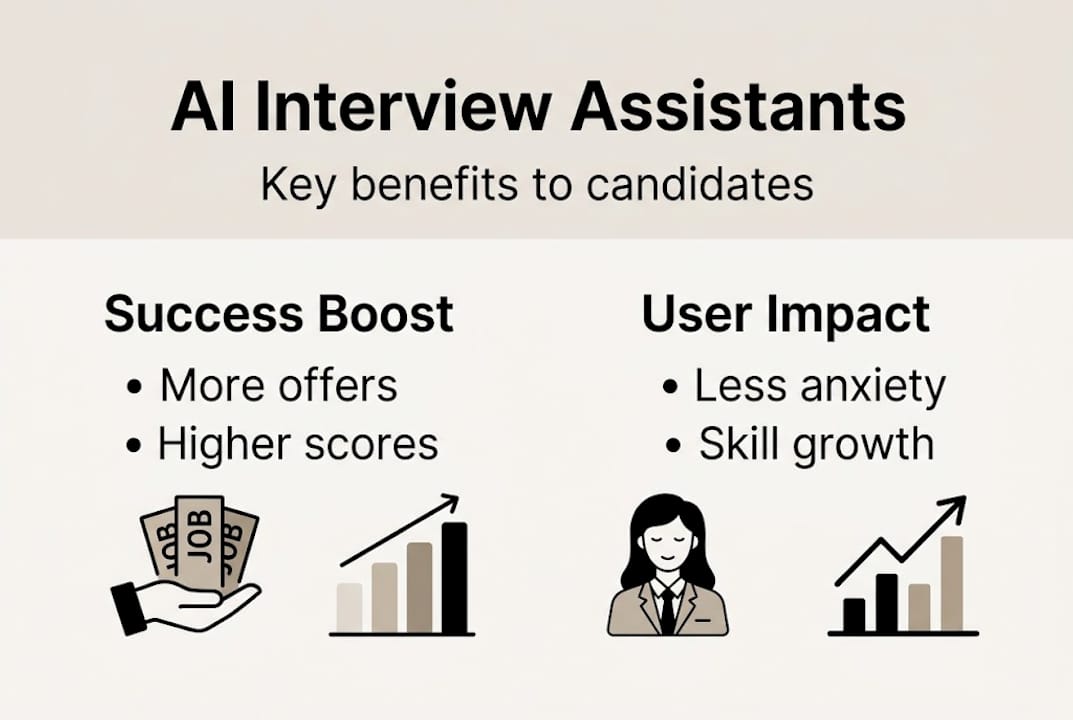
The numbers are striking. Candidates who practice with AI tools score 20 percentage points higher in interview evaluations and are 40% more likely to receive job offers. Those are not small margins. That is the difference between getting the role and being passed over.
| Benefit | What it means for you |
|---|---|
| Confidence boost | Repeated practice reduces anxiety and builds familiarity with tough questions |
| Realistic preparation | AI simulates real interview pressure better than solo rehearsal |
| Soft skill identification | Algorithms flag communication patterns you might not notice yourself |
| Performance prediction | AI models predict hiring outcomes with greater accuracy than human raters |
| Instant feedback | You learn what works and what does not after every session |
Beyond confidence, one of the most underrated benefits is how AI handles soft skill evaluation. AI predicts employment success better than human interviewers in several benchmarks, partly because it captures overlooked signals like pacing, word choice, and response structure without the unconscious bias that human raters often carry.
Here are the core benefit areas that consistently show up in the research:
- Reduced anxiety: Familiarity with the format lowers stress on the actual day.
- Precise, repeatable feedback: Unlike a friend giving vague encouragement, AI gives specific notes every time.
- Soft skill visibility: Traits like clarity, brevity, and confidence become measurable and improvable.
- Offer prediction: Some platforms flag which responses are likely to resonate with hiring managers.
User satisfaction data backs this up too. Around 80% of candidates find AI interview tools genuinely useful, with an average satisfaction rating of 4.37 out of 5. That is a high bar for any professional tool.
Understanding the full role of AI assistants in the hiring process helps you use them strategically rather than just as a crutch. And if you are comparing platforms, looking at best interview preparation software can help you find the right fit for your goals.
Limitations and ethical considerations
While the advantages are impressive, it is just as important to understand the real-world caveats and ethical questions that come with these tools.
AI assistants are powerful, but they are not perfect. Over-reliance on AI can actually reduce your confidence when you face an unexpected question without the tool. AI also struggles with emotional tone and nonverbal cues. It cannot tell if you look nervous, if your body language is closed off, or if your voice is shaking. Those signals matter to human interviewers.
The ethical debate is real and ongoing. Using AI to prepare is almost universally accepted. Using it live during an actual interview is a different question entirely.
“AI scored women and minorities higher than human raters did; human raters showed the opposite bias.” This finding from recent research highlights both the promise and the complexity of AI in hiring contexts.
This cuts both ways. AI can reduce human bias, which is genuinely valuable. But if a candidate is using a live assistant to answer questions they could not answer on their own, that raises fairness concerns for employers and other candidates. Live AI use is ethically debated as a form of potential misrepresentation, and some employers are beginning to screen for it.
Here is how to stay on the right side of that line:
- Use AI heavily during preparation and mock interviews, not as a live crutch.
- Always check the employer’s stated policy on AI tools before your interview.
- Practice until the AI-suggested answers feel like your own words, not a script.
- Supplement AI sessions with at least one human mock interview per week.
- Treat AI feedback as a starting point, not a final verdict on your performance.
For a deeper look at how to apply these boundaries effectively, AI-based coaching insights walks through how to use coaching tools responsibly without compromising your authenticity.
Pro Tip: Always pair AI insights with personal reflection and at least one human feedback session. Algorithms catch patterns; people catch presence.
How to maximize real-time assistant benefits
Understanding limits is only half the story. Here is how you can actively get the most value from real-time assistants in your preparation.
The biggest mistake candidates make is treating AI prep as a one-time activity. The greatest gains come from consistent use, especially for less-experienced candidates who see up to a 30% productivity lift. Experienced professionals see smaller gains, which means the tool is most powerful when you are building foundational interview skills.
| Preparation method | Strengths | Weaknesses |
|---|---|---|
| AI tools only | Fast feedback, always available, scalable | Misses nonverbal cues, no emotional nuance |
| Traditional prep only | Builds personal voice, human feedback | Slow iteration, inconsistent quality |
| Blended model (AI + human coach) | Best of both worlds, highest confidence | Requires more time and sometimes cost |
The blended model consistently outperforms either approach alone. Use AI for volume and speed; use human feedback for depth and nuance.
Here is a practical checklist for effective daily use:
- Run at least three AI mock sessions per week in the two weeks before your interview.
- Record your responses and review them for filler words and pacing issues.
- Focus each session on a different question category: behavioral, technical, situational.
- After each AI session, write down two things you want to improve before the next one.
- Do one full human mock interview in the final week to stress-test your real-world delivery.
Knowing how to leverage AI for interviews effectively means treating it as a training partner, not an answer machine. And if you are still deciding which platform fits your needs, reviewing your options for choosing an interview AI assistant is a smart first step.
Pro Tip: Use AI for high-volume scenario practice, but always validate your readiness with a real mock interview before the actual day.
A smarter way to approach AI-powered interview preparation
Most candidates think that loading up on AI practice sessions is enough to walk into any interview with confidence. It is not. And here is the uncomfortable truth: the candidates who over-rely on AI often perform worse under pressure than those who used it as one tool among many.
We have seen this pattern repeatedly. A candidate nails every AI mock session, scores high on every metric, then freezes when the interviewer goes off-script. Why? Because they trained to respond to prompts, not to think on their feet.
The strongest outcomes come from iterative cycles: AI-driven practice, real conversations with humans, and targeted adjustment based on both. AI tells you what you said. Humans tell you how it felt. You need both signals to improve.
Exploring virtual interview assistant insights can help you understand where these tools genuinely shine and where human judgment still has the edge. Real confidence is not built by having the right answer ready. It is built by knowing you can find the right answer even when things go sideways.
Try real-time AI interview coaching for yourself
Ready to see what these benefits look like in action? Here is where you can take your next step.
Everything covered in this article, from instant answer suggestions to soft skill feedback, is exactly what the ParakeetAI platform delivers in real time. Whether you are preparing for your first professional interview or your tenth senior-level role, the tool adapts to your context and helps you show up sharper.
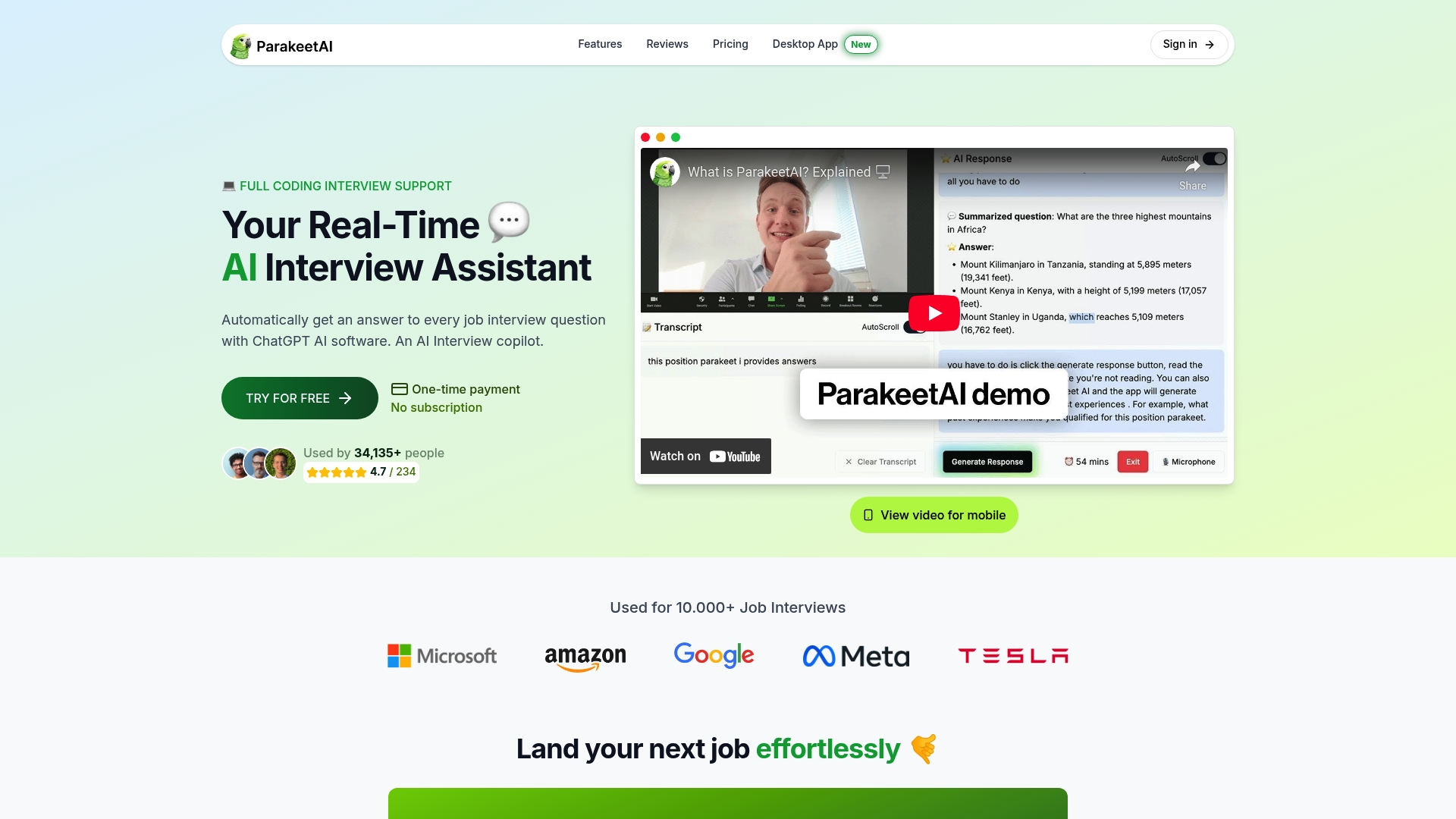
Parakeet AI listens during your interview and automatically surfaces answers to every question as it happens. No complicated setup, no steep learning curve. Just practical, immediate support at every stage of your interview journey. Start your first session today and experience the difference that real-time coaching makes.
Frequently asked questions
Do real-time AI interview assistants actually increase your chances of getting a job?
Yes. Users are 40% more likely to receive job offers when they practice consistently with AI-powered assistants, according to empirical research on AI-assisted recruitment.
Is it ethical to use AI for real-time help in live interviews?
Using AI for preparation is widely accepted, but live use is ethically debated as potential misrepresentation. Always check your employer’s policy before your interview.
Do AI interview assistants work better for some candidates than others?
Yes. Beginners see the largest gains, with up to a 30% productivity lift, while experienced candidates see smaller improvements. AI also tends to reduce scoring bias compared to human raters.
What are some drawbacks of relying too much on real-time assistants?
Over-reliance can hurt confidence when unexpected questions arise, and AI cannot read nonverbal cues. Pairing AI practice with human feedback gives you the most balanced preparation.