
Interview Checklist for Hiring Managers in 2026

TL;DR:Structured interviews are twice as predictive of job performance and ensure fair, defensible hiring decisions. Proper preparation, execution, and post-interview follow-up, supported by tools like AI, reduce bias and improve consistency across candidates. Leaders who treat structured processes as essential discipline achieve better hiring outcomes and build stronger teams.
Most hiring managers walk into interviews with good intentions and walk out with inconsistent notes, gut feelings they can’t defend, and a decision that looks different three days later. The result is wasted time, lost top candidates, and a hire that doesn’t stick. A structured interview checklist for hiring managers fixes exactly this. It replaces improvisation with a repeatable process that produces defensible, fair decisions every single time. This article covers the full picture: preparation before the interview, execution during it, verification after it, and the mistakes that quietly undermine even experienced managers.
Table of Contents
- Key takeaways
- The interview checklist for hiring managers: pre-interview preparation
- Running the interview: a step-by-step execution guide
- Verification and follow-up after each interview
- Common mistakes that derail the interview process
- My take on hiring as a leadership responsibility
- How Parakeet-ai can support your hiring process
- FAQ
Key takeaways
| Point | Details |
|---|---|
| Structure beats intuition | Structured interviews are twice as predictive of job performance compared to unstructured conversations. |
| Limit your criteria | Use the Rule of 5 to define the top five non-negotiable competencies before scheduling any interview. |
| Score immediately | Complete scorecards right after each interview section, not at the end of the day, to preserve accurate recall. |
| Calibrate with your team | Debrief meetings with anchored rubrics reduce bias and improve scoring consistency across interviewers. |
| Timing matters | Initial hiring manager screens should run 30 to 45 minutes, focused on alignment and team fit rather than deep technical grilling. |
The interview checklist for hiring managers: pre-interview preparation
The quality of your interview is determined before the candidate walks in, or logs on. Preparation is not about reviewing a resume 10 minutes before the call. It is about building a framework that makes the actual conversation structured, fair, and efficient.
Start by defining what you actually need. The most common pre-interview mistake is treating the job description as the evaluation guide. Job descriptions list responsibilities. You need to identify the five non-negotiable competencies that separate a successful hire from an average one. This is the Rule of 5 approach, which argues that defining success for the first 90 days matters far more than cataloging a long list of requirements. Ask yourself: what does this person need to demonstrate in their first three months to be considered a win?
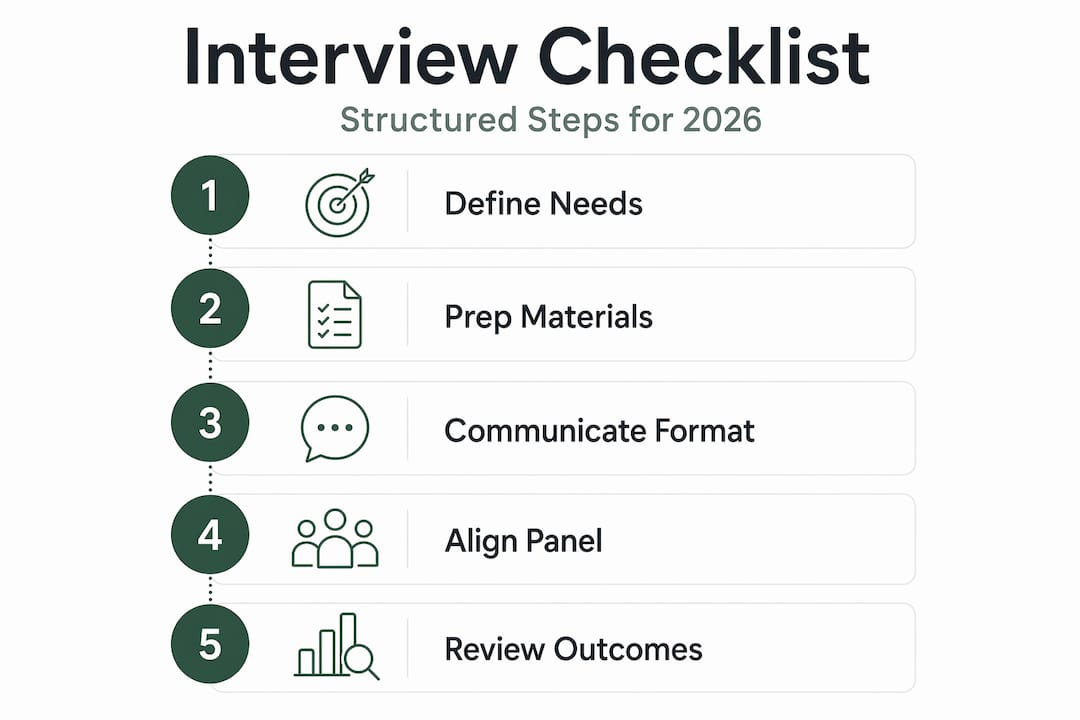
Coordinate with your recruiter before you ever speak to a candidate. Recruiters who work requisitions daily have market context you don’t. They know what competing offers look like, where candidates are dropping off in your funnel, and which competencies are hardest to find. Treating recruiters as strategic partners rather than scheduling logistics produces measurably better hiring outcomes.
Here is a practical pre-interview checklist:
- Confirm the role’s top five competencies are agreed upon by all interviewers
- Review the candidate’s resume, portfolio, and any pre-screening notes from your recruiter
- Pull up the structured interview guide and scorecard aligned to those competencies
- Block 30 to 45 minutes for the screen. The recommended screen duration is 30 to 45 minutes for initial hiring manager interviews, focused on high-level alignment
- Prepare two to three behavioral and two situational questions per core competency
- Check whether any AI resume screening tools have flagged patterns or gaps worth probing
Pro Tip: Send candidates a brief prep note 24 hours before the interview. Tell them the format, approximate duration, and one or two topic areas to expect. Candidates who arrive prepared give better answers, which means you get better data.
AI adoption in recruiting jumped to 53% in 2026, yet offer rates remain at only 18.3%, which tells you that technology alone is not the fix. Preparation discipline is. Use AI tools to screen resumes and surface candidate patterns, but treat that output as a starting point, not a verdict.
Running the interview: a step-by-step execution guide
Preparation sets the stage. Execution is where most interview processes actually break down. Without a checklist guiding the flow, interviews drift. Questions become reactive, scoring gets inconsistent, and the candidate experience suffers.
Here is a step-by-step execution sequence that works:
- Open with a standardized intro. Spend two to three minutes explaining the interview format, how long it will run, and how you’ll use the information. This sets expectations and puts the candidate at ease without wasting time.
- Lead with one alignment question. Before competency questions, confirm the candidate’s understanding of the role and their motivation. This surfaces misalignment early and saves everyone time.
- Work through behavioral questions by competency block. Don’t jump between topics. Cluster two behavioral questions per competency and move through them in order. Scorecards tied to core competencies eliminate guesswork and keep every interviewer evaluating the same things.
- Apply the STAR method as your listening filter. When a candidate answers, listen for Situation, Task, Action, and Result. If they skip the Result or describe the situation without explaining their specific role, probe with “What was your individual contribution?” or “What happened as a direct result of that decision?”
- Record observations during the conversation, not after. Note specific quotes and concrete examples in your scorecard immediately after each competency block. Memory degrades fast. Waiting until the end of a day of back-to-back interviews means you are reconstructing, not recalling.
- Keep the tone conversational. Structured does not mean robotic. Ask follow-up questions when something genuinely interests you. Real conversation improves candidate experience and your employer brand.
- Reserve the last five to eight minutes for candidate questions. This is not a courtesy. Candidates who ask thoughtful questions give you additional signal about their priorities, preparation, and critical thinking. It also respects their time and investment in the process.
Pro Tip: If you use an AI-powered interview tool that captures notes in real time, let the candidate know at the start. Transparency builds trust and removes the awkwardness of a manager typing furiously while someone is speaking.
Structured interviews are twice as predictive of job performance as unstructured ones. The execution checklist above is not about making interviews feel scripted. It is about giving yourself consistent, comparable data across every candidate you speak to.
Verification and follow-up after each interview
The interview ends. Most hiring managers move to the next meeting without completing a single field in their scorecard. This is where hiring decisions go wrong. What felt clear at 2 p.m. becomes murky by 5 p.m., especially after four interviews in a row.
A structured post-interview checklist closes that gap:
- Complete the scorecard within 30 minutes of the interview ending. Capture specific evidence for each competency rating, not adjectives like “impressive” or “unclear.”
- Schedule a debrief with all interviewers before anyone makes a verbal offer. Calibration exercises like comparative scoring reviews and mock scoring alignment reduce disagreement and prevent the loudest voice in the room from winning by default.
- Use anchored rubrics during debrief. Anchored rubrics reduce bias and improve inter-rater reliability by giving every score a behavioral definition. A “4 out of 5” should mean the same thing to every interviewer on the panel.
- Communicate next steps to candidates within 48 hours. Silence after an interview damages your employer brand even when a candidate is not selected.
- Log all feedback and decisions in your Applicant Tracking System (ATS) immediately. This creates a documented record for compliance and protects your organization if a hiring decision is ever challenged.
Here is a quick reference for post-interview documentation:
| Action | Timing | Owner |
|---|---|---|
| Complete scorecard | Within 30 minutes | Hiring manager |
| Share feedback with recruiter | Same day | Hiring manager |
| Debrief with full panel | Within 24 hours | Recruiter facilitates |
| Communicate decision to candidate | Within 48 hours | Recruiter |
| Update ATS with final notes | Before requisition closes | Recruiter and hiring manager |
AI can surface bias patterns in interview behavior in real time, which makes it a genuinely useful tool in the verification stage. If your organization uses AI interview analytics, review the output before the debrief meeting. Patterns across multiple interviews, such as consistently shorter responses from certain candidate profiles, are worth discussing explicitly.

Common mistakes that derail the interview process
Even experienced hiring managers fall into patterns that undermine their own interview process. A candidate evaluation checklist helps, but only if you know what it’s protecting against.
The most damaging mistakes look like this:
- Trusting your gut over structured scoring. Instinct has a place, but it is not a hiring methodology. Feelings about “culture fit” without behavioral evidence are usually just familiarity bias in disguise.
- Overloading initial screens with technical depth. A hiring manager screen is not the place to stress-test a candidate’s entire knowledge base. Use it to assess alignment, motivation, and communication. Deep technical evaluation belongs in later rounds with the right people in the room.
- Skipping candidate questions at the end. Cutting a candidate off when they have something to ask signals disrespect. It also means you lose signal about their critical thinking and priorities.
- Using inconsistent scoring across candidates. If your rubric is not anchored, every interviewer is using a different internal scale. One person’s 7 is another’s 4. This makes debrief meetings arguments instead of calibrations.
- Forgetting evidence-based notes. “Strong communicator” is not evidence. “Walked through a stakeholder conflict at her previous company and identified three specific solutions she tested in sequence” is.
- Ignoring AI-flagged patterns. Modern AI candidate screening tools can surface evaluation gaps and competency blind spots. Dismissing that output because it feels like extra work is a missed opportunity.
- Using outdated evaluation criteria. Many interview processes still assess skills that AI tools now handle. Balancing human judgment with AI hiring insights means updating what you measure, not just how you measure it.
Pro Tip: Review your top interview mistakes list quarterly. Audit your scorecards for pattern language. If you see the same adjectives without behavioral evidence, your panel needs a calibration session.
My take on hiring as a leadership responsibility
I’ve spent years watching capable managers treat interviews as something that happens around their actual job. The perspective shift that changes everything is recognizing that hiring is your actual job. Every leader you admire built their reputation on the team they assembled.
What I’ve seen consistently is that the managers who produce great hiring outcomes treat structured tools as discipline, not bureaucracy. They don’t resent scorecards. They trust them because they’ve watched gut-based decisions fail in ways that were completely predictable in hindsight.
The honest challenge I’ve observed with AI integration is not technical. It’s psychological. Handing part of the evaluation process to an algorithm feels uncomfortable when hiring has always been deeply human. But directing AI tools to reveal learning velocity rather than pattern-matching against past hires is genuinely powerful. It surfaces candidates who would have been missed by traditional screening.
My advice: use the checklist as a floor, not a ceiling. Let structure handle consistency, and bring your human judgment to the moments that require it. That combination is what separates effective hiring from expensive guessing.
— Jure
How Parakeet-ai can support your hiring process
Running a tight, consistent interview process requires the right tools in your corner. Parakeet-ai gives hiring managers real-time AI support during interviews, capturing structured notes, surfacing follow-up prompts, and organizing feedback so your scorecards are complete without the administrative burden.
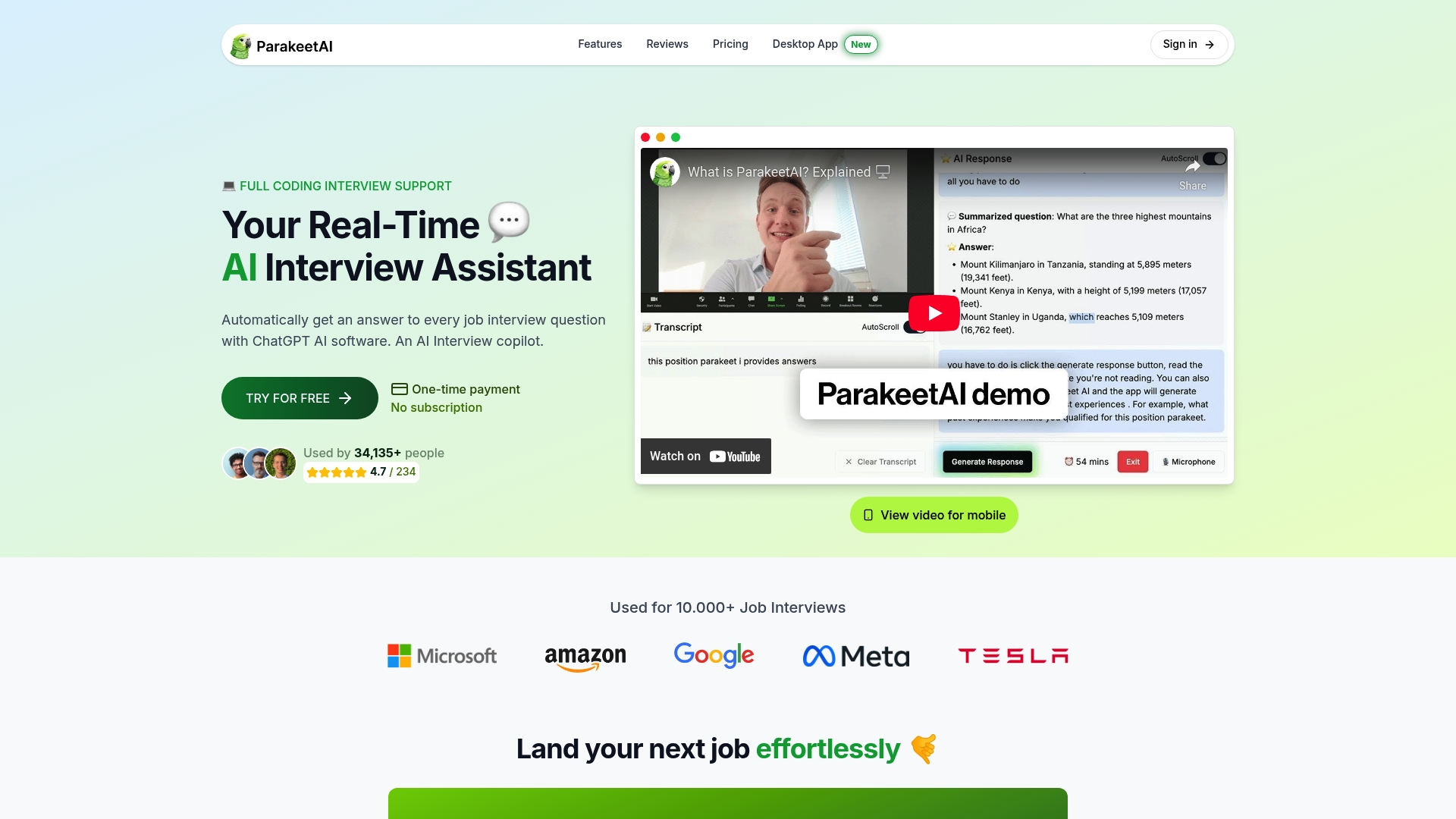
Whether you’re building your first structured interview program or refining a process that’s been running for years, the Parakeet-ai platform integrates with your existing workflow to reduce note-taking friction, flag potential bias patterns in real time, and help you evaluate candidates consistently across every round. You can also explore the full interview checklist for employers resource library to find templates and guides built specifically for hiring managers who want better outcomes without more administrative overhead.
FAQ
What is an interview checklist for hiring managers?
An interview checklist for hiring managers is a structured guide covering preparation, execution, and post-interview steps that help managers evaluate candidates consistently, reduce bias, and make defensible hiring decisions.
How long should a hiring manager screen last?
The recommended duration for an initial hiring manager screen is 30 to 45 minutes, focused on role alignment and team fit rather than exhaustive technical evaluation.
Why are structured interviews more effective?
Structured interviews predict job performance at twice the rate of unstructured conversations because they assess the same competencies across all candidates and replace intuition with comparable evidence.
How do you reduce bias in hiring decisions?
Use anchored rubrics and calibration sessions with your full interview panel to align scoring definitions before debriefs. AI tools can also flag real-time patterns in interviewer behavior that signal potential bias.
What should hiring managers document after an interview?
Complete your scorecard within 30 minutes of the interview, capturing specific behavioral evidence for each competency rating. Log all notes and decisions in your ATS to maintain compliance and create a transparent record for every hiring decision.