
What Is Interview Performance Analytics? A Clear Guide

TL;DR:Interview performance analytics transforms subjective hiring decisions into measurable data that predicts success and identifies process gaps.Structured interviews with rubric-based scoring outperform unstructured ones by providing reliable, comparable data and reducing bias.Real-time dashboards enable immediate action on bottlenecks, improving hiring efficiency, candidate experience, and interviewer effectiveness.
Most hiring decisions still feel more like gut calls than data-driven choices. That changes when you understand what is interview performance analytics: the practice of collecting, tracking, and analyzing structured data throughout the interview process to predict hiring outcomes, spot process failures, and improve decisions over time. This guide breaks down the core metrics, compares interview approaches, and explains how modern dashboards give both hiring managers and job seekers a real edge.
Table of Contents
- Key takeaways
- What is interview performance analytics
- Structured vs. unstructured interviews
- Interview analytics dashboards and real-time insights
- How to measure and improve interview performance
- My honest take on where interview analytics actually matter
- Improve your interview process with Parakeet-ai
- FAQ
Key takeaways
| Point | Details |
|---|---|
| Analytics go beyond impressions | Interview performance analytics turns subjective gut calls into measurable data points tied to real hiring outcomes. |
| Structured interviews predict better | Structured formats outperform unstructured ones in predictive validity, making analytics more accurate and fair. |
| Dashboards beat static reports | Real-time interview dashboards surface bottlenecks and drop-off risks as they happen, not weeks later. |
| Data quality is the foundation | Clean, consistent scorecard data must come before any meaningful metrics can be built from it. |
| Both sides benefit | Job seekers who understand what metrics organizations use can prepare smarter and perform with more confidence. |
What is interview performance analytics
Interview performance analytics is the systematic use of data to evaluate how well your interview process predicts, selects, and retains strong candidates. It moves hiring beyond “I liked the candidate” into territory where decisions are backed by numbers, patterns, and outcome signals you can actually repeat.
SHRM defines this practice around metrics like the interview-to-offer ratio, candidate drop-off rate, time-to-decision, and quality of hire measured via post-hire performance. Each of these metrics tells a different part of the story about where your process works and where it breaks down.
Here is what the core metrics actually measure:
- Interview-to-hire ratio: How many candidates you interview per successful hire. A high ratio often signals a mismatch between job requirements and candidate sourcing, or poor screening accuracy early in the funnel.
- Candidate drop-off rate: The percentage of invited candidates who abandon the process before completion. A spike here usually points to scheduling friction, poor communication, or an overly long process.
- Time-to-decision: How long it takes from interview completion to a hiring decision. Slow decisions lose top candidates to faster-moving employers.
- Quality of hire: Measured through post-hire performance reviews and retention data, typically tracked over six to twelve months after the hire date.
Pro Tip: Start with just three metrics: drop-off rate, time-to-decision, and quality of hire. Teams that try to track everything at once often end up measuring nothing well. Build from a simple baseline first.
Quality of hire is the most valuable metric in the set, but it is also the slowest to arrive. Because those outcome signals take months to surface, smart teams use a dual view: leading indicators during early tenure, like onboarding scores and 90-day manager feedback, alongside the lagging outcome data for longer-term evaluation.
Structured vs. unstructured interviews
Not all interviews generate data you can trust. The format matters enormously, both for candidate experience and for the reliability of anything you try to measure afterward.
| Feature | Structured interviews | Unstructured interviews |
|---|---|---|
| Question consistency | Same questions for every candidate | Questions vary by interviewer |
| Scoring method | Rubric-based scorecards | Subjective impressions |
| Predictive validity | 0.51 validity coefficient | 0.38 validity coefficient |
| Bias risk | Lower, due to anchored criteria | Higher, open to personal bias |
| Analytics reliability | High, data is comparable | Low, data is inconsistent |
Structured interviews outperform unstructured ones with a validity coefficient of 0.51 versus 0.38. That gap is not a rounding error. It means structured interviews are measurably better at predicting who will actually succeed in the role.
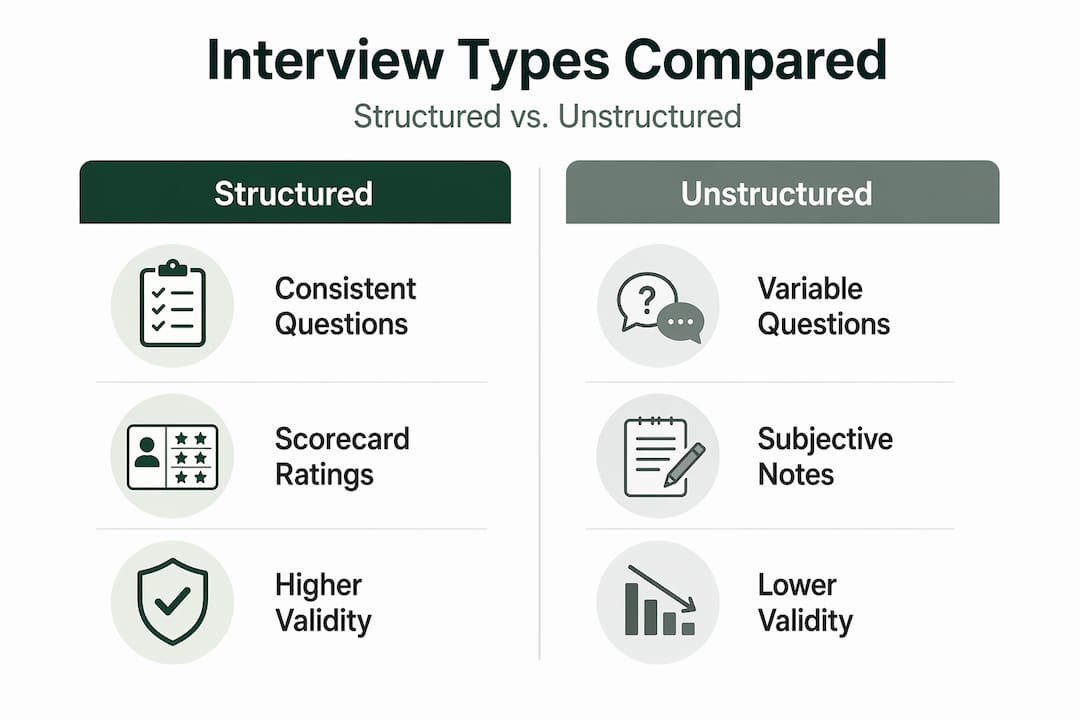
The reason is simple. When every candidate answers the same questions and gets scored against the same rubric, you can compare candidates to each other and to past hires with confidence. When one interviewer asks about leadership and another spends the same time on hobbies, you end up with data that cannot be compared at all.
Scorecards are the mechanism that makes structured interviews work. A good scorecard defines each competency clearly, anchors each score level with behavioral examples, and requires interviewers to record specific evidence for their ratings rather than a general number. Tracking multiple interview scores per candidate across different rounds and interviewers also prevents misattributing a candidate’s performance to one person’s perception.
Pro Tip: Structured interviews do not remove human judgment. They constrain where that judgment gets applied, keeping interviewers focused on evidence rather than on whether a candidate reminded them of someone they already liked.
One real challenge is calibration. Two interviewers using the same scorecard can still rate the same candidate very differently if they have not aligned on what “meets expectations” looks like in practice. Regular calibration sessions, where interviewers review and discuss ratings together before finalizing them, close that gap over time.
Interview analytics dashboards and real-time insights
Static reports that summarize last quarter’s hiring activity are a history lesson. A modern interview performance dashboard is a live control panel. It aggregates metrics continuously and surfaces problems while you can still do something about them.

What real-time visibility actually looks like in practice:
| Dashboard metric | What it reveals | Why it matters now |
|---|---|---|
| Pipeline stage velocity | Where candidates are stalling | Lets coordinators intervene before candidates disengage |
| Drop-off alerts | Candidates who stopped responding | Allows same-day follow-up to re-engage |
| Scorecard completion rate | Which interviewers are not submitting scores | Prevents data gaps that corrupt analytics |
| Score variance by interviewer | Calibration gaps across the team | Identifies who needs recalibration before more interviews run |
| Interview-to-offer conversion | Funnel efficiency at each stage | Shows which stages add value and which are redundant |
Real-time analytics highlight delays as they happen, giving hiring teams the ability to move quickly during volume spikes or competitive talent markets. If three candidates in the same role all stopped responding after the second round, that pattern shows up immediately rather than in a report three weeks later.
Candidate engagement metrics are another area where dashboards add value that spreadsheets simply cannot. Response time to scheduling requests, completion rates for assessments, and time spent in each interview stage all signal how interested a candidate is and whether the process itself is creating friction that drives people away.
For hiring managers specifically, interview analytics tools also surface interviewer productivity data: how many interviews each team member conducts, how long their decisions take, and whether their hiring recommendations correlate with downstream performance. That last point is the most powerful. It tells you which interviewers on your team are actually good at predicting success.
How to measure and improve interview performance
Whether you are a hiring manager building a process or a job seeker trying to understand what you are being measured on, these practical steps apply directly.
For hiring managers:
- Standardize data capture first. Define which competencies will be scored, what evidence looks like for each level, and make scorecard completion mandatory before any debrief. Cleaning scorecard data was the first step Nubank took before they could build any useful interviewer analytics at all.
- Define your outcome signals early. Decide before you start what “great hire” means: is it retention at 12 months, first-year performance ratings, or promotion velocity? Your upstream metrics only matter if they connect to those downstream outcomes.
- Connect interview signals to long-term results. Linking interview data to outcomes like retention and performance strengthens both the fairness and the practical impact of your analytics program.
- Reduce and calibrate your interviewer pool. Trimming to well-trained interviewers with consistent scorecard habits raises the quality of your signal dramatically. A smaller, calibrated panel beats a large, inconsistent one every time.
- Use AI transcription to capture what gets lost. Tools that record and analyze interview conversations can surface patterns in how questions are asked, how thoroughly topics are covered, and where interview consistency breaks down across your team.
For job seekers:
Understanding what interview performance tracking looks at gives you a real advantage. Most organizations using structured interviews are scoring you against predefined competencies, not general impressions. That means your job is to provide concrete behavioral evidence, not just confident answers.
Pro Tip: When preparing for a structured interview, identify two or three specific experiences for each major competency you expect to be assessed on. Interviewers are looking for evidence anchored to real situations, and vague answers rarely score well on a rubric.
Pay attention to the process itself. Slow scheduling, unclear communication, or last-minute changes are signals about the organization’s culture and operational quality. Those observations go both ways: companies are measuring your responsiveness, and you should be measuring theirs.
My honest take on where interview analytics actually matter
I’ve watched organizations spend months building elaborate interview dashboards and then wonder why hiring quality didn’t improve. The problem wasn’t the analytics. It was the data going in.
In my experience, incomplete scorecard data is the single most common reason interview analytics fails to deliver on its promise. You can have the best dashboard in the world, but if half your interviewers are submitting scores without evidence, or not submitting at all, you are measuring documentation habits more than candidate quality.
What I’ve seen actually work is starting small and being obsessive about consistency. Pick three metrics. Make scorecard completion non-negotiable. Run calibration sessions every month until your interviewers genuinely align on what good looks like. Only then should you start reading patterns in the data.
The fairness argument for interview analytics is also more important than most hiring leaders acknowledge. Unstructured interviews do not just produce worse predictions. They consistently favor candidates who match the interviewer’s background, communication style, or cultural references. Data does not fix bias automatically, but standardized rubrics and outcome tracking create accountability that informal processes never do.
I’m genuinely optimistic about where AI fits into this. Not as a replacement for human judgment, but as a way to capture and analyze what happens inside interviews at a level of detail no manual process can match.
— Jure
Improve your interview process with Parakeet-ai
If you are serious about applying interview performance analytics to your own hiring, the gap between knowing the metrics and actually capturing them consistently is where most teams get stuck.
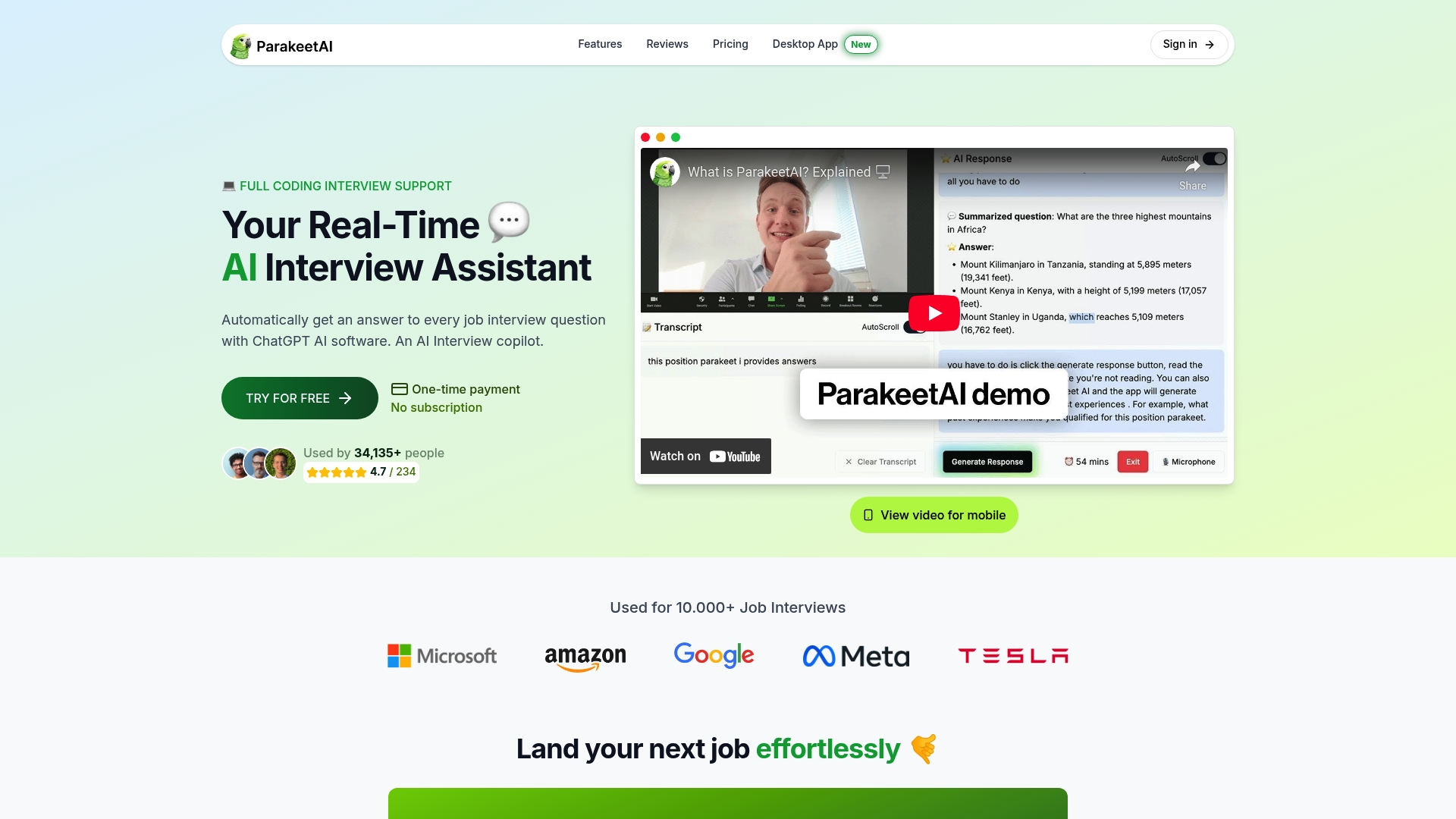
Parakeet-ai is a real-time AI interview assistant that listens to interviews as they happen and automatically generates answers, captures conversation data, and supports the kind of structured review that makes analytics meaningful. For hiring teams, it creates a consistent record of every interview that feeds directly into your evaluation and scoring process. For job seekers, it helps you prepare and perform with confidence, knowing you are walking into a structured conversation with real support.
The interview technology trends moving into 2026 are all pointing toward more data, more structure, and more accountability on both sides of the table. Parakeet-ai is built for exactly that shift. Try Parakeet-ai and see how real-time interview intelligence changes the quality of your hiring decisions.
FAQ
What is interview performance analytics?
Interview performance analytics is the practice of tracking and analyzing structured data from the interview process to evaluate hiring quality, identify process weaknesses, and predict long-term outcomes like retention and job performance.
What are the most important performance metrics for interviews?
The most widely used metrics include interview-to-hire ratio, candidate drop-off rate, time-to-decision, and quality of hire measured at six to twelve months post-hire, as defined by SHRM.
How does a structured interview improve analytics accuracy?
Structured interviews use consistent questions and rubric-based scoring, producing comparable data across candidates and interviewers. Research shows they have a higher predictive validity of 0.51 compared to 0.38 for unstructured interviews.
What is an interview performance dashboard?
An interview performance dashboard is a real-time data visualization tool that aggregates key hiring metrics, such as pipeline velocity, drop-off alerts, and scorecard completion rates, so hiring teams can act on problems immediately rather than after the fact.
How can job seekers use interview analytics insights to prepare?
Job seekers can use knowledge of structured interview scoring to prepare concrete behavioral examples for each competency likely to be assessed, since interviewers in analytics-driven processes are scoring against specific rubrics rather than general impressions.