
What Is Scalable Interview AI? an HR Guide for 2026

TL;DR:Scalable interview AI uses NLP, machine learning, and transcription to evaluate large candidate volumes consistently.Its benefits include bias reduction, standardized assessments, faster shortlisting, and improved candidate experiences when integrated with ATS and properly managed.
Hiring at scale has always been a math problem that humans struggle to solve fairly. When your team needs to evaluate 500 candidates for 20 roles across three time zones, consistency breaks down, bias creeps in, and quality of hire becomes a lottery. That is where scalable interview AI enters the picture. Understanding what scalable interview AI actually is, how it differs from basic video screening, and where it fits inside your existing recruitment stack is the difference between adopting a tool that transforms hiring and buying software that collects dust.
Table of Contents
- Key takeaways
- What is scalable interview AI, exactly?
- The real benefits of interview AI at scale
- Challenges and compliance you cannot ignore
- How to use interview AI effectively
- My honest take on where this is all heading
- Take your hiring further with Parakeet-ai
- FAQ
Key takeaways
| Point | Details |
|---|---|
| Scalable AI goes beyond automation | It uses NLP, machine learning, and transcription to evaluate candidates consistently at any volume. |
| Bias reduction requires human oversight | AI can cut assessment bias by up to 68%, but only when paired with bias audits and human review. |
| Compliance is the employer’s burden | Employers are legally responsible for AI tool outputs and must conduct pre-deployment bias audits. |
| ATS integration prevents data silos | Mapping competencies to ATS fields connects AI insights directly to hiring decisions. |
| Candidate trust is fragile | Thirty percent of job seekers avoid employers that use AI in hiring without transparency. |
What is scalable interview AI, exactly?
Scalable interview AI is a category of recruitment technology that uses artificial intelligence to conduct, transcribe, score, and analyze candidate interviews at any volume, without compromising evaluation quality as hiring demand grows. It is not a chatbot that schedules meetings, and it is not a simple video recording tool. The distinction matters because many HR teams conflate basic automation with genuine AI scalability.
At its core, scalable AI interview solutions rely on three technical pillars:
- AI transcription: The platform converts spoken responses into structured text in real time, creating a searchable, auditable record of every interview.
- Natural language processing (NLP): NLP models analyze what candidates say, how they say it, and whether their responses map to the competencies you are hiring for.
- Machine learning scoring: Algorithms trained on historical hiring data score candidate responses against defined rubrics, flagging strengths and gaps automatically.
Scalability itself refers to three dimensions. First, data volume: the system processes thousands of interview recordings without degrading performance. Second, user count: multiple hiring managers across geographies access the same standardized evaluations. Third, location independence: remote, hybrid, and onsite candidates move through identical assessment flows regardless of where they sit.
AI platforms transcribe and analyze interviews in real time, scoring responses by competencies and flagging bias while coaching interviewers. That last part is what separates true interview AI technology from simpler video screening tools. A basic video platform records and plays back. A scalable AI interview platform replaces subjective interviewer notes with structured, comparable data that compounds in value the more you use it.
Pro Tip: When evaluating any scalable AI interview solution, ask vendors specifically how the platform handles competency mapping. If the answer involves a generic scorecard you cannot customize, it is probably closer to a video recorder than genuine interview AI.
The real benefits of interview AI at scale
The business case for AI for scalable hiring is not theoretical. Organizations using AI interview platforms report 15 to 30 percent improvements in quality of hire and up to 60 percent lower cost per hire within the first hiring cycle. Those are numbers that get CFOs to pay attention.

But the advantages of scalable interviewing go beyond cost savings. Here is where the measurable value concentrates:
Bias reduction with guardrails. AI-driven evaluations can reduce assessment bias by up to 68 percent when human-in-the-loop controls and bias audits are in place. That means applying the four-fifths rule to pass-through rates by demographic group and ensuring every AI score is backed by transcript evidence a human can review. You can read more about the role of AI for interview fairness and how leading teams operationalize it.
Standardization at every touchpoint. Every candidate answers the same questions, scored against the same rubric, by the same AI model. When you are filling 50 roles simultaneously, that consistency is something a human-only panel simply cannot replicate.
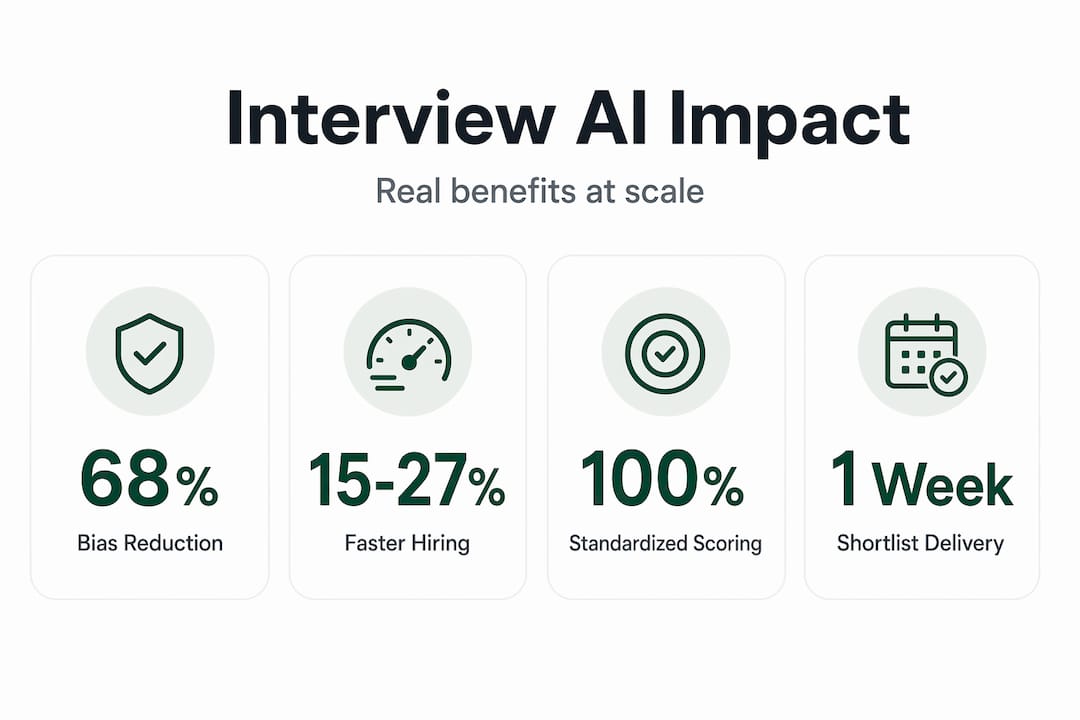
Faster shortlists. Platforms integrate with ATS systems to deliver qualified candidate shortlists within the same week of deployment. That speed matters most during high-volume hiring seasons, when waiting two weeks for panel feedback costs you top candidates to faster-moving competitors.
Candidate experience improvements. Voice-AI platforms that allow candidates to explain themselves can surface strong fits that resume screening alone misses. Candidates who feel heard, even by an AI system, report better experiences than those who submit resumes into a black hole.
The integration layer matters as much as the AI itself. Without ATS connectivity, AI insights become isolated reports that hiring managers read and then ignore when making decisions inside their existing systems. The benefits of AI in job search only materialize when the data flows where decisions actually get made.
Challenges and compliance you cannot ignore
Knowing what is scalable interview AI is only half the picture. Knowing where it can go wrong is what separates responsible adoption from legal exposure.
- Algorithmic bias is a real risk. Training data that reflects historical hiring patterns can encode the biases of those past decisions. An AI model that learned from a company that historically hired 80 percent male engineers will replicate that pattern unless it is actively audited.
- Employers bear the legal liability. Employers are legally responsible for AI hiring tool outputs and must conduct pre-deployment bias audits with full documentation. Regulatory bodies, including the EEOC and ADA, hold you accountable for what your vendor’s algorithm does. “The vendor told me it was compliant” is not a defense.
- Explainability is non-negotiable. Transcript-backed evidence for every AI score is a compliance necessity. Platforms that deliver only final scores are functionally impossible to audit or defend. If a rejected candidate asks why, you need to show your work.
- Candidate trust requires active management. Thirty percent of job seekers avoid applying to companies that use AI anywhere in hiring. Transparency about what the AI does, how scores are used, and who reviews them is not optional if you want to protect your candidate pipeline. For a full breakdown of your obligations, the AI interview compliance resource covers legal requirements by region.
- Standalone AI tools fail. Platforms deployed without workflow integration produce data that no one uses consistently. The AI insight has to live inside the system where decisions happen, not in a separate dashboard someone has to remember to check.
Pro Tip: Before signing any vendor contract, ask for documentation of their most recent bias audit methodology. Specifically, ask how the platform applies the four-fifths rule across demographic groups and what happens when a disparity is detected. Vendors who cannot answer clearly are a compliance risk.
How to use interview AI effectively
Understanding how to use interview AI is where strategy meets execution. The difference between a successful rollout and an expensive disappointment is almost always implementation quality, not product quality.
The following comparison shows what structured AI adoption looks like against ad-hoc deployment:
| Practice | Structured adoption | Ad-hoc deployment |
|---|---|---|
| Competency mapping | Mapped to ATS fields before launch | Generic rubrics not connected to ATS |
| Interviewer training | Calibration sessions before go-live | Interviewers learn the tool on their own |
| Bias monitoring | Monthly audits with fairness reports | No audit schedule |
| Human review | Every AI score reviewed by a recruiter | AI scores treated as final decisions |
| Outcome tracking | Quality-of-hire tracked per cohort | No post-hire performance linkage |
Mapping interview competencies directly to ATS fields is the most critical technical step most teams skip. Without that alignment, AI insights sit in a separate system and never influence the decisions that matter.
Here is how to structure the rollout practically:
- Start with one role type or department, not the entire organization.
- Run AI evaluations in parallel with human reviews for the first two hiring cycles. Compare results, not to validate the AI, but to calibrate your team’s interpretation of AI-generated scores.
- Use structured interview methods with consistent, job-relevant questions and defined rating scales. The AI is only as fair as the questions it analyzes.
- Review AI interview best practices for guidance on human oversight protocols.
- Track quality-of-hire data at the 90-day and 6-month mark for every cohort hired through AI-assisted processes.
The goal is not to replace human judgment. It is to give human judgment better raw material. An AI-generated transcript with competency scores gives a hiring manager a concrete foundation for their decision, rather than a set of impressionistic notes taken during a stressful conversation.
My honest take on where this is all heading
I have spent years watching HR technology go through adoption cycles, and scalable interview AI is following a pattern I recognize. The early adopters focus on efficiency gains, the laggards panic about compliance, and somewhere in the middle, the teams who actually get results treat the AI as an operating system for their entire interview process rather than a point solution.
What I have seen work consistently is the reframe from “AI tool” to Interview OS. When you treat interview AI as the connective tissue between your job requirements, your questions, your scoring, and your ATS data, you stop asking “did the AI make a good call?” and start asking “what does our data tell us about which competencies predict retention in this role?” That is a fundamentally different and more productive question.
The thing most articles will not tell you is that bias auditing is not a launch event. It is an ongoing operational responsibility. I have watched teams run a pre-deployment audit, congratulate themselves, and then never look at the data again. That is how you end up with a discrimination lawsuit two years later.
My honest recommendation is this: do not adopt scalable interview AI faster than your team can understand and govern it. A slower, more deliberate rollout that includes regular fairness reviews and genuine interviewer training will outperform a fast deployment with no governance infrastructure every single time.
— Jure
Take your hiring further with Parakeet-ai
The gap between understanding scalable interview AI and actually deploying it well is where most teams lose momentum. Parakeet-ai is built to close that gap.
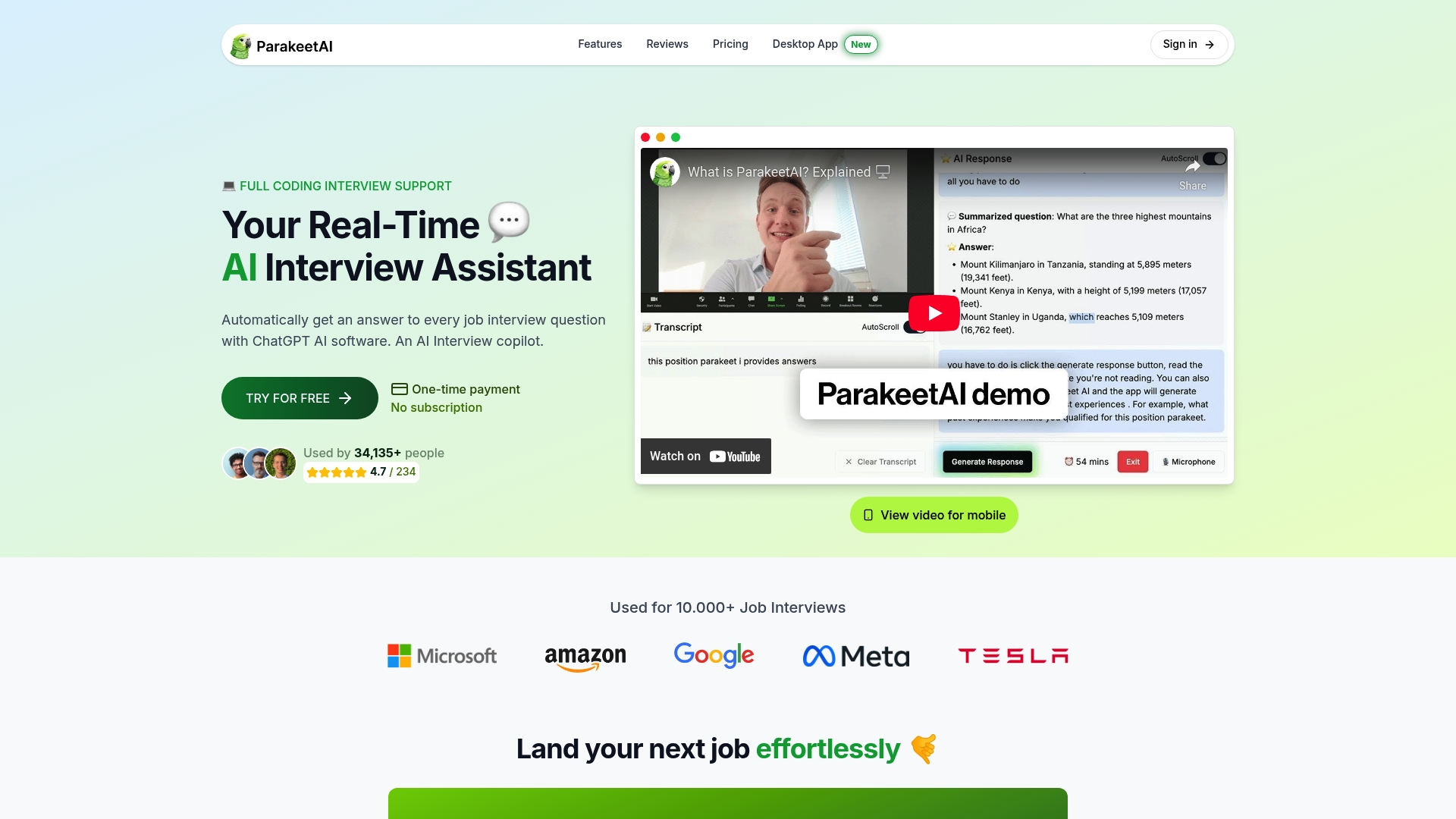
Parakeet-ai provides a real-time AI interview assistant that listens to interviews and automatically delivers answers to every question using AI, giving your team structured, evidence-based interview data from the first conversation. The platform connects with your existing recruitment workflows, supports fairness monitoring, and keeps human reviewers in the loop at every stage. Whether you are hiring for five roles or five hundred, Parakeet-ai scales with your process without asking you to rebuild it.
If you are ready to see what structured, AI-assisted interviewing looks like in practice, explore Parakeet-ai and find out how your team can hire faster, fairer, and with more confidence.
FAQ
What is scalable interview AI?
Scalable interview AI is technology that uses NLP, machine learning, and AI transcription to conduct and score candidate interviews at any hiring volume. It integrates with ATS systems to deliver structured, auditable evaluations that remain consistent whether you are assessing 10 candidates or 10,000.
How does AI reduce bias in hiring?
AI-driven evaluations reduce bias by applying consistent scoring rubrics across all candidates, removing the variability introduced by individual interviewers. Bias reduction reaches up to 68 percent when human-in-the-loop oversight and regular fairness audits are part of the process.
Who is legally responsible for AI hiring decisions?
Employers bear full legal responsibility for AI tool outputs under EEOC and ADA guidance. This includes conducting pre-deployment bias audits, maintaining documentation, and providing explainability for every candidate decision the AI influences.
How scalable is interview AI for high-volume hiring?
Most enterprise platforms handle thousands of concurrent interview sessions without performance degradation. Organizations report qualified shortlists available within the same week of deployment, which makes interview AI particularly valuable during peak hiring periods.
What are the best practices for using interview AI?
The most effective approach maps competencies to ATS fields before launch, runs parallel human and AI evaluations during calibration, schedules monthly bias audits, and tracks post-hire performance data to continuously refine scoring models.