
What Is Unbiased Interview AI? A 2026 Guide

TL;DR:Unbiased interview AI applies standardized, rubric-based scoring to evaluate candidates consistently, reducing human subjectivity.However, it does not eliminate bias entirely due to data flaws and automation bias, emphasizing the need for human oversight and regular audits.
Most people assume AI either eliminates bias or makes it worse. The truth about what is unbiased interview AI lands somewhere more interesting. These systems don’t promise a bias-free world. What they do is replace inconsistent human judgment with standardized, rubric-based evaluation, scoring every candidate against the same criteria every single time. That matters enormously, whether you are a recruiter tired of gut-feel hiring decisions or a job seeker wondering why you keep getting screened out before a human ever reads your name.
Table of Contents
- Key takeaways
- What unbiased interview AI actually is
- The real benefits and the honest limitations
- Implementing AI interviews responsibly
- What job seekers need to know
- My take on where this technology actually stands
- See how Parakeet-ai approaches interview fairness
- FAQ
Key takeaways
| Point | Details |
|---|---|
| Standardized scoring reduces subjectivity | Unbiased AI applies the same rubric to every candidate, removing inconsistent personal judgment. |
| AI reduces bias but doesn’t eliminate it | Training data flaws and automation bias mean human oversight is still non-negotiable. |
| Compliance is mandatory, not optional | Tools must meet EEOC guidelines and local laws like NYC Local Law 144 to be legally defensible. |
| Candidates benefit from transparent audits | Audit trails and scoring explanations protect candidate rights and build trust in AI-driven hiring. |
| Human review must stay in the loop | The most effective hiring AI pairs automation with meaningful human decision-making at critical points. |
What unbiased interview AI actually is
Let’s clear up the most common misunderstanding. “Unbiased” doesn’t mean the AI is perfectly neutral. It means the system applies objective, consistent criteria to every candidate rather than letting interviewers drift toward whoever reminds them of themselves.
Here’s the mechanics: an unbiased AI interview system uses pre-defined scoring rubrics, approved by the hiring organization, to evaluate candidate responses. Every applicant gets the same questions. Every answer gets measured against the same behavioral anchors. There is no room for a recruiter’s mood on a given Tuesday to sink a qualified candidate.
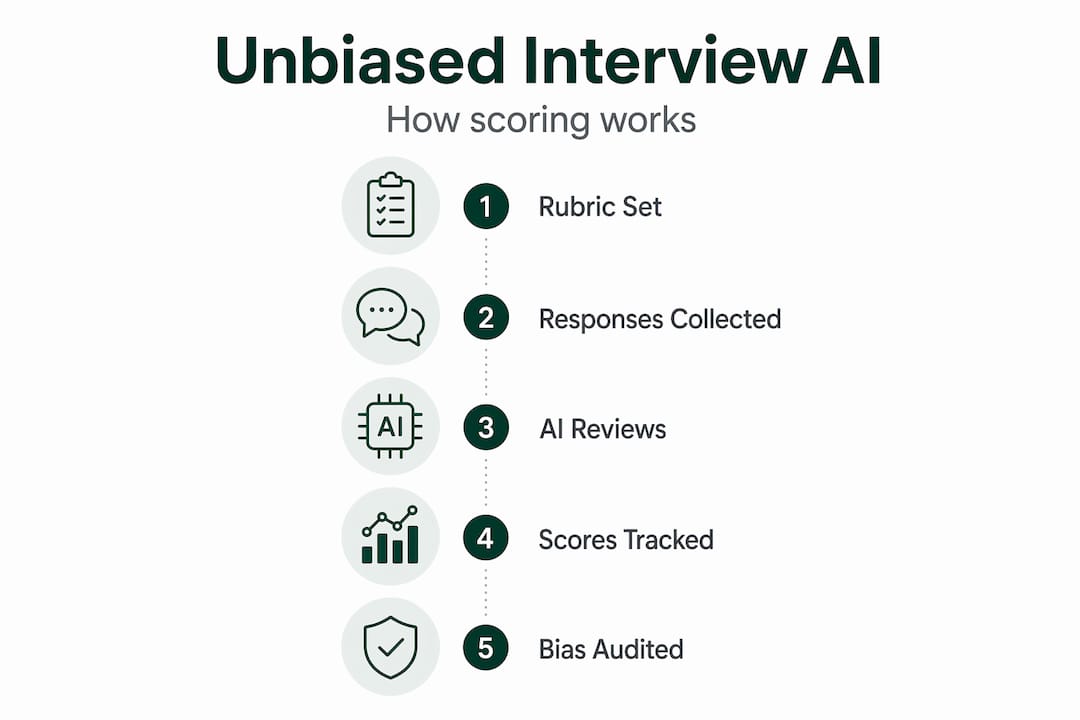
What makes this meaningfully different from traditional screening is traceability. Systems built on rubric-based scoring apply client-approved criteria to every response, which means you can look back at any decision and explain exactly why a score was what it was. That auditability is the backbone of legally defensible hiring.
One concrete example worth studying: VidCruiter’s AI Interview Scoring excludes biometric signals entirely, meaning it does not analyze facial expressions, vocal tone, or emotional cues. Instead, it evaluates what candidates said, not how they said it. That distinction matters because biometric analysis opens the door to discrimination based on disability, accent, or neurodivergence.
Key features that define a genuinely unbiased AI interview tool:
- Fixed, pre-approved scoring rubrics applied uniformly across all candidates
- Evaluation focused on job-relevant responses, not physical or demographic traits
- Transparent scoring rationale that explains each individual result
- Client-controlled criteria that can be audited and adjusted over time
- No analysis of biometric features like facial expressions or speech patterns
Pro Tip: When evaluating any AI interview tool, ask the vendor directly whether biometric data informs any part of the score. If the answer is vague, that’s your answer.
The real benefits and the honest limitations
The benefits of unbiased interview AI are not hypothetical. They show up in how consistently candidates get assessed and how much faster organizations can screen large applicant pools without letting personal familiarity drive decisions.
Consistency is the headline benefit. When every candidate answers the same structured questions and gets scored against the same rubric, you get a genuine apples-to-apples comparison. This is especially important in high-volume hiring, where interview fatigue alone can cause a recruiter’s standards to slip by the fifth candidate of the day. AI doesn’t get tired.

Speed and scale follow from consistency. AI tools can process hundreds of recorded or text-based responses and surface ranked candidates far faster than a team of human reviewers. That speed also expands access. AI anonymization of resumes strips protected characteristics from profiles early in the process, which means candidates from non-traditional backgrounds get evaluated on merit before a human ever sees their name, school, or zip code.
But the limitations are real and worth taking seriously.
| Benefit | Limitation |
|---|---|
| Consistent scoring across all candidates | Training data reflects historical inequities |
| Merit-based evaluation removes gut-feel decisions | AI resume screening favors white-associated names in 85.1% of cases |
| Scales to hundreds of candidates efficiently | Automation bias causes recruiters to overtrust AI scores up to 90% |
| Anonymization reduces demographic-based screening | Struggles to fairly assess neurodiverse and non-binary candidates |
| Auditable trail supports legal defensibility | Rapid deployments can encode discriminatory rules unintentionally |
That automation bias number deserves emphasis. When humans overtrust AI outputs, they stop applying meaningful critical review. The AI’s mistakes don’t get caught. They get institutionalized. 61% of AI recruitment tools trained on historical data replicate discriminatory patterns, which means a tool built on decades of biased hiring data will tend to reproduce that bias at scale and at speed.
“The most effective AI recruiting blends automation with empowered human judgment at critical decision points.” The systems that actually improve fairness are the ones that treat AI as a first pass, not a final verdict.
Continuous bias auditing is not optional maintenance. It is the mechanism that keeps a well-designed tool from drifting into discriminatory territory as job requirements and candidate pools evolve.
Implementing AI interviews responsibly
For HR professionals, understanding the theory of unbiased AI is only half the job. Deploying it in a way that holds up legally and earns candidate trust is where most organizations run into trouble.
Here is a practical framework for responsible implementation:
- Design structured interviews with fixed questions. Every candidate must receive the same set of questions in the same order. Structured interview formats with behaviorally anchored rating scales are the foundation of fair AI-assisted evaluation.
- Anonymize early-stage profiles. Use AI to redact names, graduation years, addresses, and other protected characteristics before human reviewers see any candidate profile. This breaks the pattern-matching bias that kicks in before a conversation even starts.
- Know your compliance obligations. In the United States, the EEOC’s four-fifths rule requires that selection rates for any protected group not fall below 80% of the highest-performing group’s rate. NYC Local Law 144 mandates third-party bias audits for any AI tool used in hiring decisions. For a deeper look at how these requirements apply to AI tools, AI interview compliance is a topic worth studying before deployment.
- Build in meaningful human override capability. AI scores should inform decisions, not make them. Every hiring process needs a point where a qualified human reviewer can question, adjust, or override an AI recommendation with a documented rationale.
- Tell candidates the AI is involved. Transparency is both an ethical obligation and a trust-building move. Only 26% of candidates trust AI to evaluate them fairly, which means proactive communication about how AI is used, and how scores are reviewed, directly affects whether top candidates complete your process or drop out.
Pro Tip: Run an adverse impact analysis on your AI tool’s outputs every quarter. Track pass rates by gender, race, and age. If any group falls below the four-fifths threshold, pause and audit before continuing.
What job seekers need to know
If you are a candidate navigating an AI-assisted hiring process, the most useful thing you can understand is what the system is and isn’t measuring. That shapes how you prepare and what rights you actually have.
The core promise of unbiased AI for interviews is that your demographic background matters less than your demonstrated competencies. The system scores what you say against a predefined rubric. That means the attributes that sometimes hurt candidates in human-reviewed processes, things like an unfamiliar name, a nontraditional career path, or a school the recruiter has never heard of, carry less weight when an AI is doing the initial screen.
What you should know before an AI interview:
- The AI is typically scoring your responses against specific, job-related criteria. Concrete, structured answers that clearly address the question score better than vague, anecdotal ones.
- You have the right to ask whether AI is used in the hiring process and what role it plays. Many jurisdictions now require companies to disclose this.
- Audit trails protect you as a candidate. If you suspect a decision was unfair, documented scoring rationale gives you something concrete to point to.
- AI systems can struggle with neurodiverse candidates and non-standard communication styles. If you have a disability that affects how you communicate in interviews, you can request accommodations before the process begins.
- Prepare as you would for a structured in-person interview. Focus on specifics, examples, and direct answers to behavioral questions.
The bias challenges in AI interview systems are real, but awareness gives you leverage. Candidates who understand how these tools work tend to perform better in AI-screened processes and are better positioned to advocate for themselves when something seems off.
My take on where this technology actually stands
I’ve spent years watching organizations adopt new hiring technology with genuine optimism and then quietly abandon it when the results didn’t match the pitch. Unbiased interview AI is different in one specific way: the underlying mechanism, standardized rubric scoring, actually works as advertised. The problems show up everywhere else.
What concerns me most is automation bias. When a recruiter trusts an AI score without questioning it, the system’s errors don’t get surfaced. They get buried under a veneer of objectivity. And because the errors come with a number attached, they feel more credible than a human judgment call that everyone knows is fallible. That is a more dangerous form of bias, not a less dangerous one.
My honest read on this technology is that it is genuinely useful when three conditions are met. The rubric reflects the actual job requirements. The scoring logic excludes demographic signals. And a qualified human reviews and can override every AI recommendation before a decision is finalized. Without all three, you are not using unbiased AI for interviews. You are using an automated process that gives discrimination a cleaner paper trail.
The future I want to see is not AI that replaces human judgment. It’s AI that forces human judgment to be more explicit, documented, and accountable. The best tools in this space are already moving in that direction. The rest need to catch up.
— Jure
See how Parakeet-ai approaches interview fairness
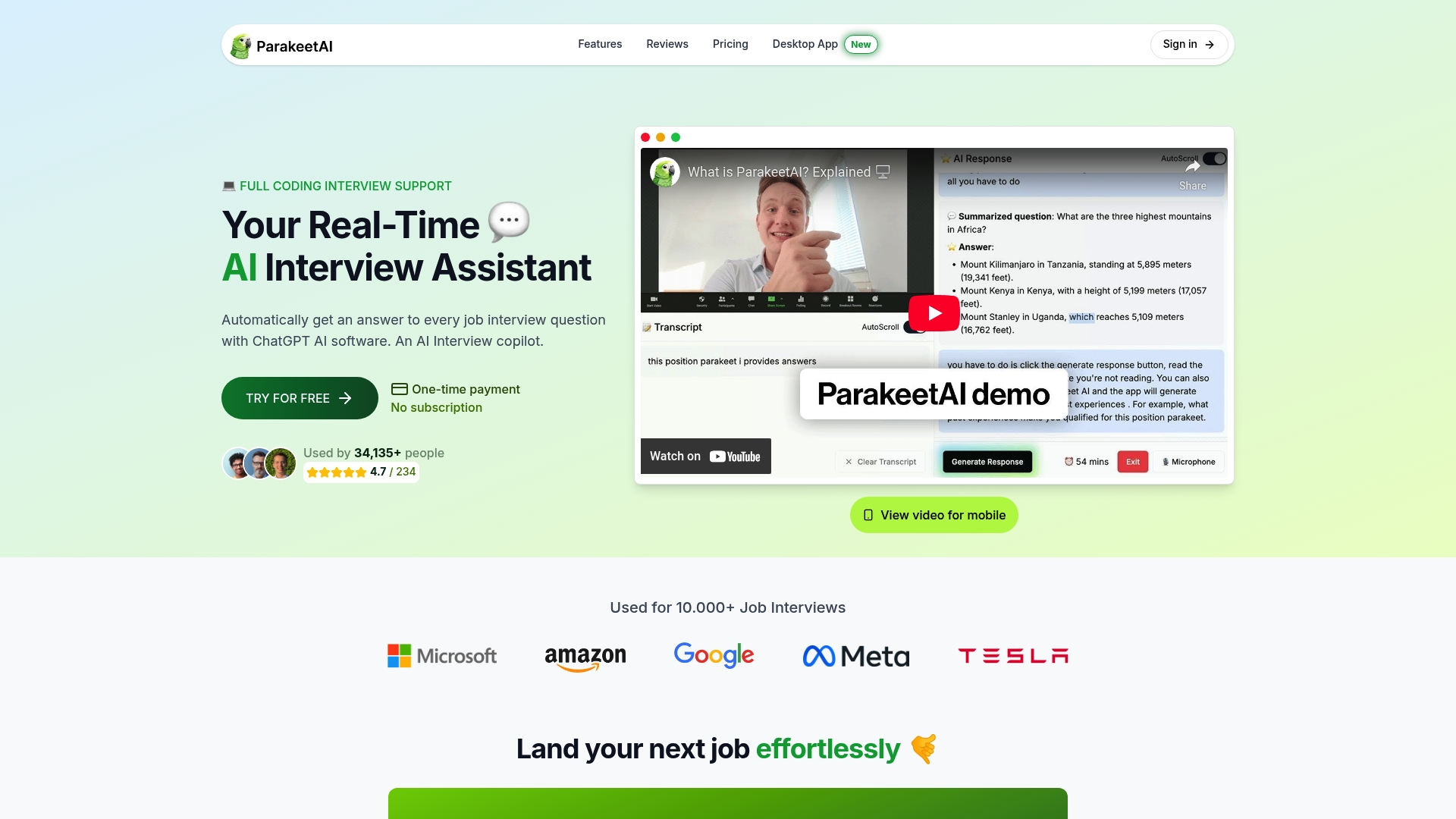
Parakeet-ai was built on the premise that every candidate deserves a fair shot and every recruiter deserves tools that hold up under scrutiny. The platform’s real-time AI interview assistant listens to your interview in progress and provides answers grounded in the job-relevant criteria that matter most, without analyzing biometric signals or making judgments based on how you look or sound.
For HR professionals, Parakeet-ai’s approach reflects the human-in-the-loop principles outlined in this article. Scores are explainable, criteria are client-defined, and human reviewers retain full authority over final decisions. For job seekers, the platform offers a real-time AI interview assistant that helps you perform at your best when it counts most. Whether you are preparing for an AI-screened process or looking to build a fairer hiring pipeline, Parakeet-ai is worth a look.
FAQ
What is unbiased interview AI in simple terms?
Unbiased interview AI uses standardized, rubric-based scoring to evaluate every candidate against the same pre-defined criteria, reducing the inconsistent personal judgments that drive subjective hiring decisions.
Can AI completely eliminate bias in hiring?
No. AI can reduce human subjectivity, but training data reflects historical bias, and automation bias leads recruiters to overtrust AI scores. Human oversight and regular audits are still required.
How does unbiased interview AI work technically?
The AI applies a client-approved scoring rubric to candidate responses, evaluating what was said against job-relevant criteria without analyzing facial expressions, tone, or other biometric data.
What regulations apply to AI interview tools?
In the US, the EEOC four-fifths rule governs adverse impact testing, and NYC Local Law 144 requires third-party bias audits. Compliance with these frameworks is mandatory for legal defensibility.
How should candidates prepare for an AI interview?
Focus on concrete, structured answers tied directly to the question asked. Ask the employer whether AI is used and what criteria it scores against. Request accommodations before the process if you have a disability that affects communication.