
What is advanced AI job screening? A complete guide

TL;DR:Nearly half of organizations now use AI for recruiting, but many applicants and HR professionals do not understand how it works. AI evaluates candidates through stages like pre-screening, assessment, summarization, and feedback loops, using technologies such as machine learning and NLP. Proper criteria definition and legal compliance are essential to ensure fair, unbiased hiring outcomes with AI tools.
Nearly half of all organizations now use AI for recruiting tasks, yet most job seekers and HR professionals have little idea what actually happens when they hit “submit” on an application. 44% to 51% of organizations already use AI for recruiting, with 73% expecting to increase that use in 2026. Understanding what is advanced AI job screening matters whether you are trying to get through it or trying to build it into your hiring process fairly and legally. This guide breaks down how it works, what it gets right, where it falls short, and what both candidates and recruiters should do about it.
Table of Contents
- How advanced AI job screening works: stages and technologies
- Benefits of advanced AI screening for job seekers and recruiters
- Legal compliance and bias mitigation in AI job screening
- Practical advice for job seekers and HR professionals using AI screening
- The hidden truth about advanced AI job screening most experts don’t discuss
- How ParakeetAI supports smarter, fairer hiring with advanced AI screening
- Frequently asked questions
Key Takeaways
| Point | Details |
|---|---|
| AI adoption | Nearly half of organizations now use AI for job screening, with usage expected to grow in 2026. |
| Screening stages | Advanced AI screening involves pre-screening, assessment, summarization, and feedback loops. |
| Efficiency and fairness | AI speeds up hiring while promoting consistent, unbiased candidate evaluation. |
| Legal compliance | Employers must monitor AI tools for bias and follow EEOC guidelines to avoid discrimination. |
| Human oversight | Maintaining recruiters’ final decision authority ensures fairness and accountability in AI screening. |
How advanced AI job screening works: stages and technologies
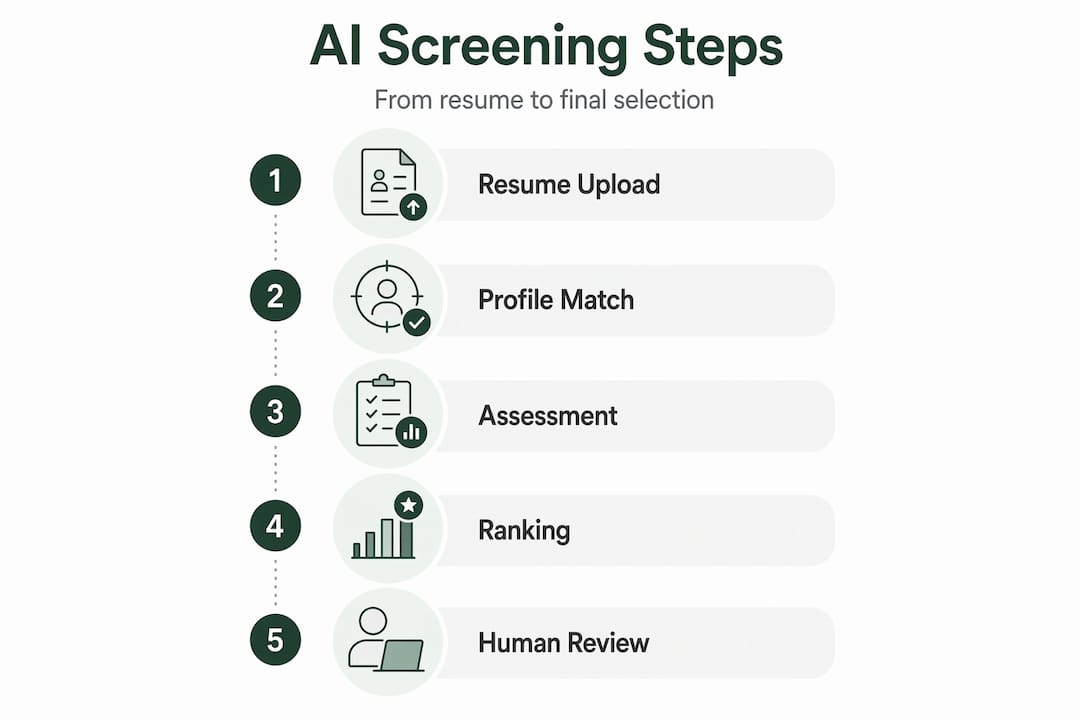
AI does not read your resume the way a recruiter does. It parses, scores, and ranks at a scale no human team can match. According to AI candidate screening research, the process typically moves through four distinct stages, and each one uses different technology to do a specific job.
The four stages of advanced AI job screening:
- Pre-screening: Natural language processing (NLP) scans incoming applications in seconds. It extracts skills, job titles, and relevant experience, then compares them against your defined criteria. This stage filters volume. A posting that receives 800 applications might be narrowed to 80 before a human ever opens a single file.
- Assessment: Shortlisted candidates move into deeper evaluation. This can include structured video interviews analyzed for vocabulary and response quality, cognitive or skills-based tests scored by machine learning models, and personality or behavioral questionnaires compared against top-performer profiles.
- Summarization: AI converts interviews and assessments into searchable transcripts. Key highlights are flagged automatically, so recruiters reviewing ten candidates can compare responses side by side rather than rewatching hours of footage.
- Feedback loops: Every recruiter decision feeds back into the model. When a recruiter advances a candidate the AI ranked lower, or passes on one it ranked highly, the system notes the gap and adjusts its weighting over time.
Core technologies driving each stage:
- Machine learning (ML): Learns patterns from historical hiring data and refines scoring models
- Natural language processing (NLP): Reads and interprets unstructured text like resumes and cover letters
- Speech recognition: Transcribes and analyzes verbal responses in video assessments
- Predictive analytics: Estimates future job performance based on patterns across successful hires
For a broader look at how this fits into job applicant screening, the technology stack continues to evolve quickly. The key insight most guides miss: the quality of each stage depends entirely on the quality of the criteria fed into it upfront.
Benefits of advanced AI screening for job seekers and recruiters
Understanding how AI screening operates makes the benefits easier to evaluate honestly, rather than taking vendor claims at face value.
For recruiters and hiring teams:
- AI screening cuts time-to-fill by 50%, freeing recruiters for interviews and relationship building instead of application sorting
- Bullhorn Amplify users report 51% more submissions, 22% higher fill rates, and 36% more placements
- Consistent criteria applied to every application removes the “Monday morning bias” problem, where fatigue and mood affect human reviewers differently throughout the day
- Audit trails document every scoring decision, which matters enormously when a rejected candidate asks why
For job seekers:
- Faster pipeline movement means fewer weeks of silence after applying
- When AI systems exclude protected attributes (race, gender, age) from scoring, candidates are evaluated on actual qualifications rather than demographic signals embedded in names or addresses
- AI can surface skills buried in non-traditional resumes that keyword-based systems would have missed entirely
The real benefits of AI in job search are genuine, but they require well-designed systems and honest implementation. An AI tool trained on biased historical data reproduces that bias at scale, which is precisely why legal oversight matters.
Pro Tip: If you are a job seeker, do not try to game keyword density. Write your resume so a specific, qualified person would clearly understand your role, responsibilities, and outcomes. AI systems using NLP reward contextual clarity over keyword stuffing, and human reviewers do too.
Legal compliance and bias mitigation in AI job screening
AI screening tools are not exempt from employment law. They are subject to the same rules as every other selection procedure, and regulators are paying close attention.
What the law requires:
- AI hiring tools qualify as “selection procedures” under Title VII of the Civil Rights Act and must be both job-related and non-discriminatory
- EEOC guidance requires employers to monitor AI tools for disparate impact using the four-fifths (80%) rule: if a protected group passes at less than 80% the rate of the highest-passing group, that is a red flag requiring investigation
- Under Title VII, employers must test AI tools for adverse impact before deployment and select less discriminatory alternatives when they exist
- The NIST AI Risk Management Framework recommends diverse teams for AI development and regular measurement of bias as part of responsible deployment
Best practices for HR teams:
- Run quarterly audits comparing pass rates across protected categories
- Keep a human reviewer in the loop for any borderline or edge-case decision
- Document the business justification for every AI scoring criterion
- Choose tools that generate plain-language explanations for candidate rankings, not just scores
“Explainable AI is not optional anymore. If you cannot defend a hiring decision in plain English, you should not be making that decision with an AI system that operates as a black box.” This perspective, consistent with what leading HR compliance experts advocate, reflects where the industry is heading on bias mitigation as regulation tightens.
The uncomfortable reality: many organizations deploy AI screening tools without completing the pre-deployment adverse impact testing the law requires. That is legal exposure hiding behind a technology purchase.

Practical advice for job seekers and HR professionals using AI screening
Knowing the rules of the game changes how you play it, on both sides of the hiring table.
For job seekers:
- Prepare for multi-modal screening. Modern AI screening rarely stops at the resume. Expect video interviews, written assessments, and timed skills tests. Practice your responses to structured video prompts the same way you would prepare for an in-person interview.
- Request accommodations early. Under the ADA, candidates can request accommodations before AI screening begins if the format disadvantages a disability. Waiting until after an auto-rejection makes the process harder. Contact HR proactively and document your request.
- Write for clarity, not density. AI NLP systems reward well-organized, contextually clear text. Describe what you did, the scale at which you did it, and the outcome it produced. “Managed social media” is invisible. “Grew LinkedIn engagement by 40% over six months for a B2B SaaS brand with 12,000 followers” is not.
- Do not assume rejection means you are unqualified. If criteria were set poorly or the AI was not calibrated for non-traditional backgrounds, great candidates get filtered out. Following up directly with a recruiter after application remains worth doing.
For HR teams:
- Define “qualified” before you configure the tool. AI automates 60% to 70% of repetitive recruiter tasks, but it can only rank against the criteria you define. Vague or inflated requirements produce vague or inflated shortlists.
- Build human review into the workflow by design, not as an afterthought. Assign a reviewer to every candidate the AI flags as borderline, and document the reasoning for advances and rejections alike.
- Revisit your criteria quarterly. Role requirements change. AI models built on last year’s hiring data may be subtly filtering out exactly the kind of candidate you need now.
- Train your recruiters on what AI output actually means. A score of 87 out of 100 is not a guarantee of a good hire. It means the candidate matches your defined criteria well. Recruiters who treat scores as verdicts hand over judgment they should keep.
Pro Tip: The role of AI in pre-employment testing works best when recruiters can see not just who scored well, but why. Prioritize tools that show you the reasoning behind a ranking, not just the number.
The hidden truth about advanced AI job screening most experts don’t discuss
Every article on AI screening covers efficiency gains and legal compliance. Here is what most of them skip.
The biggest failure point in AI screening is not the algorithm. It is the humans who configure it. Experts note that AI scoring depends entirely on precisely defined qualifications. Poorly defined criteria do not produce a weaker shortlist. They produce a confidently wrong one, fast. The AI presents its output with the same apparent certainty whether the criteria were carefully designed or thrown together in twenty minutes.
This creates a specific risk that gets almost no attention: AI narrows diversity not through obvious discrimination, but through over-specification. When you require “five years of experience in X platform” for a role where three years of adjacent experience would work equally well, you are not setting a meaningful bar. You are filtering out candidates who took non-linear paths, often women and underrepresented minorities who changed industries, took career breaks, or built skills in non-corporate settings. Practitioners confirm that without proper oversight, AI tools can quietly miss talented candidates who do not fit a rigid template.
The second hidden truth: the feedback loop that makes AI smarter can also make it more biased over time. If your historical hiring decisions favored a particular profile, the AI learns that profile is “good.” It gets better at finding more of the same. That is not intelligence. That is pattern replication.
What this means practically: treat AI as a first-pass tool with a known margin of error, not as a decision-maker. Build explicit “non-traditional background” criteria into your model. Run human spot-checks on rejected candidates, not just shortlisted ones. The rejected pile is where the bias audit matters most.
Pro Tip: Organizations that view AI as augmenting recruiter judgment rather than replacing it consistently report better hiring outcomes and fewer compliance issues. The technology is the tool. The recruiter is still the professional.
How ParakeetAI supports smarter, fairer hiring with advanced AI screening
Putting everything above into practice requires more than good intentions. It requires the right tools.
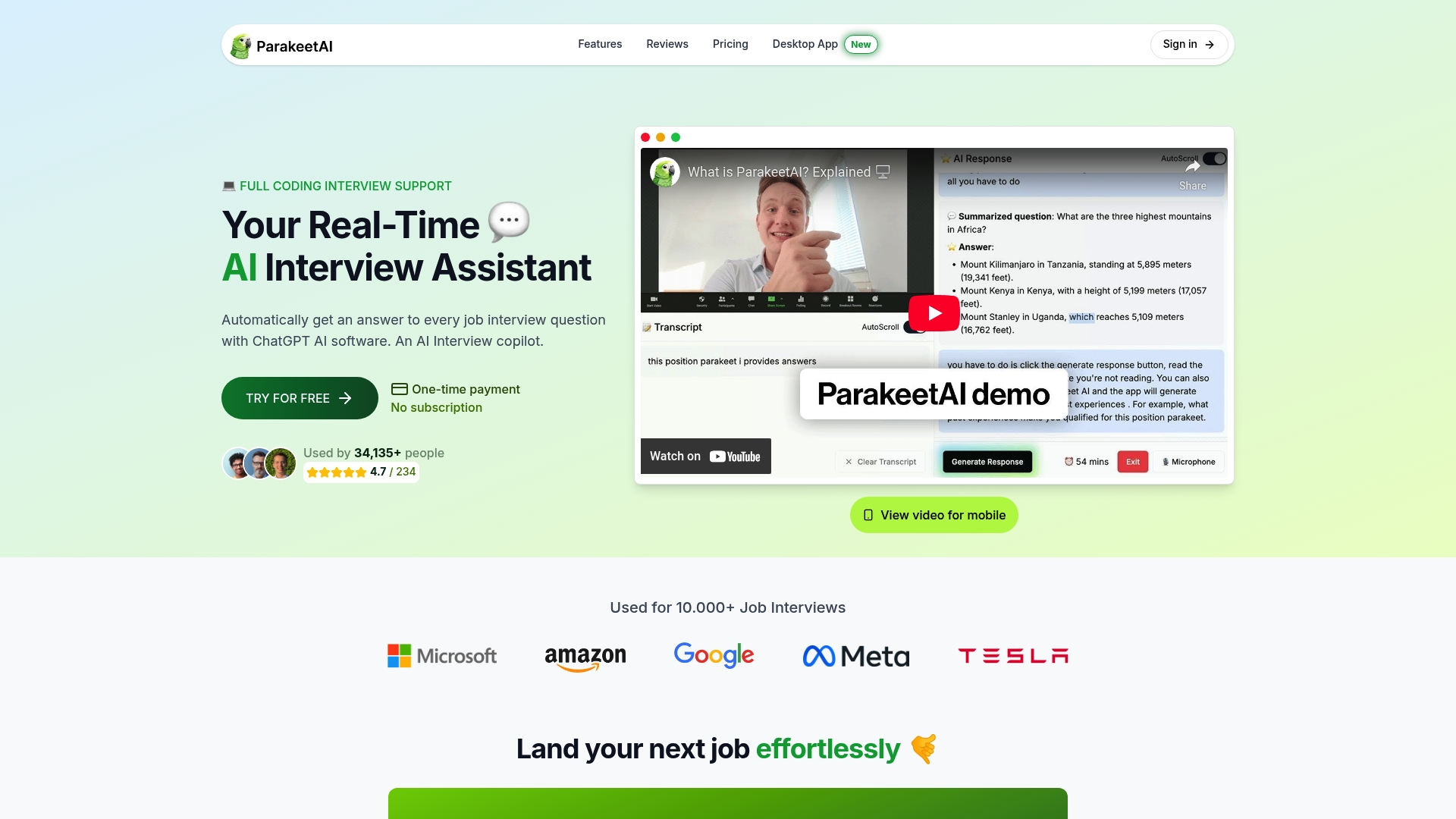
ParakeetAI is built for exactly this moment in hiring. Whether you are a job seeker preparing to navigate AI screening or an HR professional trying to implement it responsibly, ParakeetAI’s real-time AI interview assistant gives you an edge. Our platform listens during interviews and delivers instant, relevant answers so candidates stay confident and focused. For HR teams, the transparency and audit-ready design keeps your process defensible and fair. Advanced AI job screening does not have to feel like a black box, for either side. See what a smarter, more human approach to AI-assisted hiring looks like when the technology is built with accountability from the ground up.
Frequently asked questions
What exactly is advanced AI job screening?
Advanced AI job screening uses machine learning and NLP to evaluate and rank job applicants based on their fit for a role, reducing manual review time while helping recruiters make faster, more consistent decisions.
How does AI screening reduce bias in hiring?
AI screening tools apply consistent criteria to every candidate and can exclude protected attributes from scoring, but EEOC guidelines require regular auditing using the four-fifths rule to ensure no protected group is disproportionately filtered out.
Can AI screening automatically reject candidates without human review?
Best-practice AI systems recommend and rank candidates rather than issuing automatic rejections, always keeping a human recruiter in the decision seat for final hiring choices.
How can job seekers prepare for AI screening processes?
Focus on writing clear, specific descriptions of your skills and outcomes in your resume, practice video and assessment formats, and request accommodations early under the ADA if any screening format disadvantages a disability you have.
What legal protections apply to AI job screening?
AI screening is governed by Title VII, and employers must test tools for adverse impact before deployment, selecting less discriminatory alternatives when available to stay in compliance.