How interview anxiety detection AI empowers job seekers
TL;DR:Interview anxiety detection AI analyzes verbal and nonverbal cues to objectively identify signs of nervousness during interviews. It provides real-time, quantifiable feedback by fusing multiple data streams, helping candidates practice and improve their performance. While accurate and increasing in adoption, these systems should be used as reflection tools rather than definitive judgments of worth.
Most job seekers walk into interviews believing their anxiety is invisible, or at least hidden well enough. The sweaty palms, the slight voice tremor, the darting glance — they assume these signals fly under the radar. But AI detection systems are now trained to catch exactly these cues, often with greater consistency than a human interviewer ever could. This guide breaks down what interview anxiety detection AI actually is, how it processes your behavior in real time, how accurate these systems are, and most importantly, how you can use this technology to prepare smarter and feel more confident on interview day.
Table of Contents
- What is interview anxiety detection AI?
- How does interview anxiety detection AI work?
- Performance and accuracy: Can AI really spot anxiety?
- Practical uses and limitations for job seekers
- The future of interview anxiety AI: Practical power, real-world limits
- How ParakeetAI supports your interview journey
- Frequently asked questions
Key Takeaways
| Point | Details |
|---|---|
| Objective anxiety analysis | AI can reliably detect interview anxiety by analyzing your verbal and nonverbal cues. |
| Practical performance feedback | These tools give actionable insights to help you practice and improve your interview skills. |
| Accuracy matches humans | Modern interview anxiety detection AI is now as accurate as experienced human evaluators. |
| Mind privacy and authenticity | Be aware of data privacy, cultural nuance, and ethical use when using these AI tools. |
What is interview anxiety detection AI?
Before we see how this technology works, let’s clarify what interview anxiety detection AI actually means.
At its core, interview anxiety detection AI refers to artificial intelligence systems designed to identify signs of anxiety in job candidates during interviews. These systems analyze a combination of verbal and nonverbal signals — your facial expressions, the pace of your speech, your eye contact patterns — and return structured feedback about your anxiety levels and performance.
This is different from traditional interview feedback in three important ways:
- Objectivity: Human interviewers carry unconscious biases. AI models evaluate patterns consistently across every candidate.
- Real-time analysis: These systems can flag anxiety cues as they happen, not hours later in a debrief session.
- Emotional metrics: Beyond “you seemed nervous,” AI produces quantifiable data, such as a stress score or confidence rating on a measurable scale.
There are two common misconceptions worth clearing up. First, many candidates assume this technology only benefits hiring teams looking to screen people out. In reality, the most powerful use case for job seekers is practice. You can run mock interviews against these systems, receive specific feedback, and work on overcoming interview anxiety before the real interview ever happens.
Second, AI does not “feel” your nervousness the way a human does. It does not have empathy or intuition. What it does is recognize patterns in data that statistically correlate with anxiety, the same way a weather model recognizes pressure patterns that precede rain.
“These systems turn subjective human impressions into measurable data points, giving candidates a mirror they’ve never had before.”
That shift from subjective to measurable is what makes this technology genuinely useful for job seekers who want to grow.
How does interview anxiety detection AI work?
Now that you know what this AI is, let’s break down how these systems actually work during an interview.
The process follows four main steps:
- Input capture: The system records video and audio from your interview session, whether live or simulated.
- Data processing: Multiple AI models analyze the footage simultaneously, each focused on a different signal type.
- Fusion and scoring: Results from all models are combined into a unified anxiety or performance score.
- Feedback output: The system returns structured, actionable feedback, showing which moments triggered the highest stress signals and why.
The mechanics involve multimodal analysis, including facial emotion recognition (FER) using convolutional neural networks (CNNs), gaze tracking using facial landmarks, and audio analysis for pitch, hesitancy, and fluency using MFCC (a method of representing audio as data the AI can read) and large language models. Additionally, transformer models like BERT and SBERT are used for question generation, combined with CNN facial analysis and XGBoost for scoring behavioral feedback.
Here is a quick comparison of the main analysis methods used in these systems:
| Analysis method | What it detects | Key technology used |
|---|---|---|
| Facial emotion recognition | Fear, stress, confusion via micro-expressions | CNNs, deep learning |
| Audio analysis | Pitch shifts, hesitation, speaking pace | MFCC, LLMs |
| Gaze tracking | Eye contact avoidance, distraction patterns | Facial landmark models |
| Behavioral fusion | Combined signal for overall anxiety score | XGBoost, BERT models |
Consider this real scenario: you avoid eye contact, pause frequently, and speak in a lower pitch than your baseline, but your facial expression appears relatively calm. A system that only used facial analysis would miss most of the anxiety signals. Multimodal fusion catches the full picture by combining all four channels and weighting them together. That is why real-time job interview insights drawn from multiple data streams are far more reliable than any single metric.

Pro Tip: These systems analyze not just what you say, but how you say it. A strong answer delivered in a shaky, hesitant tone will still register high anxiety signals. Practice your delivery as much as your content.
Performance and accuracy: Can AI really spot anxiety?
With the technical process explained, let’s see how effective these AI tools really are and whether they’re trustworthy for job seekers like you.
The numbers are compelling. FER accuracy reaches 86%, and anxiety detection models like Dual-Channel BERT achieve 88.86% accuracy with a remarkable 99.34% high-risk recall. That last figure is particularly meaningful. It means the model almost never misses a candidate experiencing genuine high anxiety, even if it occasionally flags a false positive. In clinical and coaching contexts, catching the real cases matters most.
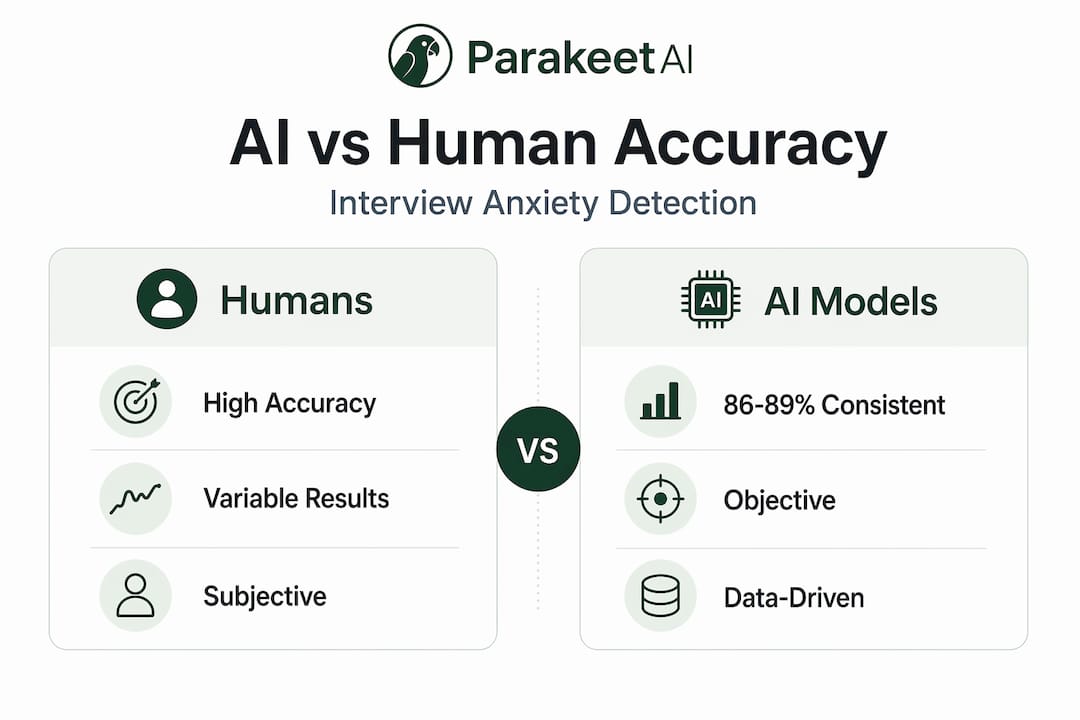
Here is how AI models stack up against human evaluators:
| Factor | Human evaluators | AI models |
|---|---|---|
| Accuracy | High but variable | 86-89% consistent |
| Objectivity | Prone to bias | Consistent across candidates |
| Bias risk | Significant | Reduced but not eliminated |
| Real-time feedback | Not possible | Core feature |
| Score consistency | Varies between raters | Standardized |
A separate large-scale review found that AI methods show higher accuracy than traditional assessment tests, based on analysis of 119 peer-reviewed studies. That is not a small sample. It represents a broad scientific consensus forming around AI-based behavioral assessment.
What does this mean for you as a job seeker? It means these systems catch signals you may not even be aware of. Most people walk out of a mock interview thinking, “That went well,” without realizing their gaze dropped every time they answered a difficult question, or that their voice pitch spiked on questions about conflict. AI surfaces those patterns clearly.
It is worth noting that AI interview ethics are still evolving. Multimodal fusion helps reduce false positives by cross-checking signals, but no system is perfect. Use the scores as directional feedback, not as absolute truth.
Practical uses and limitations for job seekers
Armed with this knowledge of accuracy and mechanics, here’s how you can actually use interview anxiety detection AI to improve your performance, and what to watch out for.
How job seekers are using these tools right now:
- Mock interview practice: Running simulated interviews with AI feedback helps you identify specific anxiety triggers before a real interview.
- Live coaching: Some platforms offer real-time prompts during practice sessions, nudging you to slow down, maintain eye contact, or adjust your tone mid-answer.
- Post-interview review: After a session, AI can generate a timestamped report showing which questions caused the most stress and how your verbal delivery changed.
Tools like AceInterview and IVAS offer ways to address interview anxiety proactively, though privacy in real-time use and accuracy across all candidate types are still being refined. That is an honest acknowledgment from the research community, and job seekers should expect continued improvements over the next few years.
There are real limitations to understand:
- Cultural variation: Emotional expression differs significantly across cultures. A candidate from a culture where eye contact is considered disrespectful will trigger false anxiety flags in systems not trained on diverse data.
- Privacy concerns: Reliance on real-time assistance raises ethical concerns about authenticity, particularly when used during live interviews rather than practice sessions.
- Possible bias: Systems trained predominantly on certain demographic groups may produce less accurate scores for others. This is an active area of research.
- Not a substitute for growth: Using AI feedback without genuine self-reflection can become a crutch rather than a catalyst.
“Detection integrates clinical scales with multimodal data but may overlook cultural variations in emotional expression, which means candidates from diverse backgrounds should interpret scores with that context in mind.”
When choosing a platform, look for tools that offer transparency about their data practices, opt-in controls, and explanations for their scores rather than just a number. You can also explore how AI fairness in interviews is being addressed by the broader tech community. For context on how AI is already shaping hiring from the other side, AI resume screening is one area where automated tools have been used for years — giving you a sense of how mature (and imperfect) this space already is.
The connection to AI ethics in interviews is important here. The same ethical questions about transparency, consent, and fairness that apply to hiring-side AI tools apply equally to candidate-side coaching tools. Know what data you are generating, who has access to it, and how it will be used.
Pro Tip: Treat your AI anxiety score the same way an athlete treats a performance metric — as a coaching tool that shows where to focus your energy, not as a verdict on your worth as a candidate.
The future of interview anxiety AI: Practical power, real-world limits
Most articles on this topic will tell you that AI anxiety detection is either a miracle or a threat. That framing misses the more useful truth: it is a mirror, and like any mirror, its value depends entirely on what you do when you look into it.
The real insight that most job seekers overlook is this. AI is not measuring your worth as a professional. It is measuring a set of behavioral signals that statistically correlate with anxiety. That is a much narrower thing, and it is also a fixable thing. A mirror showing you that your posture tightens during conflict questions is genuinely useful. A verdict declaring you “too anxious to hire” is not. The distinction matters enormously in how you approach these tools.
What actually works is using AI feedback for self-reflection and targeted practice. You identify a specific trigger, you practice responding to it deliberately, you re-test, and you improve. That loop is real and repeatable. What does not work is scripting every answer based on what the AI rewarded last session. You end up sounding rehearsed rather than genuine, which registers as a different kind of stress signal anyway.
There is an ethical edge to consider here as well. The same technology that helps you practice can, in theory, be deployed by employers to screen candidates without their knowledge. Tracking that boundary, between opt-in coaching and surveillance, is where the AI interview ethics insights conversation becomes most important. Job seekers should advocate for transparency and consent in any platform they use.
Looking ahead, the trajectory is clear. By 2028, expect much broader adoption of opt-in interview coaching tools powered by this technology, along with more personalized feedback loops that adapt to your specific communication style and cultural context. The systems will get better at distinguishing genuine anxiety from enthusiasm, cultural norms from avoidance, and deliberate pauses from nervous hesitation. For candidates who start familiarizing themselves with this space now, the learning curve will be far shorter when these tools become standard practice.
How ParakeetAI supports your interview journey
Ready to put this knowledge into action? Here’s how ParakeetAI can help you on your interview journey.
Understanding how AI detects and responds to interview anxiety is just the beginning. What changes your results is consistent, structured practice with tools designed specifically for job seekers like you.
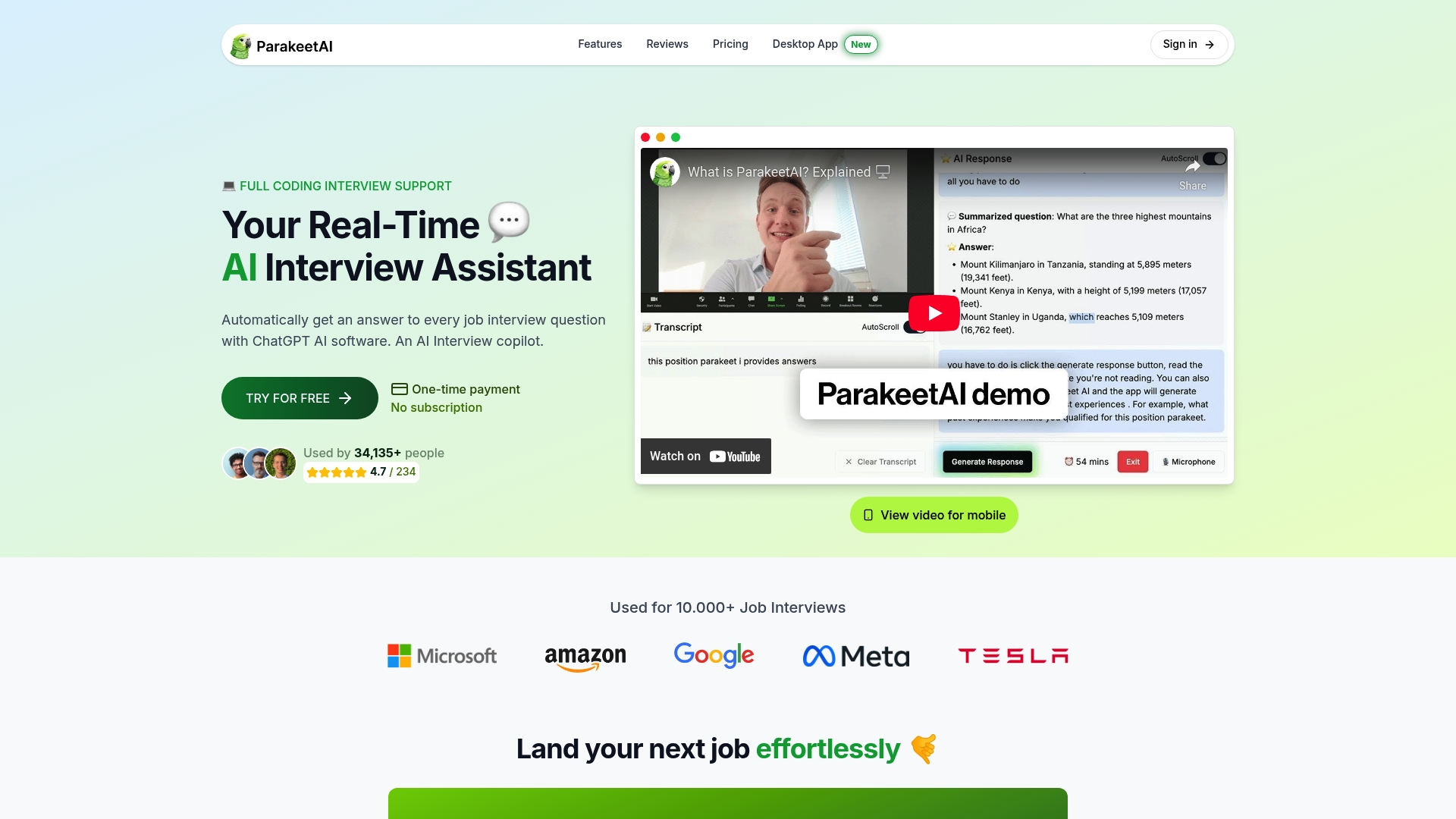
ParakeetAI is a real-time AI interview assistant that listens during your interview and automatically surfaces answers to every question as you go. Whether you’re working through mock interviews to reduce anxiety, building confidence in your responses, or looking for objective feedback on your delivery, ParakeetAI is built to support every step. Visit parakeet-ai.com to explore how real-time AI assistance can transform your interview preparation and help you walk into every interview feeling genuinely ready.
Frequently asked questions
Does interview anxiety detection AI work for all cultures and languages?
AI detection tools work best in languages and cultures they are trained on, but may miss cultural differences in emotional expression, so candidates from diverse backgrounds should weigh scores with that context in mind.
Is my interview data private when using anxiety detection AI?
Privacy depends on the platform you choose; reputable tools provide transparency and opt-in controls, but privacy in real-time use remains an evolving challenge across the industry.
How accurate is interview anxiety detection AI compared to humans?
AI now matches human evaluators closely, with less than one point difference between human and AI evaluator scores on a seven-point performance scale.
Can these AI tools help me improve before a real interview?
Yes, AI systems empower job seekers by providing objective, consistent feedback during practice sessions so you can address specific anxiety triggers before your real interview day.