
Smart questions to ask employers in any job interview

TL;DR:Many candidates focus exclusively on rehearsing answers, neglecting the importance of asking thoughtful questions during interviews.Structured, category-based questions about role, growth, culture, and the interviewer help candidates assess fit and demonstrate genuine interest.
Most candidates spend 95% of their interview prep time rehearsing answers and almost zero time crafting questions to ask back. That’s a critical mistake. Thoughtful questions help candidates clarify gray areas about role expectations and next steps, and they signal genuine due diligence and interest in mutual fit. When you walk into an interview armed with sharp, targeted questions, you’re not just impressing the hiring team. You’re actively deciding whether this role is worth your time. This article gives you a structured toolkit for doing exactly that.
Table of Contents
- How to build your list: Four categories that cover what matters
- Examples of high-impact questions by category
- Head-to-head: Comparison table of question types and what they reveal
- Adapting and asking: Timing, follow-ups, and sensitive topics
- Why asking the right questions is your best signal—and what most candidates miss
- Level up your interview prep with ParakeetAI
- Frequently asked questions
Key Takeaways
| Point | Details |
|---|---|
| Tailor your questions | Generic lists don’t work—adapt your questions to the role, company, and what matters most to you. |
| Cover all categories | Use categories like role, career goals, company culture, and the interviewer to make sure no key topic is missed. |
| High-impact examples | Ask about expectations, values, and success metrics to learn what really determines fit. |
| Adapt in the moment | Listen during the conversation and use follow-up questions to dig deeper. |
| Tackle sensitive topics wisely | Address compensation, management style, or red flags with tact at the right time in the interview process. |
How to build your list: Four categories that cover what matters
Random questions get random results. The candidates who walk out of interviews feeling genuinely informed about a role are the ones who organize their questions into categories before they ever sit down. A category-based approach covering the role, career goals, company values and culture, and the interviewer themselves helps you probe fit and expectations systematically rather than hoping you remembered to ask something important.
Think of categories as insurance. Each one covers a blind spot that another might miss. If you focus only on the day-to-day role, you might forget to explore growth opportunities. If you only ask about culture, you might miss red flags about management style. A structured approach protects you from those gaps. Research from Harvard Business Review reinforces that role-specific and company-tailored questions consistently outperform one-size-fits-all lists for revealing true fit.
Here’s a snapshot of the four core categories and what each one is designed to uncover:
| Category | Primary goal | Sample focus areas |
|---|---|---|
| Role and impact | Clarify expectations and scope | Success metrics, priorities, daily workflow |
| Career growth | Gauge long-term potential | Promotion paths, skill development, mentorship |
| Culture and values | Assess team and company environment | Mission alignment, collaboration norms, leadership style |
| Interviewer insight | Understand real human dynamics | Their experience, team challenges, decision criteria |
Going into the interview, you should have at least two prepared questions per category. That gives you eight starting questions total, enough to sustain a natural conversation and still adapt based on what comes up. You can explore common interview questions to see which topics candidates most often overlook.
- Role and impact: What does a successful first 90 days look like in this role?
- Career growth: How have previous people in this role advanced within the company?
- Culture and values: How does the team typically handle disagreement or conflict?
- Interviewer insight: What has kept you personally engaged at this company?
Pro Tip: Before your interview, rank which categories matter most to you personally. If you’re escaping a toxic management situation, prioritize the “interviewer insight” and “culture” categories first so you get those answers before time runs out.
Pairing your question categories with cultural interview questions is especially useful when company environment is a top priority for your next move.

Examples of high-impact questions by category
Once you understand the big-picture categories, you can choose questions that map directly to what you want to learn. Generic questions like “What does a typical day look like?” are fine. But specific, targeted questions are the ones that actually reveal whether this role matches your skills, values, and career trajectory.
Research from Forbes identifies some of the most revealing questions candidates can ask, including what is most important about the position, how the company supports its employees, what the company genuinely values, and how success is measured in concrete terms. Those questions get past the polished pitch and into real answers.
Role and impact questions:
- “What are the three most important priorities for someone stepping into this role in the first six months?”
- “How do you measure success in this position, and what would outstanding performance look like at the 12-month mark?”
- “What are the biggest challenges facing the person in this role right now?”
Career growth questions:
- “What development opportunities, training, or mentorship programs does the company invest in for people at this level?”
- “Can you share an example of someone who joined at this level and advanced? What did that path look like?”
- “Is there a formal review process, and how often does compensation get revisited?”
Culture and values questions:
- “How would you describe the team’s communication style and how decisions typically get made?”
- “What does work-life balance actually look like on this team in practice, not just on paper?”
- “How has the company’s culture shifted over the last two or three years?”
Interviewer insight questions:
A Forbes analysis of hiring manager perspectives shows that top candidates ask what success looks like in the role and what qualities the team seeks in a new hire. These questions show self-awareness and tell the interviewer you’re thinking about contribution, not just compensation.
- “What qualities do your best-performing team members share?”
- “What is one thing about this team that doesn’t show up in any job description?”
Statistic callout: Candidates who ask thoughtful, specific questions are significantly more likely to leave a positive impression on hiring managers and receive offers. The quality of your questions signals how seriously you’ve thought about the role before walking into the room.
If your target role is technical, reading through interview questions for software engineers can help you layer in domain-specific angles. For conversations directly with decision-makers, a focused list of hiring manager questions gives you additional depth.
Head-to-head: Comparison table of question types and what they reveal
Seeing strong examples is powerful, but knowing what each type of question uncovers makes your choices much more strategic. Not every question serves the same purpose. Some reveal whether the role is clearly defined. Others surface red flags about management style, team dysfunction, or a culture that looks good on paper but feels different from the inside.
“Design your questions to test the role’s success definition, how work gets done day to day, and whether the manager and team behavior aligns with your working style. Then use follow-ups to probe the specifics the interviewer surfaces.” Fast Company
Here’s a comparison of question types based on what they reveal and when to prioritize them:
| Question type | What it uncovers | Red flag signal | Best used when… |
|---|---|---|---|
| Role success definition | Whether expectations are clear and realistic | Vague or conflicting answers | You want to avoid a poorly defined position |
| Day-to-day workflow | How work actually happens vs. how it’s described | Excessive bureaucracy or chaos | You’re evaluating operational fit |
| Manager cadence and feedback | Leadership and communication style | Rare or nonexistent feedback culture | You’ve had past issues with management |
| Team dynamics | Collaboration health, trust, and morale | High turnover, avoidance, or deflection | You’re joining an established team |
| Growth and promotion | Real investment in employee development | No clear paths or examples | Long-term career trajectory matters to you |
| Company values alignment | Cultural authenticity vs. marketing language | Generic or scripted answers | Culture fit is a top priority |
Pay close attention to how interviewers respond, not just what they say. A hiring manager who becomes evasive when asked about management feedback style and cadence is sending a signal worth noting. Questions about leadership behavior are specifically designed to help you assess whether you’ll experience a healthy or unhealthy dynamic before you accept an offer.
Before your interviews, take a look at questions to avoid in tech interviews to make sure none of your planned questions accidentally create the wrong impression.
Adapting and asking: Timing, follow-ups, and sensitive topics
With your question list set and your strategy defined, the next skill to master is adapting on the fly and tackling sensitive topics smoothly. Static question lists fail the moment an interviewer says something surprising. Real fluency means knowing how to pivot, probe, and pick the right moment to bring up compensation or concerns about management.
Here’s a step-by-step method that works in real interviews:
- Bring a notebook or notes document. Jot down key phrases the interviewer uses during their answers. If they mention “rapid expansion” or “team restructuring,” those are threads worth pulling on later.
- Categorize your prepared questions by priority. Mark your top two from each category so if time runs short, you hit the ones that matter most.
- Listen for openings. When an interviewer mentions a challenge, a recent change, or a team goal, that’s your cue to ask a follow-up rather than jumping to the next item on your list.
- Use bridge phrases. Try “You mentioned X earlier. Can you tell me more about how that affects this role?” This shows active listening and makes your questions feel natural rather than scripted.
- Time sensitive topics carefully. Compensation, remote work policy, and management style questions land better in later rounds or with HR. First-round interviewers expect genuine curiosity about the role, not immediate logistics.
Adapting your questions and using follow-ups during the interview to clarify points the interviewer raises is one of the most recommended practices from career advisors because it demonstrates genuine engagement rather than mechanical preparation.
On compensation: yes, it’s completely appropriate to ask. The key is timing. Asking a recruiter or HR representative about salary range, benefits, and vacation policy before accepting any offer is not just acceptable, it’s essential due diligence. Waiting until the right stage and person shows professional awareness, not avoidance.
Pro Tip: When an interviewer gives a vague or overly polished answer, try a simple follow-up: “That’s helpful. Can you give me a specific example of how that’s played out on this team?” Specific examples are much harder to spin than general statements.
For more on how to handle tricky moments in technical roles, tech interview answer strategies offers concrete approaches.
Why asking the right questions is your best signal—and what most candidates miss
Here’s an uncomfortable truth about job interviews: most candidates treat their question-asking time as a formality. They pick two or three questions from a generic list they found in five minutes of searching, ask them politely, and call it done. That approach wastes one of the most powerful moments in the entire interview.
The questions you ask reveal your priorities just as clearly as your answers reveal your skills. When you ask about success metrics, you signal that you’re results-driven. When you ask about team dynamics, you show emotional intelligence. When you ask thoughtful, tailored follow-ups, you prove you’ve actually been listening. The not-one-size-fits-all principle applies strongly here: questions calibrated to the specific role, level, and team always outperform recycled lists.
The two most common mistakes we see candidates make are relying on questions they’ve used before without adapting them, and failing to follow up when an interviewer says something worth exploring. Both mistakes leave real intelligence on the table.
The less obvious insight is this: your questions are a negotiation tool. When you ask sharp questions, you subtly shift the dynamic. You’re no longer just a candidate being evaluated. You’re a professional evaluating a mutual opportunity. That shift in posture makes a real difference in how hiring managers perceive your confidence and seriousness.
Treat every question you ask as a test of fit in both directions. What does their answer tell you about whether this role and company will actually support your growth and match your working style? Make sure you also know which questions to avoid in interviews so you never accidentally undercut all the good work you’ve done.
Level up your interview prep with ParakeetAI
Knowing what to ask is only part of the equation. Practicing how you ask questions, respond naturally, and adapt in real time is what actually builds confidence before interview day.
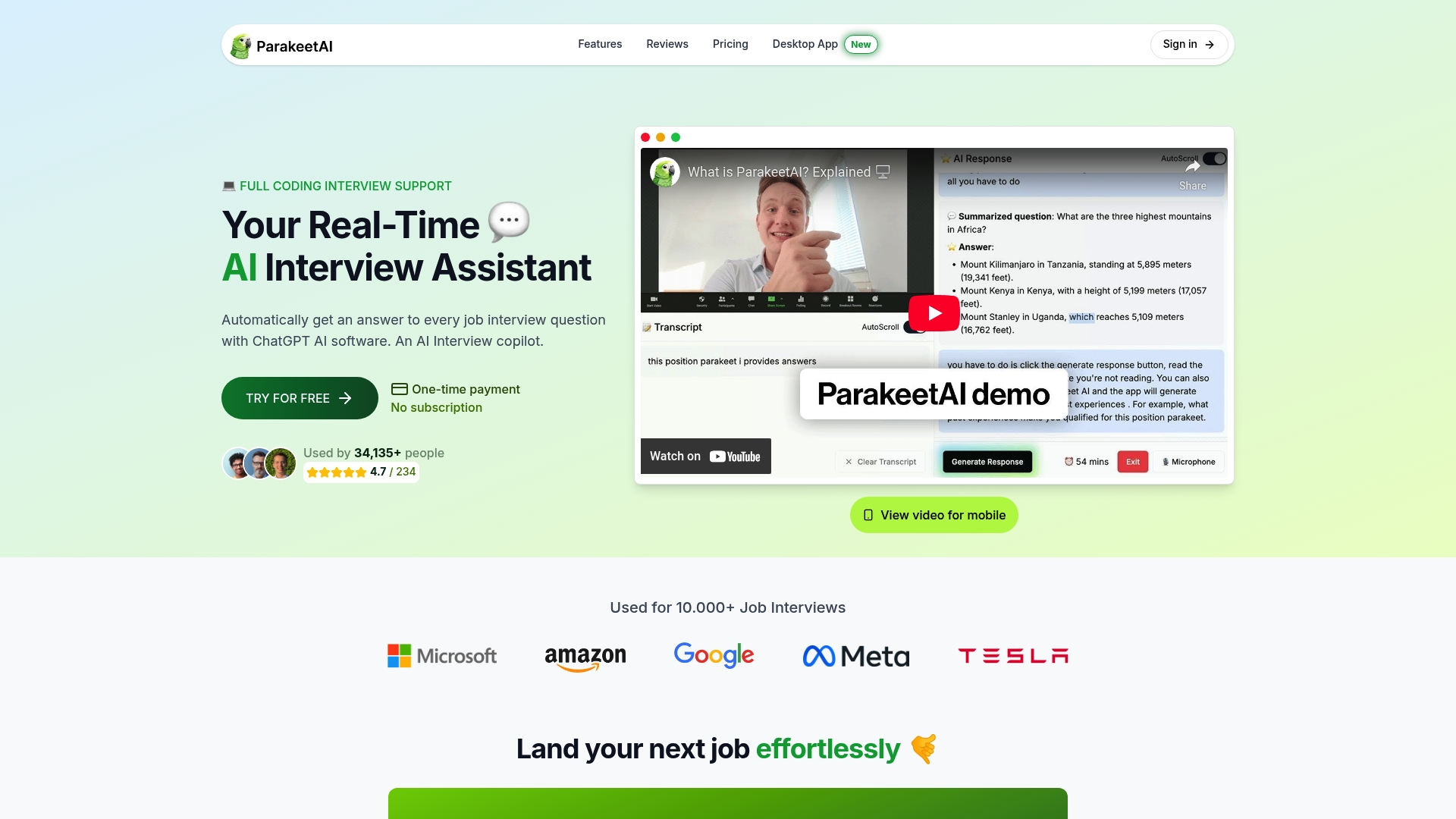
ParakeetAI is a real-time AI interview assistant that listens during your interview and automatically surfaces relevant answers and talking points as each question comes up. It helps you walk in prepared for anything, not just the questions you expected. Whether you’re refining your question strategy, practicing tough scenarios, or building out a tailored question list for a specific role, ParakeetAI gives you a structured, intelligent way to prepare smarter. Visit parakeet-ai.com to see how it works and give yourself a genuine edge in your next interview.
Frequently asked questions
What are the best questions to ask at the end of an interview?
Ask questions that clarify role expectations, team culture, and what success looks like in the first 90 days. Thoughtful, specific questions signal genuine interest and help you evaluate mutual fit before accepting any offer.
Is it okay to ask about salary and benefits during the interview?
Yes, but timing matters. Compensation and offer details, including whether salary is negotiable and what benefits are included, are best discussed with HR in later stages rather than in a first-round conversation.
How many questions should I prepare for my interview?
Prepare at least five to eight tailored questions, spread across the four categories covered in this article. Taking notes during the interview lets you add follow-up questions based on what the interviewer says, which often produces the most valuable answers.
What categories should my questions cover?
Cover the role and its success definition, career growth and development, company values and culture, and the interviewer’s management style. A category-based approach ensures you don’t miss any major dimension of fit before making your decision.
Can asking the wrong question hurt my chances?
Yes. Generic, overly personal, or negative questions can undercut an otherwise strong interview. Focus on tailored, forward-looking questions that demonstrate genuine curiosity and professional preparation to leave the strongest possible impression.