
Interview do's and don'ts: boost your success rate

TL;DR:Nearly half of candidates walk out of interviews having made avoidable mistakes, such as inadequate company research. Preparation, tailored responses, and professionalism, including effective follow-up, significantly increase interview success. Using AI tools for structured practice, feedback, and mastering frameworks like STAR enhances confidence and adaptability.
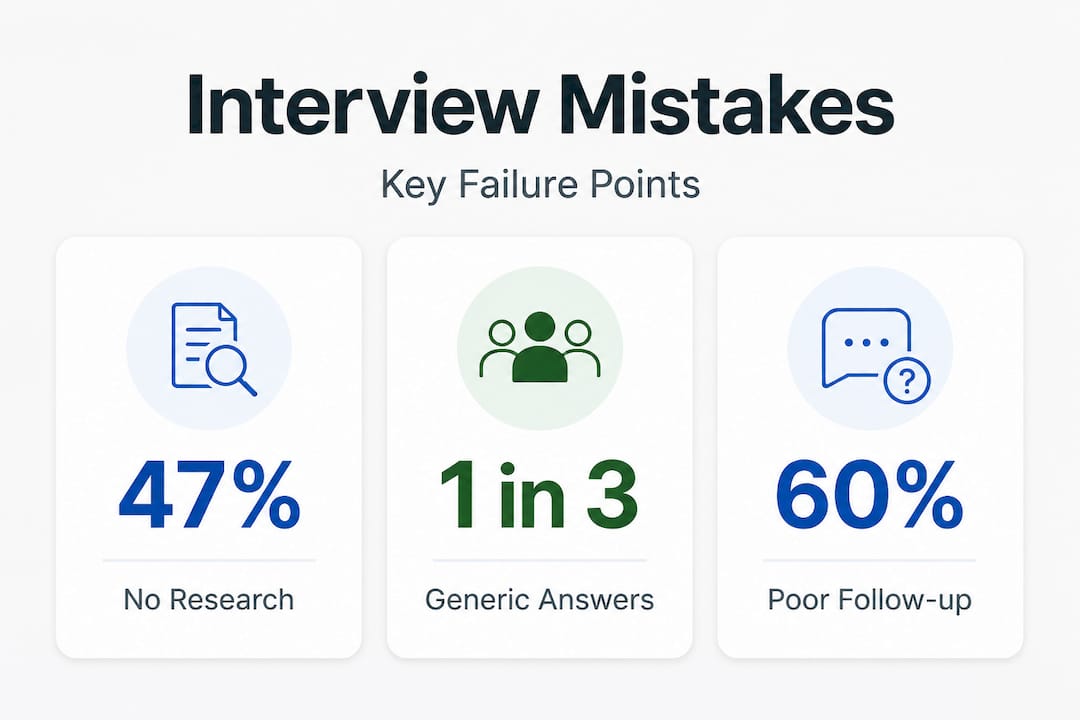
Nearly half of all job candidates walk out of interviews having made mistakes they could have easily avoided. 47% of candidates fail because they didn’t research the company well enough, a problem that takes a few hours to fix before the interview even begins. The gap between candidates who land offers and those who don’t often comes down to preparation, self-awareness, and knowing exactly which behaviors build credibility versus destroy it. With modern AI tools now available to coach you in real time, there’s no reason to repeat the same costly errors.
Table of Contents
- Key do’s and don’ts for interview success
- Harnessing AI tools for interview preparation
- Navigating tricky questions and common pitfalls
- Standing out: Interview etiquette and follow-up
- What most guides miss about interview success
- Take your interview skills to the next level
- Frequently asked questions
Key Takeaways
| Point | Details |
|---|---|
| Do your homework | Company research is essential and prevents nearly half of interview failures. |
| Leverage AI feedback | AI can help you structure answers and improve performance with real-time insights. |
| Handle tough questions wisely | Stay composed and show growth, especially when asked about conflicts or weaknesses. |
| Master etiquette and follow-up | Make a great impression from arrival through a personalized thank-you message. |
Key do’s and don’ts for interview success
Getting the basics right separates candidates who get callbacks from those who get silence. The good news is that the most impactful behaviors are learnable. Understanding which actions build a strong impression and which ones quietly kill your chances gives you a real edge before you even walk in the room.
Do’s that hiring managers notice immediately:
- Research the company’s mission, recent news, and key products before every interview. 47% of candidates fail specifically because they skip this step, and hiring managers can tell instantly when you haven’t done it.
- Tailor each answer to the specific role. Generic responses signal a lack of genuine interest and make it hard for interviewers to picture you in the position.
- Use concrete, specific examples. Saying “I improved customer satisfaction” is forgettable. Saying “I redesigned our onboarding flow and cut support tickets by 30% in six weeks” is memorable.
- Make eye contact, listen actively, and avoid interrupting. These signals communicate confidence and respect simultaneously.
- Ask thoughtful questions at the end. Questions about team structure, success metrics, or current challenges show you’re already thinking like a team member.
Pro Tip: Arrive 10 minutes early to show punctuality and professionalism. Rushing in at the last second creates unnecessary stress and sends the wrong signal before you’ve said a single word.
Don’ts that quietly cost candidates the job:
- Don’t badmouth previous employers. Even if your last manager was genuinely difficult, criticizing them signals poor judgment and immaturity to the interviewer.
- Don’t oversell your strengths with vague superlatives. Calling yourself a “results-driven team player who excels under pressure” without any evidence is meaningless.
- Don’t ask questions that could easily be answered by a quick look at the company website. This signals you didn’t prepare, which connects directly to the top interview mistakes that derail otherwise qualified candidates.
- Don’t ramble. Long, unfocused answers make interviewers work harder to find the point, and they’ll often stop listening before you finish.
“The best interview answers aren’t the most impressive ones. They’re the clearest ones. Clarity signals confidence.”
Here’s a quick comparison to see how preparation shifts the outcome:
| Behavior | Impact on your candidacy |
|---|---|
| Researching the company in depth | Demonstrates genuine interest, builds rapport |
| Generic, untailored answers | Signals low effort, forgettable impression |
| Specific examples with measurable results | Builds credibility, makes you memorable |
| Interrupting or talking over the interviewer | Signals poor listening skills |
| Thoughtful follow-up questions | Shows strategic thinking and initiative |
| Asking about salary in the first round | Perceived as only interested in compensation |
Using company research tips to build context before your interview is one of the highest-leverage moves you can make. Even 90 minutes of focused research can shift your entire tone from passive applicant to engaged candidate.
Harnessing AI tools for interview preparation
Preparation has evolved significantly. Where candidates used to rely solely on mock interviews with friends or practicing in front of a mirror, AI-powered tools now offer something far more precise: structured, unbiased feedback delivered instantly.
Why AI-driven practice works better than traditional prep:
- AI can simulate realistic interview scenarios based on your target role, industry, and experience level. It doesn’t get tired, it doesn’t go easy on you, and it doesn’t skip the hard questions.
- It identifies patterns in your speech that humans miss, including filler words like “um” and “like,” circular answers that loop back without landing, and structural gaps in your reasoning.
- AI-powered interview tools can flag when your answers lack a clear beginning, middle, and end, which is especially critical for behavioral interview questions.
- Real-time feedback during practice sessions trains you to catch yourself in the moment, not just after the fact.
One of the most important frameworks to master with AI’s help is the STAR method. STAR stands for Situation, Task, Action, and Result. Behavioral questions represent 60% of interview time in many hiring processes, and using STAR as your default structure keeps your answers focused, relevant, and persuasive.
Here’s how STAR works in practice. If an interviewer asks, “Tell me about a time you handled a difficult client,” a candidate without structure might give a five-minute story that wanders into irrelevant details. A STAR-structured candidate would briefly set the scene (Situation), clarify their specific responsibility (Task), explain the concrete steps they took (Action), and close with a measurable or meaningful outcome (Result). That approach takes about 90 seconds and leaves nothing to interpretation.
Pro Tip: Use AI to record and review your performance for continuous improvement. Watching yourself answer questions reveals habits you’d never catch in the moment, like trailing off at the end of sentences or over-explaining simple points.
Following a stepwise interview preparation process with AI at the center helps you build consistency. You’re not just practicing for one interview. You’re building a skill set that transfers across every future role.
What to focus on during AI-assisted practice sessions:
- Answer length calibration: most strong answers run between 60 and 120 seconds.
- Vocabulary precision: are you using industry-relevant language naturally, or does it sound forced?
- Emotional tone: does your voice convey enthusiasm, or does it flatten out?
- Question relevance: are you actually answering what was asked, or redirecting to what you’d rather say?
Navigating tricky questions and common pitfalls
Some questions are genuinely designed to test how you handle pressure, disagreement, or uncertainty. These moments are not traps. They’re opportunities to show self-awareness and judgment. The difference between a weak answer and a strong one usually comes down to framing.
The most common tricky question categories and how to handle them:
- Weakness questions: Don’t say “I work too hard” or “I’m a perfectionist.” These non-answers frustrate interviewers. Instead, name a real development area, describe how you recognized it, and explain the specific steps you’ve taken to improve.
- Conflict and disagreement questions: This is where many candidates stumble. The instinct is to prove you were right. But interviewers aren’t looking for victory stories. In disagreements, avoid claiming sole victory and focus on what you learned and how you collaborated to reach a resolution. Show emotional intelligence, not ego.
- Salary questions: This is one of the most mishandled moments in interviews. Don’t discuss salary too early; wait for the interviewer to bring it up. If pressed before you’re ready, a professional response like “I’d love to learn more about the full scope of the role before discussing compensation” is both graceful and strategic.
- Failure or setback questions: The worst thing you can do is claim you’ve never really failed. That reads as either dishonest or lacking self-awareness. Pick a real, relevant example. Focus on what you did after the failure, not just the failure itself.
- “Where do you see yourself in five years?” questions: This is not a quiz about career planning. It’s a test of whether your goals align reasonably with the role. You don’t need a perfect answer, just a credible one that connects your growth to the company’s opportunity.
Pro Tip: When asked about weaknesses, focus on growth and specific improvements. Frame the answer as a progression: “Six months ago I struggled with X. I took Y steps to address it, and here’s the concrete progress I’ve made.”
Here’s a quick reference for questions to avoid in interviews and the better alternatives:
| Tricky question | Weak response | Strong response |
|---|---|---|
| What’s your greatest weakness? | “I work too hard” | A real area with concrete growth steps |
| Describe a conflict | “I convinced them I was right” | Collaborative resolution with learning |
| Where do you see yourself in 5 years? | “I want your job” | Goals tied to growth within the company |
| Why did you leave your last role? | Blaming the manager | Focus on what you’re moving toward |
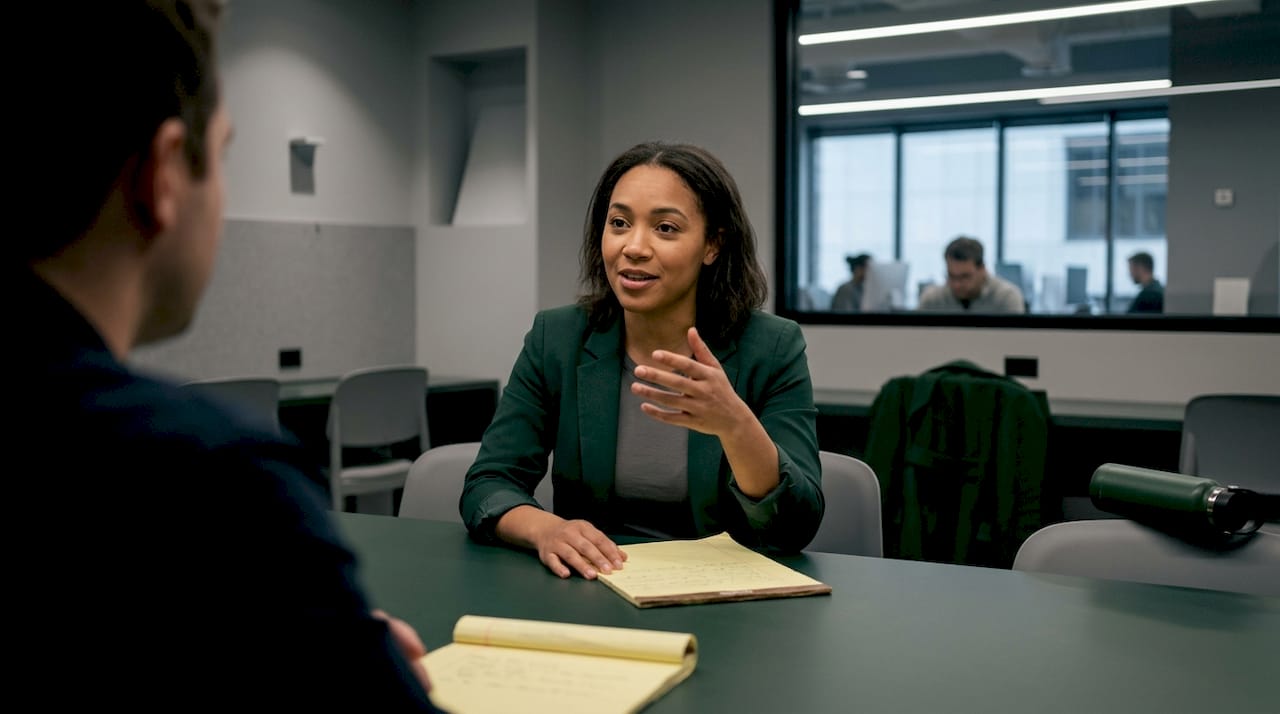
Reviewing best interview answers for common tech and professional roles can help you build a mental library of strong response structures before you go in. The goal is not to memorize scripts. It’s to internalize a pattern of clear, honest, and structured thinking.
Standing out: Interview etiquette and follow-up
Many candidates prepare intensively for the content of their answers and then lose points on the surrounding details. Etiquette and follow-up behavior signal professionalism in ways that matter more than most people realize.
Etiquette behaviors that create a lasting impression:
- Dress for the role you want, not the environment you’re currently in. When in doubt, dress one step more formal than the company’s stated culture.
- Make consistent eye contact during your answers. Looking away constantly reads as uncertainty, even when your words are strong.
- Listen completely before you answer. Pause for a beat after the question ends. Interviewers notice when candidates are so eager to respond that they talk over the end of a question.
- Keep your phone out of sight and on silent. Placing it face-up on the table, even if you never check it, creates a subtle distraction.
- Match your energy to the room. A high-energy, joke-heavy approach can work in a startup setting and fall completely flat in a structured corporate environment.
The follow-up: your last chance to differentiate yourself
Most candidates skip the follow-up entirely. That’s a mistake. A thank-you email sent within 24 hours of your interview keeps your name in front of the interviewer while their memory of you is still fresh. 47% of candidates fail basic preparation steps, and the follow-up is another version of that problem. It’s easy to do and most people don’t bother.
Pro Tip: Personalize your follow-up based on a specific topic discussed. Reference something concrete from the conversation, like a project the team mentioned, a challenge they described, or a shared perspective that came up. This shows you were truly listening and reinforces your interest in the specific role.
What to include in your follow-up note:
- A genuine thank-you for their time and the conversation.
- One specific reference to something discussed, proving this isn’t a template.
- A brief restatement of why you’re excited about the role and confident you’d add value.
- A clear, low-pressure close: something like “I look forward to next steps.”
Following interview best practices from initial preparation to post-interview communication creates a consistent, professional arc. When you also apply company research expert tips to personalize your follow-up, you’re reinforcing the same competitive advantage you built before the interview even started.
What most guides miss about interview success
Here’s an uncomfortable truth: most interview guides, including the ones written by credible sources, are built around templates. They give you frameworks, scripts, and checklists. Those things are useful. But they miss the real lever that separates candidates who grow from those who stagnate.
Adaptability matters more than memorization. Every interviewer is different. Every team has a different culture. Every role has a different definition of “success.” A perfectly rehearsed STAR answer delivered to the wrong audience at the wrong moment can actually work against you. The goal is to internalize principles so deeply that you can adapt them fluidly, not recite them mechanically.
Real growth comes from tracking your own patterns across multiple interviews. Most people treat each failed interview as an isolated disappointment. Strong candidates treat each one as a data point. What question caught you off guard? Where did your energy drop? Which answers felt strong and which ones felt hollow? Building a simple log of these observations after each interview creates a feedback loop that compounds over time.
This is where technical interview prep done with AI becomes genuinely powerful. AI doesn’t just tell you what to say. It helps you see what you actually do when you think you’re doing well. That gap between perception and reality is where the most valuable improvements live.
AI can amplify your progress, but only when you pair it with honest self-assessment. If you use it to get “good enough” answers and stop there, you’re limiting the tool. If you use it to stress-test your weakest moments, refine your structure, and build genuine confidence through repetition, the results compound quickly.
One interview won’t define your career. But your willingness to treat each one as a learning opportunity, rather than a pass-fail test, will define your trajectory over time.
Take your interview skills to the next level
Knowing what to do and actually performing it under pressure are two completely different challenges. Real confidence comes from repetition, structured feedback, and knowing that you’ve already handled the tough questions before the interview begins.
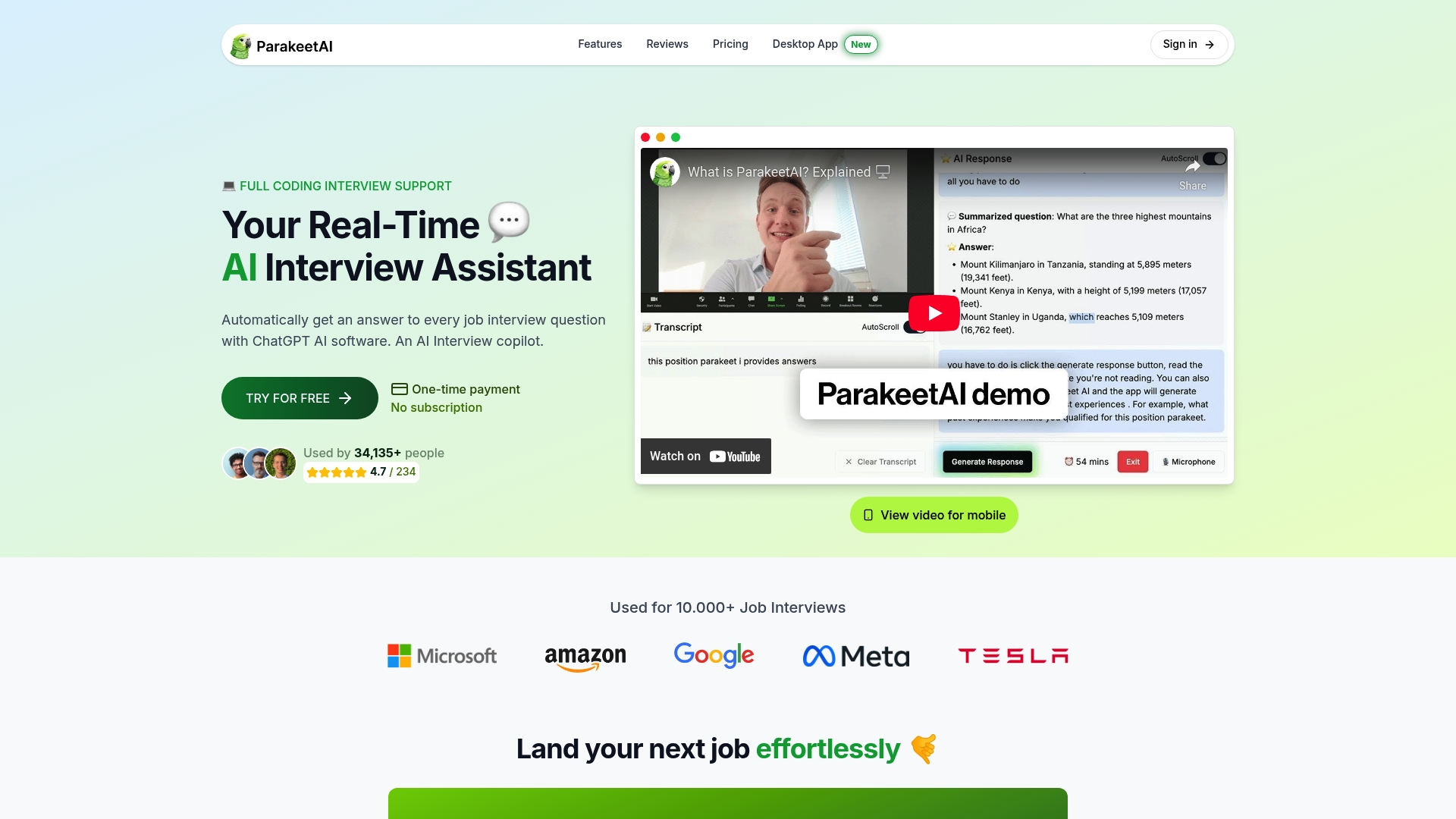
ParakeetAI is a real-time AI interview assistant that listens to your interview and automatically surfaces answers and guidance as the conversation unfolds. It’s built for job seekers who want more than generic prep. With AI-driven mock interviews, real-time coaching, and performance tracking, you get the kind of targeted feedback that turns nervous candidates into confident ones. Whether you’re preparing for your first role or your next big move, starting with a structured, AI-powered practice session gives you a measurable edge from day one.
Frequently asked questions
What should I avoid saying or doing in an interview?
You should avoid bringing up salary too early, speaking poorly of past employers, or giving generic answers. Wait for the interviewer to introduce compensation topics before engaging with them.
How can AI help me prepare for interviews?
AI can simulate real interviews, provide instant feedback on your answers, and help you structure responses using proven methods. Behavioral questions take up 60% of interview time, and AI keeps your STAR answers on track under pressure.
What’s the biggest mistake candidates make?
Neglecting company research is the single most common failure point, and it’s entirely preventable. 47% of candidates fail because they skip this basic preparation step.
How should I handle conflict or disagreement questions?
Focus on what you learned and how you reached a collaborative resolution, not on proving you were correct. Avoid claiming sole victory in any conflict story, as interviewers are evaluating your emotional intelligence, not your debating skills.
Are follow-up thank-you notes after the interview necessary?
A personalized thank-you email sent within 24 hours keeps your name top of mind and reinforces your genuine interest. It’s a small effort that a surprisingly large number of candidates skip entirely.