
Ace your interview: 10 most common questions answered

TL;DR:Most interview questions fall into three categories: behavioral, situational, and technical, helping candidates prepare specific responses. Mastering these core questions with concrete examples and authentic delivery increases interview success, while AI tools enhance practice efficiency and feedback quality. Genuine connection, adaptability, and structured storytelling with the STAR method are key to standing out and making a lasting impression.
Walking into a job interview without knowing what questions will come up feels like taking a test you never studied for. But here’s what most candidates don’t realize: across industries, hiring managers rely on the same core set of questions again and again. Research consistently shows that a small cluster of questions appears in the vast majority of interviews, which means targeted preparation pays off far more than trying to anticipate everything. Master these 10 questions, and you’ll walk in with a strategy instead of a prayer.
Table of Contents
- Understanding the core interview question types
- The 10 most common interview questions (and how to handle them)
- Comparison table: Quick reference for the top 10 interview questions
- How to avoid common pitfalls and stand out
- Integrating AI tools into your interview preparation
- What most interview guides overlook: It’s not about perfection
- Boost your interview prep with Parakeet AI
- Frequently asked questions
Key Takeaways
| Point | Details |
|---|---|
| Question types matter | Understanding the intent behind interview questions leads to more focused answers. |
| Personalize responses | Specific examples and authentic delivery make your answers memorable. |
| Use AI tools wisely | Leverage AI for feedback and practice, but always bring your own insights to the table. |
| Avoid common mistakes | Steer clear of generic responses and negative remarks about former jobs. |
| Structure answers | Frameworks like STAR keep your answers clear and impressive under pressure. |
Understanding the core interview question types
Before memorizing individual answers, it helps to understand the architecture behind interview questions. Most fall into three distinct categories, and recognizing which type you’re facing lets you shift gears instantly.
Behavioral questions ask you to describe past experiences. Phrases like “Tell me about a time when…” signal that the interviewer wants evidence of how you’ve actually behaved in real situations. These questions are based on the idea that past behavior predicts future performance.
Situational questions present hypothetical scenarios: “What would you do if…?” They test your judgment and problem-solving process rather than your history. Guidance on responding to situational interview questions in tech roles shows that the best answers lay out a clear decision-making path, not just a resolution.
Technical questions test specific knowledge or skills relevant to the role. They can range from coding challenges to accounting concepts depending on the field. You can also explore analytical interview questions to sharpen your problem-solving responses.
Here’s a quick summary of what each type reveals:
- Behavioral: Work ethic, collaboration, resilience, leadership
- Situational: Judgment, creativity, prioritization, reasoning
- Technical: Competence, depth of knowledge, ability to apply skills
Pro Tip: When a question lands, pause for one second and identify its type. That single move helps you choose the right structure for your answer before you say a word.
The 10 most common interview questions (and how to handle them)
With the types in mind, let’s tackle each of the core questions you’re likely to face. Advice on preparing for tech interviews applies broadly here, and the same principles carry across most industries.
- “Tell me about yourself.” This is your 90-second pitch. Structure it as: current role, relevant background, and why you’re excited about this opportunity. Skip personal history and focus on professional narrative.
- “Why do you want to work here?” Interviewers are testing your research and genuine interest. Reference something specific, a product, a mission, a recent initiative, and connect it to your own goals.
- “What’s your greatest strength?” Choose a strength that directly applies to the role and back it up with a brief example. Saying “I’m a great communicator” is forgettable. Saying “I reduced client escalations by 40% by redesigning our feedback process” is not.
- “What’s your greatest weakness?” Don’t say “I’m a perfectionist.” Instead, name a real skill gap you’ve been actively working to improve, and show measurable progress.
- “Where do you see yourself in five years?” Show ambition aligned with the company’s trajectory. Interviewers want candidates who plan to grow with the organization, not candidates who treat the role as a pit stop.
- “Tell me about a challenge you overcame.” Use the STAR method here (more on that later). The key is specificity. Vague stories about “a difficult project” don’t land. Concrete details do.
- “Why are you leaving your current job?” Keep it forward-looking and professional. Never criticize your current employer. Frame your reason around growth, new challenges, or alignment with your career goals.
- “What are your salary expectations?” Research the market range before the interview. Give a range based on data, and anchor slightly above your target to leave room for negotiation.
- “How do you handle pressure or tight deadlines?” Show that you have a system. Describe a real example where you managed stress effectively and delivered results. You can also look at developer interview questions for role-specific pressure scenarios.
- “Do you have any questions for us?” Always say yes. Prepare three thoughtful questions in advance. Ask about team culture, success metrics for the role, or what challenges the team is currently navigating.
The candidates who impress interviewers most aren’t the ones with the most polished answers. They’re the ones who make the conversation feel like a two-way dialogue rather than a one-sided interrogation.
Pro Tip: Before each interview, pull three values from the company’s website and weave at least one into your answers. This signals cultural fit without sounding scripted.
Comparison table: Quick reference for the top 10 interview questions
Now that you know the substance of each question, use this table as a last-minute refresher before you walk into the room.
| Question | Purpose | What interviewers want | Smart approach |
|---|---|---|---|
| Tell me about yourself | Set the tone | Professional clarity | Pitch: current, background, future |
| Why do you want to work here? | Test research | Genuine interest | Reference specific company details |
| Greatest strength | Assess fit | Relevant, proven ability | Strength plus brief example |
| Greatest weakness | Test self-awareness | Honesty and growth | Real gap with active improvement |
| Five-year plan | Test ambition | Long-term alignment | Growth tied to company direction |
| Challenge you overcame | Behavioral fit | Resilience and problem-solving | STAR method with specifics |
| Why leaving current job? | Test attitude | Professionalism | Forward-focused, no blame |
| Salary expectations | Negotiation baseline | Market awareness | Researched range, anchored high |
| Handling pressure | Test stability | Coping systems | Real example with positive outcome |
| Questions for us | Test engagement | Genuine curiosity | Three prepared, thoughtful questions |
Keep this table open on your phone the morning of your interview. Even five minutes of review sharpens your mental framework significantly.
How to avoid common pitfalls and stand out
Knowing the right answer isn’t enough. Here’s how to avoid the mistakes everyone else makes, because interviewers see the same errors repeatedly and they notice.
The most common mistakes candidates make:
- Giving generic answers that could apply to any company or role
- Rambling past the 90-second mark without reaching a clear point
- Failing to use concrete examples, relying on adjectives instead (“I’m very dedicated”)
- Apologizing or hedging excessively (“I’m not sure if this is what you’re looking for, but…”)
- Not preparing questions to ask, which signals low enthusiasm
The fix for most of these is storytelling with structure. Every behavioral answer you give should follow the STAR method: Situation (set the context briefly), Task (describe your responsibility), Action (explain exactly what you did), Result (quantify the outcome if possible). This framework keeps your answer focused and memorable.

Solid advice on avoiding interview pitfalls also stresses the importance of what you choose not to say. Candidates who avoid certain questions to avoid in interviews like asking about salary in the first round or raising complaints about past managers consistently score higher in interviewer evaluations.
Specificity is your best friend. Instead of “I led a team through a tough project,” say “I managed a five-person team through a product migration that had a two-week deadline. We delivered on time and reduced system downtime by 30%.” Numbers make stories real.
Pro Tip: Record yourself answering three of the 10 questions on your phone. Play it back. You’ll immediately hear where you’re rambling, hedging, or burying the most impressive details at the end instead of leading with them.
Integrating AI tools into your interview preparation
You can gain even more confidence by boosting your preparation with the smartest new tools available. AI-powered platforms have fundamentally changed how serious candidates prepare for interviews, and the gap between those using AI prep and those not is widening quickly.
Top ways AI helps your interview prep:
- Realistic practice: AI tools simulate actual interview conditions, asking you the same types of questions you’ll face and responding in real time.
- Personalized feedback: Unlike practicing with a friend, AI evaluates your pacing, filler word usage, answer structure, and keyword alignment with the job description.
- Answer analysis: AI can identify when your answer lacks specificity, goes off topic, or misses the core of what the question is probing for.
- Consistency tracking: AI tracks your improvement across sessions so you can see exactly where you’re growing and where you still need work.
Here’s how manual preparation compares to AI-enhanced preparation:
| Feature | Manual prep | AI-enhanced prep |
|---|---|---|
| Feedback speed | Delayed (after session) | Instant, real-time |
| Objectivity | Varies with coach | Consistent and data-driven |
| Availability | Scheduled sessions | 24/7 on demand |
| Personalization | General guidance | Tailored to role and answers |
| Cost | Often high | Low to free tier options |
| Question variety | Limited to coach’s knowledge | Vast, role-specific question libraries |
Technical interview tips from practitioners confirm that candidates who practice with AI tools show faster improvement in answer clarity and structure compared to those who rely solely on reading guides or practicing with peers.
One important caution: treat AI-generated model answers as starting points, not final scripts. The goal is to internalize the structure and adapt it to your real experiences. An AI-generated answer that doesn’t reflect your actual work history will fall apart the moment a follow-up question comes.
What most interview guides overlook: It’s not about perfection
Here’s the uncomfortable reality that most interview prep resources won’t tell you directly. Interviewers are not scoring you on whether your answer matches a textbook template. They’re assessing whether they want to work with you for 40 hours a week.
The candidates who get hired are rarely the ones with the most perfectly rehearsed answers. They’re the ones who feel present in the conversation. Over-preparation without adaptability produces a particular kind of candidate that experienced interviewers recognize immediately: robotic delivery, slightly too-long pauses between questions (a sign the person is searching for their memorized script), and answers that don’t quite respond to what was actually asked.
What top performers do differently is adapt. They listen to the full question before starting their answer. They notice when the interviewer reacts with interest and briefly expand on that point. They use natural language instead of corporate vocabulary. Insight from insider interview advice confirms that answers showing genuine reflection tend to outperform polished but hollow responses.
The most powerful interview move isn’t a perfect answer. It’s a moment of honest, specific connection that makes the interviewer think: “This person actually gets it.”
Authenticity isn’t a soft concept here. It’s a strategic advantage. If you’ve prepared your stories well using the STAR method and practiced enough that the structure feels natural, you’ll have the best of both worlds: organized thinking and genuine delivery. That combination is rare, and it’s exactly what gets candidates called back.
Boost your interview prep with Parakeet AI
If you’re ready for a real edge in your next interview, there’s a powerful tool you can try right away.
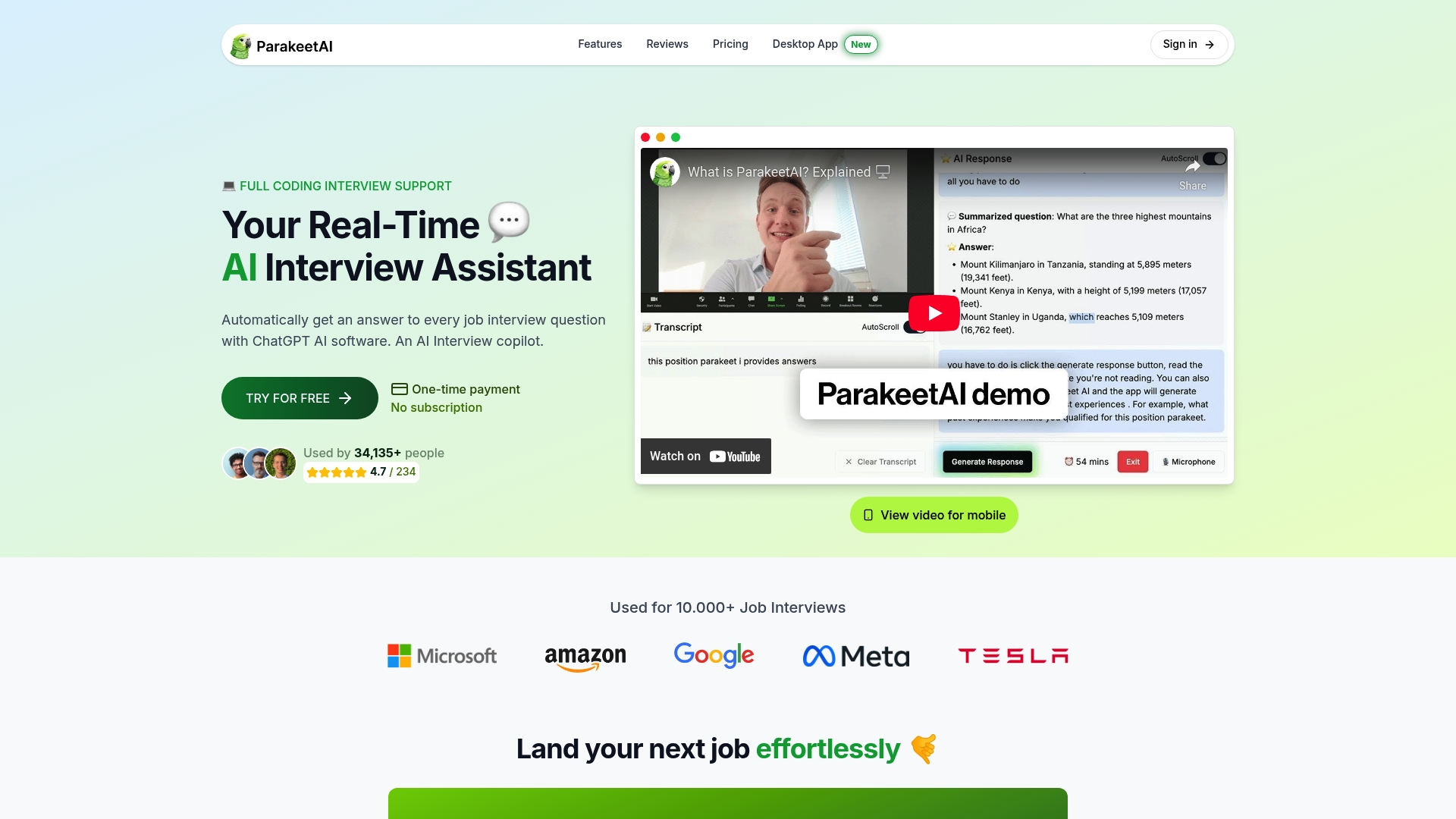
Parakeet AI interview tools take interview preparation to a level that no written guide can match. Parakeet AI listens to your interview in real time and automatically surfaces relevant, tailored answers to every question as it happens, so you’re never caught off guard. Whether you’re preparing for a behavioral deep-dive, a technical screen, or an executive-level conversation, Parakeet AI adapts to the role and gives you instant, personalized support. Explore the platform today and see how real-time AI assistance can turn your next interview into your strongest performance yet.
Frequently asked questions
How can I prepare for common interview questions with limited time?
Focus on the 10 questions listed in this guide, write bullet point stories for each using the STAR method, and rehearse your answers aloud at least twice for maximum retention and impact.
Are AI tools effective for job interview preparation?
AI tools can simulate real interview conditions, provide instant structured feedback, and help you refine your delivery, making preparation significantly more efficient than solo practice alone. Technical interview tips from practitioners back this up with measurable improvement data.
What should I avoid saying in interviews?
Avoid generic responses that lack examples, negative remarks about past employers, and questions that reveal you haven’t researched the company. Reviewing common questions to avoid before your interview can prevent costly slip-ups.
Is it better to memorize answers or speak naturally?
Speaking naturally with a clear structure is far more effective than memorizing; interviewers value authentic, specific storytelling over polished but robotic recitation.
What is the STAR method in interviews?
The STAR method stands for Situation, Task, Action, Result. It’s a proven framework for answering behavioral questions in a way that is clear, specific, and easy for interviewers to follow. Avoiding common pitfalls starts with knowing how to use this structure correctly.