
Excel in data analyst interviews with proven behavioral strategies

TL;DR:Behavioral questions assess a data analyst’s communication, problem-solving, and stakeholder skills.The STAR method helps structure clear, impactful responses highlighting actions and results.Quantifying outcomes and demonstrating soft skills set top candidates apart in interviews.
Many skilled data analysts walk into interviews feeling confident about SQL, Python, and statistical modeling, then freeze when asked, “Tell me about a time you influenced a decision with data.” Technical skills got you to the interview room, but behavioral questions determine whether you leave with an offer. Hiring managers at top companies consistently report that the biggest differentiator between equally qualified candidates is not what they know, it is how they handle real workplace challenges. This guide gives you the exact strategies, frameworks, and example responses to turn behavioral interviews from your weakest link into your strongest advantage.
Table of Contents
- Understanding behavioral interview questions for data analysts
- The STAR method: Structuring answers for maximum impact
- High-frequency behavioral questions and effective responses
- Expert tips for standing out in behavioral interviews
- Why mastering behavioral questions matters more than technical perfection
- Take your interview preparation to the next level
- Frequently asked questions
Key Takeaways
| Point | Details |
|---|---|
| Behavioral questions matter | Your non-technical skills often decide whether you get the offer in data analyst interviews. |
| STAR method is essential | Organizing your answers with Situation, Task, Action, and Result makes responses clear and memorable. |
| Quantitative impact wins | Backing up stories with measurable results sets you apart from other candidates. |
| Practice clear storytelling | Communicate without jargon and adapt messages for technical and non-technical audiences alike. |
| Continuous improvement | Reviewing common questions and reflecting on past experiences improves your interview confidence. |
Understanding behavioral interview questions for data analysts
Behavioral interview questions are designed to predict future performance by examining past behavior. The underlying logic is simple: how you acted in previous situations tells interviewers far more than how you say you would act in hypothetical ones. For data analysts specifically, these questions carry enormous weight because the role sits at the intersection of technical analysis and human communication.
The categories employers consistently probe include:
- Communication: How well you explain data insights to non-technical audiences like marketing managers or executives
- Teamwork: How you contribute to cross-functional projects and data analytics teamwork scenarios
- Problem-solving: How you approach messy, incomplete, or contradictory datasets
- Ambiguity handling: How you make decisions when requirements are unclear or business goals shift
- Conflict resolution: How you manage disagreements with stakeholders who push back on your findings
Behavioral interview questions in practice are often framed as open prompts. You will hear things like “Tell me about a time you led a project,” “Describe a situation where you had to communicate to a non-technical audience,” “Give me an example of handling stakeholder conflict,” or “Walk me through a time you had to work through failure or ambiguity” in your Google data analyst behavioral interview. These prompts are deliberately open-ended so that your answer reveals the depth and maturity of your thinking.
“The goal of behavioral questions is not to trip you up. It is to give you a stage to show how you think, communicate, and collaborate under real conditions.”
Employers assume you can run a regression or build a dashboard. What they genuinely cannot assess from your resume is whether you can translate a data story into executive language, push back diplomatically when business leaders misread the numbers, or recover gracefully when a model you built turns out to be wrong. Behavioral questions are the tool that fills those gaps.
The STAR method: Structuring answers for maximum impact
Now that you know what these questions are and why they matter, let’s look at the most effective way to answer them. The STAR method stands for Situation, Task, Action, and Result. It is the single most reliable framework for answering behavioral questions clearly and memorably.
Here is what each component means for a data analyst specifically:
| STAR component | What to cover | Data analyst-specific focus |
|---|---|---|
| Situation | The context and background | Business problem, data landscape, team makeup |
| Task | Your specific responsibility | Analytical objective, deliverable, or decision needed |
| Action | What you did and why | Tools chosen, reasoning, stakeholder approach |
| Result | The measurable outcome | Business impact, metric change, decision made |
The most common STAR mistakes among data analyst candidates are revealing. Many analysts nail the Situation and Task sections, then rush through Action with vague phrases like “I ran an analysis” without explaining why they chose a particular method. Even more damaging is skipping or underselling the Result. If you reduced customer churn by 8% or cut reporting time from three days to four hours, say so explicitly.

A strong STAR answer for mastering behavioral interviews also includes the rationale behind your choices. Interviewers are not just scoring your outcome. They are evaluating your decision-making process. If you chose SQL over Python for a particular analysis, explain the tradeoff. If you simplified a dashboard to three metrics instead of twelve, tell them why. That layer of reflection is what separates good answers from great ones.
Pro Tip: After drafting your STAR answers, read them aloud and ask yourself: “Did I explain what I did, why I did it, and what actually changed as a result?” If any of those three are missing, your answer is incomplete.
When exploring the STAR method success rate among candidates, structured responses consistently receive higher scores from interviewers than unstructured ones, even when the underlying experience is similar. The structure helps you and the interviewer stay organized, which creates a perception of competence and clarity.
High-frequency behavioral questions and effective responses
With the STAR method in hand, here are the behavioral questions you will likely face and how to structure answers that win offers.
The most commonly asked behavioral questions in data analyst interviews fall into several clear themes:
| Question theme | Example prompt | Key focus area |
|---|---|---|
| Communication | “Tell me about a time you explained complex data to a non-technical audience.” | Simplification, storytelling |
| Stakeholder conflict | “Describe a time a stakeholder disagreed with your analysis.” | Persuasion, diplomatic pushback |
| Ambiguity | “Give an example of working with incomplete or messy data.” | Problem solving, assumptions |
| Failure and learning | “Tell me about a time your analysis was wrong. What did you do?” | Accountability, growth mindset |
| Influence through data | “Describe a time you changed a business decision using data.” | Impact, credibility |
Here is a step-by-step approach to crafting responses that stick:
- Select a story that is genuinely relevant. Pick examples where your individual contribution is clear, not team wins where your role is fuzzy.
- Open with a one-sentence summary. “This was a project where I had to convince a senior marketing VP to reverse a campaign decision using A/B test results.” This hooks the interviewer before you tell the full story.
- Use actual numbers in the Result section. Vague outcomes like “it went well” or “the team was happy” are forgettable. Concrete numbers like “the new segmentation model increased email open rates by 19%” are memorable.
- Address the tradeoff or challenge explicitly. The best answers acknowledge obstacles and explain how you navigated them.
- Connect back to business impact. Analytics for problem-solving only matters if the business actually changed something as a result. Make that connection clear.
For example data analyst answers that resonate with interviewers, consider the conflict question. A weak response says, “A stakeholder disagreed with my recommendation, so I showed them the data again and they eventually agreed.” A strong response describes which data point they disagreed with, why they resisted, what specific approach you took to rebuild trust, and what the concrete business outcome was once they accepted the recommendation.
Understanding 2026 interview question trends also matters. Interviewers today are increasingly asking candidates to demonstrate how they handled AI-assisted analysis, explain decisions made under time pressure, and show how they communicate uncertainty to stakeholders. These are newer wrinkles in an already demanding behavioral landscape.
Pro Tip: Prepare five core “anchor stories” before your interview. Each story should cover multiple behavioral themes so you can adapt it to different prompts. A single project where you navigated messy data, presented to leadership, faced pushback, and ultimately drove a business outcome can answer at least four different behavioral questions.
Expert tips for standing out in behavioral interviews
Even with strong answers, subtle factors set excellent candidates apart from the rest. Here is what truly differentiates top performers in data analyst behavioral interviews.
The most critical habit is quantification. Quantifying outcomes is not optional for data analysts. If you recovered a metric, name the number. If click-through rate recovered by 12% within three days or churn dropped by 12% the following quarter, those specifics tell a precise story that generic language simply cannot. Interviewers remember numbers. They forget adjectives.
Key habits that separate standout candidates from average ones:
- Name your tradeoffs. When explaining a decision, briefly mention what you chose not to do and why. “I chose a simpler regression model over a neural network because interpretability mattered more than marginal accuracy gain for this stakeholder.” That sentence shows maturity.
- Use plain language for process, technical language for credibility. You can mention that you used XGBoost or Tableau, but explain the business reason in plain English.
- Pace your storytelling. Spend about 10% of your answer on Situation, 15% on Task, 50% on Action, and 25% on Result. Most candidates do the opposite and bury their lead.
- Acknowledge what you would do differently. Especially for failure questions, closing with “here is what I learned and how I changed my approach afterward” demonstrates intellectual honesty, which hiring managers value enormously.
- Show emotional awareness. Mention how you read the room, adapted your communication style, or noticed stakeholder anxiety early. Analytical interview practice rarely covers this soft skill, but it matters.
The rising role of AI in business analytics also means interviewers are increasingly asking behavioral questions about how analysts manage AI-generated insights, validate model outputs, and communicate uncertainty when predictions are involved. Being prepared to discuss these scenarios puts you ahead of candidates who only practice the classic behavioral question formats.
Pro Tip: Record yourself answering two or three behavioral questions out loud, then watch the playback. You will catch verbal fillers, pacing issues, and moments where you glossed over the Result without realizing it. This is one of the most uncomfortable but most effective preparation techniques available.
Why mastering behavioral questions matters more than technical perfection
Here is an uncomfortable truth that most interview prep content will not say plainly: hiring managers at data-driven companies already assume you can do the technical work. If you made it past the resume screen and the take-home case study, your technical competence is not in serious question.
What is in question is everything else. Can you work across departments without creating friction? Can you present a finding that a VP does not want to hear and maintain the relationship? Can you operate in situations where the data is unclear, the requirements keep changing, and the deadline is tomorrow? Those capabilities are what behavioral questions are designed to surface.
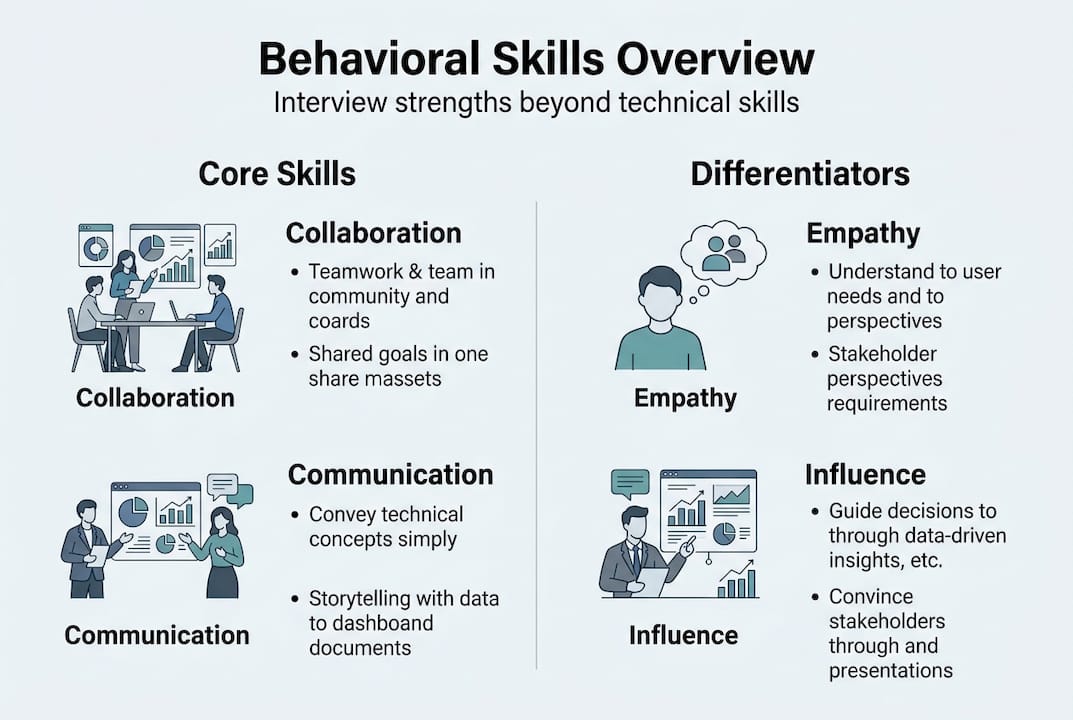
We have seen this pattern repeatedly: candidates who scored perfectly on technical assessments lose offers to candidates with slightly messier code but far stronger behavioral answers. The real tech interview stories from actual hiring cycles confirm this. Collaboration, adaptability, and emotional maturity are not soft skills in the dismissive sense of that word. They are the hard skills that determine whether a data analyst actually creates business value or just creates technically correct outputs that nobody acts on.
The longer-term career argument is even stronger. Analysts who communicate brilliantly, influence stakeholders confidently, and handle conflict with grace move into senior and leadership roles faster than peers with deeper technical expertise but weaker interpersonal skills. Mastering behavioral interviews is not just about landing one job. It is practice for the kind of professional you are building yourself to be.
The empathy and clarity you demonstrate in a behavioral interview signal to a hiring team how you will behave in a real meeting, a difficult project, and a tense data review. Do not underestimate the signal that sends.
Take your interview preparation to the next level
Knowing the strategies is one thing. Practicing them under realistic conditions is where real improvement happens. The gap between understanding STAR on paper and delivering a crisp, confident behavioral answer under pressure is significant, and it closes fastest with active, targeted practice.

ParakeetAI is a real-time AI interview assistant that listens to your interview as it happens and automatically surfaces relevant, structured answers to every question, including behavioral ones. Instead of fumbling for the right story or forgetting a key metric, you get intelligent support in the moment. Whether you are preparing for your first data analyst role or aiming for a senior position at a tech company, ParakeetAI helps you walk in ready for every question type, every time. Visit parakeet-ai.com to start practicing with personalized, real-time feedback tailored to your data analyst interview goals.
Frequently asked questions
What are the most common behavioral questions for data analysts?
Expect questions about communicating complex data to non-technical audiences, solving problems with incomplete information, handling difficult team dynamics, and learning from analytical mistakes. Common prompts include “Tell me about a time you had to communicate to a non-technical audience” and “Describe a situation where you faced stakeholder conflict.”
How do I use the STAR method in responses?
Describe the Situation briefly, clarify your specific Task, walk through your Actions with reasoning, then share a concrete Result with numbers where possible. The STAR structure keeps your answer focused and helps interviewers follow your impact clearly.
What mistakes should I avoid when answering behavioral questions?
Do not skip the Result section or describe team outcomes without clarifying your personal contribution. Avoid heavy technical jargon without context, and make sure to include your decisions and tradeoffs so interviewers understand your reasoning process, not just the outcome.
How can I stand out in my data analyst interview?
Quantify your results with specific metrics, explain the reasoning behind your choices clearly, and communicate complex ideas in plain language. Quantifying outcomes like percentages, time saved, or revenue influenced makes your answers memorable and credible.