
AI in job interviews: How technology boosts your success

TL;DR:AI now actively evaluates candidates in live interviews, scoring language and facial expressions.Preparation should focus on timed responses, clear communication, and practicing with AI tools.Ethical issues include bias, deepfake fraud, and legal risks, requiring candidates and employers to stay informed.
AI in job interviews: How technology boosts your success
Most job seekers still picture an interview as two people sitting across a table, one asking questions and the other nervously answering. That picture is outdated. Today, your first interview might be with an AI platform that records your face, analyzes your word choice, and scores your answer before a human ever reads your resume. This shift is moving fast, and candidates who understand how AI works in hiring will have a real advantage over those who do not. This article breaks down exactly what is changing, what it means for your preparation, and how to use AI tools to genuinely improve your performance.
Table of Contents
- How AI is transforming job interviews
- What makes an AI-powered interview unique?
- AI job interview preparation: What works best?
- Risks, ethics, and the future of job interview technology
- The truth about AI and the future of job interviews
- Level up your AI interview prep
- Frequently asked questions
Key Takeaways
| Point | Details |
|---|---|
| AI is mainstream | AI now plays a central role in how companies screen and select job candidates at scale. |
| Prep smarter, not harder | Hybrid practice using mock interviews—AI and human-led—delivers the best results. |
| Natural responses win | Rely on authentic, situational answers instead of trying to ‘game’ the AI system. |
| Stay ethical and aware | Know each company’s AI tool policies and avoid risky shortcuts like verbatim AI answers. |
How AI is transforming job interviews
AI has moved well beyond resume screening. It now plays an active role in live video interviews, technical assessments, and candidate ranking. Companies are adopting these systems at a remarkable pace because they solve real problems: too many applicants, too little recruiter time, and inconsistent evaluation standards across interview panels.
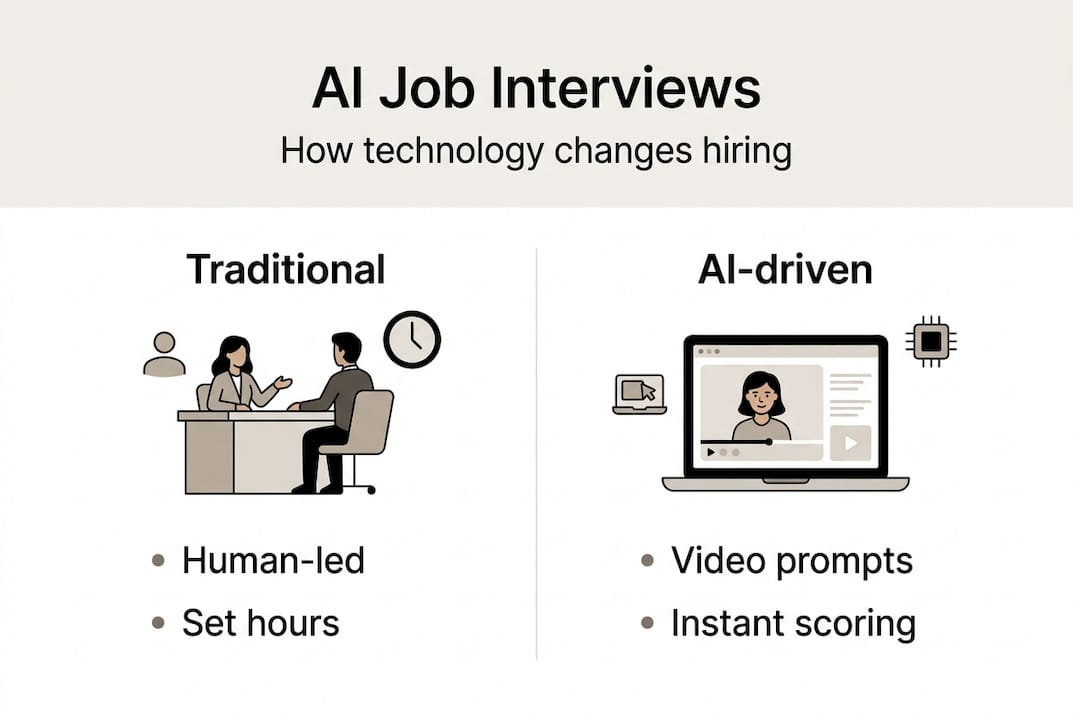
According to data on current hiring practices, 43% of large companies now use AI-driven interviews as part of their hiring process, with many reporting 30% productivity gains in their recruiting operations. Those numbers are significant. They tell you that if you apply to a large organization in 2026, there is nearly a coin-flip chance your first interview will be evaluated by an algorithm, not a person.
AI job interview platforms work by recording your video responses, then using natural language processing to evaluate vocabulary, sentence structure, and relevance. Some platforms layer in facial expression analysis to gauge confidence and emotional tone. The result is a candidate score that recruiters use to decide who advances.
Here is a quick look at how AI interviews compare to traditional formats across key dimensions:
| Factor | Traditional interview | AI-driven interview |
|---|---|---|
| Availability | Scheduled hours only | 24/7, on demand |
| Evaluator consistency | Varies by interviewer | Standardized algorithm |
| Feedback speed | Days to weeks | Immediate or near-immediate |
| Bias risk | Human bias present | Algorithmic bias possible |
| Scalability | Limited by recruiter time | Handles thousands at once |
The benefits for employers are clear. But what about you, the candidate? There are genuine upsides. You can take AI interviews at a time that suits you. You get a level playing field in terms of question consistency. And as AI interview technology becomes standard, getting comfortable with it now puts you ahead of candidates who wait.
That said, the risks are real too. Here are the main concerns that experts and candidates raise:
- Fraud and deepfakes: Some candidates attempt to game AI systems with synthetic video or audio. Detection tools are improving, but this creates distrust and tighter compliance rules.
- Algorithmic bias: AI systems trained on biased historical data can unfairly penalize certain accents, speech patterns, or facial features.
- Lack of human judgment: An AI cannot pick up on the contextual richness of a story the way an experienced interviewer can.
- The ‘race to the bottom’ problem: When both screeners and applicants use AI to automate their roles, the process risks losing genuine signal about a candidate’s real abilities.
“Ethics and compliance guidelines around AI hiring are tightening globally as regulators catch up with the technology.” The bottom line is that AI is a tool, not a replacement for thoughtful hiring, and the best organizations use it as a filter, not a final judge.
What makes an AI-powered interview unique?
AI interviews are structured differently from human-led conversations, and understanding those differences gives you a real preparation edge. In a traditional interview, a skilled interviewer might push back on a vague answer, ask a clarifying question, or pivot the conversation based on your body language. AI systems generally do not do that.
AI-driven interview features typically include a fixed question set delivered via video prompt, a countdown timer for your response, and automated scoring using NLP models. Some platforms add real-time sentiment analysis. The questions themselves span behavioral formats like “Tell me about a time when…”, technical scenarios, and situational judgment items.
According to research on how AI evaluates candidates, AI lacks deep probing on inconsistencies and often misses tone, personality nuances, and the kind of human-like interruptions that signal genuine engagement. This creates a specific challenge: your answer needs to be complete and self-contained, because the system will not prompt you to elaborate.
Here is how AI interviews stack up against traditional formats in terms of candidate experience:
| Dimension | Human interview | AI interview |
|---|---|---|
| Follow-up questions | Yes, dynamic | Rarely or never |
| Tone/personality read | High | Limited |
| Response time pressure | Moderate | High (timer-based) |
| Feedback type | Qualitative | Quantitative score |
| Technical depth | Very high (FAANG level) | Moderate |
To perform well in an AI interview, you need to approach your preparation differently. Here is a step-by-step process that works:
- Practice timed responses. AI interviews often give you 60 to 120 seconds. Rehearse until your answers feel complete within that window.
- Use the STAR method naturally. Situation, Task, Action, Result. Structure your stories without sounding rehearsed.
- Look directly at the camera. The AI analyzes eye contact as a proxy for confidence and engagement.
- Speak clearly and at a moderate pace. NLP models score clarity and vocabulary, so overly fast or mumbled speech costs you points.
- Avoid robotic delivery. Reading verbatim from notes is detectable and hurts your authenticity score.
Pro Tip: Record yourself answering practice questions on video, then watch the playback. You will notice habits like looking away from the camera or trailing off at the end of answers that you would never catch otherwise.
AI job interview preparation: What works best?
Preparation strategy matters more than raw talent when it comes to AI interviews. The format rewards structured thinking, clear communication, and confident delivery. The good news is that all three are trainable, and AI tools can accelerate your progress dramatically.

Research published in educational technology journals found that AI mock interviews improve perceived employability and confidence by 35 to 86%, and reduce overall preparation time by 40% compared to traditional study methods. Those are not small numbers. Candidates who use AI practice tools come into real interviews noticeably more composed and structured in their responses.
Understanding the mock interview benefits goes beyond just knowing the format. Repetition builds automaticity. When you have answered a behavioral question fifty times in practice, your brain retrieves the framework instantly under pressure. You stop thinking about structure and start focusing on content and delivery.
The best preparation combines AI tools and human feedback. Here is why each matters:
- AI mock interviews for volume and iteration. You can run ten practice sessions in the time it takes to schedule one human mock. AI gives you immediate scores and flags weak areas, letting you improve fast.
- Human mock interviews for nuance and adaptability. A human coach or peer will notice things an algorithm misses: hesitation patterns, lack of conviction, or a story that technically answers the question but feels hollow.
- Video self-review for self-awareness. Watching your own recordings is uncomfortable, but it is the fastest way to fix non-verbal habits.
- Research the employer’s AI platform in advance. Different platforms (HireVue, Spark Hire, Paradox) have different formats. Knowing what to expect removes surprise on the day.
- Prepare verifiable examples. AI systems flag vague or generic answers. Use specific numbers, dates, and outcomes in every story.
Pro Tip: Check whether the company you are applying to openly allows or prohibits AI copilot tools during the interview. Some employers are experimenting with transparent AI assistance as part of the process. Others will flag it as a violation. Knowing the policy before you log in protects you.
The complete mock interview guide covers additional techniques for building a preparation schedule that fits around a full-time job search. The key takeaway is this: consistent, structured practice with real feedback loops will always outperform cramming the night before.
Stat to know: AI scoring models now align with human evaluators at 89 to 93% accuracy on emotion and language metrics. The machines are paying close attention.
Risks, ethics, and the future of job interview technology
Using AI in hiring is not without serious complications. As the technology becomes more capable, the ethical stakes rise. Candidates, employers, and regulators are all navigating a landscape that is changing faster than the rulebooks can keep up.
The most immediate risk for job seekers is detectability. Screen-sharing tools used in some technical interviews can flag AI copilot software running in the background. Using an unauthorized AI tool mid-interview could disqualify your application immediately. Beyond that, platforms are developing voice pattern analysis to detect coached or AI-generated responses in real time.
On the employer side, the risks are equally complex. Here is where the current debates are focused:
- Deepfake fraud: Some candidates use synthetic video or voice to impersonate a more qualified individual. This is a growing concern in remote-first hiring.
- Algorithmic bias: If an AI system was trained primarily on data from a homogeneous candidate pool, it may systematically disadvantage people from different cultural or linguistic backgrounds.
- False confidence in automation: Relying too heavily on AI scores can cause companies to overlook genuinely strong candidates who simply did not perform well on camera.
- Compliance gaps: Ethics and compliance regulations around AI hiring are tightening in the US, EU, and other regions, and companies that move too fast may face legal exposure.
Looking at job interview tech trends for 2026 and beyond, several patterns stand out. Hybrid evaluation models, where AI handles initial screening and humans handle final rounds, are becoming the new standard. Explainable AI, systems that can show why a candidate received a specific score, is gaining regulatory attention. And skills-based assessments built on real work simulations are replacing abstract behavioral questions in many technical fields.
“The organizations building the most effective hiring systems are not choosing between AI and humans. They are designing processes where each does what it does best.”
For you as a job seeker, the practical implication is clear: stay informed. Read the fine print on any AI platform the employer uses. Understand what data is collected, how it is scored, and whether the process is audited for bias. Candidates who ask those questions in interviews signal maturity and professionalism that algorithms cannot fake.
The truth about AI and the future of job interviews
Here is something most interview coaching articles will not tell you. Mastering AI interview tools is now table stakes. Knowing how to format a STAR answer for an NLP model, keeping eye contact with a camera, and practicing timed responses are baseline skills in 2026. Every serious candidate is doing those things.
What actually differentiates the candidates who get offers is authenticity and adaptability. An AI can score your vocabulary and facial symmetry, but it cannot measure your ability to navigate an unexpected project pivot or rebuild trust with a difficult stakeholder. Those are human skills, and they come through most clearly when you stop trying to optimize for the algorithm and start telling real, specific, honest stories about your experience.
Using AI mock interview tools as accelerators for genuine self-improvement is the right frame. Practice enough that the structure becomes automatic, then focus your energy on the substance. The candidates who stand out in 2026 are not the ones who gamed the AI screener. They are the ones who used AI to become genuinely better communicators.
The human edge, real communication, honest self-awareness, and the ability to adapt mid-conversation, is what closes the offer. AI just helps you get to the room.
Level up your AI interview prep
You now understand how AI is reshaping every stage of the hiring process, from initial screening to scoring your delivery and vocabulary in real time. Knowing the landscape is powerful, but practice is what turns knowledge into results.
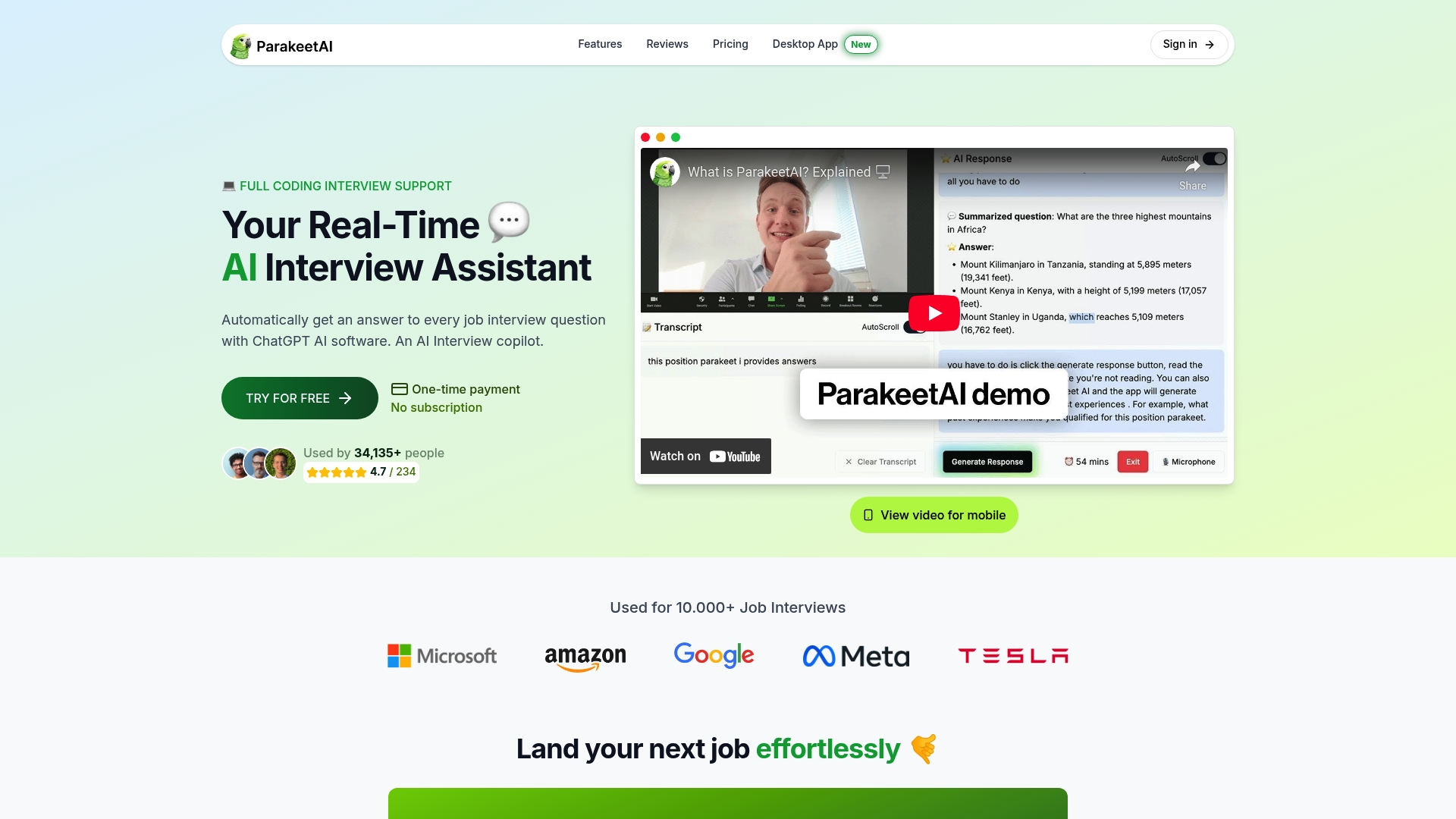
ParakeetAI gives you a real-time AI interview assistant that listens to your live interview and automatically surfaces relevant, accurate answers to each question as it is asked. Whether you are preparing for a technical screen or a behavioral round, you can practice with an advanced AI system that mirrors the formats top employers actually use. Build the digital fluency and interpersonal confidence that hiring teams are looking for, all on your own schedule, without waiting for a coach to be available.
Frequently asked questions
Are AI job interviews as accurate as interviews with humans?
Studies show AI platforms can score emotions and language with 89 to 93% accuracy compared with human evaluators, but they still miss tone nuances and contextual subtleties that experienced interviewers catch.
Can I use AI tools during a real job interview?
Some employers allow AI copilots as part of their process, but you must verify company policy first because screen-share detection tools can flag unauthorized software and disqualify your application.
What’s the best way to prepare for an AI-driven job interview?
Combine AI mock interviews for high-volume repetition with human mock interviews for authenticity, and focus on giving natural, verifiable responses with specific outcomes rather than generic answers.
Is AI hiring fairer than traditional interviews?
AI interviews can reduce some human biases and offer consistent, 24/7 availability, but they may introduce new forms of algorithmic bias and raise ethical concerns that regulators are still working to address.