
Prepare insightful questions for interviews that impress

TL;DR:Asking insightful questions signals genuine interest, critical thinking, and strong preparation.Research company details thoroughly to craft targeted, impactful questions relevant to the role.Flexibility and active listening during the interview help adapt questions and demonstrate engagement.
Most job seekers spend hours rehearsing answers but give almost no thought to the moment the interviewer asks, “Do you have any questions for us?” That pause, that blank stare, that muttered “No, I think we covered everything” can quietly sink an otherwise strong interview. 32 to 44% of hiring managers view asking zero questions as a dealbreaker. This guide walks you through exactly how to research, craft, structure, and deliver questions that show genuine interest, critical thinking, and serious preparation, turning a moment most candidates dread into one of your strongest competitive edges.
Table of Contents
- Understand why your questions matter in interviews
- Research the company to craft targeted questions
- Structure questions for maximum impact
- Refine and practice your questions before the interview
- Adapt your questions during the interview
- Our take: Why smart questions aren’t just for show
- Take your interview prep to the next level
- Frequently asked questions
Key Takeaways
| Point | Details |
|---|---|
| Insightful questions impress | Smart, well-prepared questions can make you stand out as a thoughtful, high-potential candidate. |
| Research drives relevance | Tailoring your questions to the company and role proves genuine interest and preparation. |
| Structure and adapt | Organize questions by topic and adjust dynamically during the interview for the best outcome. |
| Avoid common pitfalls | Skip generic, salary, or already-answered questions to avoid turning off interviewers. |
Understand why your questions matter in interviews
Here is something most interview guides skip: your questions are not a formality. They are a performance signal. When you ask nothing, interviewers often interpret it as low enthusiasm or shallow preparation. When you ask smart questions, you demonstrate that you think ahead, care about outcomes, and are already envisioning yourself in the role.
“Candidates who ask about success metrics are 25% more likely to be rated as high-potential by hiring managers.”
That single stat should change how you approach your question list. It is not about impressing someone with clever wordplay. It is about showing that you understand what success looks like in the role and that you genuinely want to achieve it.
Here is what smart questions accomplish:
- They signal genuine interest in the role beyond just landing a job
- They show critical thinking and your ability to evaluate a situation
- They demonstrate initiative, as you have done your homework
- They give you real data to evaluate whether this job is actually right for you
- They shift the conversation from interrogation to mutual dialogue
An interview question strategy built around the employer’s priorities, not generic curiosity, is what separates high performers from average candidates. Focus your questions on success metrics, team challenges, and how performance is measured. Explore great questions for interviews that go beyond surface-level conversation. And if you are preparing for a technical role, look at how best answers for tech roles are framed to get a sense of how strategic communication works in those contexts.
Now that you have seen why questions matter, let’s get strategic with how you prepare them.
Research the company to craft targeted questions
Generic questions get generic results. If you walk in asking “What does your company do?” or “What is the culture like?” you have already lost ground. The antidote is research. Specific, focused research that gives you the raw material to build questions that feel intelligent and informed.
Here is a step-by-step method to build that foundation:
- Visit the company website. Read the mission statement, product pages, and leadership bios. What do they emphasize? What problems are they solving?
- Search for recent news. Funding rounds, product launches, leadership changes, and market shifts all give you conversation fuel.
- Review their social media presence. LinkedIn posts, company announcements, and employee spotlights often reveal internal priorities.
- Check employee review sites. Glassdoor and Blind offer candid takes on culture and management style.
- Study the job description closely. Every bullet point is a clue about the team’s current gaps and goals.
As thorough pre-interview research into mission, news, products, and challenges is essential, the goal is to find the gaps, the things you cannot find publicly, and build questions around those.
| Research source | What it reveals |
|---|---|
| Company website | Mission, values, current products |
| Recent news articles | Growth plans, challenges, funding |
| LinkedIn company page | Culture, team size, recent hires |
| Employee review sites | Real culture, management style |
| Job description | Team needs, role priorities |
A deeper company research guide can help you build this habit systematically, and confidence-boosting research methods can make the process feel less overwhelming.
Pro Tip: Employee review sites like Glassdoor are goldmines for culture questions. If multiple reviews mention poor communication or high turnover, you now have a thoughtful, specific question to ask without revealing your source.
Next, let’s break down how to structure and organize these questions for maximum impact.
Structure questions for maximum impact
Raw research is only half the job. You also need to organize your questions so they flow naturally, cover the right territory, and avoid the common mistakes that make candidates look unprepared or tone-deaf.
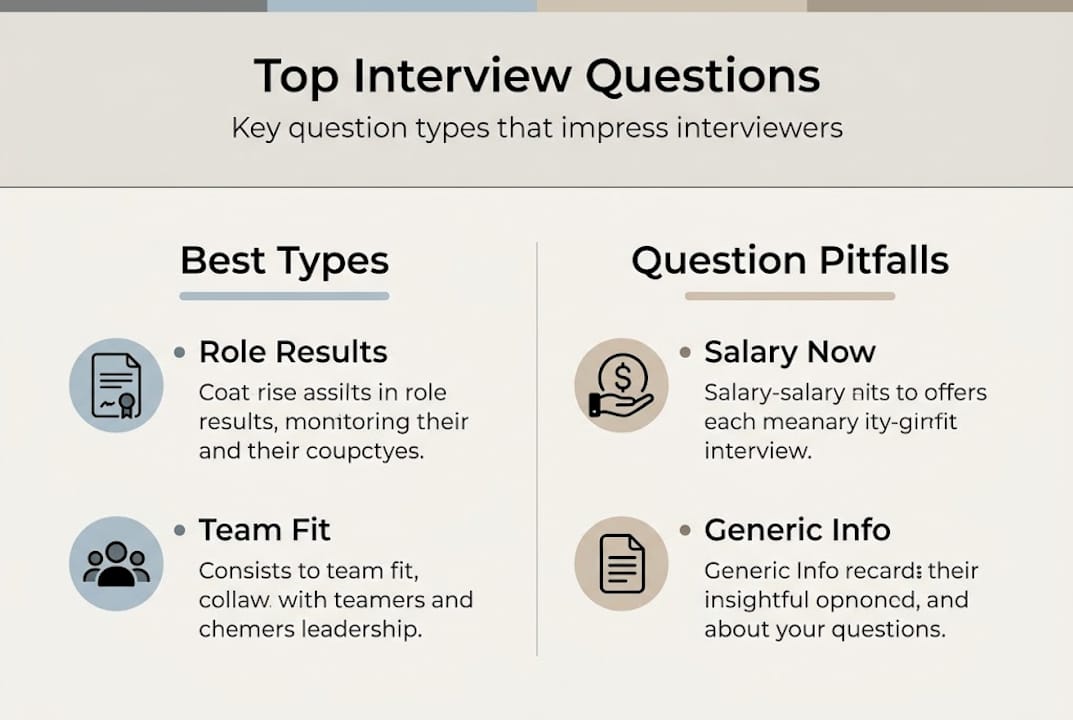
Start by grouping your questions into three core categories:
- Role-specific questions: What does success look like in the first 90 days? What are the biggest challenges someone in this role typically faces?
- Team dynamics questions: How does the team collaborate on cross-functional projects? How is feedback typically shared?
- Company and culture questions: How has the company’s direction shifted in the last year? What do you think makes people thrive here?
As smart question categorization into role, team, and culture types helps you avoid generic queries easily found online, the structure itself signals preparation. You can also look at stage-appropriate questions to understand what belongs in a first round versus a final panel.
| High-impact questions | Low-impact questions |
|---|---|
| “What does success look like in 90 days?” | “What are your company’s core values?” |
| “What challenges is the team currently navigating?” | “Do you offer remote work?” |
| “How do you measure performance in this role?” | “What are the hours?” |
| “What do you wish you knew before joining?” | “When will I hear back?” |
Avoid asking about salary, perks, or anything already answered on the company website. Those questions signal that you did not do your homework. Also, steer clear of topics covered in questions to avoid in interviews, especially for technical roles where even question phrasing carries weight.
Pro Tip: Save your most strategic or sensitive questions, like those about team dynamics or internal culture friction, for later interview rounds when you have built more rapport with the hiring team.
For more context on how question framing works in technical settings, software engineering interview tips can give you useful examples.
Once you have organized your questions, it is time to refine them for clarity and impact.
Refine and practice your questions before the interview
Having a question list is a start. Practicing it is what makes the difference. Many candidates write their questions the night before, read them once, and then stumble through delivery in the actual interview. Do not be that candidate.
Here is how to sharpen your questions before interview day:
- Cut redundant questions. If two questions are asking roughly the same thing, keep the sharper one.
- Trim vague language. Replace “tell me about the team” with “how does the team typically handle disagreements on priorities?”
- Read them out loud. Questions that look fine on paper can sound awkward when spoken. Practice until delivery feels natural.
- Adjust your tone. You are curious, not confrontational. Frame questions as genuine interest, not a grilling session.
- Track what lands. After mock practice or real interviews, note which questions generate the most engaged, detailed responses.
Remember, candidates asking about success metrics are 25% more likely to be rated as high potential. That is not a coincidence. It reflects that thoughtful, specific questions are inherently more engaging for interviewers who care about results.

Look at resources like strong interview answers to understand how the best candidates frame their communication overall, and revisit your company background tactics to make sure your questions still reflect current, accurate information. The STAR method for interviews is also a useful parallel framework for understanding structured, purposeful communication.
With your questions ready and polished, let’s consider how to adapt your approach when the actual interview unfolds.
Adapt your questions during the interview
No interview goes exactly as planned. Interviewers go long, topics shift, and sometimes your best prepared question gets answered in passing before you even ask it. Flexibility is not optional. It is essential.
Here is how to stay sharp in the moment:
- Listen actively throughout. Cross off questions mentally as topics get covered. Asking something already answered signals you were not paying attention.
- Build on what is said. If the interviewer mentions a recent team challenge, you can pivot to a related question that shows you caught it.
- Probe gently when answers feel vague. If a question about culture or team dynamics gets a rehearsed non-answer, you can follow up with “Could you share a specific example of that?”
- Keep backup questions ready. Always have at least one or two extras in each category so you are never caught empty-handed.
- Stay neutral on sensitive territory. If an interviewer seems uncomfortable with a question, acknowledge it and move on gracefully.
If an interviewer avoids answering a question about team culture or management style, treat that evasion as data. Salary and benefits questions should generally wait until after an offer is made, and the same goes for probing questions about internal conflict or past layoffs.
Pro Tip: Always have a fallback question like “What do you enjoy most about working here?” It is open-ended, positive, and almost always generates a genuine, revealing response.
To avoid common missteps, review questions to avoid so you know exactly what not to bring up regardless of the conversation flow.
After following these strategies, you will be able to drive the interview conversation and stand out as a candidate who thinks clearly and communicates with purpose.
Our take: Why smart questions aren’t just for show
Most interview advice treats your question list as a performance tool. Ask something impressive, signal your value, close strong. That framing is not wrong, but it is incomplete.
The real purpose of your questions is to figure out whether you want this job. Not every role that sounds good on paper is a good fit. Not every impressive company has a healthy team. Your questions are your due diligence, your chance to evaluate the employer the same way they are evaluating you.
We see too many candidates treat the question-asking moment as theater when it should be investigation. If an interviewer gives you vague, evasive answers about culture or growth, that is a signal worth taking seriously. A polished non-answer about “work-life balance” or “open communication” with no concrete examples behind it tells you something real about that organization.
Think of your questions as a two-way mirror. They reflect your preparation and curiosity to the interviewer. But they also let you see the company more clearly. The best candidates use both views.
Take your interview prep to the next level
Preparing insightful questions is one piece of a much bigger puzzle. What happens when you are in the room and nerves take over? What if you blank on your best question or struggle to follow the interviewer’s phrasing?
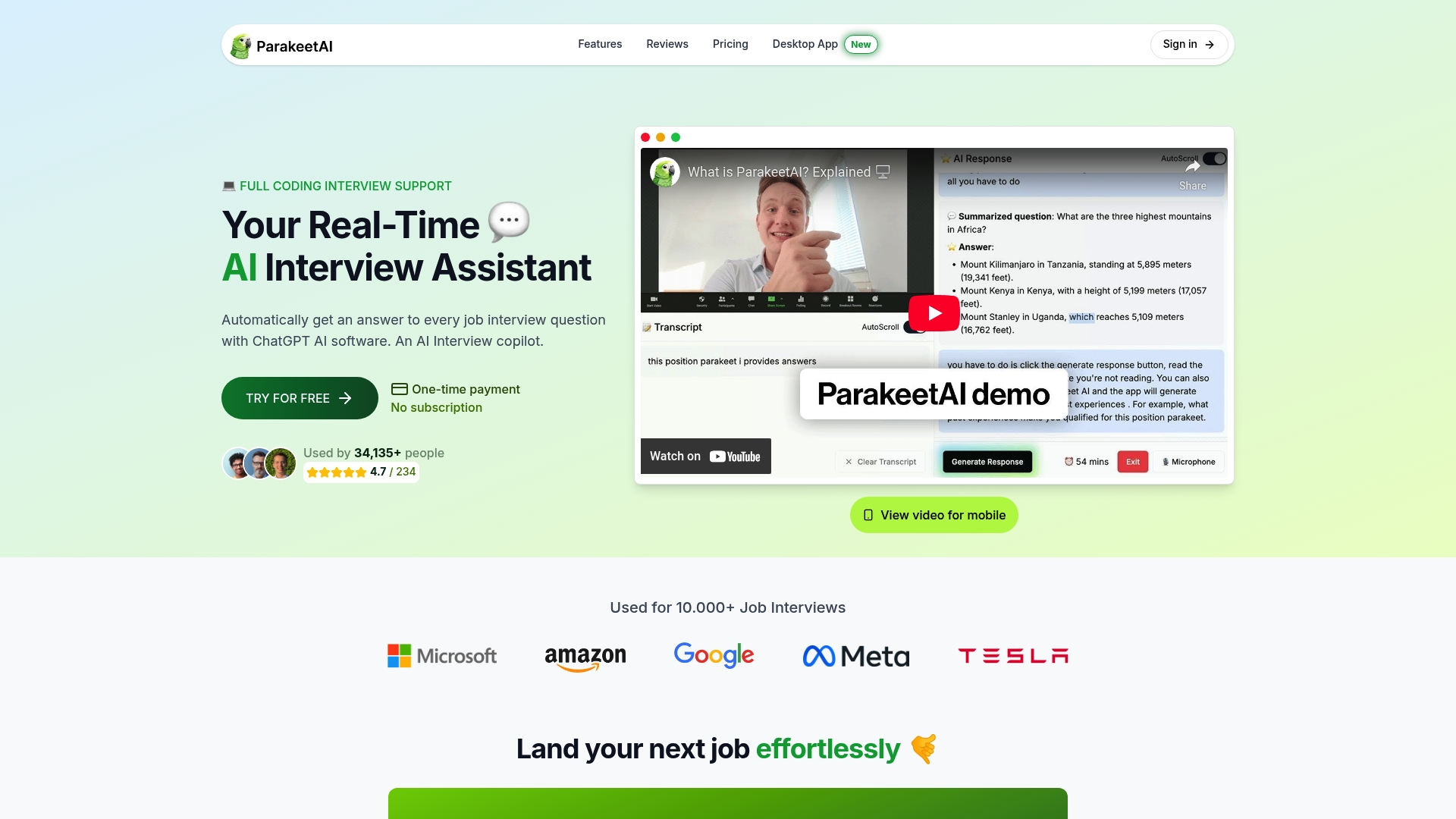
ParakeetAI is a real-time AI interview assistant that listens to your interview as it happens and automatically provides answers and prompts to help you stay sharp in every moment. No more blanking on key questions. No more second-guessing your phrasing mid-sentence. Whether you are preparing for a first-round screening or a final panel, ParakeetAI gives you the support to show up fully prepared, confident, and ready to ask the questions that actually matter.
Frequently asked questions
What are the best types of questions to ask in an interview?
The best questions are role, team, or culture-focused and signal that you have researched the organization thoroughly. Avoid generic queries that could apply to any company.
When is it appropriate to ask about salary or benefits?
Salary and perks questions are best saved until after an offer is extended or during the final stages of the hiring process. Bringing them up early can signal the wrong priorities.
How many questions should I prepare for an interview?
Prepare at least 5 to 7 questions across different categories, and always have backup questions ready in case several get answered during the conversation itself.
Is it bad not to ask any questions at the end of an interview?
Yes. 32 to 44% of managers view asking zero questions as a dealbreaker, interpreting it as a lack of interest or preparation on your part.
What if the interviewer has already answered all my prepared questions?
Thank them for the thorough discussion, reference a specific insight you found valuable, and pivot to a backup question or ask what the next steps in the process look like.