
Virtual interview feedback explained: improve fast

TL;DR:AI-powered virtual interview feedback analyzes tone, body language, and content in real time for precise improvement.Feedback covers communication clarity, confidence, pacing, filler words, and content relevance with detailed, actionable reports.Consistently applying targeted feedback through multiple sessions accelerates skill development and interview success.
Virtual interview feedback used to mean waiting days for a two-line email that told you nothing useful. That experience is now outdated. AI-powered systems can now analyze your tone, pacing, word choice, and body language in real time, giving you a precise roadmap for improvement before your next call. Whether you just finished a video interview or you’re preparing for one, understanding what modern virtual interview feedback actually measures and how to act on it can be the difference between a rejection and an offer.
Table of Contents
- What is virtual interview feedback?
- How does AI-powered interview feedback work?
- What does quality feedback look like?
- How to use feedback to improve your next interview
- A fresh perspective on virtual interview feedback
- Take your interview skills to the next level
- Frequently asked questions
Key Takeaways
| Point | Details |
|---|---|
| AI-powered feedback explained | Modern virtual interview feedback provides detailed, AI-driven insights on your performance. |
| Actionable improvement steps | Structured reports highlight what to improve with specific, measurable suggestions. |
| Objective and rapid results | AI feedback delivers instant, unbiased evaluations to help you prepare efficiently. |
| Effective self-assessment | Use feedback loops and concrete data to track your progress and boost interview success. |
What is virtual interview feedback?
Virtual interview feedback is a structured evaluation of your performance in an online job interview. It can come from a human reviewer, an automated AI system, or a combination of both. The goal is the same: to show you where you performed well and where you need to sharpen your skills.
If you’re new to this format, it helps to first understand what virtual interviewing actually involves before digging into the feedback layer. Once you have that foundation, the value of detailed feedback becomes obvious.
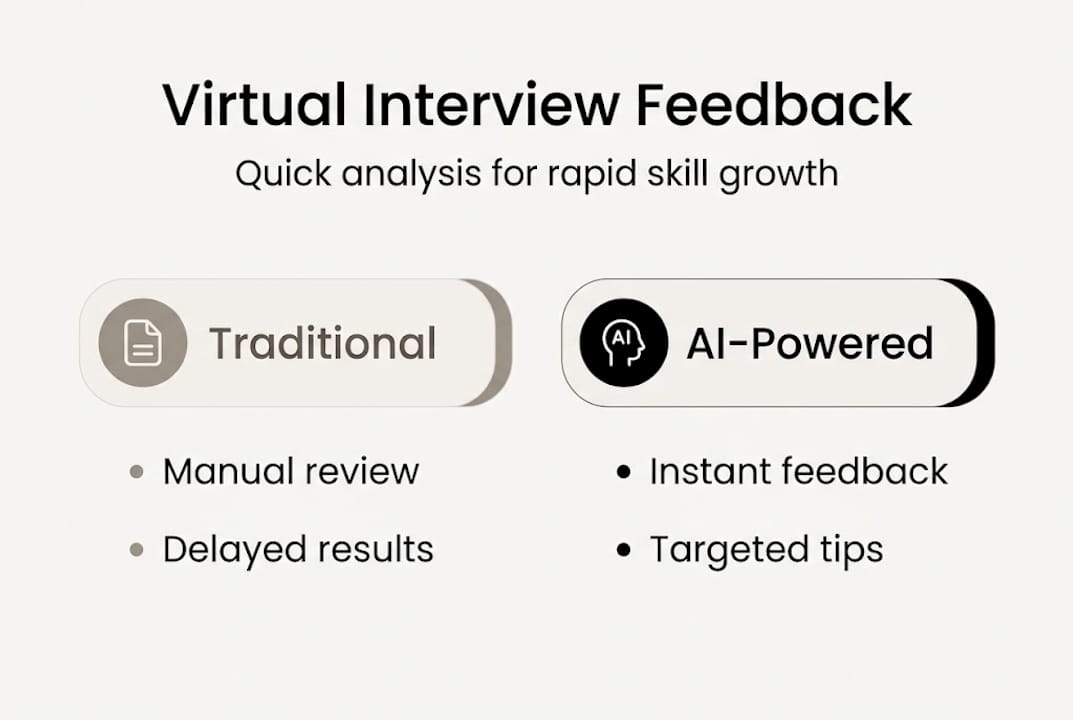
The difference between traditional and AI-powered feedback is significant. Here’s a quick comparison:
| Feature | Traditional feedback | AI-powered feedback |
|---|---|---|
| Speed | Days or weeks | Immediate |
| Objectivity | Subjective | Data-driven |
| Detail level | General comments | Category-by-category scores |
| Consistency | Varies by reviewer | Standardized rubric |
| Actionability | Often vague | Specific next steps |
Traditional feedback depends on a recruiter’s perception, mood, and bandwidth. AI feedback, by contrast, measures what actually happened in your video. AI tools can score interviews based on tone, clarity, confidence, and more, removing the guesswork.

What makes AI feedback especially powerful is its consistency. You get the same level of scrutiny whether you record at 9 AM or 11 PM. The system doesn’t get tired or distracted.
High-quality virtual interview feedback typically covers:
- Communication clarity: Are your answers easy to follow?
- Confidence signals: Does your voice and posture project certainty?
- Filler word count: How often do you say “um,” “like,” or “you know”?
- Pacing: Are you speaking too fast or too slow?
- Content relevance: Did you actually answer the question asked?
“Feedback is not a verdict. It’s a map. The more specific it is, the faster you can navigate to where you want to go.”
To explore how automated interview feedback has evolved into a real skill-building tool, you’ll find that the technology has matured well beyond basic transcription.
How does AI-powered interview feedback work?
AI interview feedback systems process your recorded video or audio through multiple layers of analysis simultaneously. It’s not just transcription. The system reads your voice, your face, your word choices, and the structure of your answers all at once.
According to research, AI analysis covers tone, clarity, confidence, body language, filler words, pacing, and content relevance using video and audio input. That level of depth is simply not possible with human reviewers at scale.
Here’s how the process works, step by step:
- Record your interview: Complete your video interview or practice session on any platform.
- AI ingests the data: The system processes audio for speech patterns and video for facial expressions and posture.
- Multi-category scoring: Each dimension (tone, pace, content) gets a separate score based on a rubric.
- Report generation: You receive a structured breakdown with scores, highlights, and improvement notes.
- Review and act: You identify your lowest-scoring areas and target them in your next practice session.
Here’s a look at common scoring categories and what they measure:
| Scoring category | What AI evaluates |
|---|---|
| Tone | Warmth, authority, energy levels |
| Pacing | Words per minute, pause frequency |
| Filler words | Count and frequency of verbal crutches |
| STAR adherence | Situation, Task, Action, Result structure |
| Confidence | Eye contact, voice steadiness, posture |
| Content depth | Relevance and specificity of answers |
Understanding how AI scores your interview helps you prepare more strategically. Instead of practicing blindly, you know exactly which categories the system weights most heavily.
Tools like Huru.ai break down word choice, pacing, and tone into separate metrics so you can isolate one issue at a time. The AI interview scoring impact on candidate preparation is measurable, with users reporting sharper, more confident answers after just a few feedback cycles.
Pro Tip: Before your next practice session, review the scoring rubric for your target tool. Match your response structure to the highest-scoring categories so every answer you practice is already aligned with what the AI rewards.
What does quality feedback look like?
Not all feedback is created equal. Generic comments like “work on your confidence” don’t help you change anything. Quality virtual interview feedback is specific, measurable, and tied to a clear next action.
AI tools provide multi-layered reports on content accuracy, speech patterns, and confidence, giving you the granular data you need to make real changes.
Here’s what a high-quality feedback report actually contains:
- Category scores: Numerical ratings for each dimension (e.g., Pacing: 72/100, Filler Words: 55/100).
- Specific examples: Timestamps or quotes showing exactly where you lost points.
- Concrete targets: Clear benchmarks like “Reduce filler words from 8 to 2 per answer.”
- Comparison data: How your performance compares to top-scoring candidates in similar roles.
- Next-step prompts: Guided exercises or drills to address your weakest areas.
For example, instead of “speak more clearly,” quality feedback says: “You averaged 165 words per minute during technical questions. Top performers in this role average 130. Try pausing for two full seconds after each question before you begin your answer.”
That’s the difference between feedback that frustrates you and feedback that actually moves the needle. When you know how to self-assess interview performance effectively, you stop waiting for external validation and start building your own improvement loop.
Content accuracy is another dimension worth highlighting. AI systems check whether your answer actually addressed the question, not just whether it sounded confident. You might deliver a polished, fluent response that misses the mark entirely. Good feedback catches that. Understanding why AI matters for interviews comes down to this precision.
Pro Tip: If you can only focus on one feedback category at a time, start with communication clarity. Improving how clearly you structure and deliver answers creates a ripple effect across nearly every other scoring dimension.
How to use feedback to improve your next interview
Receiving feedback is step one. Using it consistently is where real growth happens. Most candidates review their report once, feel good or bad about it, and move on. That approach leaves most of the value on the table.
Feedback lets candidates target communication, pacing, and content for measurable improvement, but only when applied in a structured way.
Here’s a simple roadmap to turn your feedback into real results:
- Read the full report: Don’t skip to your score. Read every category note before you form any conclusions.
- Identify your top two issues: Pick the two categories where you scored lowest or where improvement will have the biggest impact.
- Set a session goal: In your next practice interview, focus only on those two areas. Don’t try to fix everything at once.
- Record and compare: Use the same tool to record your next attempt. Pull up both reports side by side.
- Track your metrics over time: Keep a simple log of your scores per category across sessions. Progress becomes visible fast.
Beyond solo practice, you can accelerate improvement by:
- Joining interview prep communities on Reddit or LinkedIn where members review each other’s recorded answers.
- Using peer review alongside AI feedback for a balanced perspective.
- Setting weekly milestones (e.g., reduce filler words by 50% within two weeks).
- Reviewing the how AI scores interview performance criteria regularly to make sure your practice stays aligned with real scoring standards.
The video interview analysis process is most powerful when you treat it as a recurring cycle, not a one-time check. Each session adds a new data point. Over time, those data points tell a story about your growth.
A fresh perspective on virtual interview feedback
Here’s something most interview guides won’t tell you: the biggest mistake candidates make with feedback is treating it like a report card.
A report card tells you where you stood. Feedback tells you where to go. That reframe changes everything.
Most job seekers scan their results looking for praise or criticism and then emotionally react to whatever they find. Successful candidates do something different. They read feedback the way a coach reads game film, searching for repeatable patterns and specific adjustments that compound over time.
The real-time interview analysis tools available today are diagnostic instruments. A drop in your pacing score isn’t a personal failure. It’s a signal that you rehearsed under low-pressure conditions and then sped up when the stakes felt higher. That’s fixable with targeted drills.
Small, measurable improvements stack fast. Cutting your filler words from 12 to 4 per answer doesn’t sound dramatic, but it completely changes how an interviewer perceives your confidence. Track those small numbers. That’s where the real wins live.
Take your interview skills to the next level
You now understand what virtual interview feedback is, how AI generates it, and exactly how to turn it into a performance edge. The next step is putting that knowledge to work with a tool built for real results.
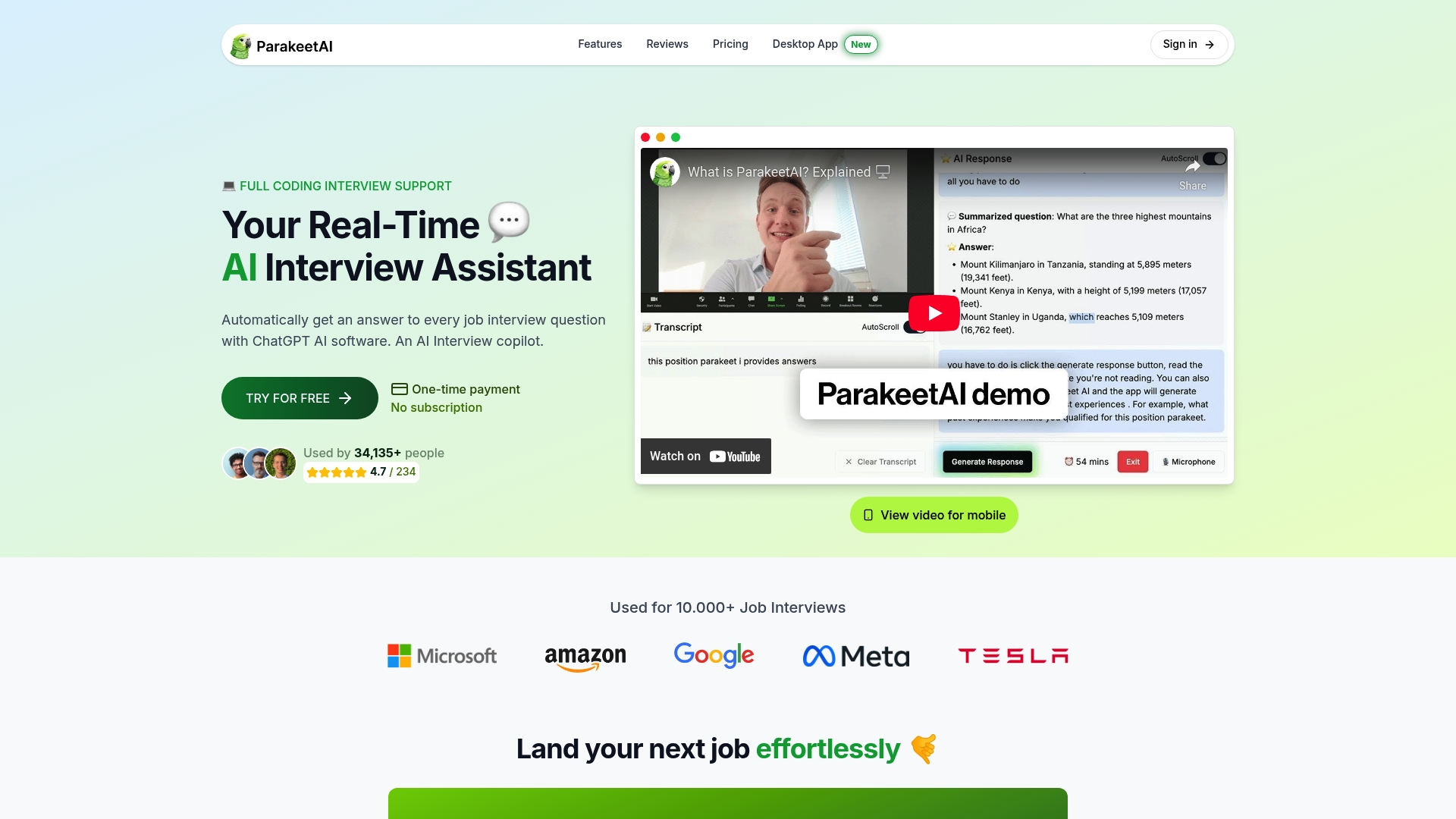
ParakeetAI is a real-time AI interview assistant that listens during your interview and instantly surfaces the best answers for every question. Beyond live support, it gives you detailed, actionable feedback tailored to your specific role and responses. Run a mock interview, get your AI-powered report, and see exactly where you stand. Every session brings you measurably closer to the offer you’re targeting. Start practicing smarter today.
Frequently asked questions
What exactly does virtual interview feedback include?
Virtual interview feedback includes an analysis of your communication skills, confidence, body language, pacing, filler words, and relevance of content. AI analysis covers all of these dimensions simultaneously using your video or audio responses.
How does AI analyze my virtual interview performance?
AI tools scan your recorded answers for patterns in speech, tone, pacing, and structure, then score each area using proven interview rubrics. These multi-layered reports cover content accuracy, speech patterns, and confidence in a single pass.
What’s the best way to use virtual interview feedback?
Focus on one or two areas at a time and build a habit of reviewing, applying, and tracking your progress with each new session. Targeting communication and pacing specifically leads to the most measurable improvement across sessions.
How is virtual interview feedback different from traditional interview feedback?
Virtual feedback powered by AI is instant, objective, and structured, while traditional feedback tends to be slower and shaped by the reviewer’s personal impression. AI-driven analysis removes subjectivity and gives you consistent scoring every single time.