
Why AI listens to interviews: boost your job success

TL;DR:AI interview tools provide real-time listening, transcription, question analysis, and answer suggestions.Using AI increases candidate confidence, answer quality, and reduces interview anxiety.AI-assisted interviews improve pass rates, candidate preference, and reduce hiring bias.
Most job seekers assume that using AI during an interview is risky, maybe even dishonest. But that assumption is quietly costing them opportunities. AI interview tools can boost candidate confidence and performance in measurable ways, and the job seekers who understand how these tools work are showing up to interviews better prepared, calmer, and more articulate. This article breaks down exactly how AI listens to your interview, why the real-time feedback it provides actually works, what the data says about outcomes, and how to use it ethically so you come out ahead without compromising your integrity.
Table of Contents
- How AI interview copilots actually listen and assist
- Why real-time AI feedback can boost your interview performance
- What does success look like? Evidence from AI-led interviews
- Ethical debates: Preparation, fairness, and future directions
- A fresh perspective: Why smart job seekers use AI as a coach, not a crutch
- Next steps: Put real-time AI interview assistance to work for you
- Frequently asked questions
Key Takeaways
| Point | Details |
|---|---|
| Real-time AI support | AI copilots listen and help you answer job interview questions instantly, giving timely suggestions and structure. |
| Confidence and skill gains | AI tools boost your interview confidence, answer quality, and nonverbal cues with proven measurable improvements. |
| Better outcomes with AI | Job seekers using AI interview support pass at higher rates and prefer the instant feedback over traditional methods. |
| Ethics and changing norms | Using AI is ethical with the right intent, but dependency can backfire as employers adapt their hiring practices. |
How AI interview copilots actually listen and assist
You might picture AI as some futuristic robot sitting in the corner of your Zoom call. The reality is much simpler, and a lot more useful. AI interview copilots run quietly in the background on your device, doing several things at once to give you real-time support.
Here is how the process works, step by step:
- Audio capture: Your device microphone picks up the interviewer’s voice, either through a virtual meeting platform like Zoom or Microsoft Teams, or via a physical mic during in-person sessions.
- Transcription: The audio is converted to text in milliseconds using speech-to-text technology, so the AI can read what was just said.
- Question classification: Natural language processing (NLP) analyzes the transcript to identify what type of question was asked, behavioral, technical, situational, or competency-based.
- Answer generation: The AI pulls from structured frameworks like STAR (Situation, Task, Action, Result) to generate a relevant, organized answer suggestion tailored to the question.
- Display: The suggested answer appears on your screen discreetly, giving you a starting point to speak from with confidence.
These real-time interview assistants work invisibly during both virtual and in-person settings. As AI copilot tools capture live audio, transcribe, analyze question types, and provide real-time structured answer suggestions, the whole cycle happens faster than you can take a breath.
| Feature | What it does | Why it helps |
|---|---|---|
| Live transcription | Converts speech to text instantly | Keeps AI in sync with conversation |
| NLP classification | Identifies question type | Targets the right answer framework |
| STAR framework output | Structures your response | Sounds polished and organized |
| Screen display | Shows answer suggestion discreetly | Reduces panic, boosts recall |
Understanding real-time job interview insights means recognizing that the AI is not answering for you. It is giving you a scaffold to build on, which is a critical distinction.
Pro Tip: Before your first AI-assisted interview session, review your tool’s privacy settings and check local recording laws. Some jurisdictions require all parties to consent before audio is captured.
The role of AI assistants is not to replace your voice. It is to make sure you never go blank when it matters most.
Why real-time AI feedback can boost your interview performance
Understanding the technology lays the groundwork, but the real question is: does it actually work?
The short answer is yes, and the data is hard to argue with. 94% of users report higher confidence, and up to 88% improve their answers while 70% improve their non-verbal cues when using AI interview tools. Those are not small gains. That is the difference between getting a callback and getting silence.
Here is what AI interview feedback typically covers:
- Speech pacing and clarity: Are you speaking too fast when nervous? AI flags it.
- Tone and sentiment: Does your voice sound flat or confident? Real-time analysis catches this.
- Body language and eye contact: Computer vision tools track up to 48 distinct nonverbal cues, including micro-expressions, posture, and gaze direction.
- Resume alignment: Some tools cross-reference your answers against your resume to flag inconsistencies before they become red flags.
- Answer structure: Are you actually answering the question, or going off on a tangent? AI keeps you on track.
The computer vision component is especially underrated. Most candidates have no idea how much their body language is communicating. Slouching, avoiding eye contact, or fidgeting can undermine an otherwise strong answer. AI tools that monitor these signals give you a mirror that most people never had access to before.
| Experience | Without AI copilot | With AI copilot |
|---|---|---|
| Answer structure | Often unorganized | STAR-aligned and clear |
| Confidence under pressure | High anxiety, blanking | Calm, supported recall |
| Non-verbal awareness | Blind to own habits | Real-time correction |
| Post-interview learning | Guesswork | Specific, actionable data |
When you see AI interview answers in practice, the pattern is consistent. Candidates who use these tools self-correct faster, stay calmer under pressure, and walk out feeling like they actually showed up as their best selves. That confidence compounds over multiple interviews.

What does success look like? Evidence from AI-led interviews
But what does all this mean in practice? Here is what recent data tells us about AI-driven interviews.
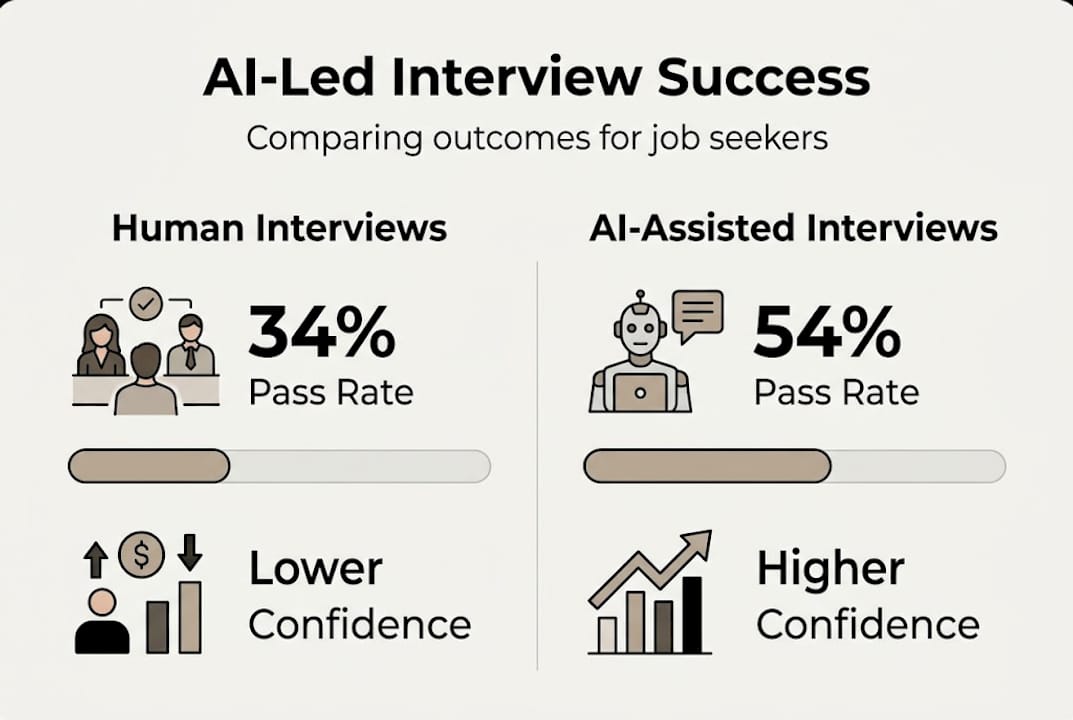
The numbers are striking. AI-led interviews yield pass rates of 54% versus 34% for traditional human-led interviews, result in higher job offers, and 78% of candidates actually prefer AI interviews over human-led ones. That preference is not just about comfort. It is about fairness, consistency, and reduced bias.
“Candidates who go through AI-assisted screening are not just more likely to get the job. They are more likely to stay in it, suggesting better fit from the start.” — micro1 AI Research
Here is what the data looks like across key performance indicators:
| Metric | Human-led interviews | AI-assisted interviews |
|---|---|---|
| Pass rate | 34% | 54% |
| Candidate preference | 22% | 78% |
| Bias consistency | Variable | Standardized |
| Time to hire | Longer | Significantly reduced |
Beyond candidates, companies benefit too. Fewer screening rounds mean less recruiter time wasted. Standardized questions reduce unconscious bias. And AI in pre-employment testing is making it possible to evaluate more candidates fairly in less time.
Here is what employers gain:
- Fewer rounds of screening for the same quality of hire
- Reduced interviewer fatigue and bias
- Faster time-to-offer without sacrificing fit
- Better data on candidate performance across a consistent rubric
As AI-led interview outcomes become more common, the hiring landscape is shifting. Job seekers who understand this shift and adapt to it early have a real structural advantage. Staying current with AI interview technology trends is no longer optional for serious candidates.
Ethical debates: Preparation, fairness, and future directions
With strong results come strong opinions. Let’s address the ethics and future of AI interview assistants.
The debate is real, and it is not going away. Here is a balanced look at both sides:
Arguments for using AI:
- Levels the playing field for candidates who lack access to expensive coaching
- Helps non-native speakers and neurodiverse candidates communicate more effectively
- Builds genuine skills through repeated, structured practice
- Reduces anxiety-driven underperformance that hides real talent
Arguments against using AI:
- Live AI assistance during interviews may misrepresent a candidate’s actual abilities
- Employers cannot assess real communication skills if AI is generating the answers
- Transparency is rarely offered, raising honesty concerns
- Could disadvantage candidates who choose not to use AI tools
“Is AI the new calculator for job prep? Just as calculators did not eliminate the need to understand math, AI tools do not replace the need to genuinely know your field. They just change what preparation looks like.” — Ashish Tripathi, LinkedIn
The debate around using AI for interviews is evolving fast. Proponents view AI as ethical augmentation. Critics warn of cheating and push for human oversight. Both sides have valid points.
Hiring practices are already adapting. More companies are shifting to output-based assessments, live coding tests, and in-person final rounds specifically to reduce AI’s influence on screening. This means the window for using AI as a live crutch is narrowing, while the value of using it for using AI for interviews as a preparation tool is growing.
Pro Tip: Use AI tools to practice and build real skills before your interview, not to generate answers live that you could not produce on your own. The goal is to internalize the frameworks so they become yours.
A fresh perspective: Why smart job seekers use AI as a coach, not a crutch
These debates spark strong opinions. Here is our honest, experience-driven take.
Most articles about AI in interviews focus on what it can do. We want to talk about what happens when candidates rely on it too heavily. The risk is real. As employers get wise to AI-generated responses, they are shifting toward work samples, case studies, and unscripted in-person conversations. A candidate who used AI as a live answer machine during screening will be exposed the moment the format changes.
The smarter play is to treat AI as a training partner. Use it to run mock interviews, identify your weak spots, and internalize structured answer frameworks until they feel natural. That is where the real edge comes from. Success hinges on ethical, prep-focused AI use rather than live dependency, and the candidates who figure that out early will still be competitive when the tools are no longer allowed in the room.
When used this way, leveraging AI for interview prep becomes one of the most democratizing tools in the job market. Not everyone can afford a career coach. But everyone can practice with an AI that gives honest, structured feedback at 11pm the night before a big interview.
Next steps: Put real-time AI interview assistance to work for you
Ready to build your interview skills? Here is how to start with the right tools.
If this article has shown you anything, it is that AI interview tools are most powerful when you use them to prepare, not just to perform. The candidates who practice consistently, study their feedback, and internalize structured frameworks are the ones who walk into interviews with genuine confidence.
Explore ParakeetAI’s interview copilot to experience real-time AI assistance that listens to your interview and helps you respond with clarity and structure. Whether you are prepping for your first role or your next big move, ParakeetAI’s resource hub has in-depth guides and the latest trends to keep you sharp. Start practicing today, and walk into every interview ready.
Frequently asked questions
How does AI actually listen to job interviews?
AI interview copilots capture live audio via your device, transcribe it instantly, classify the question type, and provide real-time answer suggestions on your screen.
Can using AI during interviews be considered cheating?
Opinions are divided. Some view it as unfair help, while others see it as a modern coaching tool that should be used transparently and ethically.
What improvements do job seekers get from AI interview tools?
Users see higher confidence, better structured answers, and improved non-verbal communication, with up to 94% reporting positive results from AI-assisted sessions.
Are employers aware candidates are using AI during interviews?
Awareness is rising, with many recruiters now adjusting their methods to spot AI use, and companies updating practices to favor work-sample or in-person assessments instead.