
What Is AI Question Recognition? A 2026 Guide

TL;DR:AI question recognition analyzes vocal pitch and linguistic cues to detect questions before they are completed, forming the foundation of reliable conversational AI. Modern systems use dual-layer techniques, combining acoustic F0 tracking with interrogative word detection, often employing two-pass models for enhanced accuracy in real-world environments. While AI identifies question intent, it does not truly understand them, and limitations such as hallucinations, bias, and speech variability necessitate human oversight.
AI question recognition is the technology that detects question intent by analyzing vocal pitch patterns and linguistic cues in real time, before a speaker finishes their sentence. This capability sits at the core of every modern voice assistant, automated interview platform, and educational dialogue system. Understanding how AI question detection works reveals why some conversational systems feel eerily responsive while others stumble on the simplest queries. For professionals building or using these systems, the difference between a system that recognizes questions accurately and one that guesses poorly is the difference between a useful tool and a frustrating one.
What is AI question recognition and how does it work?
AI question recognition is the process by which a system identifies whether a spoken or written statement carries interrogative intent, then routes that input to an appropriate response engine. The technology combines two distinct layers: acoustic analysis of the speaker’s voice and linguistic analysis of word patterns. Neither layer alone is sufficient. Together, they produce the high-confidence predictions that make real-time conversational AI possible.

The acoustic layer focuses on fundamental frequency, known as F0. When a speaker asks a question in English, their vocal pitch typically rises toward the end of the utterance. AI systems track F0 in 25 to 50 millisecond slices of audio, monitoring for that characteristic upward curve. This means the system can flag question intent before the sentence ends, giving downstream response systems a head start.
The linguistic layer works in parallel. Natural language processing models scan incoming word sequences for interrogative markers: “who,” “what,” “how,” “when,” “why,” and “is it.” These words appear early in most questions, so the model can predict question intent from the first two or three words. Statistical language models trained on large datasets reinforce this by learning which word sequences most commonly precede question marks.
Pro Tip: When designing voice interfaces, test your question recognition system with accented speech and mumbled delivery. Most failures occur at the edges of acoustic clarity, not in clean studio conditions.
Two-pass models address exactly this problem. The first pass transcribes raw speech without punctuation. The second pass applies a specialized model that restores punctuation and question marks based on text context alone. This architecture improves accuracy even when audio quality is poor, making it far more reliable in real-world deployments than single-pass systems.
- Acoustic analysis monitors F0 rise in short audio windows to detect question intonation
- Linguistic models flag interrogative words early in the utterance for fast intent prediction
- Two-pass architectures separate transcription from punctuation restoration for higher accuracy
- Statistical language models trained on large corpora predict question markers from word sequences
What AI models and algorithms power question classification?
The architecture behind machine learning question recognition has advanced considerably beyond simple keyword spotting. Modern systems use convolutional neural networks, large language models, and retrieval-augmented generation to classify not just whether something is a question, but what kind of question it is and how complex it is.
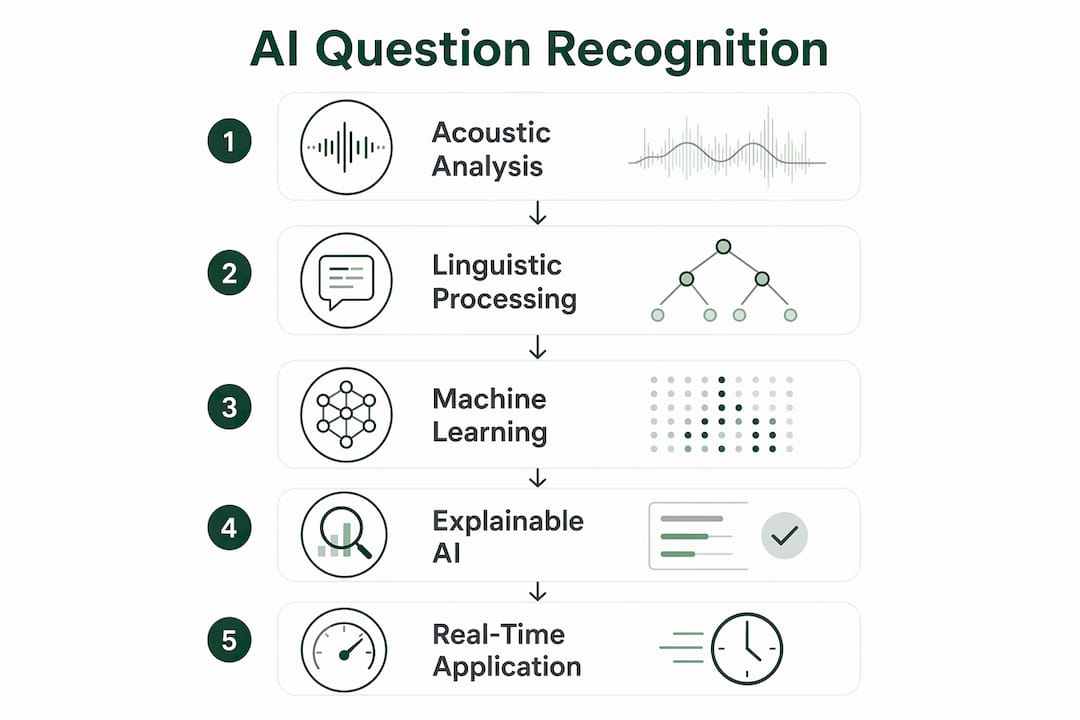
CNN models combined with explainable AI methods like SHAP and LIME represent one of the most reliable approaches for educational contexts. A study applying this architecture to 5,000 labeled educational questions achieved 88% classification accuracy and produced pedagogically interpretable explanations for each prediction. That interpretability matters enormously in education, where teachers need to understand why a question was classified as high-complexity, not just accept a black-box label.
Large language models bring a different capability. Rather than classifying question type from structure alone, LLMs analyze semantic content to detect ambiguity, incoherence, and logical gaps. A pilot study applying LLMs to 264 medical exam questions demonstrated that automated diagnostic tagging could identify ambiguous or poorly structured items, supporting human expert revision before those questions reached students. This is AI for question classification operating as a quality control layer, not just a detection mechanism.
| Model type | Primary function | Key strength |
|---|---|---|
| CNN + SHAP/LIME | Question complexity classification | Interpretable predictions for educators |
| Large language models | Ambiguity and incoherence detection | Semantic depth beyond surface structure |
| Two-pass speech models | Acoustic + linguistic question detection | Accuracy with accented or mumbled speech |
| Retrieval-augmented generation | Multi-source synthesis and reasoning | Richer answers from diverse knowledge bases |
Generative retrieval-augmented generation enables AI to pull from multiple knowledge sources and reason across them before producing an answer. The tradeoff is real: richer synthesis comes with increased hallucination risk, because the model is combining information in ways that may not reflect any single verified source.
Pro Tip: If you are evaluating AI question classification tools for an interview or assessment platform, ask vendors specifically about their explainability layer. A system that cannot explain why it flagged a question as ambiguous is a liability in high-stakes settings.
How is AI question recognition applied in automated interviews and assessments?
The practical applications of AI question understanding fall into three major domains: automated job interviews, educational assessments, and conversational agents. Each domain uses the same core technology differently, and each reveals a distinct set of tradeoffs.
In automated interviews, the system must do two things simultaneously. It must recognize when the interviewer asks a question, and it must evaluate whether the candidate’s response is genuine. Platforms that specialize in interview answer detection use vocal pitch patterns and language analysis to identify question boundaries, then monitor candidate responses for authenticity signals.
- Question boundary detection. The system identifies when a question ends and the candidate’s response window begins, using F0 tracking and interrogative word patterns.
- Response authenticity analysis. Behavioral cues including natural speech pauses, eye movement patterns, and response timing are analyzed to distinguish genuine human answers from AI-generated ones.
- Complexity scoring. The question is classified by cognitive demand, so the system can weight responses appropriately. A factual recall question carries different expectations than a situational judgment question.
- Feedback generation. The system produces structured feedback on response quality, flagging gaps, irrelevancies, or unusually fluent answers that may indicate AI assistance.
Sophisticated detection systems combine audio delivery analysis, eye tracking, and response timing to differentiate genuine human responses from AI-generated ones. This multi-signal approach is necessary because text analysis alone cannot reliably catch AI-assisted answers. A candidate using a real-time AI assistant produces text that is grammatically indistinguishable from a strong human response. The behavioral signals are what give the system away.
In educational assessments, AI question recognition serves a different purpose. Rather than evaluating candidates, it evaluates the questions themselves. LLMs flag ambiguous or poorly structured exam questions through consensus diagnostic tagging, supporting human expert revision. This shifts assessment design from a purely manual process to a human-AI collaboration, where the AI surfaces problems and humans make the final call.
The role of voice AI in interviews is expanding rapidly as organizations seek to scale hiring without sacrificing evaluation quality. The technology is not replacing human judgment. It is handling the pattern recognition work that humans find tedious and inconsistent, freeing interviewers to focus on the judgment calls that actually require human insight.
What are the challenges and misconceptions about AI question recognition?
The most persistent misconception about AI question recognition is that the system understands the question. It does not. Modern LLMs statistically predict the most likely next word based on training data patterns. They produce fluent, confident outputs that can sound like genuine comprehension. That fluency is the source of the confusion.
“Fluency is not accuracy. A system that sounds certain is not necessarily correct. The confidence of an AI output reflects the statistical weight of its training data, not the truth of the claim.”
This distinction matters in practice. When an AI question recognition system misclassifies a statement as a question, or fails to detect a question buried in a complex sentence, the error is not a reasoning failure. It is a statistical prediction failure. The fix is more and better training data, not a smarter algorithm in the human sense.
The challenges facing AI question detection today include:
- Hallucinations. Generative models sometimes produce plausible-sounding but factually incorrect responses to recognized questions. This is a structural feature of how these models work, not a bug that can be patched away.
- Detection limitations. Behavioral inconsistency detection in interviews depends on baseline data. Without a baseline for a specific candidate, the system cannot reliably distinguish nervousness from AI assistance.
- Accented and non-standard speech. Acoustic models trained predominantly on standard American or British English perform worse on accented speech, introducing bias into question detection.
- Context collapse. Short audio windows miss questions embedded in longer, complex sentences where the interrogative signal appears late in the utterance.
Human-in-the-loop validation remains the most reliable safeguard against all of these failure modes. AI question recognition systems work best when their outputs are treated as high-quality signals for human review, not as final verdicts. The role of AI in answer evaluation is to narrow the field and surface the most important signals. The human role is to interpret them.
Key takeaways
AI question recognition combines acoustic pitch analysis and linguistic pattern detection to identify question intent before a speaker finishes their sentence, making it the foundation of reliable conversational AI.
| Point | Details |
|---|---|
| Dual-layer detection | Acoustic F0 tracking and linguistic interrogative word analysis work together for high accuracy. |
| Two-pass model advantage | Separating transcription from punctuation restoration improves accuracy with accented or unclear speech. |
| CNN and LLM applications | CNNs classify question complexity with 88% accuracy; LLMs detect ambiguity in assessment items. |
| Behavioral signals in interviews | Response timing, eye tracking, and speech pauses detect AI-assisted answers beyond text analysis alone. |
| AI does not understand questions | Statistical prediction produces fluent outputs, but hallucinations and misclassifications remain structural risks. |
Why I think most teams underestimate what question recognition actually requires
Most teams building conversational AI treat question recognition as a solved problem. They plug in a speech-to-text API, assume the punctuation restoration layer handles everything, and move on. In my experience, that assumption breaks down the moment you deploy in a real environment with real users.
The acoustic layer is only as good as the audio quality it receives. Open-plan offices, mobile devices with inconsistent microphones, and non-native speakers all degrade F0 tracking in ways that lab testing never reveals. The linguistic layer compensates, but it has its own blind spots, particularly with indirect questions and culturally specific phrasing that does not follow standard English interrogative structure.
What I find genuinely underappreciated is the explainability gap. Teams can tell you their system achieves 88% accuracy on a benchmark dataset. Almost none of them can tell you which question types it fails on, or why. That gap matters enormously in automated interviews and educational assessments, where a misclassified question can affect a candidate’s outcome or a student’s grade.
The most promising direction I see is the combination of SHAP-based explainability with LLM-based ambiguity detection. Not as separate tools, but as an integrated pipeline where the classification model explains its reasoning and the LLM validates that reasoning against semantic coherence. That combination does not exist as a turnkey product yet. But the research from 2026 suggests it is closer than most practitioners realize.
The ethical dimension deserves more attention than it gets. When AI question recognition is used to evaluate candidates in automated interviews, the system’s biases become hiring decisions. Acoustic models that perform worse on accented speech are not neutral tools. They are tools that systematically disadvantage certain candidates. Transparency about model limitations is not optional in that context. It is a professional obligation.
— Jure
See AI question recognition in action with Parakeet-ai
Understanding how AI question recognition works is one thing. Seeing it operate in a real interview is another.

Parakeet-ai is a real-time AI job interview assistant that listens to your interview and automatically provides answers to every question using AI. The system applies the same acoustic and linguistic analysis covered in this article to detect each question the moment it is asked, then surfaces a relevant, structured response before you need to pause and think. For candidates preparing for high-stakes interviews, that capability changes the dynamic entirely. Explore how Parakeet-ai handles AI question understanding in interviews and see the technology working in a live context.
FAQ
What is AI question recognition in simple terms?
AI question recognition is the process by which a system detects whether a spoken or written input is a question, using vocal pitch analysis and linguistic pattern matching. It enables conversational AI to respond appropriately without waiting for the speaker to finish.
How does AI recognize questions in speech?
AI tracks fundamental frequency rise in 25 to 50 millisecond audio segments and scans for interrogative words like “what,” “how,” and “why” to identify question intent before the utterance ends.
What is the difference between question detection and question understanding?
Question detection identifies that a question was asked. Question understanding, which current AI does not truly achieve, would mean grasping the intent and context behind it. LLMs statistically predict likely responses rather than reasoning through meaning.
How is AI question recognition used in automated interviews?
Automated interview platforms use vocal pitch patterns and behavioral signals including response timing and eye tracking to identify questions, evaluate candidate responses, and detect AI-generated answers in real time.
Can AI question recognition work with accented or unclear speech?
Two-pass models improve accuracy with accented speech by separating transcription from punctuation restoration, but acoustic models trained on standard English still perform less reliably on non-standard speech patterns.