
AI Response Recommendation Explained for Job Candidates

TL;DR:AI response recommendation listens to interview questions and suggests answers based on pattern matching. Candidates improve suggestions by providing detailed context, refining prompts, and verifying facts to avoid inaccuracies. Parakeet-ai offers real-time assistance using hybrid filtering and continuous training for live interview support.
AI response recommendation is exactly what it sounds like: during a live job interview, an AI system listens to each question and instantly generates suggested answers for you to use or adapt. The technology behind this is more layered than most candidates realize, and understanding it helps you get far better results from it.
Here is how it works at a high level:
- AI generates responses one token at a time, predicting the most statistically plausible next word given everything before it
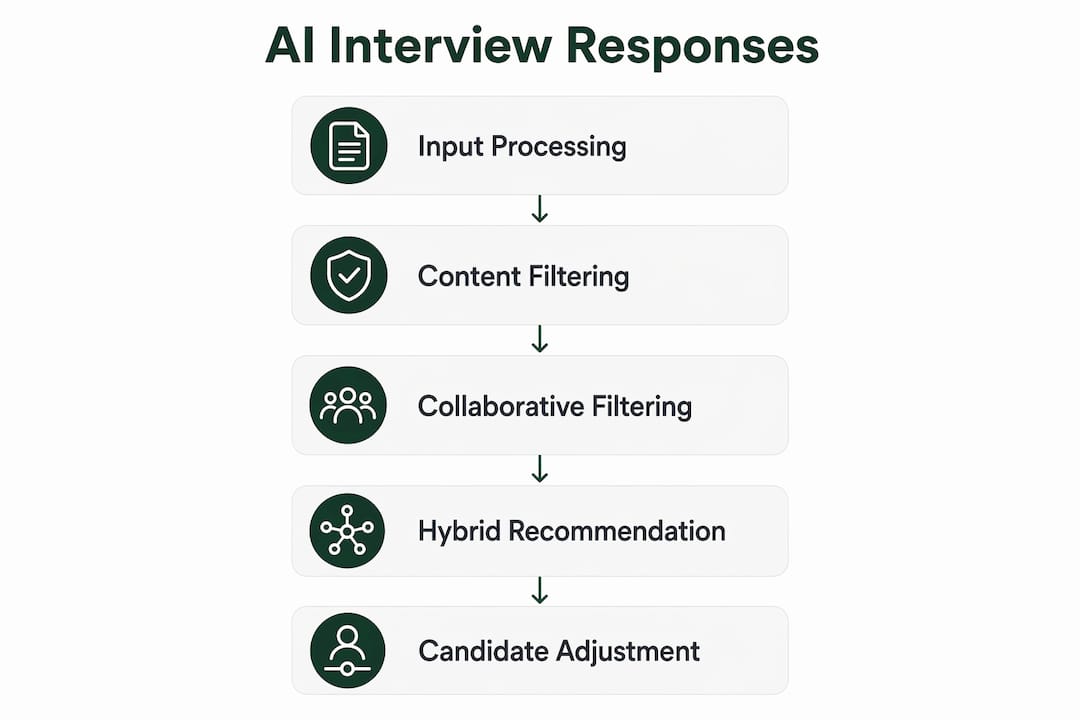
- Content-based filtering analyzes the specific question you were asked and matches it to relevant answer patterns
- Collaborative filtering draws on patterns from past successful interview responses to shape suggestions
- Hybrid models combine both filters for answers that are both relevant and stylistically appropriate
- RLHF (reinforcement learning from human feedback) fine-tunes output toward responses humans rated as helpful and clear
- Parakeet-ai applies this architecture in real time, listening to your interview and generating answer suggestions automatically as each question lands
How AI logic actually generates interview response suggestions
The engine behind any AI response recommendation system runs on two core filtering approaches, usually combined.
Content-based filtering evaluates the intrinsic features of the interview question itself, including its phrasing, topic, and the context you have provided, to surface relevant answer patterns. Ask about a gap in your resume, and the system maps that question’s attributes to answers that address gaps directly. Collaborative filtering works differently: it identifies statistically common patterns from prior successful interview interactions and uses those to inform what it suggests next. Think of it as the system asking, “What did candidates who answered this type of question well actually say?”
Most production systems, including Parakeet-ai, use a hybrid of both. The content layer handles relevance; the collaborative layer handles style and fit. RLHF then sits on top, nudging the model toward answers that human reviewers rated as clear and helpful rather than just statistically probable. The result is a suggestion that feels purposeful rather than generic, though it still carries the limitations of any pattern-matching system.
How to get sharper AI suggestions during your interview
The single biggest lever you control is the quality of context you give the system before and during the session.
- Front-load your context. Narrowing the space of plausible answers with specific background, such as your role, the company, and any constraints on your answer, pushes the AI toward more targeted suggestions from the start.
- Use specific terminology consistently. Frequent use of targeted vocabulary helps the AI recognize and include those terms in its recommendations. If you want answers framed around “cross-functional leadership,” use that phrase in your setup.
- Refine, don’t restart. When a suggestion is close but not quite right, iterative refinement prompts outperform starting over. Adjusting tone, length, or focus in a follow-up keeps the context intact and produces better results than wiping the slate clean.
- Treat every suggestion as a first draft. The AI gives you a starting point, not a finished answer. Experienced candidates adapt the output verbally, inserting personal examples and technical detail that the AI cannot know.
- Iterate through the conversation. Each exchange gives the model more context to work with. The third suggestion in a session is almost always sharper than the first.
Pro Tip: If a suggestion is close to right, tell the system to shorten it or shift the tone rather than regenerating from scratch. You preserve the context and fix the specific problem, which is faster and more accurate.
Common misconceptions about AI-generated interview recommendations
The most persistent myth is that AI “knows” the right answer. It does not. AI recommendation systems optimize for engagement and pattern matching, not objective correctness. A suggestion can sound authoritative and still be factually wrong.
The specific risk here is what researchers call the plausibility trap. Because AI generates plausible text rather than verified facts, it can state incorrect information with complete confidence. If you repeat an AI-generated claim about a company’s revenue or a technical standard without checking it, you risk a visible error in front of the interviewer. Always verify any specific fact the AI surfaces before you say it aloud.
A few other limitations worth knowing:
- Pattern bias. AI favors responses that fit prior successful patterns, which can produce generic answers that miss your unique strengths.
- Knowledge cutoff. The model’s training data ends at a fixed date, so it may not reflect recent industry developments or company news.
- No real memory. Each session starts fresh. The AI only knows what is in the current context window, not anything from a previous interview session.
- Confidently wrong tone. RLHF trains the model to sound helpful and sure of itself, which can mask mistakes. Skepticism is a feature, not a flaw.
How Parakeet-ai delivers real-time interview assistance
Parakeet-ai is built specifically for live interview sessions. It listens to your interview and automatically generates AI-driven answers to each question as it is asked, without requiring you to type or prompt manually between questions.

The platform uses hybrid recommendation architecture, combining content-based and collaborative filtering with continuous model training on live interview data. That ongoing training loop is what keeps suggestions relevant rather than stale. The user-facing design keeps the experience low-friction: you stay focused on the conversation while the system handles the suggestion layer in the background. Candidates looking to go deeper on practical application can explore AI interview best practices on the Parakeet-ai blog, which covers how to align AI assistance with different interview formats and question types.
What you should know about privacy and data security
Any tool that listens to a live interview session is handling sensitive data, and candidates should ask direct questions before using one. Look for clear answers on three points: whether audio or transcript data is stored after the session, who has access to that data, and whether the platform complies with applicable privacy regulations such as CCPA in California.
Reputable AI interview tools publish explicit data retention policies and give candidates control over what is saved. If a platform’s privacy documentation is vague or hard to find, treat that as a signal. Your interview content, including the questions asked and your responses, can reveal information about the employer’s hiring process as well as your own professional background.
Where AI response suggestions appear in real interview tools
AI response recommendation shows up across several categories of interview technology. Real-time assistants like Parakeet-ai generate live answer suggestions during the session itself. Some AI recommendation systems used in adjacent fields, such as e-commerce and customer support platforms, apply the same hybrid filtering logic to surface contextually relevant responses in real time. Customer support platforms use similar architectures to suggest ticket replies based on conversation context and past resolutions. The underlying logic, content filtering plus collaborative patterns plus RLHF tuning, is consistent across all of them. What differs is the input data and the specific training objectives each system optimizes for.
Ethical considerations when using AI during interviews
Using AI assistance during a job interview raises a real question: does it misrepresent your abilities to the employer? The honest answer depends on how you use it. Treating AI suggestions as a thinking aid, the way you might use notes in a prepared presentation, is different from reading answers verbatim without understanding them.
The practical risk is also worth considering. If you rely entirely on AI-generated answers and the interviewer asks a follow-up that goes off-script, you may not have the underlying knowledge to respond. Candidates who leverage AI for interviews most effectively use it to organize and sharpen their thinking, not to replace it. Transparency with yourself about what you actually know versus what the AI supplied is the baseline for using this technology responsibly.
Key Takeaways
AI response recommendation works best when candidates treat suggestions as drafts to adapt, not answers to recite.
| Point | Details |
|---|---|
| Hybrid AI logic drives suggestions | Content-based and collaborative filtering combine to match question context and successful past response patterns. |
| Context quality determines output quality | Specific background and consistent terminology narrow the AI’s suggestions toward more relevant answers. |
| Refine rather than restart | Iterative prompts that adjust tone or length outperform restarting when a suggestion is close but imperfect. |
| Plausibility is not accuracy | AI generates confident-sounding text that may be factually wrong; verify specific claims before stating them aloud. |
| Parakeet-ai listens in real time | Parakeet-ai automatically generates answer suggestions during live sessions using hybrid recommendation architecture and continuous model training. |