
How to ask questions in interviews: AI guide for 2026

Asking the right questions during an interview can make or break your chances of landing the job. Many job seekers struggle to formulate impactful questions that demonstrate insight, engagement, and genuine interest in the role. Without proper preparation, you risk appearing disengaged or unprepared, missing critical opportunities to stand out. AI tools now offer structured, personalized ways to craft and practice interview questions that impress hiring managers. This guide will teach you how to leverage AI to formulate questions, prepare confidently, and avoid common pitfalls that derail otherwise strong candidates.
Table of Contents
- Understanding The Importance Of Asking Questions In Interviews
- Preparing Effective Interview Questions Using AI Tools
- Practicing And Refining Your Questions With AI-Driven Mock Interviews
- Common Mistakes When Asking Questions And How AI Helps Avoid Them
- Boost Your Interview Success With Parakeet AI
- Frequently Asked Questions
Key takeaways
| Point | Details |
|---|---|
| AI-powered prompts | Use AI to craft and refine impactful interview questions tailored to specific roles and companies. |
| Preparation matters | Analyze job descriptions and company context using AI to generate relevant, insightful questions. |
| Practice builds confidence | AI mock interviews help you deliver questions naturally and identify areas for improvement. |
| Humanize your delivery | Refine AI-generated responses to ensure authentic connection and avoid robotic phrasing. |
| Strategic questioning | Structured questions reflect deep understanding and demonstrate your fit for the role. |
Understanding the importance of asking questions in interviews
Interview questions reveal more than curiosity. They offer insights into your engagement, critical thinking, and cultural fit. Well-crafted questions show you’ve researched the company and understand the role’s challenges and opportunities. Interviewers pay close attention to the quality of your questions because they signal whether you’re genuinely interested or just going through the motions.
Many candidates feel unprepared to ask meaningful questions, leading to missed opportunities. Preparation gaps cause anxiety, trigger the impostor spiral, and result in incomplete or generic responses that fail to impress. Interviewers listen for clarity, reasoning, and relevance, and AI prompts support preparation by focusing on these aspects. Without structured practice, you might default to safe but uninspiring questions that don’t differentiate you from other candidates.
AI tools help overcome these issues by providing structured practice environments. They analyze job descriptions, generate tailored questions, and simulate real interview scenarios. This preparation reduces anxiety and builds the confidence you need to ask questions that demonstrate strategic thinking. By addressing common interview pitfalls before the interview day, you position yourself as a thoughtful, prepared candidate who adds value from the first conversation.
- Questions reveal your understanding of the role and company priorities
- Thoughtful inquiries demonstrate research and genuine interest
- Poor preparation leads to generic questions that fail to impress
- AI tools provide frameworks to structure and refine your approach
Pro Tip: Prepare at least five questions before every interview, even if you think you’ll only use two or three. Having backup questions shows you’re engaged throughout the conversation.
Preparing effective interview questions using AI tools
Start by feeding the job description into AI to extract top skills and role expectations. AI analyzes job descriptions to identify key requirements and helps you understand what the employer values most. This analysis forms the foundation for crafting relevant, insightful questions that reflect employer priorities. Instead of guessing what matters, you base your questions on concrete data.

Use AI-generated data to craft questions that demonstrate your understanding of the role. For example, if the job description emphasizes cross-functional collaboration, ask about team dynamics and communication structures. If innovation is a priority, inquire about how the company supports experimentation and manages risk. Each question should connect directly to something you learned from your AI-powered analysis.
Employ AI prompts to adjust tone for different interview stages and seniority levels. Early screening calls require different questions than final-round interviews with senior leadership. AI helps you calibrate your approach based on who you’re speaking with and where you are in the process. This customization shows awareness of interview dynamics and respect for the interviewer’s time and expertise.
- Input the complete job description into your AI tool
- Review the extracted skills, qualifications, and role priorities
- Generate 10 to 15 initial questions based on the analysis
- Refine questions to match your personal brand and communication style
- Organize questions by category: strategy, culture, role challenges, growth
- Practice delivering questions naturally using AI mock interview tools
Iterate questions with AI to improve clarity, relevance, and alignment with your personal brand. The first draft is rarely perfect. AI feedback helps you identify vague phrasing, overly complex structures, or questions that don’t add value. Refine until each question is crisp, purposeful, and demonstrates your unique perspective on the role.
| Question Focus | Purpose | Example |
|---|---|---|
| Company strategy | Understand long-term goals and market position | How does this role support the company’s expansion plans for 2026? |
| Team culture | Assess fit and collaboration style | What does success look like for someone in this role during the first 90 days? |
| Role challenges | Show awareness of obstacles and problem-solving mindset | What are the biggest challenges the team is currently facing? |
| Growth opportunities | Demonstrate ambition and long-term thinking | How does the company support professional development for this position? |
Pro Tip: Use an interview prep guide with AI tools to streamline your preparation process and ensure you’re covering all critical areas before interview day.
Diversify your inquiry angles to show well-rounded interest. Don’t focus exclusively on one area like compensation or work-life balance. Mix strategic questions with cultural and role-specific inquiries to demonstrate comprehensive thinking. This balance shows you’re evaluating the opportunity from multiple perspectives, which signals maturity and thoughtfulness. Refer to interview preparation basics to build a strong foundation.
Practicing and refining your questions with AI-driven mock interviews
Set up AI mock interviews to practice delivering questions naturally and confidently. Simulation environments let you test your questions in realistic scenarios without the pressure of a live interview. You can experiment with phrasing, timing, and tone until you find what feels authentic. This practice builds muscle memory so your questions flow smoothly when it matters most.
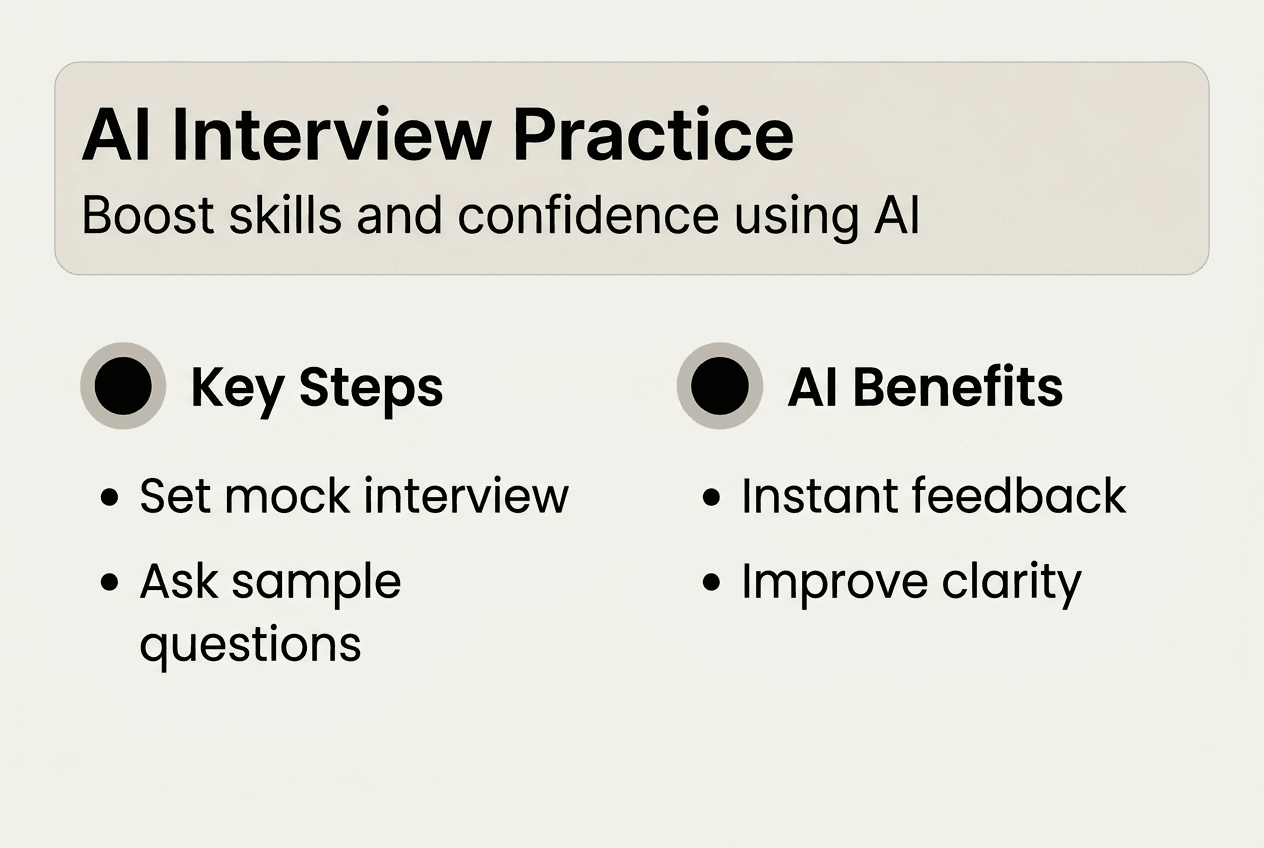
Receive AI feedback focusing on clarity, reasoning, and question relevance. AI serves as a personalized interview coach to run mock interviews, score answers, and predict questions. The feedback highlights whether your questions are too vague, too complex, or miss the mark entirely. This objective assessment helps you refine your approach before facing a real interviewer.
Use AI to identify robotic or overly scripted language in your questions and refine for authenticity. AI-generated questions can sound mechanical if you don’t personalize them. The goal is to use AI as a starting point, then adapt the language to match your natural speaking style. Authenticity matters because interviewers can tell when you’re reciting memorized scripts versus engaging in genuine conversation.
Practice until your questions feel polished but personal, demonstrating your unique perspective. Repetition builds confidence and reduces anxiety. Each mock interview session reveals small improvements you can make. Over time, these incremental changes add up to a significant difference in how you present yourself. The more you practice, the more comfortable you become with the interview format.
- Record yourself asking questions and review for awkward phrasing or hesitation
- Test different versions of the same question to find the most natural delivery
- Practice transitioning between questions smoothly without long pauses
- Use AI feedback to identify patterns in your delivery that need adjustment
- Simulate various interview scenarios to prepare for different interviewer styles
Pro Tip: Create a bullet-point reminder list of key question goals to review before your interview. This quick reference keeps you focused without relying on memorized scripts.
Explore AI-based coaching in interviews to understand how technology can accelerate your preparation. These tools provide immediate feedback that would take weeks to gather through traditional practice methods. The speed and precision of AI coaching give you a competitive edge. Learn about the advantages of AI interview tools to maximize your preparation efficiency.
Common mistakes when asking questions and how AI helps avoid them
Generic questions fail to impress and suggest poor preparation. Asking “What’s the company culture like?” or “What does a typical day look like?” shows minimal effort. These questions could apply to any company or role. Interviewers want to see you’ve done your homework and can ask questions that demonstrate specific knowledge about their organization and challenges.
Overly long or unclear questions confuse interviewers and lose impact. Rambling questions make it hard for interviewers to understand what you’re actually asking. They might answer a different question than you intended, or worse, they might view you as someone who can’t communicate clearly. Concise, focused questions respect the interviewer’s time and demonstrate your ability to think clearly under pressure.
Robotic, AI-generated phrasing reduces perceived authenticity and engagement. If your questions sound like they came straight from a chatbot, you’ll appear disconnected. Interview prep often lacks feedback, leading to the impostor spiral, blind grind, and practice gap. Interviewers value genuine curiosity and human connection. Using AI-generated questions without personalization undermines the very qualities that make you memorable.
AI tools provide comparison data to spot weak versus strong question styles. By analyzing thousands of successful interview questions, AI can show you what works and what doesn’t. This data-driven approach removes guesswork from your preparation. You learn to recognize patterns in effective questions and apply those patterns to your own inquiries.
- Avoid questions easily answered by basic company research or the website
- Skip questions focused solely on what the company can do for you
- Don’t ask multiple questions at once, forcing the interviewer to choose which to answer
- Eliminate filler words and unnecessary qualifiers that weaken your delivery
- Steer clear of yes/no questions that don’t invite meaningful conversation
| Weak Question | Why It Fails | Strong Alternative |
|---|---|---|
| What does the company do? | Shows zero research effort | How does this role contribute to the company’s 2026 product roadmap? |
| Do you like working here? | Too personal and vague | What aspects of the team culture have contributed most to recent project successes? |
| What are the benefits? | Self-centered and premature | How does the company support work-life integration for this team? |
| Is there room for growth? | Generic and uninspired | What career paths have previous people in this role pursued? |
Practice with AI feedback reduces common pitfalls and boosts interview confidence. The more you expose yourself to constructive criticism in a safe environment, the better prepared you’ll be for the real thing. AI doesn’t judge or get frustrated, making it the perfect practice partner. Use adaptive interview preparation strategies to continuously improve your question quality and delivery.
Boost your interview success with Parakeet AI
You’ve learned how to formulate, refine, and deliver powerful interview questions using AI. Now it’s time to put these techniques into action. Parakeet AI offers tailored coaching to sharpen your interview questions and delivery. Our AI tools analyze job descriptions and simulate real interview scenarios, giving you the practice you need to succeed.
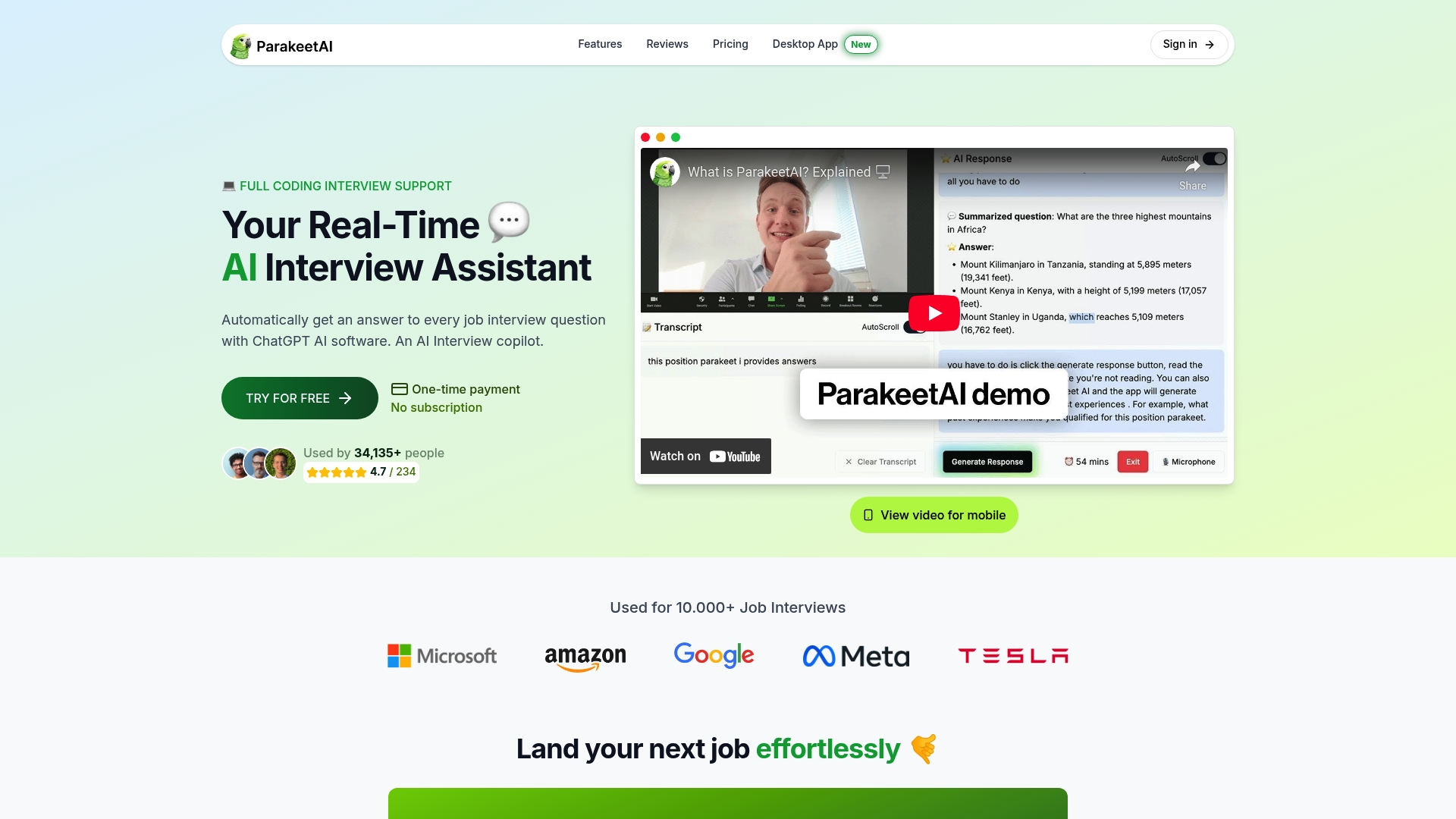
Get personalized feedback to refine authenticity and effectiveness. Whether you’re preparing for your first interview or your fiftieth, Parakeet AI adapts to your experience level and goals. Our platform bridges the gap between learning techniques and applying them confidently. Explore Parakeet AI interview tools to start your preparation today. Discover how AI-driven mock interviews explained can transform your approach. Follow our stepwise interview preparation guide for confident results that land offers.
Frequently asked questions
What are the best types of questions to ask during an interview?
Effective questions focus on company goals, role expectations, team culture, and growth opportunities. They demonstrate you’ve researched the organization and understand its challenges. Avoid overly broad questions like “Tell me about the company” or self-centered inquiries that only address compensation and benefits. Strong questions show strategic thinking and genuine interest in contributing to the team’s success.
How can AI tools help me prepare personalized interview questions?
AI highlights the top skills and priorities from the job description to guide question creation. AI analyzes job descriptions to identify key requirements and tailor responses based on company trends and role nuances. It customizes questions to match the seniority level, interview stage, and specific employer priorities. This personalization ensures your questions are relevant, insightful, and aligned with what the hiring team values most.
What common mistakes should I avoid when asking interview questions?
Avoid generic, robotic, or overly long questions that fail to demonstrate preparation or engagement. Ensure clarity and relevance by keeping questions focused and concise. Interview prep often lacks feedback, leading to the impostor spiral, blind grind, and practice gap. Practice with AI tools to prevent anxiety and improve authenticity. Steer clear of questions easily answered by basic research or those that focus exclusively on personal benefits.
Can practicing with AI improve my confidence in asking interview questions?
Yes, AI simulates real interview conditions and evaluates your questions for clarity, relevance, and delivery. AI serves as a personalized interview coach to run mock interviews, score answers, and predict questions. Feedback highlights areas for improvement and helps you develop natural delivery. Repeated practice reduces anxiety and builds authentic confidence, ensuring you present yourself as a prepared, thoughtful candidate who adds value from the first conversation.