
AI in People Analytics: Why It Matters for HR in 2026

AI in people analytics solves a problem that has quietly frustrated HR leaders for years: organizations sit on enormous amounts of workforce data, yet fewer than 10% can directly correlate that data to business outcomes in any systematic way. The core reason why AI in people analytics changes this picture comes down to three things it does that traditional approaches simply cannot: it integrates fragmented data at scale, surfaces predictive signals before problems become crises, and puts advanced analysis within reach of HR professionals who are not data scientists.
Here is what that looks like in practice:
- Data integration without overhaul: Most organizations run numerous HR and productivity systems. AI acts as a connecting layer across all of them.
- Predictive risk detection: AI identifies attrition risk months before an employee resigns, giving managers time to act.
- Natural language access: HR leaders can ask plain-English questions and get answers in seconds, no SQL or data science background required.
- Administrative time savings: AI agents reduce human effort on routine HR tasks significantly, freeing capacity for strategic work.
- Democratized decision-making: Line managers and senior leaders gain access to workforce insights without ever logging into an analytics platform.
How AI-powered people analytics drives real business outcomes
The shift AI creates in HR is not incremental. It is the difference between a team that reports on what happened last quarter and one that advises on what will happen next month.
AI-driven analytics connect workforce factors directly to business KPIs in ways that were previously too labor-intensive to attempt. Josh Bersin’s research describes this as “systemic analytics,” where every human capital variable, from recruitment practices to pay models to training history, can be queried together to explain performance variation across teams or regions. When a CEO asks why employee productivity is up in one region, AI can surface the specific hiring and compensation factors behind it.
The efficiency gains are concrete. AI agents cut talent sourcing effort substantially, and predictive models flag attrition risks months in advance, enabling targeted retention interventions before the resignation letter arrives. At Sunstate Equipment in Phoenix, VP of HRIS Sameer Raut described asking a GenAI chatbot, “What are the top reasons for hourly employee terminations in the past 12 months?” and received a detailed answer within seconds, a task that previously required a data science team or hours of manual report-building.
The strategic shift: AI moves HR from a function that explains the past to one that shapes the future. Real-time workforce intelligence reaches line managers and CFOs in the format they actually use, whether that is a Slack message, a dashboard, or a meeting-room answer on demand.
Beyond speed, AI also improves data quality. Automated data cleansing, augmentation, and the unification of disparate HR records produce more reliable inputs for every downstream decision, from workforce planning to diversity initiatives to compensation modeling.
Responsible and ethical AI practices in people analytics
AI in HR carries real risks, and the organizations getting this right are the ones treating ethics as a design requirement, not an afterthought.

The most cited framework for balancing automation and human judgment is the 30% rule: automate roughly 70% of routine, repeatable tasks while reserving 30% for human judgment, empathy, and contextual decision-making. The logic is straightforward. AI handles scale and speed; humans handle the decisions where context, culture, and accountability matter most.
Bias is the other major concern. AI models trained on historical HR data can inherit and amplify existing inequities, particularly in hiring, promotion, and performance assessment. Explainable AI techniques like SHAP values help HR teams understand why a model produced a specific recommendation, making it possible to audit outputs for fairness and explain decisions to employees and regulators.
- Map processes before automating them. Automating a broken process produces faster, more efficient failures. Workflow redesign must come first.
- Run regular fairness audits on AI outputs across demographic groups, especially for high-stakes decisions like promotion or termination.
- Establish clear human override protocols so managers can question, adjust, or reject AI recommendations without friction.
- Communicate transparently with employees about how AI is used in decisions that affect them.
Pro Tip: Before deploying any AI model in HR, document what “fair” means for your organization specifically. Generic fairness benchmarks often miss the nuances of your workforce composition and culture.
Governance also means knowing what AI should never decide alone. Terminations, promotions, and compensation changes all carry legal and human weight that requires a person in the loop, every time.
What the future of AI in people analytics looks like
The trajectory is toward continuous, systemic workforce intelligence rather than periodic reporting. Today’s org charts and annual engagement surveys are snapshots. The next generation of AI-driven people analytics treats the workforce as a living system, updating in real time as conditions change.
Cornell professor Chris Collins describes the coming shift clearly: AI will deliver real-time workforce data directly to line managers, moving HR roles toward interpretation, coaching, and organizational design rather than report generation. The HR professionals who thrive will be those who combine AI fluency with consulting and storytelling skills, translating data into decisions that business leaders can act on.
- AI agents with scoped permissions will handle routine workflows autonomously, from scheduling interviews to processing onboarding paperwork, while flagging exceptions for human review.
- CFOs will demand auditable workforce intelligence that links people investments to specific labor economics, pushing HR to produce the kind of rigorous analysis that finance teams expect from every other function.
- Embedded analytics in everyday tools like Slack and Microsoft Teams will put workforce insights in front of managers who would never open a dedicated HR platform.
- Skills-based workforce planning will replace headcount-based planning, with AI continuously mapping internal capability gaps against business strategy.
The organizations building this capability now are hiring businesspeople into HR analytics roles and giving them consulting mandates alongside data tools. That combination, business acumen plus AI access, is what separates the 10% of companies doing systemic analytics from the rest.
How AI closes the expertise gap in people analytics
39% of HR leaders identify limited analytics expertise as their single biggest barrier to using people analytics effectively. That number explains why so many well-funded HR teams still rely on gut instinct for decisions that data could answer.

Natural language interfaces directly address this gap. When Lydia Wu, former senior director of people strategy at Panasonic Energy of North America, described GenAI lowering the barrier to entry for people analytics, she was pointing at something specific: historically, generating a meaningful HR report required a team of data scientists. Now a CHRO can type a question and get an answer. The skill requirement shifts from data engineering to knowing which questions to ask.
The readiness gap, though, runs deeper than tools. 73% of organizations have deployed or piloted AI in HR, but only 18% have reskilled their workforce to support AI-enabled analytics. Deploying a tool without building the interpretive capacity to use it well produces dashboards nobody trusts and recommendations nobody acts on.
Explainable AI is part of the answer. When HR teams can see why a model flagged a particular employee as a flight risk, they can validate the logic, catch errors, and build the organizational trust that makes AI recommendations worth acting on. Without that transparency, even accurate predictions get ignored.
Key AI technologies powering people analytics
The methods behind AI in people analytics are worth understanding, not because HR teams need to build them, but because knowing what each one does helps you ask better questions of your vendors and your data.
Machine learning (ML) is the engine behind most predictive HR models. Supervised ML algorithms train on historical data, such as past attrition patterns, to predict future outcomes. Unsupervised ML finds clusters and patterns in workforce data that no one thought to look for, like a group of high performers who share an unusual combination of tenure, team size, and manager tenure.
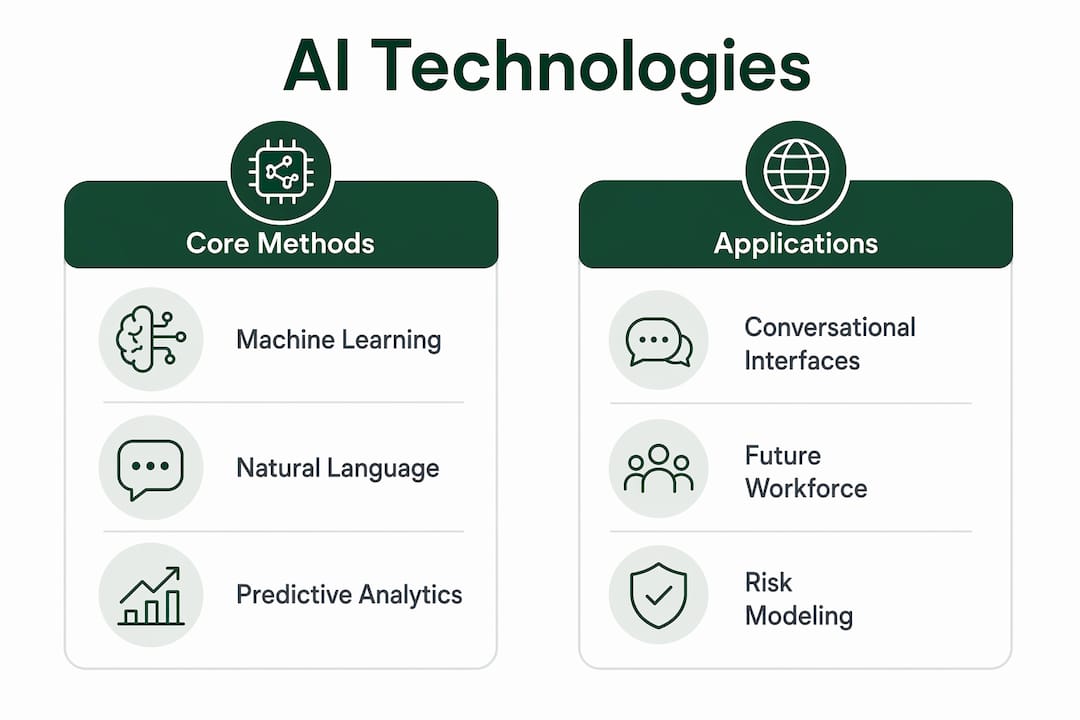
Natural language processing (NLP) powers the conversational interfaces that have made people analytics accessible to non-technical users. It also enables sentiment analysis on open-ended survey responses, exit interview transcripts, and internal communication patterns, turning unstructured text into quantifiable signals about engagement and culture.
Large language models (LLMs) take NLP further by handling complex, context-dependent queries. A CHRO can ask, “How does the software engineering team’s voluntary turnover compare to industry benchmarks?” and an LLM-powered assistant will compile and retrieve that information from internal datasets without requiring a specific query format.
Predictive analytics combines these methods to model future workforce states, from headcount needs six months out to the probability that a specific role will go unfilled based on current pipeline data. For HR teams exploring AI applications in employee insights, predictive analytics is often where the clearest business case lives.
Common challenges when applying AI to people analytics
AI does not fix bad data. It amplifies it. Organizations that feed AI models with inconsistent, incomplete, or poorly labeled HR data get confident-sounding wrong answers, which can be worse than no answer at all.
Data quality and integration are the most persistent technical challenges. With workforce data spread across dozens of systems, getting clean, consistent inputs requires ongoing data governance work that most HR teams underestimate before deployment. Privacy and compliance add another layer: employee data is sensitive, and AI systems that touch it must comply with regulations like GDPR in Europe and a growing patchwork of state-level privacy laws in the United States.
Organizational resistance is just as real as the technical barriers. Managers who distrust algorithmic recommendations, employees who worry about being scored without their knowledge, and HR teams uncertain about their own role in an AI-augmented function all create friction that slows adoption. Change management is not optional; it is the work that determines whether a well-built AI tool actually gets used. For teams navigating AI interview compliance and fairness questions, these cultural dynamics show up early and often.
How to integrate AI into your existing people analytics systems
Start with a specific, high-value problem rather than a platform-wide transformation. Attrition prediction, time-to-hire analysis, and skills gap identification are all well-defined problems with clear data requirements and measurable outcomes. Picking one gives you a proof of concept that builds internal credibility before you scale.
Step 1: Audit your data. Map what HR data you have, where it lives, and how consistent it is across systems. AI integration surfaces data quality problems immediately, so finding them first saves time.
Step 2: Define the decision you want to improve. AI tools work best when the business question is specific. “Reduce 90-day attrition among hourly workers” is a better starting point than “improve retention.”
Step 3: Choose tools that fit your technical capacity. Enterprise platforms with built-in AI capabilities, like Workday Illuminate or SAP Joule, reduce integration complexity for organizations already on those systems. Standalone analytics tools offer more flexibility but require more data engineering work.
Step 4: Build interpretive capacity alongside the tool. Train HR team members to read, question, and contextualize AI outputs. The goal is not to trust the model blindly but to use it as a starting point for human judgment.
Step 5: Establish governance before you scale. Define who can access what data, how AI recommendations get reviewed, and what decisions require human sign-off. Governance built after deployment is always harder than governance built in from the start. Teams looking at HR software options for specific sectors will find that governance requirements vary significantly by industry and workforce type.
Traditional people analytics vs. AI-powered approaches
The gap between traditional and AI-powered people analytics is not just about speed. It is about what questions you can even ask.
| Dimension | Traditional analytics | AI-powered analytics |
|---|---|---|
| Data sources | Single or few systems | 30+ integrated systems |
| Query method | Predefined reports, SQL | Natural language questions |
| Analysis type | Descriptive (what happened) | Predictive and prescriptive |
| Time to insight | Days to weeks | Seconds to minutes |
| User requirement | Data literacy needed | Accessible to non-technical users |
| Update frequency | Periodic snapshots | Continuous, real-time |
| Bias detection | Manual audits | Explainable AI tools (e.g., SHAP) |
Traditional analytics tells you that turnover spiked last quarter. AI-powered analytics tells you which teams are likely to see turnover next quarter, which managers are the common factor, and what intervention has the highest probability of working. That is a fundamentally different kind of HR function.
Real-world examples of AI improving workforce planning
The Sunstate Equipment case is instructive precisely because it is not a Fortune 500 story. A mid-market company with a rising hourly worker turnover problem used a GenAI-powered chatbot to identify the top termination drivers in 12 months of data, in seconds, without a data science team. The VP of HRIS then used those insights to track open positions for technicians and identify patterns in hiring needs before they became gaps.
At a broader level, organizations using predictive workforce analytics have demonstrated the ability to identify attrition risks months before employees resign, enabling targeted retention conversations rather than reactive backfill hiring. The difference in cost is substantial: replacing an employee typically costs a multiple of their annual salary, while a well-timed retention conversation costs almost nothing.
Josh Bersin’s research points to the companies doing systemic analytics well as those that have redefined people analytics as a business analytics function. They hire people with business backgrounds into HR analytics roles, give them consulting mandates, and arm them with AI tools to dig into the data. The payoff shows up in workforce planning that actually connects to business strategy, not just HR metrics.
Key Takeaways
AI fundamentally transforms people analytics by integrating fragmented workforce data, enabling predictive insights, and making advanced analysis accessible to HR teams without deep technical expertise.
| Point | Details |
|---|---|
| Data integration at scale | AI connects 30 HR and productivity systems without requiring a system overhaul or a dedicated data science team. |
| Expertise gap addressed | 39% of HR leaders cite limited analytics expertise as their top barrier; natural language interfaces directly remove that obstacle. |
| Efficiency gains are measurable | AI agents reduce human effort on routine HR tasks significantly and cut talent sourcing effort substantially. |
| Ethical guardrails are required | The 30% rule and explainable AI techniques like SHAP values keep human judgment central and AI outputs auditable. |
| Readiness gap is the real risk | 73% of organizations have piloted AI in HR, but only 18% have reskilled their workforce to use it effectively. |