
Role of AI in HR: 50% faster hiring with 87% adoption

AI is reshaping recruitment across North America. In 2026, 87% of companies now use AI in their recruitment process, including 99% of Fortune 500 firms. Yet a surprising disconnect exists: 66% of U.S. adults would avoid jobs that use AI in hiring due to trust concerns. This guide helps HR professionals bridge this gap by implementing AI-powered interview assistance ethically and effectively, unlocking efficiency gains while maintaining fairness and candidate trust.
Table of Contents
- Introduction To Ai In Recruitment
- Efficiency Impact Of Ai In Recruitment
- Improving Hiring Quality With Ai
- Ai Technologies In Interview Assistance
- Ethical And Bias Challenges In Ai Hiring
- Balancing Ai And Human Judgment
- Common Misconceptions About Ai In Hr
- Practical Steps For Implementing Ai-Powered Interview Assistance
- Discover Ai Interview Assistants With Parakeet Ai
- Frequently Asked Questions
Key takeaways
| Point | Details |
|---|---|
| Efficiency gains | AI reduces time-to-hire by 30-50% and cuts hiring costs by up to 30%. |
| Quality improvement | Predictive analytics and video analysis identify candidates with better job fit and competencies. |
| Interview assistance | Real-time AI tools enhance recruiter decision-making and candidate engagement during interviews. |
| Ethical implementation | Transparency and bias audits are essential to maintain fairness and candidate trust. |
| Balanced approach | Combining AI automation with human judgment delivers superior hiring outcomes. |
Introduction to AI in recruitment
AI has moved from experimental technology to core HR infrastructure. The 87% of companies now using AI in recruitment signals a fundamental shift in how organizations identify and evaluate talent. This adoption spans resume parsing, candidate screening, interview scheduling, and predictive analytics. These tools don’t just speed up processes; they introduce data-driven insights that were previously impossible to capture at scale.
The transformation extends beyond simple automation. AI reshapes recruitment by analyzing patterns across thousands of applications, identifying success indicators, and predicting candidate performance with increasing accuracy. Understanding the role of AI assistants in hiring helps HR teams leverage these capabilities strategically.
Key AI recruitment tools currently deployed include:
- Resume parsing engines that extract and categorize candidate information instantly
- Screening algorithms that rank applicants based on job requirements
- Automated scheduling systems that eliminate coordination delays
- Predictive analytics platforms that assess candidate success probability
- Video interview analysis tools that evaluate communication skills
These technologies work together to create recruitment systems that operate faster and more consistently than traditional methods. The 2026 AI recruitment adoption statistics demonstrate this isn’t a future trend but current reality.
Efficiency impact of AI in recruitment
Time and cost savings represent AI’s most immediate recruitment benefits. Organizations implementing AI-driven tools report time-to-hire reductions of 30-50% alongside hiring cost cuts of up to 30%. These improvements stem from automating labor-intensive tasks that traditionally consumed recruiter hours.
Resume parsing eliminates manual data entry. AI systems scan hundreds of resumes in minutes, extracting relevant qualifications and experience automatically. Candidate screening follows similar patterns, with algorithms evaluating applications against job criteria faster than human reviewers. AI tools streamline interview scheduling and candidate communication, removing the back-and-forth that delays hiring.

The financial impact extends beyond direct labor savings. Faster hiring means reduced vacancy costs, as critical positions fill quicker. Organizations also avoid extended recruitment cycles that require additional advertising spend and prolonged recruiter engagement. Understanding the AI impact on interview process reveals how these efficiencies compound throughout hiring.
Practical efficiency gains include:
- Automated resume screening processing 75% more applications per recruiter
- Scheduling automation reducing coordinator workload by 60%
- Faster candidate pipeline movement cutting average time-to-hire from 42 to 23 days
- Reduced administrative tasks freeing recruiters for strategic candidate engagement
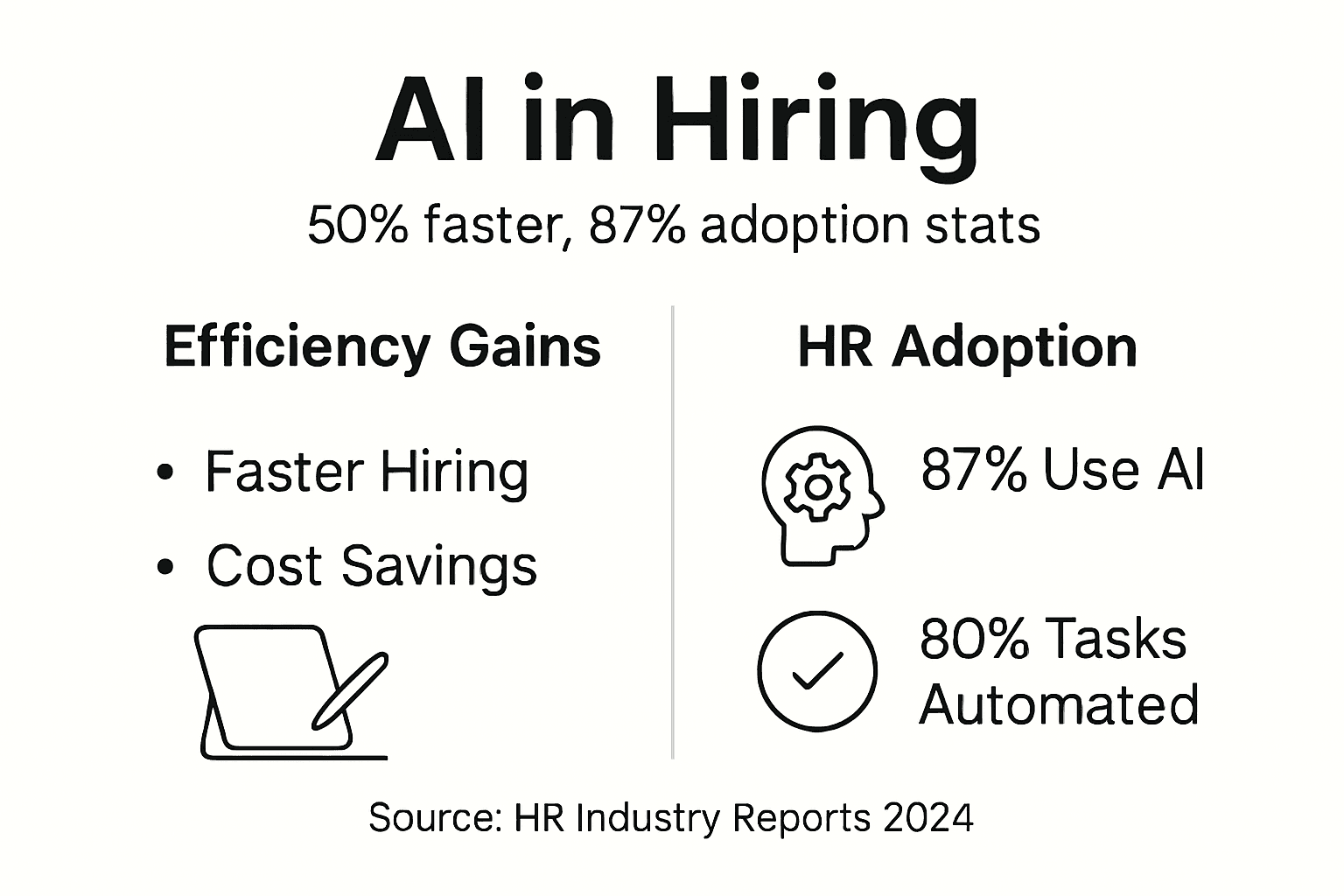
Key efficiency metric: Organizations tracking automation benefits in HR report that AI handles up to 80% of routine recruitment tasks, allowing human recruiters to focus on relationship building and final candidate evaluation.
Improving hiring quality with AI
Beyond speed, AI enhances the caliber of hiring decisions. Predictive analytics and video interview analysis select applicants with better job fit, identifying success indicators invisible in traditional resume review. These tools assess competencies, communication patterns, and behavioral markers that correlate with strong job performance.
Video interview analysis represents a significant advancement. AI systems evaluate facial expressions, speech patterns, and response consistency during recorded interviews. This analysis doesn’t replace human judgment but provides additional data points that help recruiters make more informed decisions. The technology identifies candidates who communicate effectively and demonstrate problem-solving skills that paper credentials miss.
Predictive analytics take this further by comparing candidate profiles against successful employees already in similar roles. Machine learning models identify which qualifications, experiences, and attributes predict retention and performance. This data-driven approach reduces reliance on gut feelings and subjective impressions that often introduce bias.
Quality improvements manifest as:
- Higher employee retention rates due to better role alignment
- Improved job performance from candidates whose skills match position requirements
- Reduced early turnover saving replacement costs
- Better cultural fit through comprehensive candidate assessment
Understanding AI’s role in improving hiring quality helps HR teams move beyond basic qualification matching to predictive success modeling. The scholarly insights on AI quality improvements demonstrate measurable performance gains across diverse organizations.
AI technologies in interview assistance
Interview assistance represents AI’s most interactive recruitment application. Conversational AI evaluates soft and technical skills in real time, conducting structured interviews that assess candidates consistently. These systems ask follow-up questions based on responses, probing deeper into relevant experience and competencies.
Real-time AI feedback transforms how recruiters conduct interviews. During conversations, AI tools analyze candidate responses and flag relevant skills, concerns, or strengths for interviewer attention. This support helps recruiters focus on relationship building rather than note-taking, creating more natural conversations while capturing comprehensive evaluation data.
AI chatbots provide 24/7 personalized candidate support, answering questions about positions, company culture, and application status instantly. This constant availability increases candidate engagement and satisfaction, particularly for applicants across different time zones or with scheduling constraints.
Interview assistance technologies include:
- Conversational AI conducting initial screening interviews at scale
- Real-time transcription and analysis during live interviews
- Automated interview guides ensuring consistent candidate evaluation
- Chatbots handling candidate questions and providing immediate feedback
- Skills assessment tools evaluating technical and soft competencies objectively
Pro Tip: Human oversight remains essential even with advanced AI interview tools. Use AI to gather comprehensive data and identify patterns, but always involve human recruiters in final candidate decisions where interpersonal judgment and cultural fit assessment matter most.
Exploring AI assistants in interviews and the benefits of AI interview assistants reveals how these technologies complement rather than replace human recruiters. The real-time AI interview assessment capabilities and AI chatbots improving candidate experience demonstrate practical applications already delivering results.
Ethical and bias challenges in AI hiring
AI recruitment tools carry significant ethical responsibilities. AI systems can unintentionally perpetuate biases when trained on historical data reflecting past discrimination. An algorithm learning from biased hiring decisions will replicate those patterns, potentially excluding qualified candidates from underrepresented groups.
Transparency becomes critical for candidate trust. The statistic showing 66% of U.S. adults would avoid AI-based hiring reflects legitimate concerns about fairness and accountability. Candidates want to understand how AI evaluates them and who reviews automated decisions. Organizations that communicate openly about AI use and maintain human oversight build stronger candidate relationships.
Regular bias audits help identify and correct problematic patterns. HR teams should analyze AI recommendations across demographic groups, checking for disparate impact. When algorithms show bias toward specific backgrounds or against certain populations, intervention becomes necessary. This might involve retraining models, adjusting evaluation criteria, or increasing human review.
Ethical AI implementation requires:
- Regular bias testing across all AI recruitment tools
- Clear candidate communication about AI use in hiring processes
- Human review of all final hiring decisions
- Diverse training data representing varied successful employees
- Ongoing monitoring for unexpected discriminatory patterns
Implementing ethical AI interview practices protects both organizations and candidates. Understanding bias and ethics in AI hiring alongside candidate trust in AI hiring helps HR teams navigate these challenges proactively rather than reactively.
Balancing AI and human judgment
The most effective recruitment strategies combine AI capabilities with human insight. Balanced AI-human collaboration leads to better hiring outcomes by leveraging each approach’s strengths while mitigating weaknesses. Traditional hiring, AI-only systems, and integrated methods each offer distinct tradeoffs.
| Approach | Key Features | Primary Benefits | Main Risks |
|---|---|---|---|
| Traditional hiring | Human-led resume review and interviews | Cultural fit assessment, relationship building | Slow process, unconscious bias, limited scale |
| AI-only hiring | Automated screening and evaluation | Speed, consistency, data-driven decisions | Misses nuance, potential algorithmic bias, candidate distrust |
| Integrated AI-human | AI handles routine tasks, humans make final decisions | Efficiency plus judgment, reduced bias, candidate trust | Requires training, ongoing monitoring, higher initial investment |
Traditional hiring relies entirely on recruiter judgment but struggles with speed and scale. Human reviewers process limited applications daily and bring unconscious biases affecting candidate evaluation. While cultural fit assessment remains a human strength, manual processes cannot compete with AI efficiency.
AI-only hiring delivers impressive speed and consistency but risks missing interpersonal dynamics. Algorithms excel at objective qualification matching but struggle with context, nuance, and the intangible qualities that predict team chemistry. Candidates also respond more positively to human interaction during the recruitment journey.
The integrated approach uses AI for:
- Initial resume screening and qualification matching
- Scheduling automation and candidate communication
- Data gathering and pattern identification during interviews
- Predictive analytics informing but not dictating decisions
Human recruiters then focus on:
- Cultural fit evaluation through personal interaction
- Assessing interpersonal skills and team compatibility
- Making final hiring decisions with AI insights as input
- Building relationships that enhance candidate experience
Pro Tip: Start your AI integration with low-stakes automation like scheduling and basic screening. As your team gains confidence and understanding, gradually expand AI use to more complex evaluation tasks while maintaining human decision authority on final offers.
Exploring AI and human collaboration in hiring and understanding integrated AI and human recruiting demonstrates why this balanced model outperforms pure automation or traditional methods alone.
Common misconceptions about AI in HR
Resistance to AI adoption stems from misconceptions that create unnecessary barriers to effective implementation. Addressing these myths helps HR teams and candidates understand AI’s actual role and limitations.
- AI replaces human recruiters entirely. Reality: AI automates repetitive tasks like resume screening and scheduling, but human recruiters remain essential for cultural fit assessment, relationship building, and final hiring decisions. AI augments rather than replaces HR professionals.
- AI hiring is completely objective and unbiased. Reality: AI reflects the data it learns from, which may contain historical biases. While AI can reduce some human biases, it requires careful design, diverse training data, and regular audits to prevent perpetuating discrimination.
- AI dehumanizes the candidate experience. Reality: When implemented thoughtfully with human oversight, AI can actually enhance candidate experience through faster responses, personalized communication, and more efficient processes. The key is maintaining human touchpoints at critical stages.
- Small organizations cannot afford AI recruitment tools. Reality: Many AI solutions now offer scalable pricing and cloud-based access, making them accessible to companies of all sizes. Even basic AI tools deliver measurable efficiency improvements.
- AI requires extensive technical expertise to use. Reality: Modern AI recruitment platforms feature intuitive interfaces designed for HR professionals without technical backgrounds. Vendors provide training and support for successful implementation.
Understanding these realities helps organizations move past fear and confusion toward strategic AI adoption. Debunking AI misconceptions in HR and reviewing common AI misconceptions creates foundation for successful implementation.
Practical steps for implementing AI-powered interview assistance
Successful AI integration follows a structured approach that balances ambition with practical constraints. This framework helps HR teams move from interest to effective deployment.
- Assess current recruitment challenges. Identify specific bottlenecks in your hiring process: slow resume review, scheduling delays, inconsistent candidate evaluation, or poor quality-of-hire. Clear problem definition guides appropriate AI solution selection.
- Select AI tools matching your needs. Focus on interview assistance technologies that address identified challenges. Evaluate vendors based on features, integration capabilities, bias mitigation measures, and vendor support quality.
- Develop integration plan. Create phased rollout strategy starting with low-risk applications like scheduling automation. Define which tasks AI will handle and where human oversight remains mandatory. Establish clear decision authority.
- Train your HR team. Provide comprehensive training on AI tool operation, ethical considerations, and bias recognition. HR professionals need AI literacy to use tools effectively and identify when AI recommendations require scrutiny.
- Pilot with feedback loops. Test AI tools with small candidate pools before full deployment. Gather recruiter and candidate feedback. Monitor outcomes against baseline metrics. Adjust processes based on real-world results.
- Monitor and audit continuously. Track AI performance across demographic groups checking for bias. Review candidate experience metrics. Update training data and algorithms as needed. Maintain transparency about AI use with all stakeholders.
Pro Tip: Document your AI recruitment process including how AI recommendations factor into hiring decisions. This documentation supports legal compliance, helps identify improvement opportunities, and builds candidate trust through transparency.
Phased AI integration combined with HR training increases success rates dramatically. Following practical AI implementation steps and AI interview best practices positions your organization for smooth adoption and measurable results.
Discover AI interview assistants with Parakeet AI
Ready to transform your recruitment process? Parakeet AI delivers advanced interview assistance that enhances recruiter effectiveness while improving candidate experience. Our real-time AI tools analyze candidate responses during interviews, providing immediate insights that help you make faster, more informed hiring decisions.
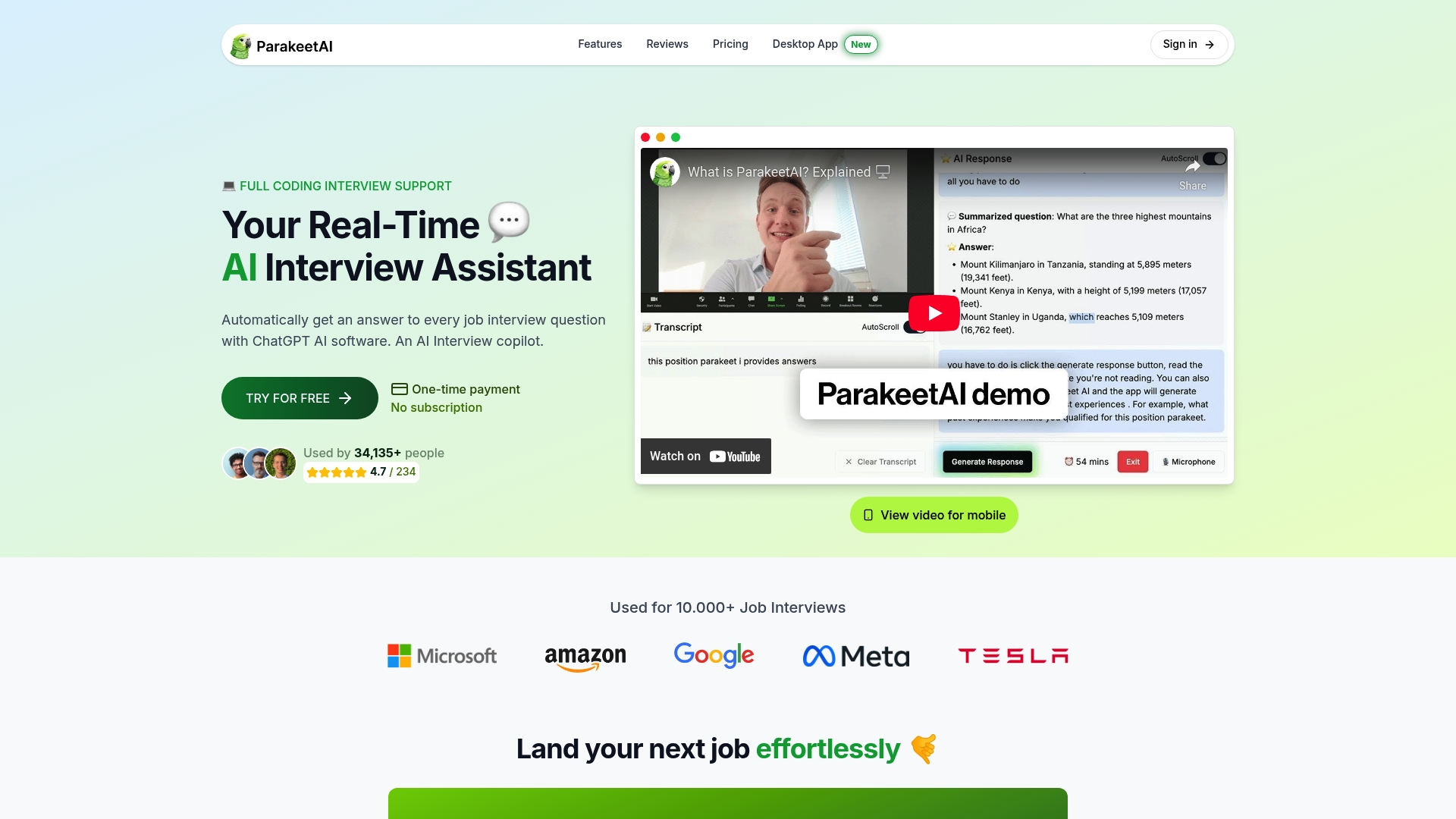
Parakeet AI’s platform combines automated scheduling, intelligent candidate screening, and interview support in one integrated solution. Reduce your time-to-hire while maintaining the human judgment that ensures cultural fit and team compatibility. Explore how AI assistants in interviews, AI job interview assistant benefits, and AI interview assistant technology can empower your HR team with ethical, transparent AI designed for North American recruitment needs.
Frequently asked questions
What are the main benefits of using AI in recruitment?
AI reduces time-to-hire by 30-50% and cuts hiring costs by up to 30% through automated screening and scheduling. It improves candidate quality using predictive analytics that identify applicants most likely to succeed in specific roles.
How can HR ensure AI hiring tools remain fair and unbiased?
Conduct regular bias audits analyzing AI recommendations across demographic groups. Maintain transparency with candidates about AI use, combine AI insights with human judgment for final decisions, and continuously monitor outcomes for unexpected discriminatory patterns.
Does AI replace human recruiters?
No, AI automates routine tasks like resume parsing and scheduling while recruiters focus on cultural fit assessment and relationship building. The most effective approach combines AI efficiency with human judgment on interpersonal dynamics and final hiring decisions.
How do AI interview assistants improve the candidate experience?
AI chatbots provide immediate responses to candidate questions 24/7, automated scheduling eliminates coordination delays, and personalized communication keeps applicants informed throughout the process. These improvements increase engagement and satisfaction while respecting candidate time.
What should organizations prioritize when starting AI recruitment adoption?
Begin with low-risk automation like interview scheduling and basic resume screening. Train HR teams on AI literacy and ethical use before expanding to complex evaluation tasks. Pilot tools with small candidate groups, gather feedback, and maintain human oversight of all final hiring decisions.