
How to Conduct Interview Questions Using AI Tools

TL;DR:Effective interview preparation with AI involves providing detailed inputs and practicing structured responses.Using real-time AI support during interviews helps build confidence and improves answer consistency.
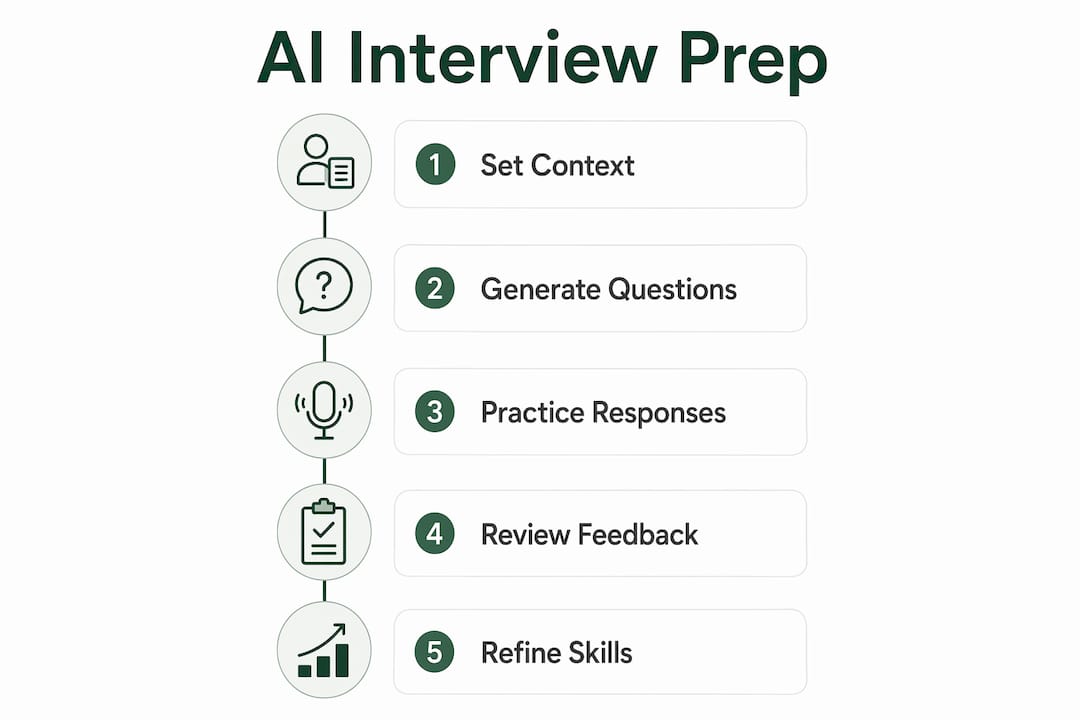
Conducting interview questions well comes down to one thing: preparation that mirrors the real thing. Feed an AI tool your resume, the job description, the role title, and the company name, and you get tailored behavioral, situational, and technical questions instead of generic prompts that could apply to any candidate anywhere. Practice answering one question at a time, get feedback, and repeat. That loop, done consistently, is what separates candidates who feel ready from those who just hope for the best.
Here is what the most effective AI-assisted interview prep looks like in practice:
- Start with precise inputs: resume, job description, role title, and company name
- Use structured prompts that instruct the AI to ask one question at a time and give feedback after each answer
- Practice responses using the STAR method (Situation, Task, Action, Result) for behavioral questions
- Prepare three to five specific questions to ask the interviewer, grounded in the company’s real challenges
- Review AI feedback to find and fix weak spots before the actual interview
Pro Tip: Treat every AI practice session like the real interview. No pausing to check notes, no restarting mid-answer. Finish the response, then review the feedback.
Table of Contents
- How to generate tailored interview questions with AI
- Best practices for answering interview questions
- What questions should you ask the interviewer?
- How Parakeet-ai gives you real-time support during interviews
- How to prepare responses before the interview
- Common misconceptions about answering interview questions
- How to evaluate and interpret candidate responses using AI tools
- Ethical considerations when using AI in interview preparation
- Strategies for reducing bias in how you prepare and present
- How AI analytics help you get better between interviews
- Cultural considerations in U.S. job interviews
- Key Takeaways
How to generate tailored interview questions with AI
Generic question lists waste your prep time. The quality of what an AI generates depends almost entirely on what you give it. A vague prompt like “give me interview questions for a marketing role” produces questions you could find on any career blog. A specific prompt that includes your actual resume, the full job description, and the company name produces questions that reflect the real gaps and priorities an interviewer will probe.
Once you have the right inputs in place, use prompts that instruct the AI to simulate a real interview flow. Asking one question at a time with feedback after each answer mirrors how interviews actually feel, rather than dumping ten questions at once and letting you skim through them mentally.
- Provide your full resume, the job posting, the role title, and the company name before generating questions
- Request behavioral, situational, and technical questions specific to the role
- Instruct the AI to ask questions one at a time and give structured feedback on each response
- Use AI gap analysis to identify which skills or experiences are underrepresented in your answers
- Adjust your prompt for seniority: a director-level role needs questions about strategic decisions, not just task execution
Pro Tip: Save your best prompt template and reuse it across applications. Swap in the new job description and company name each time, and you have a fresh, targeted practice set in under two minutes.
Best practices for answering interview questions
Structure matters more than most candidates realize. The STAR method gives behavioral answers a shape that interviewers can follow: what the situation was, what your specific responsibility was, what you actually did, and what the outcome was. Keep the Situation and Task brief. The Action section is where you earn the answer.
On the weakness question, genuine self-awareness beats a scripted pivot. Name a real weakness, describe what you are actively doing about it, and move on. Interviewers have heard “I work too hard” thousands of times. A specific, honest answer with a concrete improvement step lands differently.
Recording yourself during practice reveals things silent rehearsal never will: filler words, pacing issues, answers that run too long. Watch it once. You will fix more in ten minutes of self-review than in an hour of thinking through answers in your head.
When a tough question catches you off guard, asking for a moment to think signals composure, not weakness. A brief pause followed by a structured answer reads far better than nervous filler.
Pro Tip: Practice your five core stories out loud until they feel natural, not memorized. The goal is fluency, not recitation.
What questions should you ask the interviewer?
Most candidates treat “Do you have any questions for us?” as a formality. It is not. The questions you ask reveal more about your thinking than most of your answers do.
Questions grounded in company-specific challenges consistently outperform generic ones. “What are the biggest challenges the team is facing right now?” signals that you want to understand the real work, not just the polished version. “What does success look like in the first 90 days?” shows you are already thinking about delivering value. “How is performance measured in this role?” communicates accountability.
- Avoid questions answered on the company’s homepage
- Prepare at least six questions so you have backups if some get answered during the conversation
- Use AI to generate and refine questions based on the company’s industry, recent news, and the job description
- Ask questions throughout the interview, not just at the end, to build a more natural conversation
- Consider asking: “Is there anything about my background that gives you pause?” Few candidates ask it; the ones who do stand out
Pro Tip: Run your planned questions through an AI tool before the interview. Ask it to flag any that sound generic or could be answered with a quick Google search.
How Parakeet-ai gives you real-time support during interviews
Most prep tools help you before the interview. Parakeet-ai works during it. The platform listens throughout the interview and provides AI-generated answer suggestions in real time, calibrated to the job and role context you set up in advance. When a question lands, you get a suggested response immediately, without breaking your composure or scrambling for the right framing.
- Supports every stage: introductions, behavioral questions, technical questions, and questions for the interviewer
- Lets you build a personalized story bank so your context carries across sessions without re-explaining your background each time
- Combines live assistance with post-session review so you can track what worked and what to sharpen
- Reduces the anxiety that comes from feeling underprepared, which itself improves delivery
For software engineering interview prep, Parakeet-ai generates role-specific technical and behavioral questions that reflect what engineering interviewers actually test.
Pro Tip: Set up your job context in Parakeet-ai before the interview, not the morning of. The more specific your inputs, the more relevant the real-time suggestions.
How to prepare responses before the interview
Preparation is not memorization. The goal is to have a clear structure for your most likely answers, not a script. Map the five or six questions that appear in nearly every interview: tell me about yourself, why this role, a challenge you overcame, your greatest weakness, and a time you led something. Draft a STAR story for each. Practice them out loud, with a timer.
Your LinkedIn profile is part of your prep. A strong, current profile reinforces the narrative you bring to the interview. A well-built LinkedIn profile that matches your resume and highlights measurable results makes it easier to stay consistent when interviewers ask about your background.
Common misconceptions about answering interview questions
The biggest one: longer answers are better answers. They are not. A tight, structured two-minute answer beats a rambling four-minute one every time. Interviewers are tracking whether you can communicate clearly under pressure, not whether you can fill silence.
Another common mistake is treating every question as a performance. Interviewers are also evaluating whether you would be easy to work with. Conversational, direct answers that acknowledge uncertainty where it exists tend to land better than polished monologues that feel rehearsed.
Finally, many candidates assume the interview ends when the questions do. It does not. How you close, the questions you ask, and how you follow up all factor into the final impression.
How to evaluate and interpret candidate responses using AI tools
AI-driven mock interview tools score answers across multiple dimensions: structure, specificity, ownership, and evidence. The most useful feedback does not just tell you a score. It points to the exact phrase where your answer lost clarity or where you said “we” when the interviewer needed to hear “I.”
Adaptive mock interviews with follow-up probes push harder than static question lists. When an AI follows up with “how do you know that worked?” or “what trade-offs did you consider?”, it surfaces the gaps that a surface-level answer hides. Use that feedback to target specific STAR components, not just to redo the whole answer from scratch.

Ethical considerations when using AI in interview preparation
Using AI to practice and prepare is straightforward. Using it to generate answers in real time raises questions worth thinking through. The core principle is that AI assistance should sharpen your thinking, not replace it. If you rely on live AI suggestions without understanding the underlying answer, you risk giving a response you cannot defend when the interviewer follows up.
Transparency matters too. Some employers explicitly prohibit AI assistance during interviews. Know the rules before the interview, and use AI tools in a way that builds your actual capability rather than masking gaps that will surface later in the role.
Strategies for reducing bias in how you prepare and present
Bias in interviews cuts both ways. Interviewers carry assumptions; candidates do too, about what kind of answer is expected or what kind of person gets hired. Structured preparation helps on both sides.
For candidates, using AI to generate a diverse range of question types, including questions about conflict, failure, and disagreement, prepares you for the full range of what interviewers actually ask. Practicing with behavioral interview question sets that reflect real role requirements, rather than idealized ones, produces more honest and effective answers.
For interviewers, standardized question sets and AI-assisted scoring reduce the influence of first impressions and conversational rapport on hiring decisions. Consistent criteria applied across all candidates produce more defensible and equitable outcomes.
How AI analytics help you get better between interviews
The value of AI feedback compounds across sessions. A single mock interview tells you what went wrong. Five sessions with tracked feedback tell you whether you are actually improving, and where the persistent gaps are.
Maintaining a story bank across sessions prevents you from re-explaining your background every time and sharpens narrative consistency. Over multiple sessions, you build a library of tested stories with metrics, clear ownership, and tight structure that you can retrieve quickly under pressure.
Cultural considerations in U.S. job interviews
U.S. interview culture rewards directness, confidence, and specific examples. Hedging answers with excessive qualifiers or speaking in generalities about team accomplishments rather than your individual contribution tends to read as a lack of ownership, not humility.
At the same time, authenticity matters. Candidates who try to perform a version of confidence they do not feel often come across as rehearsed rather than capable. The goal is to be specific and direct about what you actually did and what it produced. That combination, specificity plus directness, is what U.S. interviewers consistently respond to across industries and levels. For additional interview preparation strategies relevant to job seekers, grounding your approach in concrete examples from your own experience remains the most transferable technique.
Key Takeaways
Effective interview preparation with AI requires specific inputs, structured practice, and honest self-review to produce answers that hold up under real interview pressure.
| Point | Details |
|---|---|
| Quality inputs drive quality questions | Provide your resume, job description, role title, and company name to get role-specific questions from AI. |
| STAR method structures strong answers | Break behavioral answers into Situation, Task, Action, and Result for clarity and impact. |
| Strategic questions signal serious candidates | Ask about team challenges, performance metrics, and early success criteria, not generic curiosity questions. |
| Real-time AI assistance builds confidence | Parakeet-ai listens during the interview and provides live answer suggestions calibrated to your role context. |
| Iterative practice compounds improvement | Tracking AI feedback across multiple sessions reveals persistent gaps and measurable progress over time. |