
How to leverage AI for interviews to boost job success

Job interviews can feel overwhelming. You prepare answers, research the company, and still worry about blanking on a tough question. Many job seekers struggle with interview anxiety and inconsistent performance, which costs them opportunities. AI-powered mock interviews offer a practical solution by simulating real scenarios, delivering personalized feedback, and building confidence through repeated practice. This guide shows you how to effectively use AI for interview preparation to improve your performance and land the job you want.
Table of Contents
- Key takeaways
- Understanding the benefits and limitations of AI for interview preparation
- Getting prepared: tools, requirements, and best practices for AI interview prep
- Step-by-step guide to conducting AI-powered mock interviews
- Verifying your progress and avoiding pitfalls with AI interview tools
- Boost your interview success with Parakeet AI tools
- FAQ
Key Takeaways
| Point | Details |
|---|---|
| AI boosts performance | AI mock interviews simulate real scenarios, record responses, and provide immediate feedback to boost actual interview performance. |
| Self efficacy gains | Regular AI practice increases self efficacy, which correlates with stronger performance in real interviews. |
| Ethical use required | Use AI for preparation only and avoid using it during actual interviews to prevent cheating and reputational damage. |
| Setup and latency matter | A reliable device, microphone, camera, internet connection, and quiet space are essential to minimize latency and improve feedback quality. |
Understanding the benefits and limitations of AI for interview preparation
AI mock interviews simulate real interview scenarios using natural language processing and machine learning algorithms. These tools ask you questions, record your responses, and analyze your answers for content quality, delivery pace, and communication effectiveness. AI mock interviews improve perceived employability and actual interview performance according to empirical research.
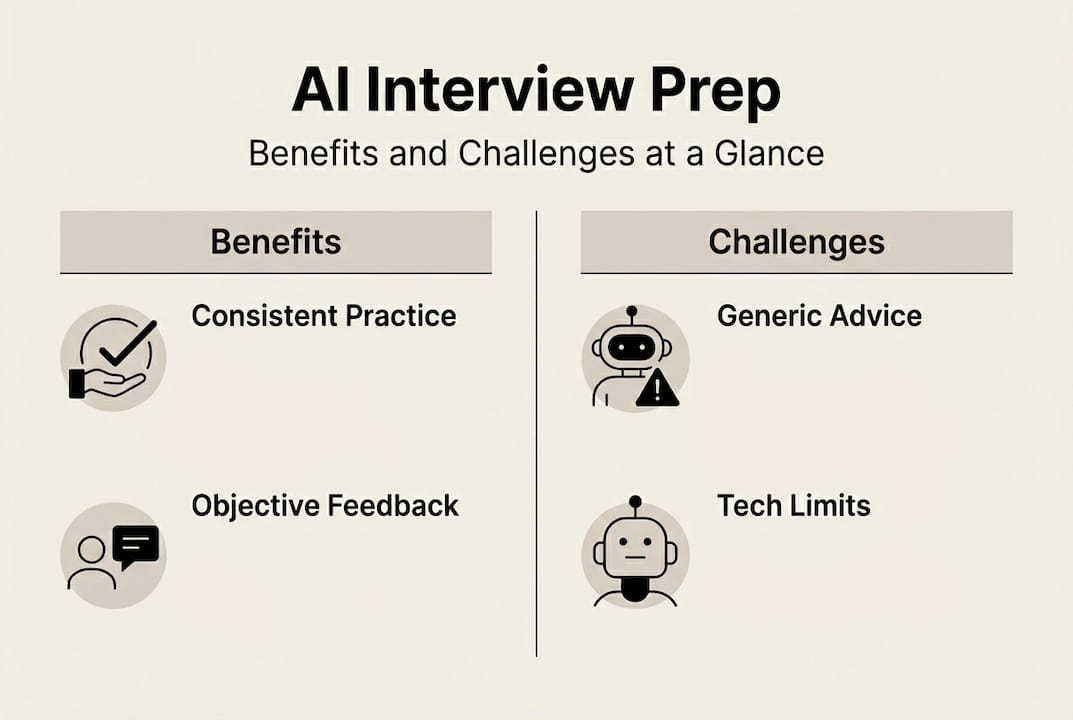
The benefits of AI-driven interview preparation are substantial. You can practice answering common and challenging questions without scheduling conflicts or social pressure. The technology provides immediate, personalized feedback on your responses, identifying specific areas for improvement like filler words, vague answers, or weak examples. Most importantly, training with AI mock interviews increases self-efficacy, which directly correlates with better performance in real interviews. The benefits of mock interviews tech extend beyond just practicing answers to building genuine confidence.
Key advantages include:
- Unlimited practice opportunities at any time
- Objective feedback without human bias
- Safe environment to make mistakes and learn
- Customizable scenarios for specific roles or industries
- Progress tracking over multiple sessions
However, AI interview tools have important limitations you need to understand. Detection of cheating doubled in 2025, with companies catching candidates who use AI assistance during actual interviews. This leads to immediate disqualification and damaged professional reputations. AI-generated answers can sound generic or robotic if you memorize them without personalization. Some tools experience latency issues, particularly offline versions, which can disrupt your practice flow. Proctoring software in real interviews can flag suspicious behavior like looking off-screen or typing during responses.
“Companies are investing heavily in detection technology because AI-assisted cheating undermines the entire hiring process and leads to poor job performance post-hire.”
The ethical boundary is clear: use AI tools for preparation and skill development, never during actual interviews. Dishonest use not only risks immediate consequences but also sets you up for failure if you get hired without the genuine skills the role requires. When used properly, AI interview preparation builds real competence rather than creating a false facade.
Getting prepared: tools, requirements, and best practices for AI interview prep
Successful AI interview preparation starts with the right setup and understanding what you need. At minimum, you need a device with a microphone and camera, stable internet connection for cloud-based tools, and a quiet space for focused practice. Most AI interview platforms work on laptops, tablets, or smartphones, though larger screens provide better feedback visibility.
Several AI interview tools offer different features and capabilities. Popular options include platforms with industry-specific question banks, behavioral interview simulators, technical coding interview assistants, and general-purpose mock interview tools. Some AI-driven mock interviews explained platforms focus on specific sectors like technology, healthcare, or finance, while others provide broader coverage. For technical interview prep, specialized tools can evaluate coding solutions and problem-solving approaches.
Offline and multilingual AI tools exist but may show latency and generic answers compared to cloud-based alternatives. The trade-off between convenience and performance depends on your specific needs and internet access reliability.
| Feature | Cloud-based tools | Offline tools | Hybrid solutions |
|---|---|---|---|
| Response speed | Instant | 2-5 second delay | Variable |
| Answer quality | Highly contextual | More generic | Depends on connectivity |
| Customization | Extensive | Limited | Moderate |
| Privacy | Data uploaded | Fully private | Mixed |
| Cost | Subscription | One-time purchase | Tiered pricing |
Best practices for effective AI interview preparation:
- Schedule regular practice sessions rather than cramming before interviews
- Simulate real conditions by dressing professionally and eliminating distractions
- Record sessions to review your body language and vocal patterns
- Focus on one skill area per session for targeted improvement
- Take notes on feedback immediately after each practice round
- Gradually increase difficulty as you improve
Pro Tip: Alternate between AI mock interviews and practice sessions with friends or mentors. AI provides consistent, objective feedback on technical aspects, while humans catch interpersonal nuances and authenticity issues that algorithms might miss. This combination creates well-rounded preparation.
Pay attention to your tool’s specific features and limitations. Some platforms excel at behavioral questions but struggle with technical assessments. Others provide excellent speech analysis but limited content feedback. Understanding these strengths helps you supplement with additional resources where needed. Most importantly, treat AI practice as seriously as you would a real interview to build muscle memory and reduce anxiety.
Step-by-step guide to conducting AI-powered mock interviews
Executing effective AI mock interviews requires a systematic approach that maximizes learning from each session. Follow this process to get the most value from your practice time.
- Select your AI tool and create an account, completing any initial setup or profile configuration required.
- Choose a specific interview scenario that matches your target role, including job title, industry, and experience level.
- Review the question types and format before starting so you understand what to expect.
- Set up your environment exactly as you would for a real interview, including lighting, background, and professional attire.
- Start the mock interview session and respond to each question as thoroughly and naturally as possible.
- Record your session if the tool allows, or use separate recording software for later review.
- Complete the entire interview without stopping, even if you struggle with certain questions.
- Review the AI-generated feedback report immediately after finishing, while the experience is fresh.
- Identify your top three strengths and three areas needing improvement from the feedback.
- Create specific action items for each weakness, such as preparing better examples or reducing filler words.
- Practice addressing those weak areas in your next session.
- Repeat this cycle multiple times, tracking your progress across sessions.
Analyzing AI feedback effectively requires understanding what different metrics mean. Most tools evaluate content quality, which measures how well your answers address the question with specific examples and relevant details. Delivery metrics assess your speaking pace, volume, clarity, and use of filler words. Body language analysis, when available, tracks eye contact, facial expressions, and posture. Some platforms provide scores or ratings, while others offer narrative feedback.

How to conduct mock interviews effectively involves looking beyond surface-level scores to understand the reasoning behind feedback. If the AI notes your answer lacked specificity, identify which parts were too vague and prepare concrete examples. When feedback mentions pacing issues, time yourself speaking and practice adjusting your speed. Training with AI mock interviews increases self-efficacy and actual interview success when you actively apply the feedback rather than just reading it.
Practical improvement examples based on common AI feedback:
- Feedback: “Your answer was too brief and lacked specific examples.” Action: Prepare three detailed STAR method stories for common behavioral questions.
- Feedback: “You used filler words 23 times in 5 minutes.” Action: Practice pausing silently instead of saying “um” or “like.”
- Feedback: “Your response didn’t address the leadership aspect of the question.” Action: Review the question carefully and outline key points before answering.
- Feedback: “Your speaking pace was too fast, reducing clarity.” Action: Practice speaking at 150 words per minute and breathing between sentences.
Pro Tip: After completing three to five AI mock interviews, schedule a practice session with a mentor or friend. Ask them to evaluate the same areas the AI identified as weaknesses. This human perspective validates whether your improvements are noticeable and authentic, not just technically correct. The master mock interview workflow job success approach combines multiple feedback sources for comprehensive skill development.
Iteration is essential. One practice session won’t transform your interview skills. Plan for at least eight to ten sessions spread over several weeks, focusing on different question types and gradually increasing difficulty. Track your scores or ratings across sessions to visualize improvement and maintain motivation.
Verifying your progress and avoiding pitfalls with AI interview tools
Measuring your improvement with AI tools requires tracking specific metrics over time rather than relying on subjective feelings. Most platforms provide scoring systems or performance dashboards that show trends across multiple sessions. Focus on metrics like average response length, filler word frequency, answer relevance scores, and delivery ratings. Create a simple spreadsheet to log these numbers after each practice session, making it easy to spot patterns and celebrate progress.
Look for consistent upward trends rather than session-to-session fluctuations. Your third mock interview might score lower than your second due to harder questions or an off day, but your average should improve over five to ten sessions. Pay special attention to specific skills you’re targeting. If you’re working on reducing filler words, that metric should show clear improvement even if overall scores stay steady initially.
Common pitfalls to avoid:
- Overrelying on memorized AI-generated answers instead of developing genuine understanding
- Practicing only easy questions and avoiding challenging scenarios
- Ignoring delivery feedback while focusing solely on content
- Using AI assistance during actual interviews, which risks detection
- Neglecting human interaction practice, which builds interpersonal skills
- Stopping practice once you feel “good enough” instead of maintaining consistency
The consequences of honest versus dishonest AI usage differ dramatically:
| Approach | Short-term outcome | Long-term outcome | Professional impact |
|---|---|---|---|
| Honest preparation | Gradual skill improvement | Genuine competence and confidence | Sustainable career growth |
| Dishonest real-time use | Possible interview success | Performance issues on the job | Damaged reputation and termination risk |
| Memorizing AI answers | Robotic interview performance | Inability to handle unexpected questions | Missed opportunities |
| Balanced AI and human practice | Strong interview performance | Well-rounded professional skills | Career advancement |
Detection of AI misuse in interviews rose sharply, leading to bad hires and subsequent terminations. Companies now use sophisticated proctoring software that tracks eye movement, typing patterns, and response timing to identify candidates using unauthorized assistance. Even if you initially avoid detection, starting a job without the skills you claimed leads to poor performance reviews and potential dismissal.
“The rise in AI-assisted interview cheating has forced companies to implement stricter monitoring, but it’s also made them more skeptical of candidates who seem too polished or give textbook answers without personal authenticity.”
Genuine preparation creates lasting value. When you use AI tools ethically to build real skills, you enter your new role confident and capable. You can handle unexpected challenges because you developed actual problem-solving abilities, not just memorized responses. The role of ai chatbots in interviews should be as a training partner, not a crutch during actual assessments.
Verify your readiness by conducting mock interviews with progressively less preparation time. If you can perform well with only 24 hours’ notice for a practice session, you’re building genuine skills rather than rehearsed performances. Ask trusted colleagues or mentors to conduct surprise mock interviews where you don’t know the questions in advance. Your ability to think on your feet and provide thoughtful answers demonstrates real competence.
Boost your interview success with Parakeet AI tools
Now that you understand how to leverage AI for interview preparation, you need a platform that delivers on these principles with advanced features and personalized support. Parakeet AI offers AI-driven mock interviews specifically designed for both technical and general roles, providing the realistic practice scenarios discussed throughout this guide.
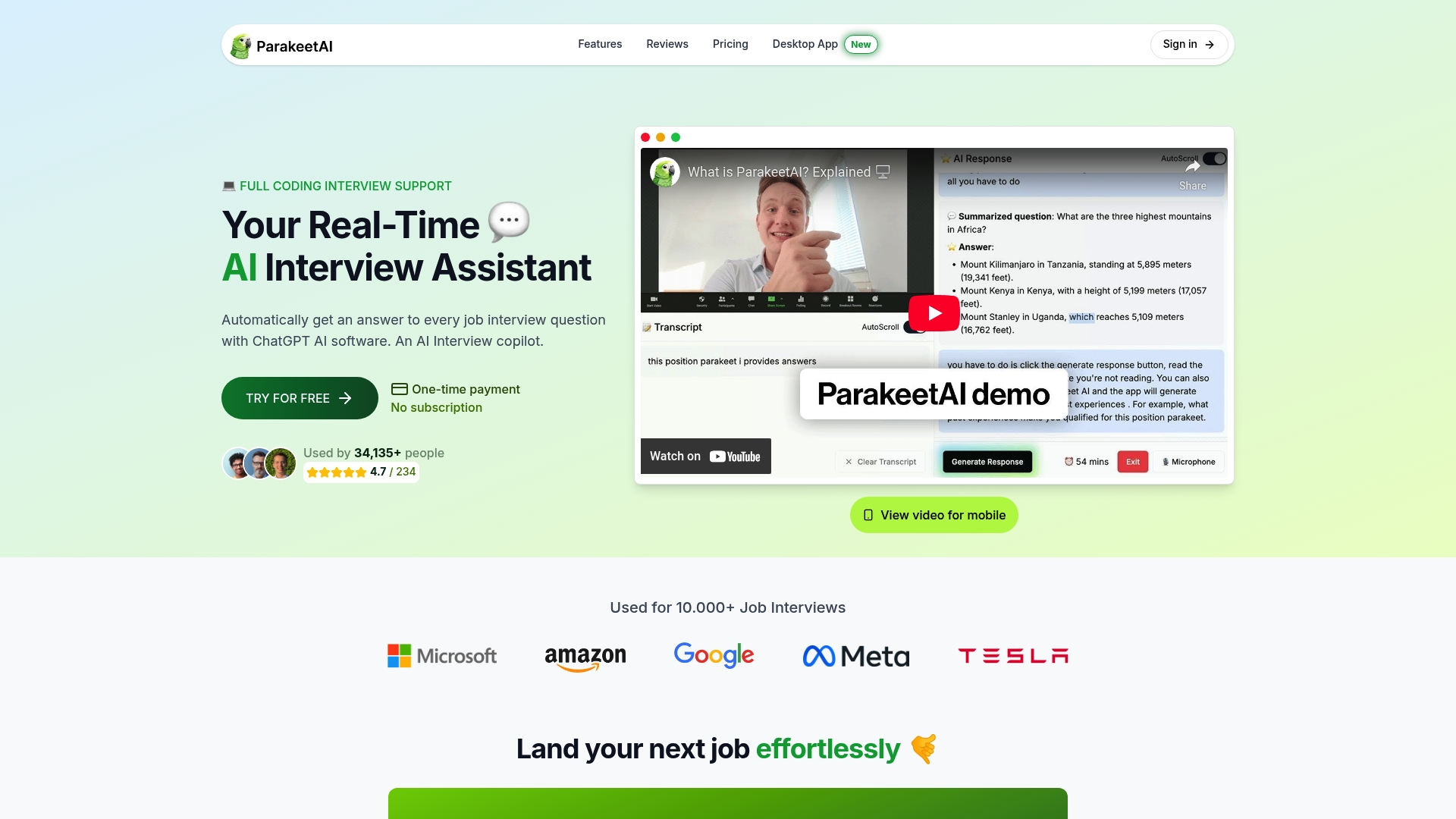
The platform analyzes your responses in real time, delivering personalized feedback that goes beyond generic suggestions to address your specific communication patterns and content gaps. Whether you’re preparing for software engineering interviews, management positions, or entry-level roles, Parakeet AI adapts to your needs with customizable question banks and difficulty levels. The technology behind Parakeet AI combines natural language processing with industry-specific knowledge to create authentic interview experiences that build genuine confidence and competence. Using these tools enhances the preparation strategies covered in this guide, giving you a competitive advantage in your job search.
FAQ
How accurate are AI interview feedback tools?
AI interview tools provide valuable insights into your performance, analyzing factors like response relevance, delivery pace, and communication clarity with consistent objectivity. However, they sometimes offer generic suggestions that don’t account for industry-specific nuances or company culture fit. The accuracy improves significantly when you use reputable platforms with large training datasets and combine AI feedback with human review from mentors or peers who understand your target role.
Can AI interview tools replace human mock interviews?
AI tools offer scalable, accessible practice that you can use anytime without scheduling conflicts or social anxiety. They excel at providing objective metrics and consistent feedback across multiple sessions. However, they don’t fully replicate the nuanced human interactions, unexpected follow-up questions, or interpersonal chemistry assessment that real interviewers bring. Combining both methods yields the strongest preparation, with AI handling repetitive practice and skill tracking while humans provide authenticity checks and relationship-building experience.
How can I avoid being flagged for AI misuse during real interviews?
Use AI tools strictly for preparation and skill development, never during live interviews where it constitutes cheating. Proctoring software detects suspicious behaviors like frequent off-screen glances, unusual typing patterns, or unnaturally perfect answers delivered too quickly. Focus on internalizing concepts and developing genuine understanding rather than memorizing AI-generated responses. Practice maintaining natural eye contact with your camera, speaking conversationally rather than reciting rehearsed scripts, and pausing to think before answering complex questions.
Are there AI tools that support multiple languages and offline use?
Several AI interview platforms offer multilingual support and offline modes to accommodate global users and those with limited internet access. These features expand accessibility and convenience significantly, allowing practice regardless of location or connectivity. However, offline tools typically experience longer response times and may provide more generic feedback compared to cloud-based alternatives that access larger databases and more sophisticated processing power. Evaluate whether the trade-off between convenience and performance quality matches your specific preparation needs.