
Digital Interviewing Trends for HR Professionals in 2026

TL;DR:Digital interviewing, incorporating live video, asynchronous responses, and AI assessments, is now essential for efficient talent acquisition. Human oversight, transparency, and proper format matching are crucial to addressing candidate trust issues and reducing bias risks in AI-driven processes. Implementing structured communication, technical preparedness, and candid disclosure helps organizations foster fairness and improve hiring outcomes in 2026.
Digital interviewing is the use of technology-enabled formats, including live video, asynchronous video, and AI-assisted assessments, to conduct and evaluate job candidates without requiring physical presence. The shift is no longer optional. 67% of companies now use AI in recruiting, and platforms like Zoom, HireVue, and Greenhouse have become standard infrastructure for talent acquisition teams. To explain digital interviewing trends in 2026 is to explain where hiring itself is headed: faster screening, more data, and a growing tension between efficiency and candidate trust.
What are the main digital interviewing formats and how do they differ?
Digital interviewing covers four distinct formats, each suited to different hiring stages and role types. Understanding which format fits which context is the first decision every recruiter needs to make.
| Format | Best use case | Key limitation |
|---|---|---|
| Live video interview | Final rounds, senior roles | Scheduling friction across time zones |
| Asynchronous video interview | High-volume screening, entry-level | Lower completion rates, candidate discomfort |
| Panel video interview | Cross-functional roles, leadership | Coordination complexity, candidate pressure |
| VR/AR assessment | Technical, spatial, or simulation roles | High setup cost, limited accessibility |
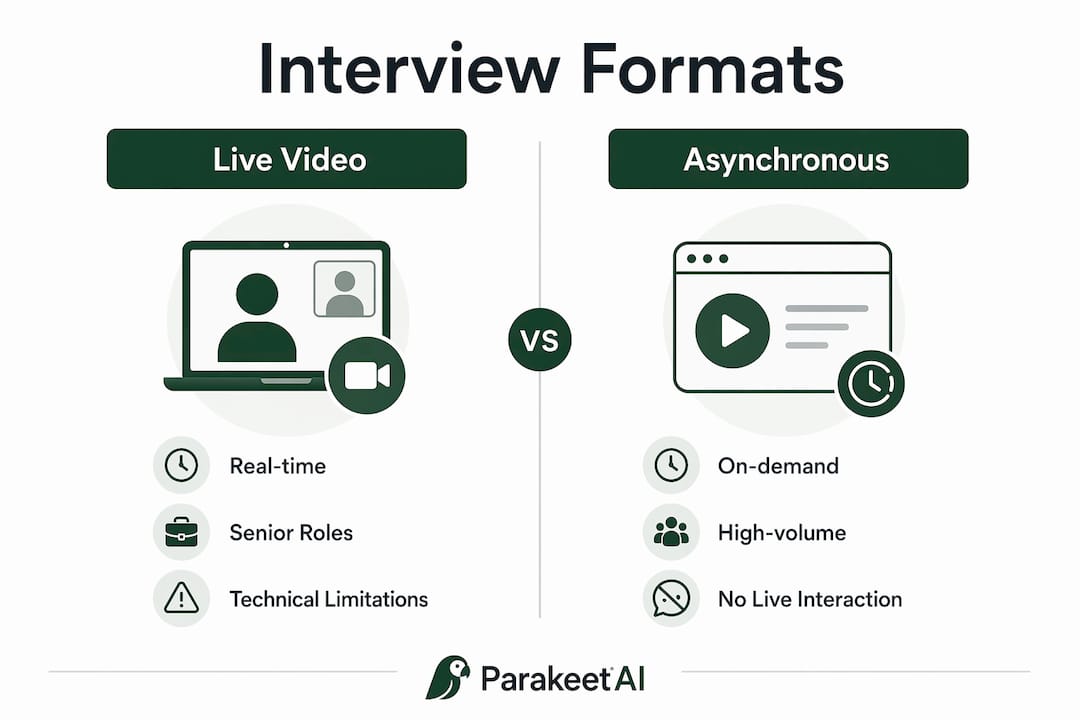
Live video interviews replicate the real-time dynamic of in-person conversations using tools like Zoom, Microsoft Teams, or Google Meet. They preserve nonverbal cues and allow follow-up questions, making them the preferred format for final-round evaluations. The tradeoff is scheduling. Coordinating multiple stakeholders across time zones adds days to the hiring cycle.
Asynchronous video interviews ask candidates to record responses to preset questions on their own time, with platforms like HireVue or Spark Hire scoring those responses automatically. The efficiency gain is real, but so is the dropout risk. Asynchronous interviews reduce application continuation by 50%, with women disproportionately affected. That statistic should give any recruiter pause before deploying async as a default screening tool.
Panel video interviews introduce coordination complexity that live single-interviewer formats avoid. When three or four stakeholders join a video call simultaneously, candidates often feel outnumbered, and interviewers sometimes talk over each other. Clear facilitation protocols matter more here than in any other format.
VR and AR assessments are the newest addition to the digital hiring toolkit. Companies in engineering, logistics, and healthcare are piloting immersive simulations that test spatial reasoning or procedural skills in ways no video call can replicate. Adoption is still limited by hardware costs, but the trajectory is clear.
Pro Tip: For high-volume entry-level roles, pair asynchronous video with a brief live call in the final stage. Candidates who complete both steps are significantly more engaged, and you get behavioral data from both formats.
How is AI transforming digital interviewing workflows and outcomes?
AI’s role in digital interviewing has moved well beyond resume parsing. It now touches every stage of the process, from initial screening to scheduling to real-time decision support during live calls.

The efficiency numbers are striking. 78% of recruiters report significant time savings from AI-assisted hiring tools, and 32% report measurable bias reduction compared to purely human-led screening. A 50% reduction in time-to-hire is the headline figure, and it reflects real operational change for teams managing hundreds of applications per role.
AI functions in digital interviewing fall into three categories. First, pre-interview screening: tools parse resumes, rank candidates against job criteria, and flag gaps before a human ever reads the file. Second, in-interview scoring: platforms like HireVue analyze speech clarity, keyword presence, and answer structure in asynchronous responses, producing a ranked shortlist automatically. Third, real-time support: AI copilot tools listen to live interviews and surface relevant follow-up questions or candidate data for the interviewer in real time. Parakeet-ai operates in this third category, providing live answer suggestions to candidates as questions are asked.
The limitations deserve equal attention. A 3-million-application analysis found that repeated use of the same AI vendor across multiple hiring cycles compounds systemic bias rather than reducing it. This is what researchers call algorithmic monoculture: when every company uses the same scoring model, the same candidate profiles get rewarded and the same profiles get filtered out, regardless of actual job performance.
“LLMs in hiring reshape how candidate information is framed, which is why human oversight remains non-negotiable for decision legitimacy.” — Frontiers in Artificial Intelligence
Only 41% of hiring teams fully trust AI to make sound assessments, even as adoption accelerates. That gap between use and trust is the defining tension in AI-assisted hiring right now. The teams getting this right are the ones treating AI as a filter and a prompt, not a decision-maker.
What are the candidate trust challenges in AI-driven digital interviews?
Candidate discomfort with AI interviewing is not a perception problem. It is a data problem, and the numbers are specific enough to demand a strategic response from any recruiter running AI-scored processes.
38% of U.S. job seekers have withdrawn from a hiring process specifically because it involved an AI interview. A separate 33% abandon processes that use AI-scored pre-recorded video without any human review. These are not fringe candidates. They include experienced professionals who have other options and choose to walk away rather than submit to a process they do not understand or trust.
The disclosure gap is the clearest fix available. 75% of candidates want legal disclosure of when AI is evaluating them. That is not a radical demand. It is the same expectation candidates have always had about who is in the room. When you do not tell candidates that an algorithm is scoring their word choice and facial expressions, you are not protecting a proprietary process. You are eroding your employer brand.
Here is what makes the bias perception data counterintuitive: candidates report similar rates of perceived bias from AI and human interviewers, roughly 27 to 36% depending on the category. Age and race bias are reported at nearly identical rates from both sources. This means switching to AI does not automatically reduce candidate concerns about unfairness. What reduces those concerns is transparency and visible human involvement.
Practical steps to rebuild candidate trust in AI-driven processes:
- Disclose AI use in the job posting, not buried in terms and conditions.
- Explain what the AI measures and what it does not measure.
- Guarantee that a human reviews every AI-generated score before a decision is made.
- Offer an alternative format for candidates who request one.
- Send a brief follow-up explaining how their interview was evaluated, regardless of outcome.
Pro Tip: Add a single sentence to your interview confirmation email explaining that AI tools assist your review process and that a recruiter personally evaluates every candidate. That one sentence reduces withdrawal rates and sets accurate expectations before the interview begins.
The AI interview compliance conversation is accelerating at the regulatory level too. Several U.S. states are already moving toward mandatory disclosure requirements. Getting ahead of that curve now protects you legally and competitively.
How to implement digital interviewing techniques that actually work
Effective digital interviewing is not about deploying the most sophisticated platform. It is about matching the right format to the right stage and preparing both your team and your candidates to perform well within it.
Technical preparation is non-negotiable. Late joining or technical failure significantly reduces interview success rates for candidates, which means your process is filtering on technical access rather than job-relevant skills. Send candidates a test link 48 hours before the interview. Specify camera, lighting, and audio requirements. This is not hand-holding. It is removing noise from your signal.
Structured communication improves data quality. The STAR method (Situation, Task, Action, Result) works in digital formats, but pacing differs from in-person delivery. In a live video interview, silence feels longer than it does in a room. Train your interviewers to allow three to five seconds after a question before prompting. Candidates who are given that space give more complete answers.
For asynchronous formats, the structure of your questions determines the quality of responses you receive. Vague prompts produce vague answers. Specific behavioral prompts tied to the job’s core competencies produce data you can actually compare across candidates.
Balance AI assistance with human judgment at every decision point. Use AI to rank and flag, but require a human to read the top 20% of candidates before advancing anyone. This catches the cases where an algorithm scores a strong candidate poorly because their communication style does not match the training data. The role of AI in HR is to reduce volume, not to replace judgment.
Follow-up and feedback close the loop. Most digital hiring processes end with silence for rejected candidates. A brief automated message explaining the decision criteria, not the specific score, reduces negative reviews on Glassdoor and Indeed by giving candidates a reason rather than a rejection. That matters for your next hiring cycle.
Key takeaways
Digital interviewing in 2026 requires HR teams to combine format-specific strategy, transparent AI use, and structured human oversight to achieve both efficiency and candidate trust.
| Point | Details |
|---|---|
| Format selection drives outcomes | Match live, async, or panel formats to the hiring stage and role type, not just convenience. |
| AI accelerates but does not decide | Use AI to reduce volume and surface patterns, then require human review before every advancement decision. |
| Transparency reduces withdrawal | Disclose AI use upfront and explain what it measures to prevent the 38% candidate dropout rate. |
| Async carries hidden bias risk | Repeated use of the same AI vendor compounds systemic bias across hiring cycles, per 3-million-application research. |
| Structure beats sophistication | Behavioral prompts, STAR-aligned questions, and technical prep improve data quality more than platform upgrades. |
The uncomfortable truth about AI and hiring in 2026
I have spent years watching HR teams adopt new technology with genuine enthusiasm and then quietly walk back the rollout six months later when the candidate complaints start coming in. The pattern with AI interviewing is the same, just faster and louder.
The efficiency gains are real. I do not dispute the data. But technology alone cannot improve trust. A survey of 423 HR professionals found strong efficiency gains from AI adoption but minimal improvement in candidate trust. That gap exists because most teams implement AI as a cost reduction tool and then wonder why candidates feel like they are being processed rather than considered.
What I have found actually works is treating AI as a preparation tool rather than an evaluation tool. When AI helps a recruiter prepare better questions, surface relevant candidate history, or flag inconsistencies in a job description, it adds value without creating the adversarial dynamic that scored async video produces. The future of digital interviews belongs to teams that use AI to be more human in their interactions, not less.
The other thing I would push back on is the assumption that candidates who object to AI interviewing are simply resistant to change. The 38% withdrawal rate is not technophobia. It is a rational response to opacity. When you cannot explain what an algorithm is measuring or why it scored someone the way it did, you have not built a better hiring process. You have built a faster one. Those are not the same thing.
The teams I respect most in this space are the ones asking hard questions about their AI vendors: What is the training data? Who was overrepresented? What happens when the model is wrong? Those questions are not obstacles to adoption. They are the difference between a hiring process that scales and one that quietly filters out the candidates you actually need.
— Jure
How Parakeet-ai helps you stay ahead of digital interviewing
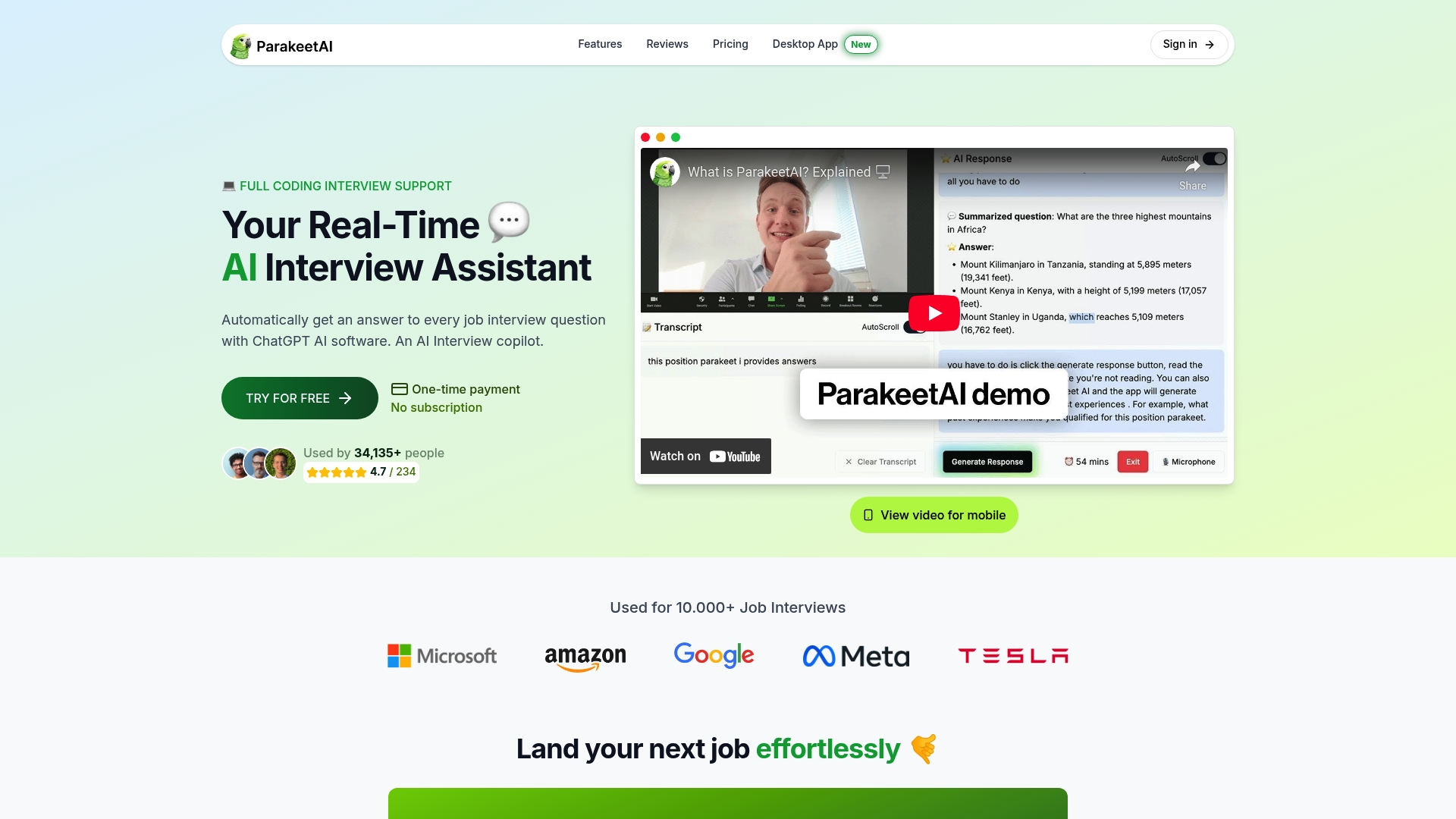
Parakeet-ai is built for the reality of digital interviewing in 2026, where candidates and recruiters alike are navigating AI-scored formats, live video pressure, and rising expectations for transparency. The platform listens to interviews in real time and provides instant, contextually relevant answers to every question, giving candidates the support they need to perform at their best. For HR teams, that means better signal from every interview and a candidate experience that reflects well on your organization. Explore how Parakeet-ai can improve your digital hiring process and reduce the friction that costs you top candidates.
FAQ
What is digital interviewing?
Digital interviewing is any technology-enabled format used to screen or evaluate job candidates remotely, including live video, asynchronous video, and AI-assisted assessments. Platforms like Zoom, HireVue, and Greenhouse are the most widely used tools in 2026.
How does AI change the digital hiring process?
AI automates resume screening, scores asynchronous video responses, and provides real-time support during live interviews. 67% of companies now use AI in recruiting, reducing time-to-hire by up to 50%.
Why do candidates withdraw from AI-driven interviews?
38% of U.S. job seekers have withdrawn from a hiring process that involved AI evaluation, primarily due to lack of transparency about what the AI measures and the absence of visible human review.
What are the best practices for asynchronous video interviews?
Use specific behavioral prompts tied to core competencies, send candidates a format guide in advance, and always have a human reviewer assess AI-generated scores before making advancement decisions.
How do you reduce bias in AI-assisted digital interviews?
Avoid relying on a single AI vendor across all hiring cycles, require human oversight at every decision point, and disclose AI use to candidates. Research on 3 million applications shows that repeated use of the same AI vendor compounds rather than reduces systemic bias.