
AI interview trends: boost your job success in 2026

TL;DR:Most hiring managers now use AI in the interview process, significantly improving candidate outcomes.AI-driven interviews offer faster, more consistent, and less biased evaluations compared to traditional methods.Candidates should combine AI practice with human feedback to develop authentic responses and ethical interview skills.
Nearly 99% of hiring managers now use AI somewhere in the hiring process, yet most job seekers still prepare as if a human will be judging every word. That gap is costing candidates real opportunities. AI has quietly reshaped how interviews are structured, scored, and even conducted, and the rules have changed faster than most people realize. This article breaks down the biggest AI interview technology trends, what the data says about outcomes, which tools actually work, and exactly how you can build a preparation strategy that puts you ahead of the competition.
Table of Contents
- How AI is transforming job interviews worldwide
- Key technologies and platforms shaping 2026 interviews
- AI vs human interview prep: strengths, drawbacks, and the hybrid edge
- Best practices: mastering your AI-powered interview preparation
- Why the smartest candidates blend AI fluency with human strengths
- Level up your interview prep with advanced AI tools
- Frequently asked questions
Key Takeaways
| Point | Details |
|---|---|
| AI boosts interview outcomes | Data shows AI-based prep significantly improves candidate performance and hiring rates compared to traditional coaching. |
| Hybrid prep works best | Blending AI tools with human mock interviews delivers faster learning and deeper readiness than either alone. |
| Know latest platforms | Specialized AI interview platforms outperform generic tools, offering structured feedback and scenario realism. |
| Ethics matter | Use AI tools for practice, not real-time cheating, to avoid risks and maintain professionalism. |
| Practice consistently | Daily short sessions with AI tools, paired with periodic human coaching, build lasting job interview success. |
How AI is transforming job interviews worldwide
AI is no longer a background tool that HR teams use to sort resumes. It now sits at the center of the interview process itself, from scheduling and question generation to real-time scoring and final hiring decisions. Companies of every size are deploying AI interview platforms at scale, processing thousands of candidates in the time it once took to review a handful.
The numbers behind this shift are striking. AI-assisted recruitment produced a 20 percentage point lift in final pass rates and a 17 percentage point increase in job attainment compared to traditional methods. Those are not marginal improvements. They represent a fundamentally different outcome for candidates who go through an AI-supported process versus those who do not.
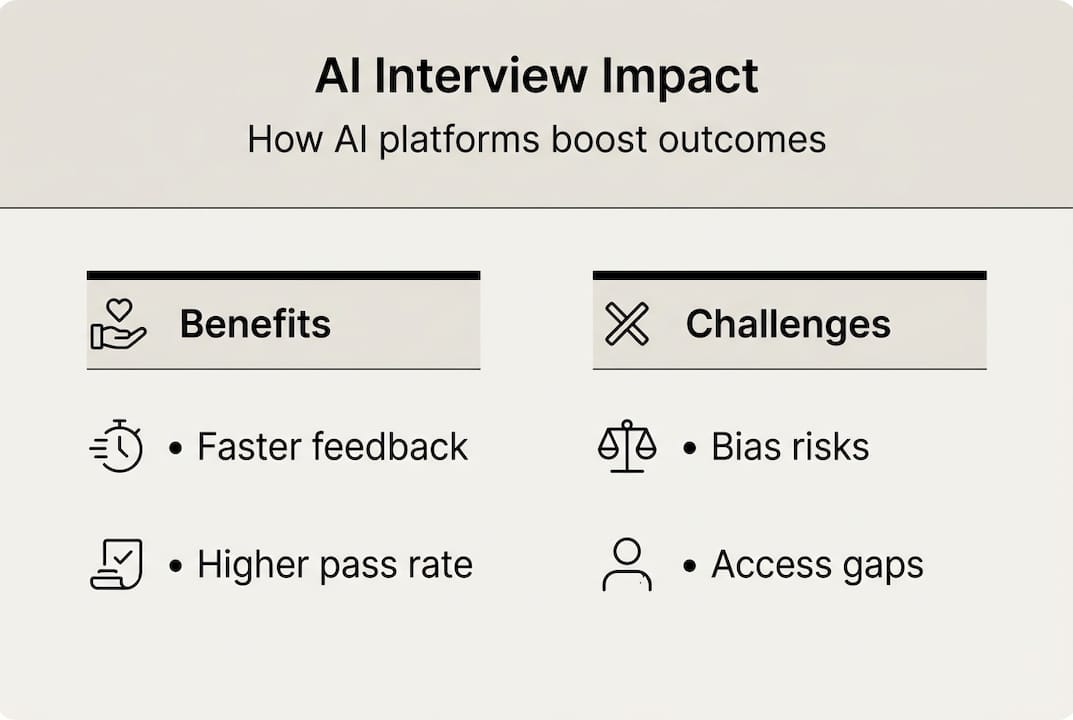
Here is a quick look at how AI-driven and traditional interview processes compare:
| Factor | AI-driven interviews | Traditional interviews |
|---|---|---|
| Speed of evaluation | Minutes | Days to weeks |
| Consistency of scoring | High | Variable |
| Candidate volume handled | Thousands | Dozens |
| Bias in scoring | Reduced (in some studies) | Higher human variance |
| Feedback to candidates | Immediate | Rare or delayed |
Not every finding is positive, though. A field experiment on async interviews found that requiring candidates to complete asynchronous video interviews caused more than a 50% drop in continuation rates, with women disproportionately affected. That is a real diversity concern for employers and a signal to job seekers that the format itself can feel like a barrier.
“AI scoring systems, however, tend to rate women and underrepresented minorities higher than human interviewers do, suggesting that removing human bias from scoring can actually level the playing field.”
You can learn more about the AI interview benefits for job seekers and get a deeper look at AI interview technology explained to understand how these systems work under the hood. Research on employability outcomes data further confirms that candidates who understand and adapt to AI-driven processes see measurably better results.
Key technologies and platforms shaping 2026 interviews
Not all AI interview tools are built the same. Understanding the categories helps you choose the right preparation strategy.
The three main types of AI interview technology:
- Async platforms: Candidates record video responses to pre-set questions. AI scores tone, word choice, facial expression, and pacing. Examples include HireVue and Spark Hire.
- Live AI copilots: Real-time tools that listen during a live interview and suggest answers or talking points. These are powerful but carry ethical considerations (more on that below).
- Hybrid systems: Platforms that combine human interviewers with AI scoring layers, giving companies both the nuance of human judgment and the consistency of machine analysis.
For preparation specifically, specialized platforms have a clear edge. Specialized AI platforms report a 67% success rate for candidates compared to just 23% for those using general tools like ChatGPT. The difference comes down to context. A general large language model can help you brainstorm answers, but it cannot simulate the pressure of a timed video response or give you feedback on your vocal delivery.
Here is how the main preparation tool types compare:
| Tool type | Best for | Key limitation |
|---|---|---|
| Specialized AI prep platforms | Behavioral drills, speech coaching | Cost, learning curve |
| General LLMs (e.g., ChatGPT) | Answer drafting, brainstorming | No real-time simulation |
| Async practice tools | Mimicking real async interview formats | Less adaptive feedback |
| Live AI copilots | Real-time guidance | Ethical and detection risks |
Research on AI employability outcomes confirms that structured, repeated practice with purpose-built tools produces stronger results than ad hoc preparation. Explore understanding AI interview tools for a full breakdown of what each platform type offers, and check out this AI preparation guide to map out your personal strategy.
AI vs human interview prep: strengths, drawbacks, and the hybrid edge
AI and human coaching each bring something the other cannot fully replicate. Knowing where each one shines helps you allocate your prep time wisely.

Where AI clearly wins: AI delivers volume, consistency, and speed. You can run 20 behavioral question drills in a single evening, get instant feedback on your answer structure, and track your improvement over time. There is no scheduling friction and no awkwardness. AI never gets tired of hearing your answer to “Tell me about yourself.”
Where humans still have the edge: Human coaches and practice partners bring something AI cannot fake: genuine social pressure. A real person asking unexpected follow-up questions, reacting to your body language, and pushing back on vague answers creates a kind of stress that sharpens your actual performance. AI is faster for repetition, but humans provide the nuanced qualitative feedback that prepares you for unpredictable moments.
The AI in hiring process is evolving fast, and the smartest candidates treat AI and human prep as complementary, not competing.
The optimal hybrid sequence:
- Start with AI drills to build your answer bank and eliminate filler words.
- Use AI feedback to refine your STAR (Situation, Task, Action, Result) storytelling structure.
- Move to human mock interviews once your fundamentals are solid.
- Use AI again after each human session to reinforce corrections.
- Reserve your final human mock for a full-length, high-pressure simulation.
Pro Tip: Use AI for daily repetition and fundamentals, then schedule one human mock interview per week to stress-test your performance under real social conditions.
One caution worth flagging: live AI copilot tools that feed you answers during an actual interview carry real ethical and detection risks. Most employers consider this a form of dishonesty. Build your confidence with AI prep before the interview, not during it. And explore adaptive preparation strategies to keep your practice evolving as your skills grow.
Best practices: mastering your AI-powered interview preparation
Knowing the tools is one thing. Building a system that actually produces results is another. Here is how to put everything together.
Build a consistent daily routine:
- Set aside 15 to 30 minutes each day for focused AI practice. Daily AI practice combined with hybrid prep has been shown to measurably boost performance.
- Rotate through question types: behavioral, situational, technical, and culture-fit.
- Record yourself at least twice a week and review the playback critically.
- Track which question types still trip you up and prioritize those.
Stay on the right side of ethics: Using AI to prepare is smart. Using AI to cheat during a live interview is a different matter entirely. Hybrid skills fluency, meaning AI literacy combined with strong interview fundamentals, is what employers are actually looking for. Candidates who lean entirely on real-time AI assistance during interviews often come across as robotic or disconnected when the tool lags or fails.
Day-before and day-of checklist:
- Run one final AI mock session the evening before your interview.
- Review your top three stories using the STAR format.
- Test your tech setup if the interview is remote.
- Get a full night of sleep. AI prep cannot compensate for exhaustion.
- On the day, focus on listening actively, not reciting memorized scripts.
Pro Tip: Start with free AI tools to build your baseline, then invest in a specialized platform once you have identified your specific weak spots. Targeted improvement beats broad practice every time.
For a full walkthrough, see how to leverage AI for interviews and explore the specific AI tools advantages that give job seekers a measurable edge.
Why the smartest candidates blend AI fluency with human strengths
Here is the uncomfortable truth most interview advice skips: over-relying on AI practice creates a specific kind of candidate who performs well on structured questions and falls apart the moment a human interviewer goes off-script. We see this pattern repeatedly. Candidates who drill exclusively with AI tools develop polished, formulaic answers that sound rehearsed rather than genuine.
The candidates who actually stand out are the ones who use AI to build their foundation and then deliberately practice being human. That means personal storytelling, showing real enthusiasm, and handling awkward silences without panic. Hiring managers notice when someone can pivot naturally, and no AI tool can fully train that skill.
Transparent, ethical use of AI also signals professionalism. Mentioning that you used AI tools to prepare, when it comes up naturally, shows self-awareness and adaptability. That is a quality employers want on their teams. Read why use AI for job interviews for a complete picture of how to position your AI fluency as a genuine asset.
Level up your interview prep with advanced AI tools
The data is clear: candidates who use specialized AI tools for consistent, structured practice get hired at significantly higher rates. The best part is that getting started does not require a big investment or a steep learning curve.
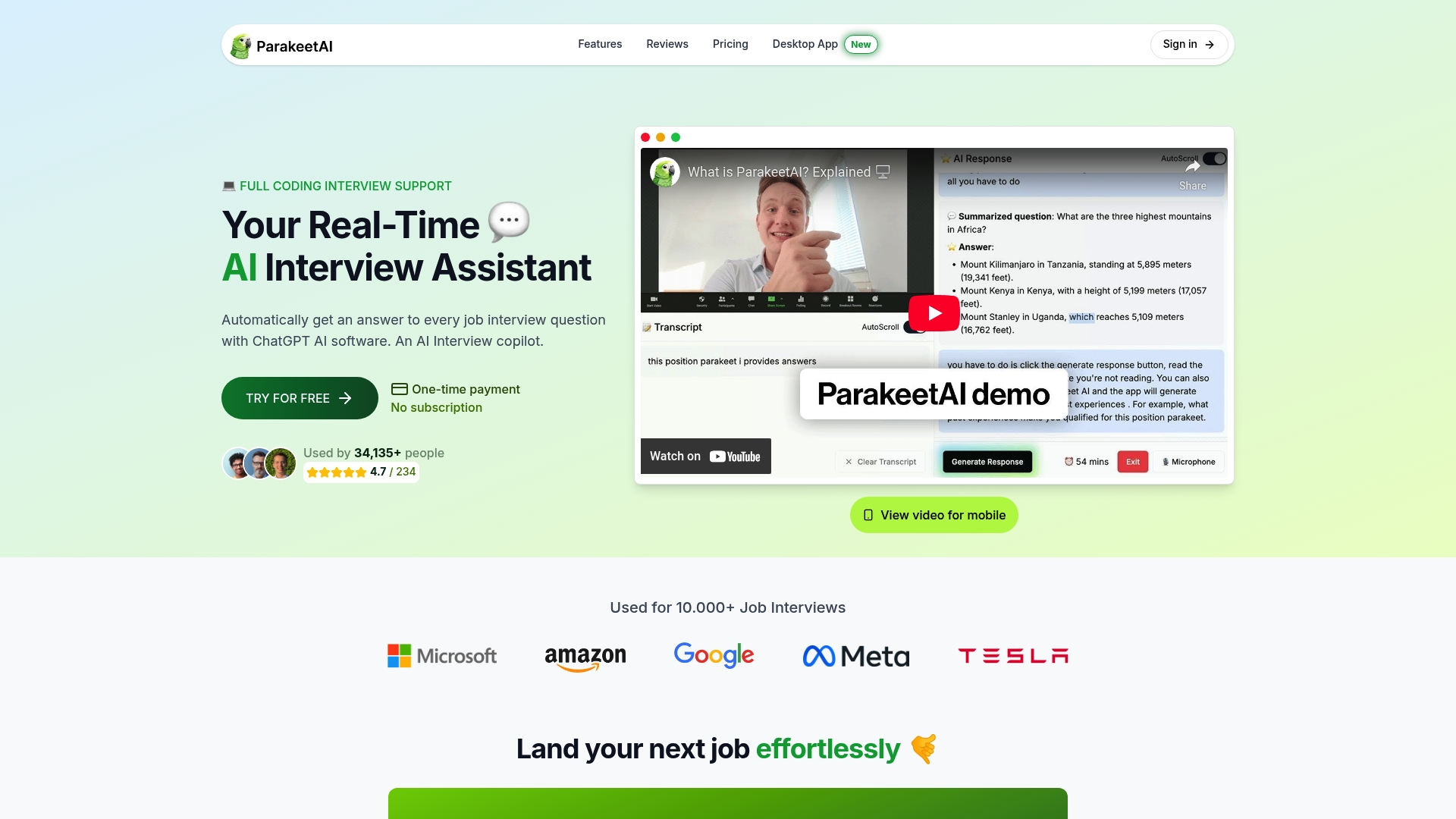
ParakeetAI is built specifically for job seekers who want real-time AI support during their preparation, not just generic question lists. It listens, responds, and helps you sharpen every answer before you ever walk into an interview room. Pair it with the insights from this article and the full library of AI-powered job interview tools to build a prep routine that actually moves the needle on your job search.
Frequently asked questions
How do AI interview tools improve job seeker success?
AI tools deliver instant, targeted feedback and simulate real interview conditions at scale. AI-assisted recruitment produced a 20 percentage point lift in final pass rates compared to traditional hiring methods.
Which is better for interview prep: AI or human coaching?
Both serve distinct purposes and work best together. AI is faster for repetition, while human coaching delivers the nuanced, adaptive feedback that prepares you for unpredictable interview moments.
Are there ethical issues with using AI during live interviews?
Yes. Real-time AI copilot tools used during live interviews are widely considered dishonest and carry detection risks. Use AI strictly for preparation, not as a live crutch, to stay on solid ethical ground.
Do AI interview tools disadvantage any applicant groups?
Async formats see over 50% continuation drops, particularly among women, which is a real access concern. However, AI scoring systems tend to rate women and minorities higher than human interviewers, which can reduce bias in final decisions.
What is the optimal way to use AI for interview prep?
Consistent daily 15 to 30 minute sessions with a specialized platform, combined with weekly human mock interviews, produces the strongest results according to expert recommendations.