
Executive Interview Preparation: A Senior Leader's Guide

TL;DR:Executive interview preparation focuses on mastering storytelling, leadership presence, and stakeholder engagement.Using frameworks like F.O.R.M.G. helps candidates deliver concise, strategic answers that showcase judgment under pressure.Building strong narratives, mapping stakeholders, and practicing deliberate communication enhance success in senior-level interviews.
Executive interview preparation is the process of mastering structured storytelling, leadership presence, and stakeholder engagement to succeed in senior-level interviews. At the executive level, hiring committees do not evaluate operational competence alone. They assess strategic judgment, risk calibration, and your ability to communicate organizational impact clearly under pressure. The candidates who advance are those who prepare with the same rigor they bring to leading organizations. This guide gives you the frameworks, narrative techniques, and presence skills to walk into any senior leadership interview and own the room.
What frameworks best support executive interview preparation?
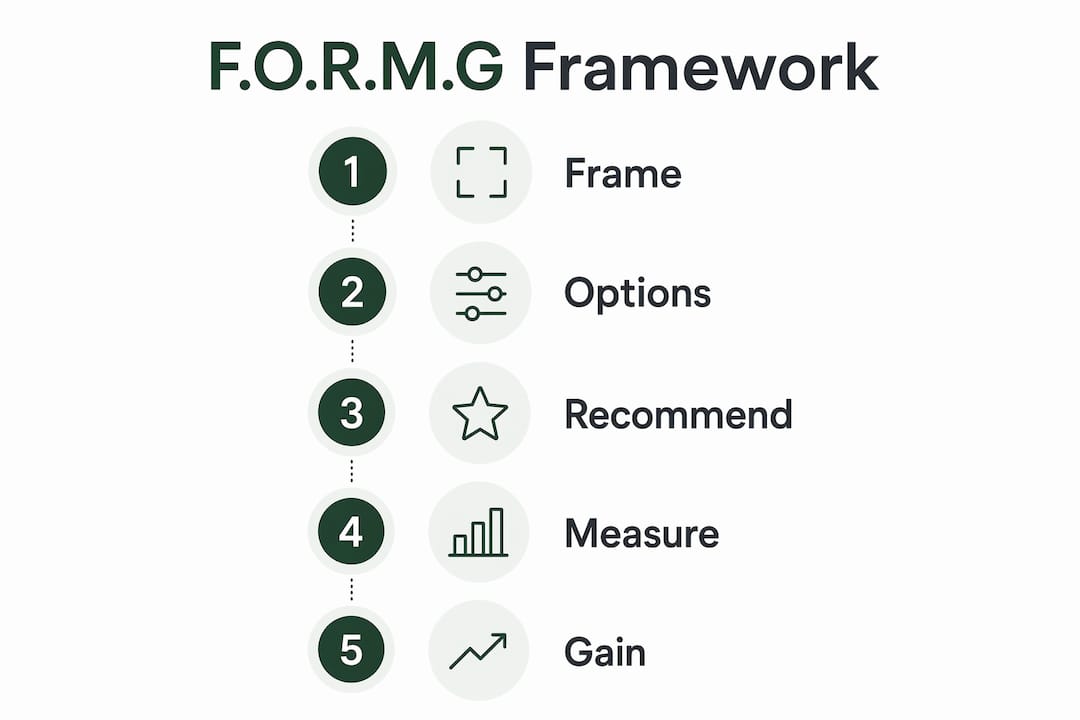
The F.O.R.M.G. framework is the most effective structured method for answering executive interview questions. It organizes responses into five phases: Frame, Options, Recommend, Measure, and Govern. Each phase guides the interviewer through your thinking without letting the answer drift into operational detail or run too long.
F.O.R.M.G. phases should ideally take 1–2 minutes each during practice, then compressed to under 90 seconds in the actual interview. That compression signals confidence and clarity. Interviewers at the board and C-suite level interpret concise answers as a sign of strong judgment, not a lack of depth.
Here is how each phase works in practice:
- Frame: Define the problem or decision context in one or two sentences. Avoid restating the question.
- Options: Name two or three credible paths forward. Show you considered trade-offs.
- Recommend: State your preferred course of action clearly. Do not hedge.
- Measure: Identify the metrics or signals you would track to confirm success.
- Govern: Explain how you would sustain the outcome, including who owns accountability.
Pro Tip: Practice F.O.R.M.G. answers out loud with a timer. If you cannot deliver a complete answer in under 90 seconds, cut the Options phase to two choices and tighten your Recommend statement.
Executive hiring committees use standardized scoring rubrics that evaluate five core competencies on a 1–5 scale, including strategic thinking and risk calibration. Knowing this structure lets you map your F.O.R.M.G. answers directly to what evaluators are scoring.
| F.O.R.M.G. Phase | Purpose | Time Target |
|---|---|---|
| Frame | Define the problem clearly | 10–15 seconds |
| Options | Show range of thinking | 20–25 seconds |
| Recommend | State your decision | 10 seconds |
| Measure | Name success metrics | 10 seconds |
| Govern | Assign accountability | 10 seconds |
How do you craft and compress leadership narratives?
Leadership narrative compression requires selecting 3–5 high-impact stories that showcase judgment and organizational outcomes, not operational details. Most candidates arrive with manager-level stories. Those stories describe what they personally did. Executive-level stories describe what the organization became because of decisions they made.
The shift is significant. A manager says, “I led a team that reduced costs by 15%.” An executive says, “I restructured the procurement function across three business units, which reduced supplier risk and freed $40 million in working capital over 18 months.” The second version shows systems thinking, stakeholder coordination, and durable impact.
Organizational-level stories show leadership impact as scalable systems rather than individual tasks. The best ones describe a before state, the decision or intervention, and an after state that outlived your direct involvement. That last element, the outcome that persisted after you moved on, is what separates executive candidates from strong managers.
Build your narrative bank using this sequence:
- Identify the organizational problem. What was broken, stalled, or misaligned before you acted?
- Name the stakeholders involved. Who had competing interests, and how did you align them?
- Describe the decision you made. What did you choose, and what did you trade off to get there?
- Quantify the outcome. Use revenue, cost, time, retention, or market position as your proof points.
- Show what lasted. Describe the system, culture shift, or capability that remained after you left the role.
Pro Tip: Record yourself telling each story and play it back. If you cannot hear a clear before-and-after arc in under 90 seconds, the story needs another round of compression.
Strategic rehearsal differentiates good candidates from exceptional ones. Rehearsing your narratives out loud, not just in your head, builds the muscle memory that keeps stories tight under pressure.
What role does stakeholder mapping play in senior interview success?
Stakeholder mapping before interviews is essential to tailor responses and gain trust from diverse panels including boards and search committees. Each group in an executive interview process has different priorities, and a message that resonates with a CEO may fall flat with a board chair.
Map your interviewers into four categories before any senior leadership interview:
- Board members: They care about governance, risk, and long-term value creation. Lead with how you manage uncertainty and protect the organization’s future.
- CEO or hiring executive: They care about execution speed, cultural fit, and whether you will make their job easier. Lead with alignment and track record.
- Peer executives: They care about collaboration, shared resources, and whether you will compete with or complement their agendas. Lead with cross-functional wins.
- External search committees: They care about market positioning and whether you fit the brief they sold to the client. Lead with the narrative that matches the role specification.
Sequencing matters as much as content. If you meet the search committee first, use that conversation to understand the board’s priorities. Then reinforce those themes when you reach the board stage. Each interview round should build on the last, not repeat it. Candidates who treat every round as a fresh start miss the chance to show they listen, adapt, and build momentum.
Pro Tip: After each interview round, send a brief follow-up note that references one specific topic from the conversation. It signals attention to detail and reinforces your key narrative without being repetitive.
How do you build presence and resilience for high-stakes interviews?
Executive interviews do not test for “right answers” but for clear, intentional communication under pressure. That distinction changes how you should practice. Presence is not a fixed trait you either have or lack. It is an active communication skill built through deliberate choices in pacing, focus, and delivery.
Strong executive candidates communicate leadership presence through pace, focus, and intentional pauses, actively managing their delivery to build trust. Presence is assessed by interviewers via communication style, not just content strength. Slowing down at key moments signals confidence. Rushing signals anxiety, even when the content is strong.
Presence is shaped by active communication choices: pacing, eye contact, and deliberate pauses build credibility. Practice these three techniques in every mock session:
First, pause before answering. A two-second pause after a question signals that you think before you speak. That is exactly what boards want in a senior leader.

Second, slow your pace on your most important sentences. If you are stating a recommendation or a key outcome, drop your speaking rate by 20%. The listener’s brain registers slower speech as more authoritative.
Third, use mock interviews with real pressure. Ask a colleague or executive coach to interrupt you mid-answer, challenge your recommendation, or ask a follow-up you did not prepare for. Composure under challenge is what work-sample interviews and structured problem-solving exercises are designed to test.
Pro Tip: Video record at least three full mock interviews before your actual interview. Watch for filler words, rushed transitions, and moments where your body language contradicts your message.
You can also apply AI-powered preparation strategies to simulate high-pressure scenarios and sharpen your delivery before the real conversation.
What are common executive interview questions and how do you answer them?
Judgment, especially risk calibration and decision-making under ambiguity, is the core competency that differentiates executives from managers in interviews. The questions at the executive level reflect that. They are rarely about what you know. They are about how you decide, who you bring along, and what you do when the data is incomplete.
Common executive interview questions fall into three categories:
- Strategic judgment: “How would you prioritize competing investments when resources are constrained?” Apply F.O.R.M.G. to show your decision process, not just your conclusion.
- Influence and alignment: “Describe a time you drove change without formal authority.” Use a leadership narrative that shows stakeholder mapping and coalition building.
- Risk and resilience: “Tell me about a decision that did not go as planned. What did you do?” Show self-awareness, course correction, and what the organization learned.
Prepare at least two stories for each category. One story should come from your most recent role. The other should come from a different context to show range. Interviewers at the executive level notice when every answer comes from the same job.
Prepare three to five questions to ask the interviewer. The best ones show you have done your research and are thinking about the role’s real challenges. Examples include: “What does success look like in the first 90 days?” and “What is the biggest obstacle the incoming leader will need to address?” These questions position you as a peer, not a candidate.
For technology executives, reviewing common interview pitfalls specific to the sector can sharpen your preparation further. You can also explore interview best practices for applying structured frameworks in technology organizations.
Key Takeaways
Effective executive interview preparation combines structured frameworks, organizational-scale storytelling, stakeholder mapping, and deliberate presence skills to separate top candidates from strong managers.
| Point | Details |
|---|---|
| Use F.O.R.M.G. for every answer | Structure responses across five phases and compress to under 90 seconds for maximum credibility. |
| Tell organizational-scale stories | Describe systems built and outcomes that lasted, not tasks you personally completed. |
| Map stakeholders before each round | Tailor your message to board, CEO, peer, and search committee priorities separately. |
| Build presence through active choices | Use deliberate pauses, slower pacing on key points, and mock interviews under real pressure. |
| Prepare questions that signal peer thinking | Ask about 90-day success criteria and key obstacles to position yourself as a strategic partner. |
What I have learned coaching leaders through executive interviews
Most leaders I have worked with arrive believing executive interviews reward the most experienced candidate. That belief is the first thing I correct. Boards and search committees are not comparing resumes in the room. They are watching how you think, how you communicate under pressure, and whether they would trust you with a crisis at 11 PM on a Friday.
The candidates who struggle are almost always the ones who over-prepare content and under-prepare delivery. They have every answer memorized but rush through them, bury the key point in the middle of a long story, or lose composure when an interviewer pushes back. Content without presence does not win at the executive level.
The candidates who advance are the ones who treat preparation as a communication discipline, not a knowledge exercise. They rehearse out loud. They compress their stories until every sentence earns its place. They study their interviewers before walking in the door. And they ask questions that make the panel feel like the conversation has already started.
The most underrated skill in any senior leadership interview is the ability to say something difficult with calm authority. Practice that, and the rest follows.
— Jure
Parakeet-ai: AI-powered practice for executive interviews
Preparing for a senior leadership interview takes more than reading frameworks. It takes repeated, realistic practice with feedback you can act on.
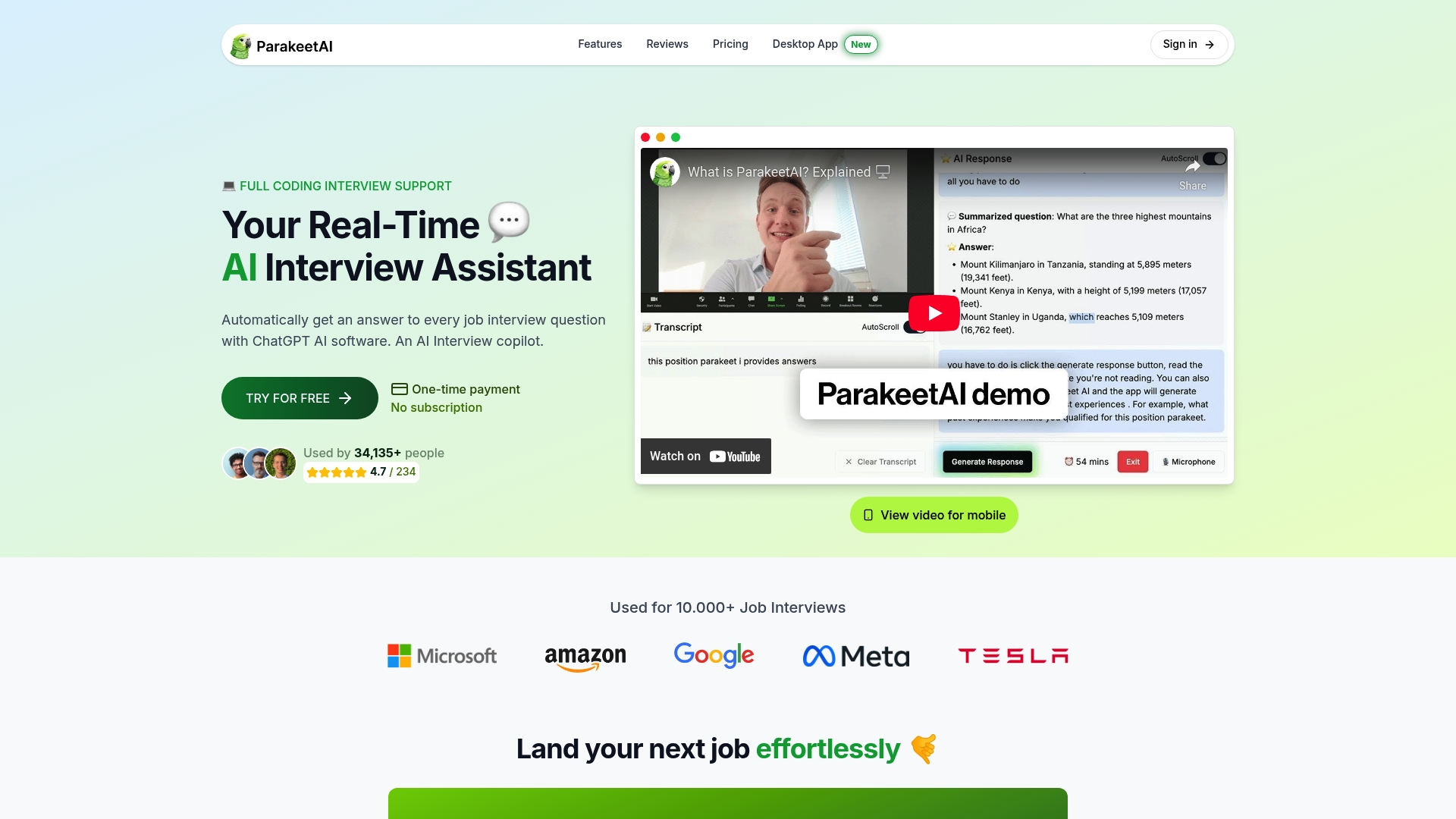
Parakeet-ai is a real-time AI interview assistant that listens to your interview and automatically provides answers to every question using AI. For executives preparing for high-stakes conversations, it offers a way to rehearse under pressure, refine your narrative delivery, and sharpen your responses before the real interview. Whether you are working through F.O.R.M.G. answers or compressing leadership stories, Parakeet-ai gives you a practice environment that responds to you in real time. Visit Parakeet-ai to see how AI-assisted preparation can sharpen your executive interview readiness.
FAQ
What is executive interview preparation?
Executive interview preparation is the process of developing structured responses, leadership narratives, and presence skills to succeed in senior-level hiring conversations. It goes beyond rehearsing answers to focus on strategic communication and stakeholder influence.
How is an executive interview different from a standard interview?
Executive interviews assess strategic judgment, risk calibration, and organizational impact rather than individual task performance. Hiring committees use standardized scoring rubrics across competencies like strategic thinking to compare candidates systematically.
What is the F.O.R.M.G. framework?
F.O.R.M.G. is a five-phase structure for answering executive interview questions: Frame, Options, Recommend, Measure, and Govern. Answers compressed to under 90 seconds using this framework improve perceived credibility and decision-making clarity.
How many stories should I prepare for an executive interview?
Prepare 3–5 high-impact leadership stories that demonstrate organizational-level outcomes, not personal task completion. Each story should show a clear before-and-after arc with measurable impact that outlasted your direct involvement.
How do I improve executive presence for interviews?
Executive presence is built through deliberate communication choices: intentional pauses, controlled pacing, and consistent eye contact. Practicing mock interviews on video and reviewing your delivery helps identify and correct habits that undermine authority.