
Hiring Trend Analysis Explained for HR Pros in 2026

What is hiring trend analysis, and why does it matter now?
Hiring trend analysis is the systematic process of tracking and interpreting patterns in hiring data over time to guide recruitment strategy and workforce planning. You collect data from job postings, labor reports, applicant tracking systems, and compensation surveys, then look for directional signals: which roles are growing, which skills are disappearing, where geographic demand is shifting, and how fast positions are filling.
The core elements recruiters and workforce planners track include:
- Hiring volumes — total headcount added per period, segmented by department, region, or role level
- Skill demand patterns — which competencies appear most frequently in new postings and how that mix is changing
- Compensation trends — posted wage growth by occupation and tier, signaling where competition for talent is heating up
- Time-to-fill and application rates — operational metrics that reveal friction in the hiring funnel
- Geographic shifts — where employers are concentrating hiring and where talent supply is tightest
- Turnover and backfill ratios — distinguishing growth hiring from replacement hiring, which carry very different strategic implications
The data sources feeding this analysis range from the U.S. Bureau of Labor Statistics’ JOLTS reports and BLS employment situation releases to proprietary ATS data, LinkedIn Talent Insights, and third-party job posting indexes like Indeed’s Job Posting Index. Each source captures a different slice of the market, so strong analysis triangulates across several rather than relying on any single feed.
What makes this process genuinely useful is the shift from reactive to proactive hiring. When you understand the direction and velocity of change in your talent market, you stop scrambling to fill seats and start building pipelines before the need becomes urgent.
Key metrics you should be tracking in every hiring analysis
Effective analysis of recruitment trends depends on knowing which numbers actually tell you something versus which ones just look busy on a dashboard.
Quantitative metrics worth watching:
- Time-to-fill — the number of days between a requisition opening and an accepted offer; rising time-to-fill often signals a tightening talent pool before broader market data catches up
- Application-to-interview ratio — how many applicants it takes to produce one qualified interview; a deteriorating ratio is an early warning of sourcing or screening problems
- Offer acceptance rate — a declining rate usually points to compensation misalignment or a broken candidate experience
- Turnover rate by tenure band — separating first-year attrition from longer-tenure departures reveals whether you have an onboarding problem or a culture problem
- Hiring velocity — the rate at which roles are filled relative to the pace they open; a widening gap between open and filled roles compounds into a structural backlog
Qualitative factors that change the interpretation:
- Seniority clustering — a sudden spike in senior-level postings often signals a company moving from building to scaling; mid-level clustering suggests operationalizing an existing function
- Competency clusters — groupings of skills that appear together in postings reveal how job architectures are evolving, often faster than formal job descriptions are updated
- Hiring purpose — net new headcount versus backfill versus restructuring replacement each carries different budget and timeline implications
Data sources and tools commonly used:
- BLS JOLTS and the monthly Employment Situation report for macro labor market context
- Indeed Hiring Lab’s Job Posting Index for real-time demand signals
- SHRM research reports for recruiter-level benchmarks and priorities
- ATS platforms (Workday, Greenhouse, Lever) for internal pipeline analytics
- LinkedIn Talent Insights and Lightcast for skill demand and competitive intelligence
Pro Tip: Cross-reference your internal ATS data against external job posting indexes monthly. Internal data tells you what you hired; external data tells you what the market is doing. The gap between the two is where your sourcing strategy lives.
Why hiring trend analysis drives better recruitment outcomes
Reactive hiring is expensive. When a critical role opens unexpectedly and you have no pipeline, you pay more, wait longer, and often settle. Trend analysis is the mechanism that prevents that scenario from repeating.

The clearest business case sits in anticipating talent needs before they become urgent. When you track skill demand shifts over rolling quarters, you can start building candidate relationships and internal development programs months before a formal requisition opens.
Trend analysis also aligns hiring plans with market realities that internal stakeholders often underestimate:
- Skill availability gaps — knowing that AI engineering talent is scarce in your region before you commit to a headcount plan saves a painful mid-year conversation with finance
- Compensation benchmarking — posted wage data from Indeed’s Hiring Lab showed wage growth holding at 2.4% year-over-year in May 2026, with low-wage occupations growing faster at 2.7%; that kind of granularity lets you set realistic offer bands before candidates walk away
- Regional demand signals — geographic hiring concentration data tells you whether to invest in local sourcing or remote-first pipelines
Cost reduction follows naturally. Shorter time-to-fill, better offer acceptance rates, and reduced agency dependency all flow from knowing your market before you need it. The role of AI in HR is accelerating this further, with predictive analytics surfacing pipeline gaps weeks earlier than manual review could.
Emerging hiring trends reshaping recruitment strategies in 2026
The 2026 hiring environment looks structurally different from even two years ago. A few shifts stand out as genuinely consequential rather than cyclical noise.
AI adoption and the skills gap it creates: Many organizations now report AI as their biggest skills gap, and some recent job cuts are linked to AI-driven restructuring. At the same time, 85% of recruiting executives expect increased use of predictive analytics to guide hiring decisions. AI job postings increased significantly year-over-year, reflecting demand that supply cannot yet meet.
Skills-first hiring replacing credential gatekeeping: 53% of employers removed degree requirements from certain roles to expand talent pools. Competency clusters are replacing rigid job descriptions, and hiring managers are evaluating what candidates can do rather than where they studied.
Internal hiring and talent mobility: 61% of new roles at Fortune 500 companies were filled internally in 2025, with many having formal mobility programs. Quiet hiring, where organizations redeploy existing employees into emerging need areas without external searches, is becoming a deliberate workforce strategy rather than a workaround.
The AI application surge: Applications increased 45% year-over-year by March 2026, with 39% of candidates using AI tools to apply. That volume makes resume-based screening increasingly unreliable as a signal of actual fit.
Cooling job posting volumes: The Indeed Job Posting Index stood just 0.4% above pre-pandemic levels as of May 2026, with year-over-year change at -4.8%. Job postings declined 7–25% across major markets in early 2026. That does not signal a collapsing labor market; it signals normalization after a period of historically elevated demand, and it requires a different sourcing posture than the hyper-hiring years.
How to apply hiring trend insights strategically
The most common mistake in analyzing recruitment trends is treating it as a quarterly snapshot exercise. Markets move faster than that, and a three-month-old picture of skill demand can send your sourcing strategy in the wrong direction.
Experts now recommend continuous trend monitoring over static snapshots, tracking both the velocity and direction of change in skills and roles. A skill that appeared in 12% of postings last quarter and now appears in 19% tells you something very different from one that has held steady at 15% for a year.
Practical steps for embedding trend analysis into your workflow:
- Cluster your job posting data by seniority level. A surge in senior postings signals strategic expansion or a leadership gap; a surge in mid-level postings usually means operationalizing something that already works. The pattern reveals intent that individual requisitions obscure.
- Build a skills velocity tracker. Log which competencies appear in new postings each month and calculate their growth rate. Skills growing faster than 20% quarter-over-quarter deserve pipeline investment now, not when a req opens.
- Integrate upstream assessments to cut AI application noise. With 94% of hiring managers reporting that hiring takes longer now, early-stage skills assessments are the most direct way to restore signal quality. The role of AI in pre-employment testing has made this faster and more defensible than manual screening.
- Align trend findings with workforce planning cycles. Trend data only changes behavior when it reaches the people setting headcount budgets. A monthly one-page brief to finance and business unit leaders, showing where skill gaps are widening, converts analysis into resource decisions.
A step-by-step methodology for conducting hiring trend analysis
A repeatable process matters more than any single tool. Here is a methodology that works at both team and enterprise scale.
Step 1: Define the scope and time horizon. Decide whether you are analyzing a single function, a business unit, or the full organization. Set a rolling window, typically 12–24 months of historical data, plus a forward-looking horizon of 6–12 months for forecasting.

Step 2: Gather data from multiple sources. Pull internal ATS data for pipeline metrics, compensation data from your HRIS, and external data from BLS reports, Indeed’s Job Posting Index, and skill demand platforms like Lightcast. No single source is complete.
Step 3: Establish baseline metrics. Calculate your current state across time-to-fill, offer acceptance rate, application-to-interview ratio, and turnover by tenure. These baselines are your reference point for everything that follows.
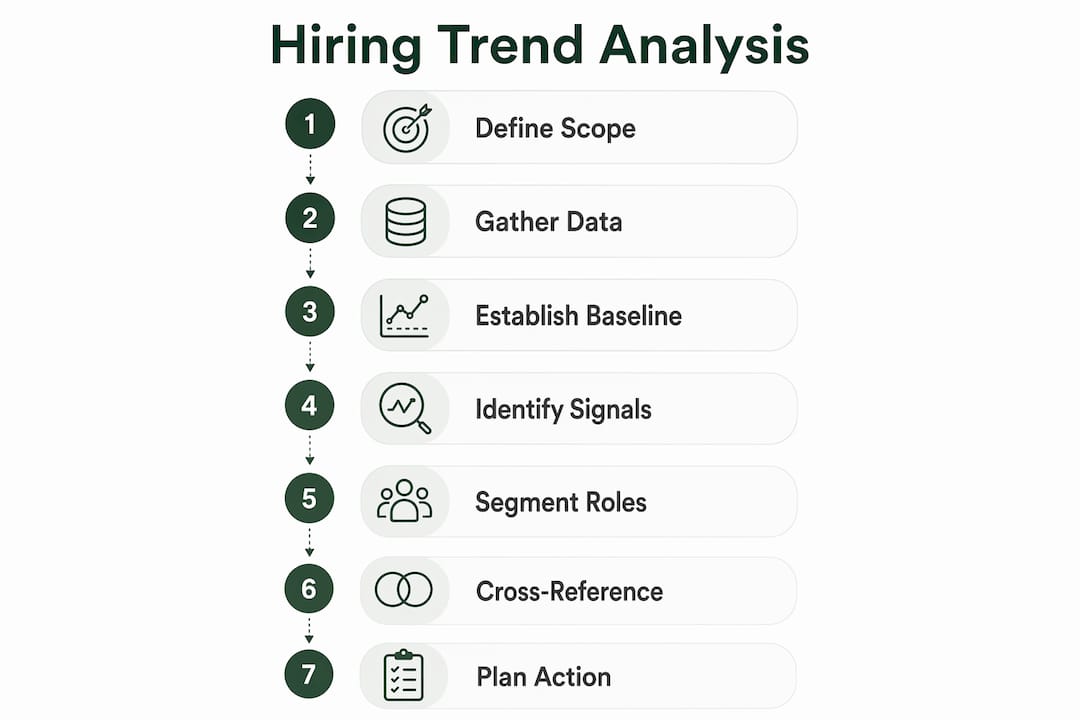
Step 4: Identify directional signals. Look for metrics moving consistently in one direction over three or more periods. A single data point is noise; a consistent direction is a trend worth acting on.
Step 5: Segment by role, region, and seniority. Aggregate numbers hide the patterns that matter. A flat overall time-to-fill might mask a severe bottleneck in one function or geography.
Step 6: Cross-reference internal data with external market signals. If your internal application rates are rising but external posting volumes are falling, you may be benefiting from reduced competition. If both are rising, you have a sourcing problem.
Step 7: Translate findings into workforce planning inputs. Convert trend data into concrete recommendations: which roles need pipeline investment now, where compensation bands need adjustment, and which skills require internal development programs.
Challenges and limitations you need to account for
Hiring trend analysis is only as good as the data feeding it, and several structural problems can distort your conclusions.
Data quality and completeness. Internal ATS data is often inconsistently tagged, with requisitions coded differently across business units or time periods. Before you analyze trends, you need clean, consistently defined data. That usually means a data governance project before an analytics project.
Lagging indicators masquerading as leading ones. Time-to-fill and offer acceptance rates tell you what already happened. By the time a trend shows up clearly in those metrics, you are already behind. Pairing lagging indicators with leading ones, like skill demand velocity in external postings, gives you earlier warning.
The AI application surge distorting volume metrics. With applications up 45% year-over-year and 39% of candidates using AI to apply, raw application volume is no longer a reliable proxy for candidate quality or genuine interest. Teams that treat application counts as a health metric will draw wrong conclusions.
Confusing normalization with decline. Job posting volume decreases may not indicate layoffs but normalization after an intense hiring boom. Interpreting a return to pre-pandemic posting levels as a crisis, when the pre-pandemic market was actually healthy, leads to unnecessary alarm and poor resource decisions.
Small sample sizes in niche roles. Trend analysis works well at scale. For highly specialized roles where you hire two or three people per year, the data is too thin to produce reliable directional signals. Use external market data to supplement internal patterns in those cases.
What successful hiring trend analysis looks like in practice
The clearest illustration of trend analysis working well comes from organizations that caught the skills-first shift early. Companies that began tracking competency cluster data in their job postings in 2023 and 2024 noticed that degree requirements were disappearing from competitor postings well before the 53% employer adoption figure became widely reported. Those organizations adjusted their own screening criteria ahead of the market, which widened their addressable talent pool before their competitors did.
A second pattern worth noting involves internal mobility programs. Organizations that tracked their own internal application rates alongside external posting volumes noticed that employees were applying for internal roles at higher rates when external market confidence was low. That signal, visible in the data well before any formal survey, allowed workforce planners to accelerate internal mobility programs and reduce external sourcing costs during a period when external hiring was both slower and more expensive.
The teams that get the most from employee recruitment analysis share one habit: they review trend data in the same meeting where headcount decisions are made, not in a separate analytics review that feeds a report nobody reads. Proximity to the decision is what converts insight into action.
For recruiters navigating the 2026 environment, tools that support data-driven recruitment decisions are increasingly central to staying ahead of market shifts rather than reacting to them.
Key Takeaways
Hiring trend analysis gives HR teams the foresight to hire proactively, align compensation with market reality, and build pipelines before demand becomes urgent.
| Point | Details |
|---|---|
| Continuous monitoring beats snapshots | Track skill demand velocity monthly, not quarterly, to catch directional shifts before they become hiring crises. |
| AI is reshaping both supply and demand | Many organizations now report AI as their biggest skills gap, and 85% of recruiting executives plan to use predictive analytics for hiring decisions. |
| Application volume is no longer a reliable signal | Applications rose 45% year-over-year by march 2026, with 39% AI-assisted; early skills assessments restore screening accuracy. |
| Internal hiring is a primary sourcing channel | 61% of new Fortune 500 roles were filled internally in 2025, making talent mobility data a core input for workforce planning. |
| Posting declines need nuanced interpretation | A return to pre-pandemic job posting levels reflects normalization, not collapse; context from multiple data sources prevents misreading the signal. |