
Master your interview with AI-powered preparation guide

Job seekers using AI-assisted interview preparation see 12% more job offers and 18% higher start rates compared to traditional methods. AI tools now provide real-time feedback, performance scoring, and unlimited practice opportunities that were impossible just a few years ago. This guide reveals proven strategies to leverage AI effectively while maintaining authenticity, combining cutting-edge technology with human insight to maximize your interview success. You’ll discover which free and premium tools deliver results, how to avoid common pitfalls, and exactly how to integrate AI into your preparation workflow for confident, compelling interviews.
Table of Contents
- Key takeaways
- How AI is transforming interview preparation
- Balancing AI and human coaching: a hybrid approach
- Navigating AI limitations and edge cases in interview prep
- Step-by-step guide to integrating AI tools into your interview prep
- Explore Parakeet AI for smarter interview preparation
- Frequently asked questions about AI interview guides
Key Takeaways
| Point | Details |
|---|---|
| Offer and start gains | AI aided preparation yields more job offers and higher start rates than traditional methods. |
| Core methods | STAR method together with resume tailoring and performance scoring drive effective responses. |
| Hybrid approach | Combining AI with human coaching provides scalable practice and personalized feedback. |
| Free tools | Free entry level AI tools such as PrepPilot LinkedIn AI practice sessions and Microsoft Copilot provide widely accessible practice opportunities. |
How AI is transforming interview preparation
AI has fundamentally changed how candidates prepare for interviews by introducing methodologies that provide immediate, actionable feedback. Core methodologies include STAR method for behavioral questions, real-time feedback, resume/job description tailoring, and performance scoring that evaluate content relevance, speech clarity, and confidence levels. These systems analyze your responses against job requirements and industry standards, identifying gaps in your answers before you step into the real interview.
Popular free tools have democratized access to sophisticated interview preparation. PrepPilot offers mock interviews with instant feedback, LinkedIn provides AI-powered practice sessions tailored to specific roles, and Microsoft Copilot helps craft responses to common interview questions. These platforms simulate realistic interview scenarios, allowing you to practice answering tough questions without the pressure of a live evaluator watching every word.
The data behind AI-assisted preparation is compelling. Empirical data shows AI-assisted recruitment improves outcomes: 12% more job offers, 18% more starts, 17% higher retention compared to candidates who rely solely on traditional preparation methods. These improvements stem from AI’s ability to provide consistent, objective feedback that helps you refine both content and delivery. Performance scoring systems evaluate multiple dimensions simultaneously, something human coaches struggle to do in real time.
Pro Tip: Use the STAR method (Situation, Task, Action, Result) to structure every behavioral answer. AI tools can evaluate whether your response includes all four components and suggest improvements to make each element more impactful.
AI tools excel at providing scalable, 24/7 practice opportunities that fit any schedule. You can conduct mock interviews at midnight or during lunch breaks, receiving immediate feedback without coordinating schedules with human coaches. This accessibility means you can iterate rapidly, testing different answer approaches and refining your delivery through multiple practice sessions. The technology also adapts to your progress, identifying persistent weaknesses and adjusting question difficulty to match your skill level.
The real power of AI-powered job interview tools lies in their ability to analyze patterns across thousands of successful interviews. They recognize which answer structures, word choices, and delivery styles correlate with positive interviewer reactions. This data-driven approach removes guesswork, showing you exactly what works based on real interview outcomes rather than subjective opinions.
Balancing AI and human coaching: a hybrid approach
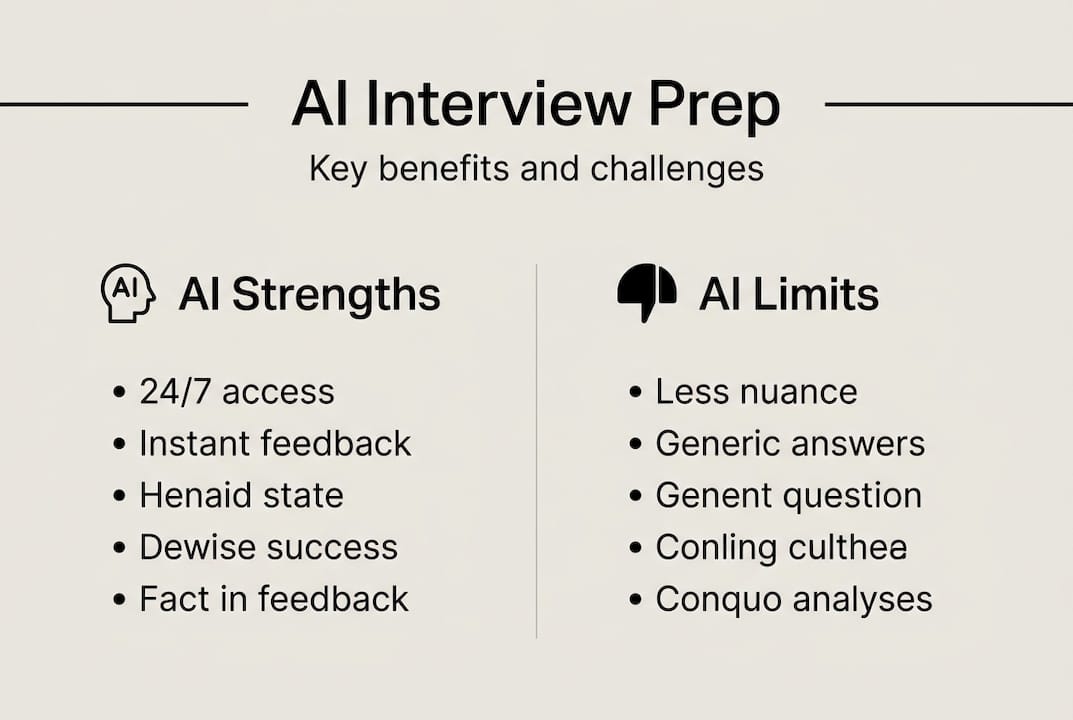
AI interview preparation offers distinct advantages and limitations that become clear when you examine both sides objectively. Understanding these tradeoffs helps you build a preparation strategy that leverages technology’s strengths while compensating for its weaknesses.
| AI interview prep pros | AI interview prep cons |
|---|---|
| Unlimited practice sessions anytime | Lacks emotional intelligence and warmth |
| Instant, data-driven feedback | May generate generic, impersonal responses |
| Objective performance scoring | Cannot assess cultural fit or soft skills |
| Scalable across multiple candidates | Risks creating robotic, over-rehearsed delivery |
| Consistent evaluation criteria | Misses subtle communication nuances |
Pros of AI include scalability and data-driven feedback; cons include lacking emotional nuance and risking generic answers that fail to showcase your unique personality and experiences. Human coaches bring irreplaceable value through their ability to assess warmth, read body language, and evaluate whether your communication style matches the company culture. They catch subtle issues like nervous habits, unclear explanations, or answers that technically address the question but miss the underlying intent.

The most effective preparation strategy combines AI’s volume and consistency with human insight and authenticity checks. Hybrid prep: AI for volume and feedback, humans for behavioral nuance and cultural fit; audit AI outputs for authenticity to ensure responses sound natural and genuine. This approach lets you practice extensively with AI while reserving human coaching sessions for high-value activities like final polish, company-specific preparation, and authenticity verification.
Pro Tip: Always read AI-generated answers aloud and ask yourself, “Would I actually say this in conversation?” If it sounds stiff or uses vocabulary you wouldn’t normally choose, rewrite it in your own voice before practicing.
Overreliance on AI creates a specific risk: candidates who memorize AI-generated responses often sound rehearsed and disconnected during actual interviews. Interviewers quickly detect when someone is reciting prepared scripts rather than thinking through answers authentically. This disconnect damages credibility and raises concerns about whether the candidate can think independently or adapt to unexpected situations.
Best practices for hybrid interview preparation include:
- Use AI tools for initial practice and identifying weak areas in your responses
- Schedule human coaching sessions after you’ve practiced extensively with AI
- Have a trusted peer or mentor evaluate whether your AI-polished answers sound authentic
- Focus AI practice on technical skills and structured questions; use humans for behavioral and cultural fit
- Record yourself practicing AI-suggested answers to catch robotic delivery patterns
- Treat AI feedback as a starting point for improvement, not the final word on quality
The AI-based coaching in interviews landscape continues evolving, with newer tools attempting to bridge the gap between technical feedback and human-like interaction. However, the fundamental limitation remains: AI cannot fully replicate the interpersonal dynamics of a real interview. Your preparation should reflect this reality by using AI for what it does best while ensuring human touchpoints validate your authenticity and cultural alignment.
Navigating AI limitations and edge cases in interview prep
AI systems have documented failure modes that can derail your interview preparation if you’re not aware of them. AI can miss edge cases and hallucinate answers; verbalizing edge cases in coding boosts performance by demonstrating thorough problem-solving skills that AI-generated solutions might overlook. Understanding these limitations helps you use AI tools strategically rather than blindly trusting their outputs.
Technical interviews expose AI’s weaknesses most clearly. When preparing for coding challenges, AI might generate solutions that work for standard inputs but fail on boundary conditions, null values, or unusual data structures. The system may confidently present incorrect algorithms or miss performance optimization opportunities that experienced engineers would catch immediately. This creates a dangerous scenario where you practice flawed approaches, ingraining bad habits that surface during actual interviews.
How to verbalize edge cases in coding interviews:
- State the standard case your solution handles, then immediately identify what could break it
- Walk through boundary conditions like empty inputs, single elements, or maximum size constraints
- Discuss data type edge cases such as negative numbers, zeros, or special characters
- Consider performance edge cases where input size or complexity could cause timeouts
- Mention error handling for invalid inputs or unexpected states
Over-polishing answers with AI creates subtle but significant problems:
- Responses become too formal and lose conversational flow that builds rapport
- You memorize perfect answers but struggle to adapt when questions change slightly
- Your delivery sounds rehearsed, triggering interviewer skepticism about authenticity
- AI-suggested vocabulary doesn’t match your natural speaking style, creating inconsistency
- You rely on memorization instead of developing genuine understanding of concepts
Preserving authenticity requires conscious effort when using AI-generated content. The goal is improvement, not transformation into someone you’re not. Your genuine experiences, personality, and communication style are assets that differentiate you from other candidates. AI should enhance these qualities, not replace them with generic, optimized responses that could come from anyone.
Use AI-generated outputs as test input generators rather than authoritative answer sources. For technical problems, AI can suggest diverse test cases and edge scenarios you should consider. For behavioral questions, it can propose answer structures and key points to cover. However, the actual content should come from your real experiences, expressed in your natural voice. This approach leverages AI’s pattern recognition while maintaining the authenticity that interviewers value.
Human review remains essential for catching AI oversights. Before finalizing any AI-assisted preparation, have someone with relevant experience evaluate your responses. They’ll identify technical errors, spot unnatural phrasing, and confirm that your answers actually address what interviewers want to know. This validation step prevents you from confidently presenting flawed information or sounding robotic during the actual interview.
The interview best practices tech jobs emphasize that technology should augment, not replace, critical thinking. When AI suggests an approach or answer, ask yourself why that recommendation makes sense. Understand the underlying principles rather than memorizing outputs. This deeper engagement ensures you can handle variations and unexpected questions that AI hasn’t specifically prepared you for.
Step-by-step guide to integrating AI tools into your interview prep
A structured approach to AI-assisted interview preparation maximizes effectiveness while avoiding common pitfalls. This framework guides you from tool selection through final rehearsal, ensuring each practice session builds toward interview success.
How to integrate AI tools into your interview preparation:
- Select an AI tool that matches your needs and budget, starting with free options like PrepPilot or LinkedIn’s practice features
- Conduct initial mock interviews to establish baseline performance and identify specific areas needing improvement
- Review AI feedback carefully, focusing on patterns rather than isolated comments, and prioritize high-impact improvements
- Practice revised answers multiple times, recording yourself to ensure delivery sounds natural and confident
- Schedule a human review session with a peer, mentor, or coach to validate authenticity and catch AI blind spots
- Conduct final rehearsals that simulate real interview conditions, including timing, environment, and stress levels
Free and premium options like PrepPilot, LinkedIn Warmup, Copilot, and Huru exist; start free and scale up if needed based on your preparation timeline and budget. Free tools provide solid foundational practice, while premium platforms offer advanced features like industry-specific questions, detailed performance analytics, and personalized coaching recommendations.
| Tool type | Key features | Best for | Typical cost |
|---|---|---|---|
| Free AI tools | Basic mock interviews, general feedback, common questions | Entry-level candidates, initial practice, budget-conscious prep | $0 |
| Mid-tier platforms | Industry-specific questions, performance tracking, video analysis | Experienced professionals, targeted preparation | $20-50/month |
| Premium coaching | AI plus human expert review, personalized strategy, unlimited practice | Senior roles, career transitions, comprehensive prep | $100-300/month |
| Enterprise solutions | Company-specific prep, advanced analytics, integration with recruiting | Corporate training programs, high-volume hiring | Custom pricing |
Essential considerations when using AI interview tools:
- Set realistic goals for each practice session rather than trying to perfect everything at once
- Track progress over time to identify improvements and persistent challenges
- Vary question types and difficulty to build adaptability rather than memorizing specific answers
- Practice under realistic conditions including time pressure and potential distractions
- Balance quantity and quality by ensuring each session includes reflection and refinement
- Schedule regular breaks to avoid burnout and maintain enthusiasm for preparation
Combining AI practice with human interaction creates the most effective preparation experience. Use AI tools for daily practice and skill building, then schedule periodic sessions with peers or coaches who can provide perspective that technology cannot. This hybrid model gives you volume and consistency from AI while ensuring your preparation stays grounded in authentic communication and interpersonal skills.
The iterative learning approach works best for interview preparation. Each practice session should identify specific areas for improvement, which you then address in subsequent sessions. AI tools excel at tracking this progression, showing you exactly how your performance evolves across content quality, delivery confidence, and response completeness. This data-driven feedback loop accelerates improvement by focusing effort where it matters most.
The stepwise interview preparation confident results methodology emphasizes consistent practice over marathon sessions. Twenty minutes daily produces better outcomes than occasional three-hour blocks because regular repetition builds muscle memory and reduces anxiety. AI tools make this daily practice feasible by eliminating scheduling friction and providing immediate feedback that keeps you engaged and motivated.
Explore Parakeet AI for smarter interview preparation
Now that you understand how to leverage AI effectively in your interview preparation, consider a platform designed specifically for this purpose. Parakeet AI combines real-time AI assistance with intelligent coaching features that help you prepare more efficiently and perform more confidently during actual interviews.
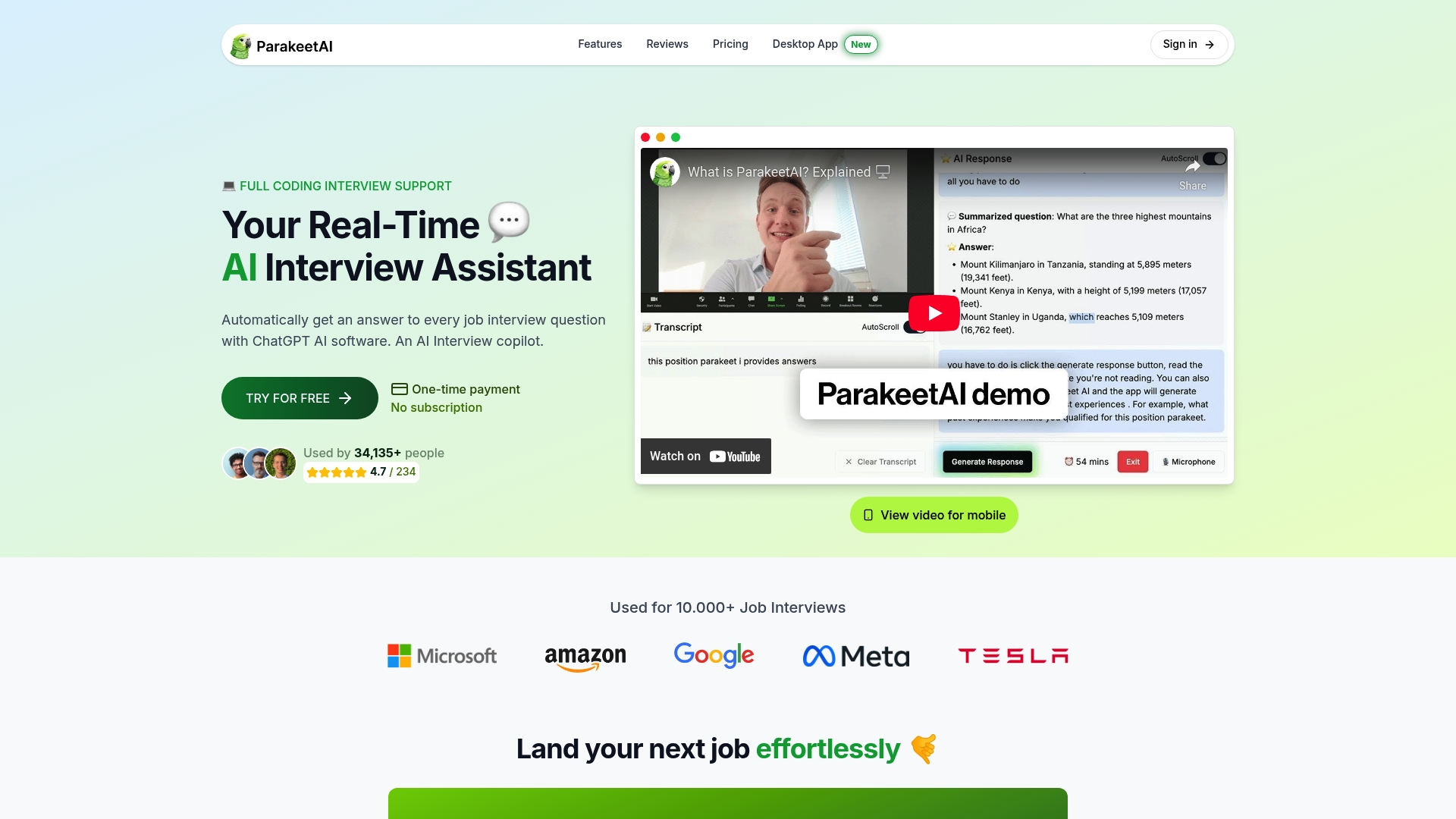
The Parakeet AI interview platform listens to your interview in real time and automatically provides answers to every question using AI. This seamless integration means you get support exactly when you need it, without fumbling through notes or trying to remember prepared responses. The platform offers tailored practice sessions that adapt to your industry, role, and experience level, ensuring every minute of preparation directly improves your interview performance. Whether you’re preparing for technical interviews, behavioral questions, or executive-level discussions, Parakeet AI provides the resources and feedback you need to succeed.
Frequently asked questions about AI interview guides
What are the best free AI tools for interview prep?
PrepPilot, LinkedIn’s AI interview warmup, and Microsoft Copilot offer solid free options with mock interviews and instant feedback. These platforms cover common interview questions across industries and provide basic performance scoring without requiring payment.
How can I avoid sounding robotic when using AI-generated answers?
Always rewrite AI suggestions in your own words and read them aloud to check for natural flow. Practice answers as conversations rather than memorized scripts, and have a friend listen to confirm you sound like yourself.
Is AI interview coaching effective for non-technical roles?
Yes, AI tools excel at preparing for behavioral questions, situational scenarios, and communication skills relevant to any role. The STAR method structuring and delivery feedback apply equally well to sales, management, and customer-facing positions.
Can AI help with preparing for behavioral interview questions?
AI tools analyze your STAR-formatted responses for completeness and impact, suggesting improvements to make your examples more compelling. They identify missing components and help you articulate results more clearly, though human review ensures authenticity.
How often should I practice with AI tools before the real interview?
Daily 20-minute sessions for two weeks before your interview build confidence and fluency without causing burnout. Increase frequency to twice daily in the final three days, focusing on your weakest areas and most likely questions.