
How to Prepare for Technical Interviews: A Step-by-Step AI Guide

TL;DR:Technical interviews challenge even strong engineers to perform under stress and explain their thinking clearly. Preparing with a structured plan, diverse resources, and realistic simulations enhances confidence and reduces scattered efforts. Using AI tools thoughtfully as feedback sources and engaging actively with problem-solving and communication practice leads to more effective interview readiness.
Technical interviews are notorious for catching even strong engineers off guard. The pressure isn’t always about knowing less than other candidates — it’s about performing under stress, structuring your thinking clearly, and getting almost zero feedback until it’s over. This guide walks you through exactly how to prepare step by step, from understanding the interview formats you’ll face to using AI tools wisely so you build real skills instead of a false sense of readiness. If your past prep has felt scattered or your mock sessions haven’t translated into actual confidence, this is where that changes.
Table of Contents
- Understand the technical interview landscape
- Gather your resources and set your plan
- Practice effectively: Coding, communication, and feedback
- Avoid common pitfalls in technical interview preparation
- What most guides miss about technical interview prep with AI
- Ready to accelerate your technical interview prep?
- Frequently asked questions
Key Takeaways
| Point | Details |
|---|---|
| Know the interview format | Understand what kinds of questions and skills companies assess before you start prepping. |
| Strategize your prep | Gather the right resources, set a schedule, and use AI tools as a supplement. |
| Practice actively with feedback | Solve questions under time limits, communicate clearly, and review AI-driven feedback critically. |
| Avoid over-relying on AI | Use AI to simulate and get suggestions but always verify and adapt its outputs with your own reasoning. |
| Focus on self-reflection | Refine your approach by constantly reflecting and adapting based on feedback, both from AI and your own insights. |
Understand the technical interview landscape
Now that you know why a thoughtful approach matters, let’s clarify exactly what you’ll be facing in your next technical interview.
Technical interviews aren’t one-size-fits-all. Depending on the company, role, and seniority level, you could face anything from a 30-minute live coding session to a multi-hour system design conversation. Understanding the landscape before you start practicing is one of the highest-leverage things you can do.
Here’s a breakdown of the most common formats:
| Interview type | What’s assessed | Typical format |
|---|---|---|
| Live coding challenge | Problem solving, coding accuracy, speed | Screen share with IDE or coding platform |
| System design | Architecture thinking, scalability | Open-ended whiteboard discussion |
| Take-home assignment | Code quality, documentation, judgment | Submitted project within 24-72 hours |
| Behavioral round | Communication, teamwork, conflict resolution | Structured or conversational Q&A |
| Debugging exercise | Analytical thinking, familiarity with tools | Bug-laden codebase you must fix |
The skills being evaluated across these formats cluster around three core areas: raw coding ability, algorithmic reasoning, and communication. Companies want to see not just that you solved the problem, but that you can explain your approach, ask smart clarifying questions, and recognize the trade-offs in your solution.
Common technical interview prep basics mistakes happen because candidates prepare for only one format. Someone who drills LeetCode problems religiously may freeze in a system design conversation. Someone who excels at system design may panic when asked to write code on a whiteboard without autocomplete.
It’s also worth knowing that assessments aren’t perfect predictors of real-world performance. Research confirms that coding benchmarks have reliability constraints — meaning a single poor performance on a timed coding test doesn’t reflect your full capability as an engineer. Companies use these assessments because they’re scalable, not because they’re flawless. Knowing this should reframe your mindset: your job is to perform consistently well within an imperfect system, not to achieve some idealized score.
“The interview process is a game with specific rules. Understanding those rules isn’t gaming the system — it’s being a smart competitor.” — An insight shared by countless senior engineers who’ve sat on both sides of the table.
Gather your resources and set your plan
Having understood what’s ahead, the next step is equipping yourself with the right tools and a clear plan.
Scattered preparation is the enemy of real progress. Spending an hour browsing YouTube tutorials and another 30 minutes halfheartedly solving a LeetCode problem you’ve already seen is not preparation. It’s the illusion of preparation. A structured, resource-aware approach makes every hour you invest count.
Essential tools you’ll need:
- A laptop with a reliable internet connection (obvious, but interruptions cost you focus)
- A code editor you’re genuinely comfortable in (VS Code, IntelliJ, or whichever suits your stack)
- A video platform for mock interviews (Zoom, Google Meet, or a dedicated platform like Pramp)
- A note-taking system for logging feedback, patterns, and things to revisit
- An AI assistant for simulation, explanation, and rapid feedback
Here’s how the major resource categories stack up:
| Resource type | Strength | Limitation |
|---|---|---|
| Books (e.g., CTCI, Elements of Programming Interviews) | Deep explanations, structured curriculum | Slower-paced, no real-time feedback |
| Online platforms (LeetCode, HackerRank) | Large problem bank, timed practice | No communication skill practice |
| AI tutors and tools | Instant feedback, personalized coaching | Outputs need verification |
| Mock interview platforms (Pramp, Interviewing.io) | Real human feedback, realistic conditions | Harder to schedule, variable quality |
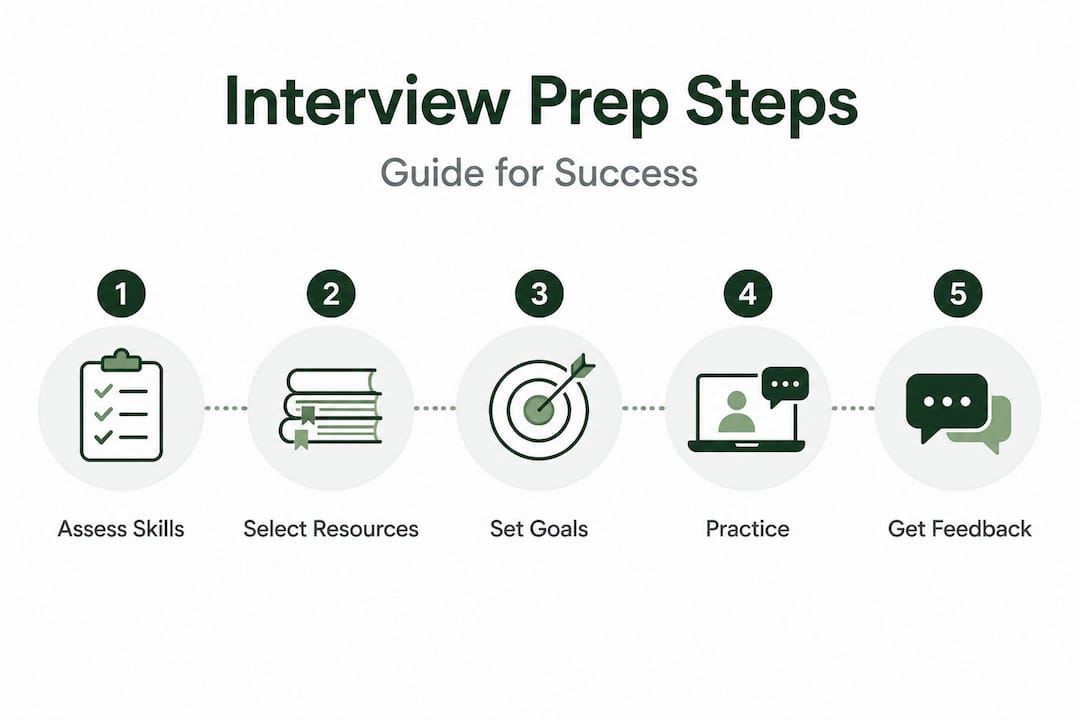
Use a combination. No single resource covers everything. Following a stepwise preparation plan means you sequence these resources intentionally rather than hopping between them randomly.

Set SMART goals for your prep timeline. Specific: “I will complete 50 medium difficulty arrays and strings problems.” Measurable: track completion and error rate. Achievable: realistic given your schedule. Relevant: tied to the actual formats your target companies use. Time-bound: scheduled to finish two weeks before your interview date.
Pro Tip: When using AI tools to simulate mock interviews, treat every answer they give you as a starting point for your own thinking, not a final answer. A strong AI-powered prep guide will always encourage you to reason through the problem yourself before checking AI suggestions. Research specifically notes that AI outputs are suggestions to be verified with your own logic, not accepted wholesale.
Practice effectively: Coding, communication, and feedback
With your plan in place, it’s time to jump into hands-on practice and feedback loops.
Effective practice looks very different from passive practice. Reading through solutions doesn’t build the same muscle as solving problems yourself under pressure, explaining your reasoning out loud, and reviewing what went wrong. Here’s how to practice with intention:
- Select problems strategically. Don’t just solve random problems. Map the problem categories (arrays, graphs, dynamic programming, trees) to the actual patterns your target companies are known to test. Sites like Glassdoor and Blind give real interview question examples.
- Code under time pressure from day one. Set a timer. 20 to 30 minutes per medium problem. This trains your brain to manage stress, move forward even when uncertain, and avoid spending 45 minutes perfecting a solution that doesn’t even work yet.
- Talk through your solution while you code. This is the single most underrated practice habit. Interviewers want to hear how you think, not just what you type. Record yourself if you don’t have a practice partner. Listen back. You’ll notice where your explanation breaks down or sounds vague.
- Review solutions critically, even when you get it right. Was your solution optimal? Could you reduce space complexity? Could you explain the trade-offs clearly? Getting the right answer isn’t the finish line — understanding the reasoning is.
- Use AI as a mock interviewer. Feed it a problem and ask it to evaluate your approach. Then, critically, push back on its feedback. Ask why. Propose alternative solutions. AI for interview practice works best as a conversation partner, not an oracle.
- Log every session. Write down what you struggled with, what feedback you got, and what you’ll focus on next time. This feedback loop is where real improvement happens.
Communicating during interviews trips up many technically strong candidates. Clarifying requirements before diving in shows maturity. Asking “Should I optimize for speed or memory?” signals systems thinking. Narrating your thought process, even when you’re unsure, keeps the interviewer engaged and gives them something to evaluate beyond your final answer.
Research confirms you should treat AI evaluation as a suggestion, not a final measure of your readiness. AI mock sessions are valuable precisely because they’re repeatable and low-stakes. Use that to your advantage.
Following technical interview best practices consistently across dozens of sessions is how you build the kind of calm, structured performance that interviewers notice and remember.
Pro Tip: Keep a running log of every mock session. Note the problem, your approach, where you got stuck, what feedback you received, and what you’ll adjust next time. Candidates who iterate on feedback improve dramatically faster than those who just accumulate practice hours.
Avoid common pitfalls in technical interview preparation
Even with good tools and habits, some traps are easy to fall into — here’s how to sidestep the most common ones.
Most preparation failures aren’t about a lack of effort. They’re about misallocated effort. Here are the pitfalls that derail even motivated candidates:
- Blindly accepting AI evaluations. AI tools can score your solution, suggest improvements, and point out edge cases. But they can also be wrong, or assess you on criteria that don’t match your target company’s expectations. Always think critically about what the AI is telling you and why. The advantages of AI interview tools are real, but so are their limitations.
- Skipping behavioral prep entirely. Many candidates spend 95% of their time on coding and zero time preparing for behavioral questions. Most technical interviews include at least one behavioral round, and failing it — even with a perfect coding performance — can cost you the offer. Practice the STAR method (Situation, Task, Action, Result) for common scenarios.
- Not simulating real interview conditions. Practicing problems on your couch with music on and your phone nearby is not the same as sitting in a quiet room, screen sharing with a stranger, and thinking aloud. Simulate the actual conditions. Dress the part if it helps. Use a camera. Feel the pressure before it’s real.
- Ignoring time management inside the interview. Many candidates spend 20 minutes on a brute-force approach and run out of time before they can optimize. Practice allocating roughly the first 5 minutes to understanding the problem, the next 15 to an initial solution, and any remaining time to optimization.
- Using only one type of resource. As noted above, books alone, or LeetCode alone, or AI alone will each leave gaps. Combine them deliberately.
Critical reminder: Research warns that users must calibrate and verify AI outputs themselves, since benchmark scores and AI-generated evaluations don’t always translate accurately to real interview performance. Treat AI feedback as one data point among many, not as ground truth.
What most guides miss about technical interview prep with AI
Most technical interview prep guides spend their energy telling you what to do: solve more problems, practice more, use AI tools. Far fewer guides ask the harder question — how you’re engaging with that practice. And that’s where the real gap lives.
AI tools are genuinely useful. They can simulate interviewers, explain complex algorithms, and give you instant feedback at 2 a.m. when no human practice partner is available. But here’s the uncomfortable truth: candidates who use AI the most aren’t automatically the ones who improve the most. The ones who improve fastest are the ones who use AI as a mirror, not a crutch.
When an AI tells you your solution is correct, do you move on? Or do you ask it why your solution works, what edge cases it might miss, and whether there’s a more elegant approach? That extra layer of questioning is where learning actually happens. It’s also the layer that most people skip because it’s slower and less satisfying than getting a green checkmark.
Building confidence with AI tools requires self-awareness. You need to recognize when AI feedback is genuinely improving your thinking and when it’s giving you the illusion of improvement. An AI that evaluates your code highly might be missing the fact that you couldn’t explain your solution aloud, or that you used a built-in library function without understanding what’s happening under the hood.
Solid research reinforces this point: AI should supplement your reasoning, not substitute it. That means asking harder questions after every practice session. Not just “Did I get it right?” but “Do I understand this deeply enough to explain it to a skeptical interviewer?” and “Would I have reached this solution on my own without hints?”
Real interview readiness isn’t a score on a prep platform. It’s the feeling of sitting in a live interview, encountering a problem you haven’t seen before, and trusting your own thinking process enough to work through it calmly and clearly. AI can get you partway there. Your critical engagement with that AI feedback takes you the rest of the way.
Ready to accelerate your technical interview prep?
If you want personalized, actionable feedback and a smarter prep process, take the next step below.
You’ve worked through the full framework: understanding what to expect, building a resource plan, practicing with real feedback loops, and avoiding the traps that slow most candidates down. Now imagine having an AI assistant that listens to your actual interview in real time and surfaces relevant, structured answers as each question is asked.
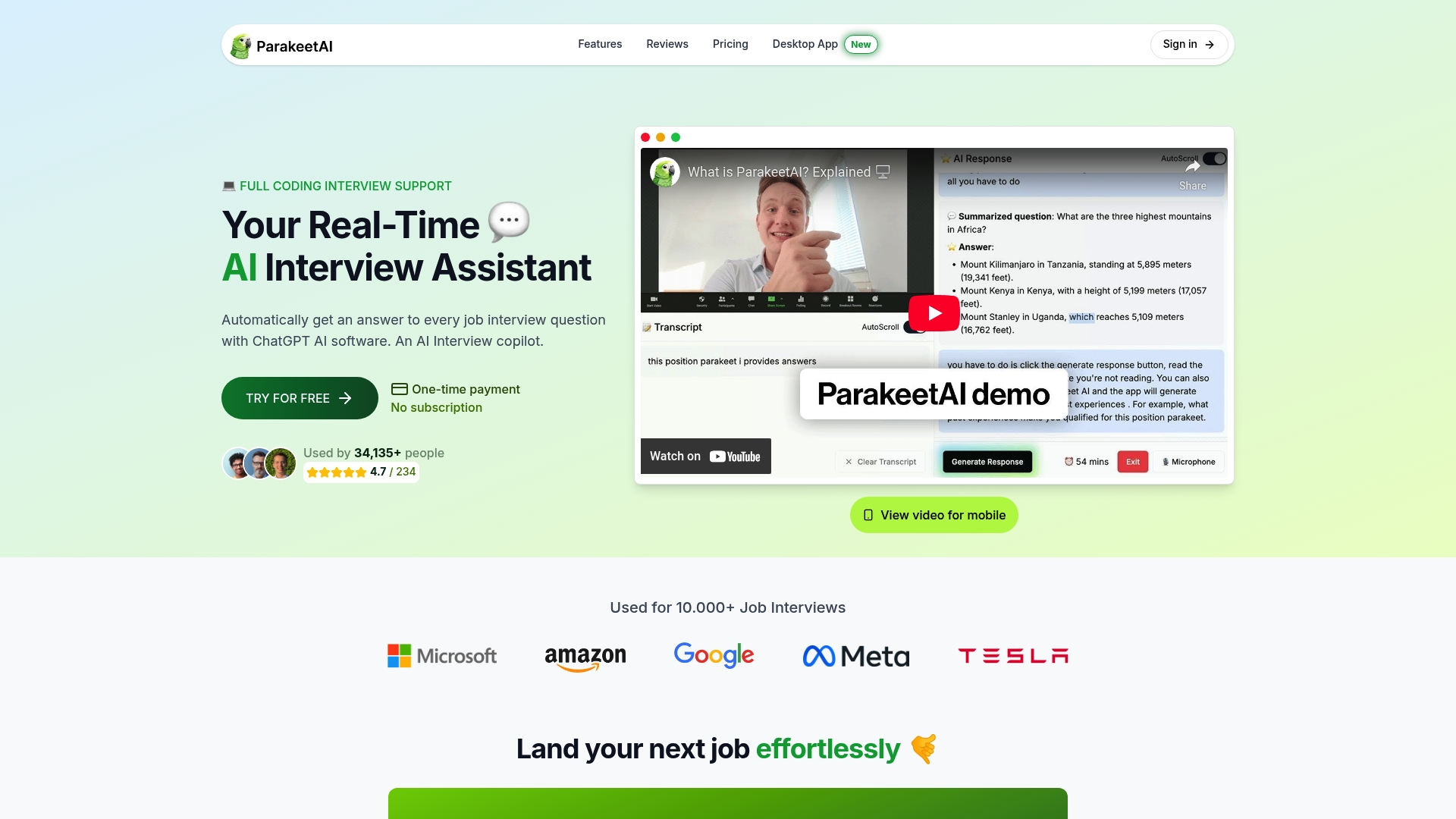
That’s exactly what Parakeet AI is built for. Whether you’re walking into a live coding challenge, a system design session, or a high-pressure behavioral round, Parakeet AI works alongside you to give you context-aware support when you need it most. It’s not about having the answers handed to you — it’s about having a smart, real-time partner that helps you stay structured and confident. Start your smarter prep process with Parakeet AI today and turn your preparation into performance.
Frequently asked questions
How much time should I spend preparing for a technical interview?
Most candidates benefit from 2 to 4 weeks of focused preparation, adjusting the timeline based on skill gaps and the specific formats your target companies use.
Are AI tools reliable for technical interview practice?
AI tools provide valuable simulation and feedback, but their evaluations must always be verified with your own reasoning — benchmark scores can mislead if taken at face value without critical assessment.
What is the biggest mistake when using AI for interview prep?
Accepting AI outputs without verifying or adapting them is the most common pitfall; always calibrate AI outputs yourself to match your actual problem-solving approach and reasoning style.
How can I improve communication skills for interviews?
Practice explaining your solutions out loud during every mock session and actively seek feedback on clarity, structure, and how confidently you walk through your reasoning process.