
Engineering manager behavioral interview questions: stand out

TL;DR:Behavioral interviews for engineering managers focus on leadership and organizational impact rather than technical skills. Effective responses utilize the STAR or STAR-L frameworks to showcase real situations, actions, results, and key lessons learned. Preparation with versatile stories and honest reflection enhances chances of demonstrating senior-level leadership qualities successfully.
Most engineering managers walk into behavioral interviews confident in their technical depth, only to stumble when asked to describe a time they navigated a high-stakes team conflict or led a struggling project back from the edge. The real differentiator is not your technical knowledge. Structured responses using STAR highlight leadership, not just coding, and top hiring panels want evidence of how you think, coach, and drive organizational change. This guide gives you the exact question types, answer frameworks, and preparation strategies you need to turn behavioral interviews into your strongest asset.
Table of Contents
- Understanding behavioral interview questions for engineering managers
- Core behavioral question types and what they reveal
- Mastering your answers with the STAR and STAR-L frameworks
- Sample behavioral interview questions and strong answers
- Why behavioral interviews test more than just leadership
- Your next step: Practice and refine with ParakeetAI
- Frequently asked questions
Key Takeaways
| Point | Details |
|---|---|
| Showcase leadership impact | Interviewers want to see how you lead teams, drive change, and deliver results organization-wide. |
| Use STAR/STAR-L methods | Structure every answer with Situation, Task, Action, Result, and your Learnings for maximum clarity. |
| Prepare quantifiable examples | Cite measurable outcomes to prove your effectiveness as an engineering manager. |
| Practice for probing follow-ups | Be ready for deeper questions that test your adaptability and continuous learning. |
Understanding behavioral interview questions for engineering managers
Behavioral interview questions are not about hypotheticals. They ask for real events from your past because past behavior is the single best predictor of future performance. For engineering managers, this distinction matters enormously. You are not being evaluated for your debugging skills or your architecture knowledge. You are being evaluated for how you lead people through ambiguity, conflict, and pressure.
“Behavioral questions are designed to reveal leadership and organizational impact, not just coding skills.”
What does that mean in practice? It means interviewers are listening for specific signals in your answers: how you communicate expectations, how you resolve friction between team members, how you align engineering work with business goals, and how you scale a team’s capacity without burning people out.
Common engineering manager interview scenarios span a wide range of leadership situations. Here are the most frequent areas interviewers probe:
- Motivating an underperforming team member or reviving team morale during a difficult quarter
- Handling competing priorities between product, engineering, and stakeholders
- Managing a project that missed its deadline and communicating that failure upward
- Coaching a strong individual contributor toward a leadership track
- Aligning distributed or cross-functional teams on a shared technical vision
Notice that none of these require you to write a single line of code. Effective collaboration strategies in software projects are exactly what interviewers are trying to assess. They want to know whether you can work across disciplines, manage upward and downward simultaneously, and keep quality high without micromanaging.
The confusion many managers make is spending 90% of their preparation on system design and coding rounds, then winging the behavioral portion. That is a costly mistake. Behavioral rounds often carry equal or greater weight in final hiring decisions at senior levels, especially at organizations where culture fit and leadership maturity define the offer.
Core behavioral question types and what they reveal
Having established the focus, let’s break down behavioral questions into categories and what each reveals about your leadership.
Interviewers do not ask random questions. There is a deliberate structure behind the question types, and each one surfaces a different dimension of your leadership style. Understanding the intent behind each category lets you prepare the right stories instead of scrambling during the interview.
| Question type | What it reveals | Sample question |
|---|---|---|
| Conflict resolution | How you manage interpersonal tension and defend decisions | “Describe a disagreement you had with a peer manager.” |
| Coaching and mentoring | How you develop talent and handle underperformers | “Tell me about a time you turned around a struggling engineer.” |
| Driving results | How you deliver under pressure and hold teams accountable | “Describe a time you shipped a critical feature under a tight deadline.” |
| Managing ambiguity | How you lead when the path forward is unclear | “Tell me about a time when priorities shifted without warning.” |
| Scaling teams | How you build systems and processes as organizations grow | “How have you expanded your team’s capacity while keeping quality high?” |
Leadership, quantifiable outcomes, and organizational impact are central to all structured responses in these categories. Interviewers are not satisfied with process descriptions. They want to hear numbers, scope, and organizational reach.

Here is what many managers overlook: every question type above invites follow-up probing. If you say your team improved delivery speed, the interviewer will ask how much and how you measured it. If you describe resolving a conflict, they will ask what you would do differently. Prepare for second and third layers to every story.
A few key behaviors to demonstrate across all question types:
- Taking ownership of outcomes, not just credit for wins
- Naming specific stakeholders you influenced and how
- Calling out your own mistakes with honesty and self-awareness
- Linking your actions to business goals, not just team goals
For remote leadership strategies, the same principles apply but require additional emphasis on communication, visibility, and asynchronous collaboration. If you have managed remote or distributed teams, those stories often resonate strongly with modern hiring panels.
Pro Tip: Prepare five to seven core stories that each span multiple question types. A story about a painful project failure can address managing ambiguity, driving results under pressure, stakeholder communication, and personal growth all at once. Versatile stories save preparation time and give you flexibility during the interview.
Mastering your answers with the STAR and STAR-L frameworks
Once you know the question type, here is how to construct answers that set you apart using proven frameworks.
The STAR method is a widely used structure: Situation, Task, Action, Result. It gives your answer a clear beginning, middle, and end. But for engineering managers at senior levels, STAR alone often falls short because it stops at outcomes and misses the reflective layer that hiring panels at top companies actively look for.
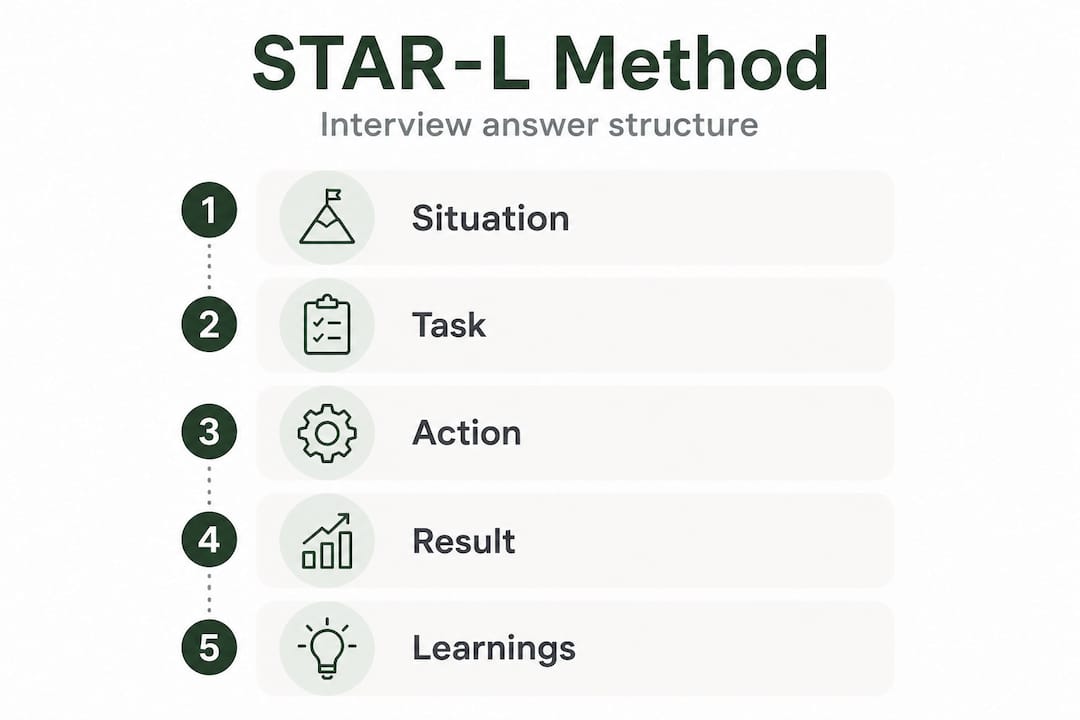
That is where STAR-L comes in. The STAR-L method adds “Learnings” to the traditional framework, helping candidates surface lessons from their leadership experiences. This addition is not cosmetic. It signals to interviewers that you operate with a growth mindset and can extract transferable insight from both wins and failures.
| Framework stage | Engineering manager focus | Example content |
|---|---|---|
| Situation | Set organizational context | “Our team of 12 engineers was six weeks from a major product launch…” |
| Task | Clarify your specific leadership responsibility | “I was responsible for aligning backend and frontend delivery timelines…” |
| Action | Emphasize your decisions, not team actions | “I introduced a daily sync, reassigned two engineers to critical path work…” |
| Result | Quantify outcomes and organizational impact | “We shipped on time, reduced P1 bugs by 40%, and the product hit 200K users…” |
| Learnings | Reflect on what you took away | “I learned that timeline risk surfaces earlier in planning if I ask ‘what could go wrong’ explicitly…” |
Here is a step-by-step guide to mastering the STAR method for engineering manager roles:
- Choose a story with organizational reach. Stories that affected one person are weak. Stories that affected a team, a product, or a business metric are strong.
- Set the situation quickly. Give just enough context for the interviewer to understand what was at stake. Two to three sentences maximum.
- Own the task. Do not blur your role with the team’s role. Use “I” not “we” when describing your specific accountability.
- Make your actions specific and deliberate. Describe the decisions you made, the trade-offs you considered, and why you chose a particular path. This is where leadership is revealed.
- Anchor the result in a metric. “The team improved” is weak. “Deployment frequency increased by 35% over the following quarter” is strong.
- Add your learning last. One to two sentences on what you now do differently. This shows maturity and intellectual honesty.
A common mistake engineering managers make in the Action stage is defaulting to “we” language: “We decided to restructure the sprint planning process.” The interviewer wants to know your role in that decision. Did you propose it? Did you face resistance? How did you bring the team along? Own your leadership explicitly.
Pro Tip: Time your STAR-L answers. Aim for two to three minutes per answer. Longer answers risk losing focus; shorter answers often lack the depth needed to demonstrate impact at a senior level. Practice out loud, not just in your head.
Sample behavioral interview questions and strong answers
With solid frameworks in hand, let’s apply them to sample questions and showcase what strong, leadership-focused answers look like.
Below are representative behavioral questions for engineering managers, with notes on what strong answers include. Review these as a study guide, not a script.
Question 1: “Tell me about a time you had to give critical feedback to a senior engineer.”
Strong answers here address:
- Why the feedback was necessary and what was at risk if you stayed silent
- How you prepared for the conversation and chose the right timing and setting
- The specific words and framing you used to deliver the feedback constructively
- The engineer’s reaction and what happened over the next few weeks
- What you learned about delivering feedback to high-performers specifically
Strong answers focus on leadership actions and quantifiable outcomes, not just the emotional narrative of the conversation.
Question 2: “Describe a time you scaled a process to support team growth.”
Look for additional manager interview examples across a range of themes, but for scaling questions, strong answers should include:
- The original process and why it started breaking as the team grew
- The specific redesign decisions you made, including trade-offs you rejected
- How you got buy-in from skeptical team members or stakeholders
- The measured impact: onboarding time, incident rates, delivery predictability, team satisfaction scores
Question 3: “Tell me about a time your team missed an important deadline.”
This is a favorite because it tests honesty, accountability, and problem-solving under pressure. Weak answers blame external factors exclusively. Strong answers:
- Acknowledge your own missteps in planning or risk identification early
- Describe how you communicated the miss to leadership before it became a surprise
- Explain what short-term fixes you implemented and what systemic changes followed
- Quantify the recovery: “We recovered 80% of lost ground within the next sprint cycle.”
Common mistakes to avoid across all your answers:
- Telling stories where you were the lone hero and the team was passive
- Describing fictional or vague situations rather than real, specific events
- Focusing on how hard the situation was emotionally rather than what you did about it
- Skipping the learning or treating the result as self-evidently positive without evidence
Understanding qualities of a successful Scrum Master can also inform how you frame answers about process facilitation and team enablement. Strong managers often borrow servant-leadership principles when articulating how they create conditions for team success.
Why behavioral interviews test more than just leadership
Now that we have explored questions, answers, and expert techniques, let’s step back and reconsider what behavioral interviews are truly assessing and why.
Here is the perspective most interview prep guides miss: behavioral interviews are not memory tests. They are not asking you to recall your greatest hits as a manager. They are stress tests for how you think. The interviewer is watching how you organize information under mild pressure, how honestly you represent failures, and whether you show genuine reflection or polished spin.
Most managers prepare by rehearsing their stories until the answers sound polished. That is not a bad instinct, but it creates a problem. Over-rehearsed answers sound like marketing, not leadership. Interviewers at senior levels have heard thousands of these stories. They can tell the difference between a manager who actually wrestled with a hard situation and one who packaged a convenient narrative.
The most overlooked dimension of behavioral interviews is humility in failure. When you describe a project that struggled or a feedback conversation that went badly at first, the quality of your reflection reveals more than the outcome does. Did you diagnose the real root cause or the comfortable one? Did you change your behavior afterward or just adapt the story?
We have observed through the lens of interview coaching that candidates who include genuine uncertainty in their answers, moments where they are clear they did not have the answer immediately, consistently outperform those who present themselves as decisive and infallible at every step. Real leadership includes not knowing. Hiring managers trust people who know what they do not know.
Explore engineering interview deep-dives to see this principle applied across different role levels. The pattern holds: the more senior the role, the more interviewers value self-aware reflection over curated confidence.
Behavioral interviews also test organizational awareness. Can you describe your decisions in the context of the company’s goals at the time? Can you explain how your team’s work connected to revenue, retention, or product strategy? Managers who anchor their stories in business context stand out because they signal that their thinking operates at a company level, not just a team level.
Your next step: Practice and refine with ParakeetAI
Knowing the question types and frameworks is one thing. Executing them smoothly under real interview pressure is another entirely.
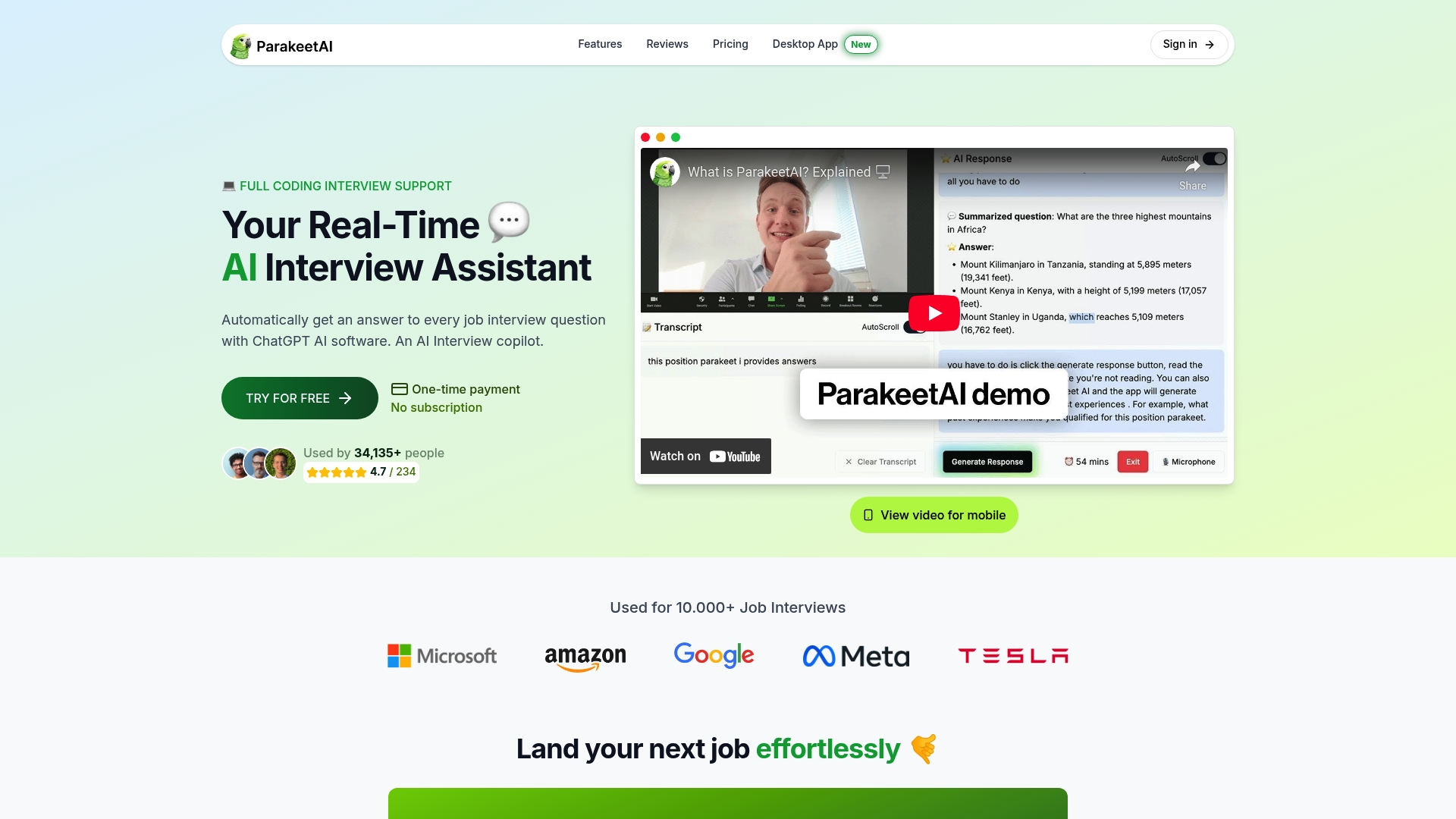
ParakeetAI is a real-time AI job interview assistant that listens to your live interview and automatically surfaces targeted answers to every question as it happens. For engineering managers preparing behavioral rounds, this means you get instant, relevant prompts when questions about team conflict, performance management, or scaling come your way. You can also use ParakeetAI’s mock interview tools to rehearse your STAR-L stories, stress test your answers, and refine your delivery before the real conversation. Stop preparing alone with static question lists. Practice smarter with an AI coach that responds to what you actually say.
Frequently asked questions
What are the most common behavioral interview questions for engineering managers?
Expect questions about handling team conflicts, driving organizational change, mentoring struggling engineers, and recovering from missed deadlines. Behavioral questions for engineering managers focus on leadership actions and measurable impact, not technical execution.
How can I structure my answers for behavioral interview questions?
Use the STAR or STAR-L method: describe the Situation, Task, Action, Result, and what you Learned. STAR-L structured responses are especially effective for senior engineering manager roles because the Learnings stage signals growth mindset and maturity.
How can I show organizational impact in my answers?
Quantify your results, describe how your leadership decisions scaled across multiple teams, and connect your actions to business metrics. Quantifiable outcomes and organization-wide scaling in your answers signal senior-level thinking.
Are leadership or technical answers more important in behavioral interviews?
Leadership-focused answers with measurable results are consistently prioritized over technical detail in behavioral rounds. Emphasizing leadership actions over individual coding is the key differentiator at the engineering manager level.