
Interview checklist for employers: hire better in 2026

Over 60% of candidates report negative experiences with disorganized interviews, directly impacting your employer brand and ability to secure top talent. An interview checklist transforms chaotic hiring into a strategic advantage by standardizing questions, reducing bias, and improving evaluation consistency. This guide walks you through building and implementing an effective interview checklist that elevates your 2026 hiring outcomes.
Table of Contents
- Introduction To Interview Checklists
- Pre-Interview Preparation For Employers
- Structuring The Interview Process
- Reducing Bias Through Checklists And Training
- Effective Question Types And Candidate Evaluation
- Post-Interview Follow-Up And Decision Making
- Leveraging Technology In Interviewing
- Common Misconceptions About Interviewing
- Conclusion And Action Steps For Employers
- Enhance Your Hiring With Parakeet AI
- Frequently Asked Questions
Key takeaways
| Point | Details |
|---|---|
| Standardized checklists reduce bias | Using structured interview tools decreases unconscious bias by 30%, leading to fairer hiring decisions. |
| Structured interviews predict success better | Structured interviews show 24% higher predictive validity compared to unstructured formats. |
| Training improves objectivity | Interviewers trained in bias awareness reduce discriminatory decisions by 25%. |
| Scorecards enhance consistency | Interview scorecards improve hiring consistency by 35% through quantitative candidate comparison. |
| AI streamlines evaluation | AI-driven tools reduce evaluation time by 25% while maintaining assessment quality. |
Introduction to interview checklists
An interview checklist is a standardized framework that guides employers through every stage of the hiring process, from pre-interview preparation to post-interview follow-up. It ensures consistent question delivery, uniform evaluation criteria, and systematic documentation across all candidates.
Your hiring process faces three persistent challenges: unconscious bias creeping into decisions, inconsistent evaluation methods across interview panels, and poor candidate experiences damaging your employer reputation. Interview checklists directly address these pain points by creating transparent, repeatable processes that every interviewer follows.
Organizations implementing structured checklists report more strategic hiring decisions and improved quality of hire metrics. The framework removes guesswork and replaces it with evidence-based assessment methods. Key components include:
- Pre-defined behavioral and situational questions aligned to job competencies
- Standardized rating scales for objective candidate comparison
- Clear interview stages with allocated time blocks
- Bias mitigation protocols and interviewer training requirements
- Documentation templates for consistent record keeping
Checklists transform your interviews from subjective conversations into data-driven evaluations that predict job performance accurately.
Pre-interview preparation for employers
Thorough preparation separates successful hiring outcomes from mediocre ones. Before any candidate walks through your door or joins a video call, complete these essential steps to create a professional, organized interview environment.
- Develop a detailed interview agenda specifying each segment’s purpose and duration, typically allocating 5 minutes for introductions, 30-40 minutes for questions, and 5-10 minutes for candidate questions.
- Send confirmation emails 48 hours before interviews containing meeting links, parking information, interviewer names, and expected duration.
- Schedule mandatory bias recognition training for all interview panel members, covering common cognitive biases like halo effect, confirmation bias, and similarity attraction.
- Distribute standardized question sets and evaluation rubrics to panelists at least 24 hours beforehand, ensuring everyone understands scoring criteria.
- Require interviewers to review candidate resumes, portfolios, and application materials 30 minutes before scheduled interviews.
- Prepare a backup technology plan for virtual interviews including alternative meeting platforms and phone numbers.
This preparation level signals professionalism to candidates while equipping your team with tools for objective assessment. Implementing interview process best practices with AI can automate many preparation tasks, reducing administrative burden on HR teams.

Pro Tip: Create a digital pre-interview checklist template that automatically generates customized agendas and sends candidate confirmations, saving 3-4 hours per hiring cycle.
Structuring the interview process
Structured interviews outperform unstructured formats by significant margins. Research demonstrates that unstructured interviews have 24% lower predictive validity than their structured counterparts, making your hiring decisions substantially less accurate without proper framework.
A well-structured interview uses identical core questions for all candidates in the same role, enabling direct performance comparison. This consistency eliminates the natural human tendency to ask follow-up questions based on personal interest rather than job relevance.
Behavioral questions asking candidates to describe past experiences reveal actual competencies better than hypothetical scenarios. Situational questions testing problem-solving approaches complement behavioral inquiries by assessing adaptive thinking. Together, these question types predict job performance with remarkable accuracy.
| Interview Type | Predictive Validity | Consistency | Bias Risk |
|---|---|---|---|
| Structured | High (76%) | Very High | Low |
| Semi-structured | Moderate (52%) | Moderate | Moderate |
| Unstructured | Low (38%) | Low | High |
Consistent timing reduces candidate anxiety and prevents interviewers from spending disproportionate time on favored candidates. Allocate equal question time across all interviews, typically 3-5 minutes per major question.
Clear agendas shared beforehand help candidates prepare thoughtful responses, improving the quality of information you gather. Key structural elements include:
- Opening rapport-building segment (5 minutes maximum)
- Core competency questions in predetermined order
- Consistent follow-up probing for incomplete answers
- Candidate question period at the identical interview stage
- Defined closing statements about next steps
Pro Tip: Record virtual interviews (with consent) so panel members can review responses when completing scorecards, improving evaluation accuracy by 15-20%.
Reducing bias through checklists and training
Unconscious bias represents the single largest threat to fair hiring decisions. Your brain processes 11 million bits of information per second but only 40 consciously, meaning 99.999% of your decision-making happens below awareness.
Interview checklists combat this neurological reality through systematic standardization. Using an interview checklist reduces unconscious bias risk by 30%, leading to demonstrably fairer hiring outcomes. When every candidate answers identical questions scored against uniform criteria, subjective preferences carry less weight.
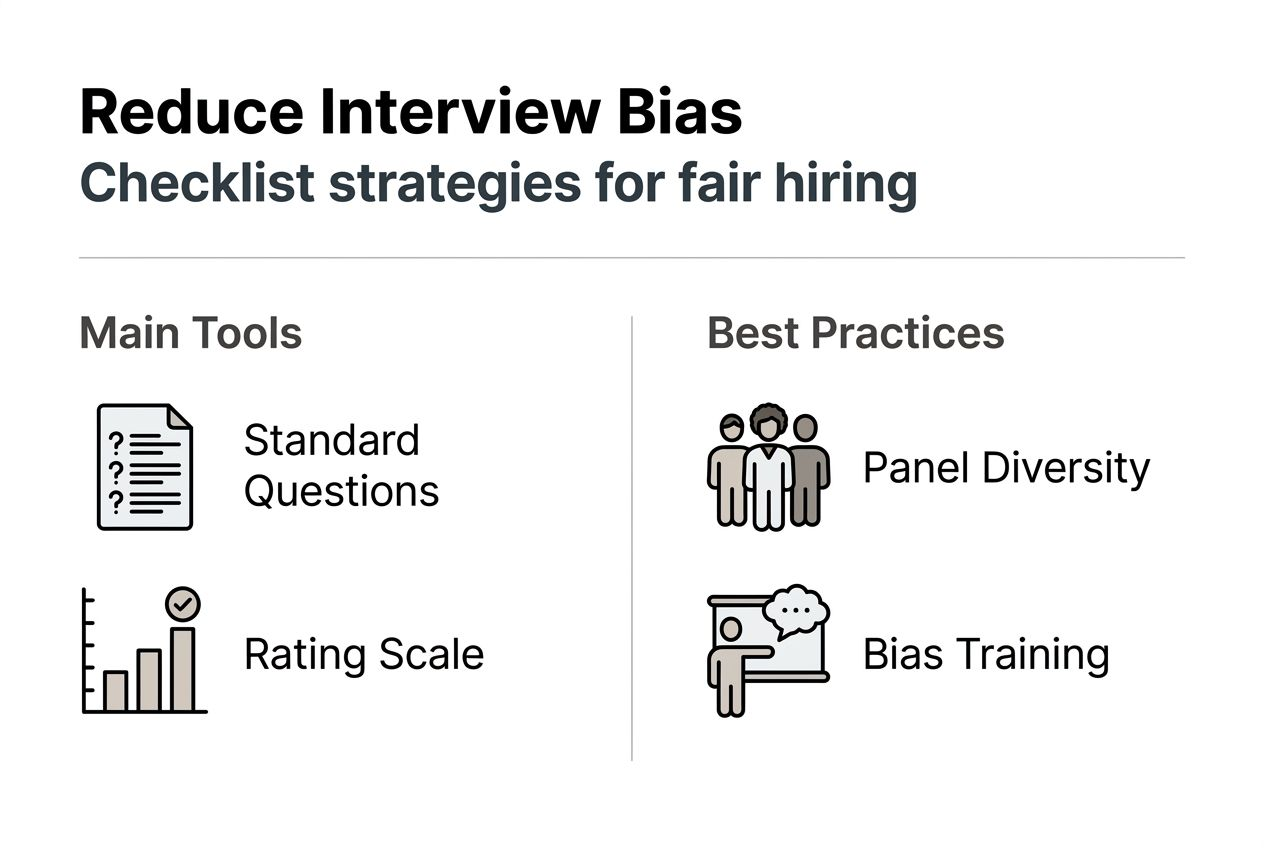
Rating scales transform qualitative impressions into quantitative data points. A 5-point competency scale with clearly defined performance indicators at each level eliminates vague assessments like “seemed good” or “not sure.” Scorecards compiled immediately after interviews prevent memory distortion and recency bias.
Interviewers trained in unconscious bias mitigate discriminatory hiring decisions by 25%, but training alone proves insufficient without structural support. Your checklist must integrate bias-reduction protocols:
- Blind resume reviews removing demographic identifiers before shortlisting
- Diverse interview panels representing varied backgrounds and perspectives
- Standardized questions prohibiting improvised inquiries about protected characteristics
- Mandatory documentation explaining rating decisions with specific behavioral evidence
- Regular panel composition rotation preventing groupthink
“The greatest obstacle to discovering truth is not ignorance, it is the illusion of knowledge. Interview checklists replace assumed candidate understanding with evidence-based assessment.”
Diverse panels particularly strengthen decision quality by surfacing assumptions that homogeneous groups miss entirely. When panel members challenge each other’s ratings constructively, hiring accuracy improves measurably.
Effective question types and candidate evaluation
The questions you ask determine the insights you gain. Behavioral questions focusing on past performance remain the gold standard for predicting future success. These questions typically begin with “Tell me about a time when…” or “Describe a situation where…”
Competency-based questions target specific skills your role requires, such as conflict resolution, strategic thinking, or technical problem-solving. Frame questions around real challenges candidates will face, not theoretical scenarios disconnected from daily responsibilities.
Avoid illegal questions about age, marital status, religious beliefs, pregnancy plans, or other protected characteristics. Similarly, eliminate leading questions that telegraph desired answers, such as “We value teamwork here, so how well do you work in teams?” These questions generate useless responses because candidates simply parrot your stated preference.
Interview scorecards promote quantitative evaluation immediately following each interview. Interview scorecards with consistent rating scales improve hiring consistency by 35% compared to narrative-only assessments. Rate each competency independently before discussing candidates as a group, preventing dominant personalities from swaying the panel.
Effective question categories and evaluation criteria:
- Technical competency: Assess job-specific skills through practical scenarios or portfolio reviews
- Cultural alignment: Evaluate work style preferences and values without asking about protected characteristics
- Problem-solving ability: Present realistic challenges requiring analytical thinking
- Communication skills: Observe clarity, listening ability, and professional presence throughout the interview
- Motivation and goals: Understand career trajectory and role alignment
| Competency | Rating Scale | Evidence Required |
|---|---|---|
| Technical Skills | 1-5 (Beginner to Expert) | Specific examples with measurable outcomes |
| Communication | 1-5 (Poor to Exceptional) | Clarity, conciseness, active listening demonstration |
| Problem-Solving | 1-5 (Struggles to Excels) | Structured approach, creative solutions, adaptability |
| Culture Fit | 1-5 (Misaligned to Excellent) | Work style match, values alignment, team dynamics |
Consistent scoring prevents reliance on gut feelings that often mask unconscious bias. Require interviewers to justify ratings with specific behavioral examples from the conversation, not vague impressions.
Post-interview follow-up and decision making
The interview doesn’t end when the candidate leaves. Immediate follow-up actions and structured decision processes ensure you maintain professionalism while making objective hiring choices.
- Send acknowledgment emails within 24 hours thanking candidates for their time and confirming decision timelines, typically 5-7 business days.
- Complete scorecards individually before any panel discussion, capturing initial impressions while memories remain fresh and detailed.
- Schedule debrief meetings within 48 hours where panelists share ratings and discuss discrepancies using evidence from interview responses.
- Aggregate numerical scores across competencies and interviewers, identifying candidates who consistently demonstrated required skills.
- Document final decisions with clear rationales tied to job requirements, creating an audit trail for internal review and legal compliance.
- Provide structured feedback to unsuccessful candidates when requested, focusing on competency gaps rather than personal characteristics.
- Track hiring metrics including time-to-fill, offer acceptance rates, and quality of hire indicators to continuously improve your interview process.
Objective decision-making requires separating data from opinion. When panel members disagree significantly on ratings, revisit the specific interview segments causing discrepancy rather than averaging scores. This discussion often reveals one interviewer noticed behavioral evidence others missed.
Transparency throughout the post-interview phase builds trust with candidates regardless of outcome. Clear communication about next steps, decision factors, and timelines demonstrates respect for their time investment.
Leveraging technology in interviewing
Technology transforms interview efficiency and effectiveness when implemented strategically. AI-driven interview assistants reduce evaluation time by up to 25% while maintaining or improving assessment quality, freeing HR teams to focus on relationship-building rather than administrative tasks.
Automation streamlines repetitive processes that consume hours weekly. Intelligent scheduling systems coordinate availability across candidates and panel members, eliminating the 15-20 email exchanges typical of manual coordination. Automated reminder sequences reduce no-show rates by 30-40%.
Data analytics provide actionable insights impossible to extract manually. Track which interview questions correlate most strongly with successful hires, identify interviewer rating patterns suggesting bias, and benchmark your process against industry standards. AI-powered job interview tools aggregate this data automatically, surfacing trends that improve future hiring decisions.
Real-time AI assistance during interviews supports interviewers without replacing human judgment. These tools:
- Suggest relevant follow-up questions based on candidate responses
- Track time allocation to ensure consistent pacing across interviews
- Highlight potential bias indicators in question phrasing or rating patterns
- Generate preliminary scorecards for interviewer review and refinement
- Transcribe conversations for accurate documentation and later review
Implementing interview process best practices with AI enhances rather than replaces human decision-making. Technology handles data processing and pattern recognition while you focus on relationship assessment and cultural evaluation.
“Technology amplifies human capability when deployed thoughtfully. The goal isn’t replacing interviewers but equipping them with tools that expose blind spots and enhance objectivity.”
Understanding the role of AI for interview fairness helps you select tools that genuinely reduce bias rather than simply digitizing existing flawed processes. Seek platforms with transparent algorithms and regular bias audits.
Common misconceptions about interviewing
Several persistent myths about interview effectiveness prevent employers from adopting evidence-based practices. Addressing these misconceptions directly helps you make informed process improvements.
Myth: Interview success relies mainly on gut instinct and chemistry. Fact: Research consistently shows structured interviews predict job performance far more accurately than intuition-based assessments. Your gut feeling often reflects unconscious bias rather than competency evaluation.
Myth: Asking identical questions limits candidate insight. Fact: Standardized questions improve reliability and fairness without compromising assessment quality. Consistent questions enable direct comparison while follow-up probes can still explore unique aspects of each candidate’s experience.
Myth: Candidate experience is unaffected by interview organization. Fact: Disorganized interviews directly damage employer brand and deter top talent from accepting offers. Candidates interpret chaotic processes as indicators of workplace dysfunction.
Myth: Longer interviews provide better candidate understanding. Fact: Interview length matters less than structure and question quality. A focused 45-minute structured interview yields more predictive information than a rambling 90-minute conversation.
Myth: Interview training wastes time since hiring is intuitive. Fact: Untrained interviewers consistently make predictable errors including overweighting first impressions, seeking confirmation of initial judgments, and favoring candidates similar to themselves. Brief training sessions deliver measurable improvement in hiring accuracy.
Replacing these misconceptions with evidence-based practices transforms your hiring outcomes. The data overwhelmingly supports structured approaches over informal conversations, regardless of interviewer experience level.
Conclusion and action steps for employers
Implementing an effective interview checklist in 2026 requires systematic planning and consistent execution. Start by defining clear job criteria including technical competencies, soft skills, and cultural elements essential for role success.
Develop standardized question sets aligned to these criteria, ensuring every question serves a specific assessment purpose. Train your interview panels on bias recognition and scorecard completion before they conduct any interviews. Use rating scales consistently and require evidence-based justifications for all scores.
Leverage technology strategically to automate administrative tasks while enhancing human judgment. Conduct regular process reviews examining which questions predict successful hires and where bias patterns emerge. Your actionable roadmap:
- Audit current interview processes identifying inconsistencies and bias risks
- Create standardized question libraries for each role or role family
- Implement mandatory interviewer training covering bias, legal compliance, and scoring methods
- Deploy scorecards requiring immediate post-interview completion
- Schedule regular calibration sessions where interviewers discuss rating standards
- Track hiring metrics measuring quality, efficiency, and candidate satisfaction
- Refine your checklist quarterly based on performance data and feedback
Pro Tip: Pilot your new interview checklist with a single role before organization-wide rollout, gathering feedback from interviewers and candidates to refine the process before scaling.
Continuous improvement separates good hiring processes from exceptional ones. Treat your interview checklist as a living document that evolves with your organization’s needs and emerging best practices.
Enhance your hiring with Parakeet AI
Ready to transform your interview process from chaotic to strategic? Parakeet AI delivers real-time interview assistance that helps you implement every checklist best practice covered in this guide.
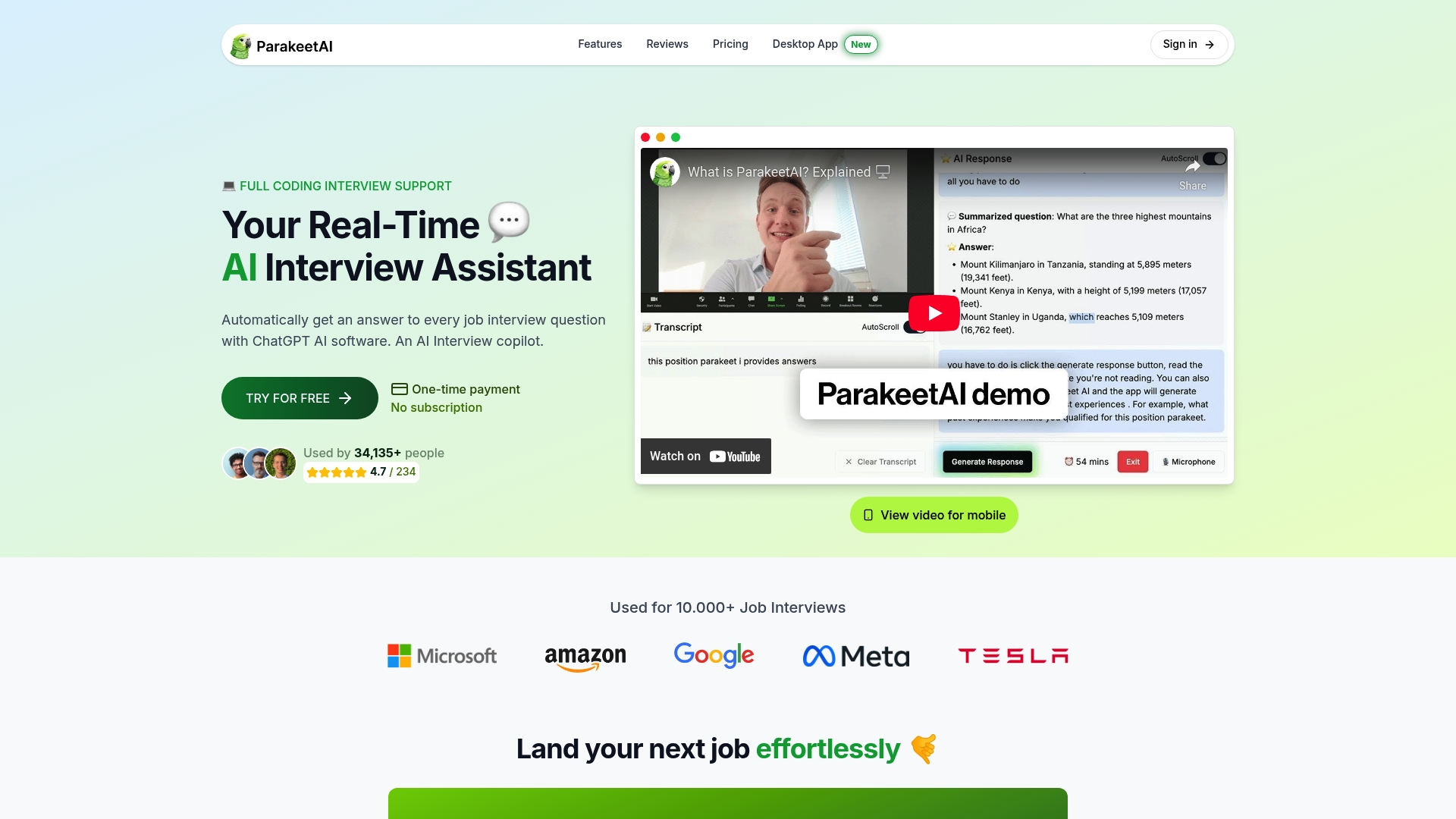
Our platform automates interview scheduling, guides you through structured questioning, and generates objective scorecards instantly. The AI listens during interviews and suggests relevant follow-up questions while tracking time allocation to ensure consistency. Advanced analytics identify bias patterns and highlight your most predictive questions.
AI-powered job interview tools from Parakeet AI integrate seamlessly with your existing ATS, requiring zero workflow disruption. You’ll reduce time-to-hire by 25% while improving hiring quality through data-driven decisions that eliminate guesswork. Discover how leading employers are leveraging AI to build fairer, more effective interview processes in 2026.
Frequently asked questions
What is an interview checklist and why should employers use one?
An interview checklist is a structured guide organizing every interview stage from preparation through decision-making. It standardizes questions, evaluation criteria, and documentation to ensure consistency across all candidates. Employers benefit from improved fairness, reduced unconscious bias by up to 30%, and more accurate hiring predictions. The checklist transforms subjective conversations into evidence-based assessments that identify top performers reliably.
How can interviewers reduce unconscious bias during candidate evaluations?
Use standardized questions and rating scales that every candidate receives identically, eliminating improvised inquiries that introduce bias. Train interviewers to recognize and manage cognitive biases like confirmation bias and halo effect through structured workshops. Complete scorecards immediately after interviews before discussing candidates, preventing dominant panel members from swaying others. Diverse interview panels with rotating composition challenge assumptions homogeneous groups miss entirely.
What types of questions best assess candidates during interviews?
Behavioral questions exploring past experiences like “Describe a time you resolved team conflict” predict future performance most accurately. Situational questions testing problem-solving approaches through realistic scenarios complement behavioral inquiries effectively. Competency-based questions targeting specific role requirements reveal actual skill levels rather than theoretical knowledge. Avoid leading questions that telegraph desired answers and illegal questions about protected characteristics to maintain fairness and legal compliance.
How does technology improve the interview process for employers?
Automation streamlines scheduling coordination, reduces no-show rates through reminder sequences, and eliminates hours of administrative email exchanges. AI tools reduce candidate evaluation time by 25% while maintaining assessment accuracy through real-time scorecard generation. Data analytics identify which questions predict successful hires, expose interviewer bias patterns, and track hiring metrics automatically. Technology amplifies human judgment by handling data processing while you focus on relationship assessment and cultural evaluation.