
How to interview someone: essential questions and AI tips

TL;DR:Structured interviews with predefined questions increase fairness and predictive validity.Using different question types like behavioral and situational provides comprehensive candidate insights.AI tools support consistent evaluation, reduce bias, and streamline the interview process.
Bad interview questions cost more than you might expect. When hiring managers rely on vague, inconsistent, or poorly worded questions, they invite gut-feeling decisions and systemic bias into the process. Job seekers, meanwhile, walk away frustrated by questions that feel irrelevant or unfair. The fix is not a longer list of questions. structured interviews use predetermined, job-related questions with standardized rubrics, increasing predictive validity and fairness across every candidate. This article breaks down exactly how to design and deliver interview questions that work, from understanding the core question types to using AI tools that make your process faster and more equitable.
Table of Contents
- Understanding the types of interview questions
- Design a structured interview process
- Ask the most effective interview questions
- How AI and technology enhance interviews
- Why most interview guides miss the mark and what actually works
- Take your interviews to the next level with AI
- FAQ
Key Takeaways
| Point | Details |
|---|---|
| Use structured interviews | Structured interviews increase fairness, consistency, and predictive accuracy for hiring. |
| Ask a question mix | Blend behavioral, situational, and values-based questions for the most complete candidate picture. |
| Enhance with AI | Leverage AI tools to automate scoring, reduce bias, and scale best practices in interviews. |
| Train and calibrate | Regular interviewer training and calibration are essential to maximize the benefits of structure and technology. |
Understanding the types of interview questions
Not all interview questions are created equal. The type of question you ask shapes the quality of information you get, and that directly affects your ability to predict whether someone will succeed in the role. The main categories every interviewer should know are behavioral, situational, general, values or culture fit, and candidate-driven questions.
Key question types and what they reveal:
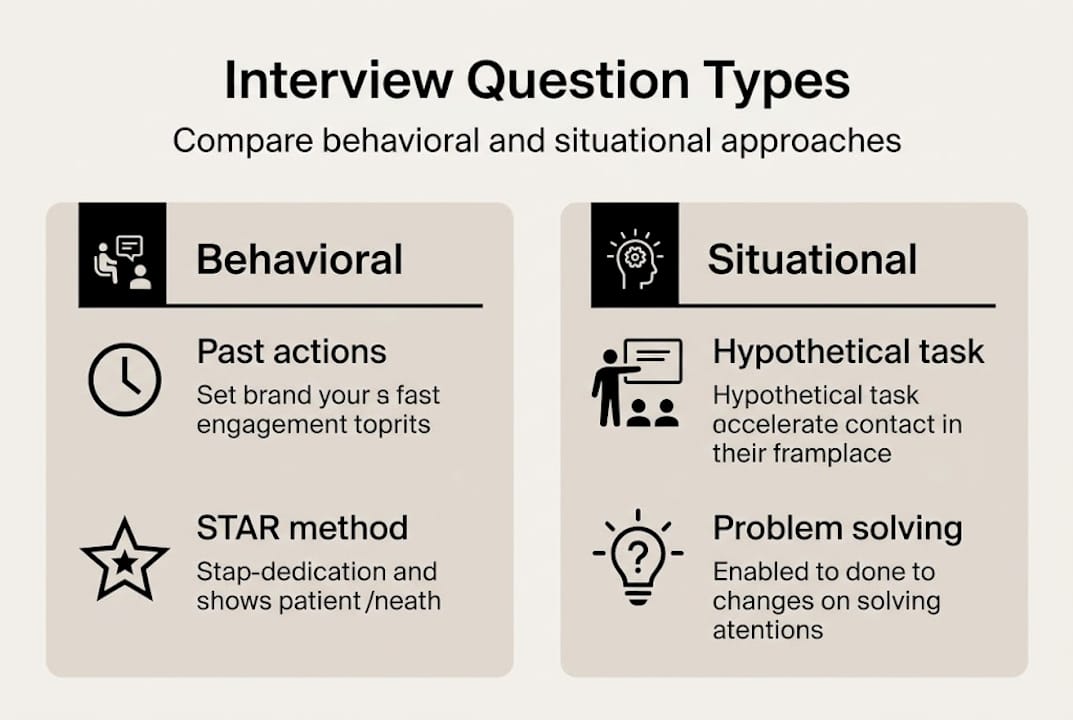
- behavioral questions ask candidates to describe past experiences. Example: “Tell me about a time you managed a conflict on your team.”
- situational questions present hypothetical scenarios. Example: “If a client escalated a complaint, what would you do first?”
- general questions assess background and motivations. Example: “Why are you interested in this role?”
- values or culture fit questions explore alignment with team norms, such as cultural interview questions that reveal how someone approaches collaboration.
- candidate questions invite the interviewee to ask their own questions, which signals curiosity, preparation, and priorities.
behavioral questions predict future performance based on past behavior, and pairing them with the Situation, Task, Aaction, Result (or STAR) method gives you structured, comparable answers. competency-based questions, including behavioral, situational, and general formats, are recommended by the Society for Human Resource Management as the fairest and most effective approach.
| Question type | Best used for | Core attribute probed | Example prompt | Evidence strength |
|---|---|---|---|---|
| behavioral | Mid to senior roles | Past performance | “Tell me about a time…” | High |
| situational | Any level | Problem solving | “What would you do if…” | High |
| general | All stages | Background, motivation | “Why this company?” | Medium |
| values/culture fit | Team integration | Work style, values | “What environment helps you thrive?” | Medium |
| candidate-driven | Any stage | Self-awareness, curiosity | Open floor for questions | Variable |
Using behavioral interview tips alongside situational questions is not redundant. They test different things: one reveals what someone has done, the other reveals how they think.
Pro tip: Mix at least two question types per core competency. A behavioral question probes experience, while a situational question tests reasoning. Together, they give you a fuller, more reliable signal.
Design a structured interview process
Knowing which question types to use is only the starting point. The next step is building a repeatable process that produces fair, comparable results across every candidate you interview.
Here is a step-by-step setup that works:
- identify 4 to 6 core competencies tied directly to job performance. Think about what separates good performers from great ones in this specific role.
- build question sets for each competency. Write 2 to 3 questions per competency using behavioral and situational formats.
- create scoring rubrics. Define what a weak, acceptable, and strong answer looks like for each question before the interview starts.
- train your interviewers. Brief everyone on how to probe, when to follow up, and how to document responses without editorializing.
- score independently. Each interviewer completes their own rubric before any group discussion. This is critical for preventing groupthink.
- debrief with data first. Review rubric scores together before sharing personal impressions.
Using predetermined, job-related questions for all candidates is what separates structured from unstructured interviews, and the performance difference is measurable. Research shows structured interviews have a predictive validity of r=0.51 compared to r=0.38 for unstructured formats. That gap translates directly to better hires.
Google’s structured process defines 4 to 6 role attributes, uses a mix of behavioral and hypothetical questions, and applies independent scoring before any debrief. It is one of the most cited models in modern hiring research.
| Interview type | predictive validity | Inter-rater reliability | bias risk |
|---|---|---|---|
| structured | r=0.51 | High | Low |
| unstructured | r=0.38 | Low | High |
For role-specific examples, look at how engineering interview questions or manager interview questions adapt this structured framework to different functions.
Pro tip: Review and refresh your question sets every 12 months. Questions that circulate widely lose their predictive value because candidates rehearse specific answers to known prompts.
Ask the most effective interview questions
With a structured process ready, the real skill is choosing and phrasing individual questions so they consistently surface what you need to know.
“The best interviews feel like a focused conversation, not an interrogation. Structure gives you consistency; the right questions give you insight.” — Harvard Business Review
HBR recommends organizing questions into four stages: warm-up, skills and probing, values or culture fit, and candidate questions. Each stage serves a specific function.
Sample questions by interview stage:
- warm-up: “Walk me through your career path and what brought you to this point.”
- skills/probing: “Tell me about the most complex project you have led. What made it difficult, and how did you resolve it?”
- values/culture fit: “How do you approach situations where you disagree with a team decision?”
- candidate questions: “What does success in this role look like after 90 days?”
Follow-up probes are just as important as the original questions. If an answer feels vague, push with: “Can you walk me through exactly what you did?” or “What was the outcome?” These probes help you distinguish rehearsed answers from genuine experience.

Know what to watch for with problematic questions. Any question that touches on age, religion, national origin, family status, or disability is not just off-brand. It is illegal in most U.S. jurisdictions. Review questions to avoid in interviews before designing your set.
Bias also sneaks into how questions are worded. Questions that lead candidates toward a preferred answer, or that assume specific life circumstances, undermine the fairness you built into your structure. A question like “We work long hours here. Is that going to be a problem?” is both leading and potentially discriminatory.
For candidates preparing their own responses, studying best tech answers gives a useful lens on what strong, structured responses look like from the other side of the table.
Pro tip: Before using a new question set with real candidates, run a calibration session internally. Have team members answer the questions and score each other. This exposes rubric gaps and wording problems before they affect your hiring decisions.
How AI and technology enhance interviews
Even with the right questions in place, technology can make your process faster, more consistent, and less susceptible to human error.
AI can standardize rubrics, enable blind scoring by anonymizing candidate information, and analyze response patterns for signs of bias in question wording or evaluator behavior. These are not small wins. They scale the discipline of structured interviewing to processes and team sizes where manual oversight is impractical.
Key ways AI supports better interviews:
- automated rubric generation: AI tools can draft scoring criteria based on job descriptions and competency frameworks, saving hours of setup time.
- blind review features: Remove names, photos, and demographic signals from interview records before scoring begins.
- response pattern analysis: Flag questions where candidate scores cluster unusually high or low, which often signals a question is too easy, too vague, or culturally biased.
- real-time assistance: Tools like AI interview assistants can listen to live interviews and surface relevant follow-up prompts based on what the candidate just said.
- audit trails: AI platforms log every score, comment, and rubric change, making your process defensible and reviewable.
For additional context on how AI in tech recruitment is already changing how companies source and evaluate candidates, the evidence from tech startups is compelling.
The risks are real, though. AI is only as good as the data it trains on. If your historical hiring data reflects bias, automating decisions on top of it will amplify, not reduce, unfair patterns. Human oversight is not optional. Use AI as an analyst and an assistant, not as a decision-maker. For technical roles, reviewing technical interview question tips alongside AI tools gives you the domain-specific context that automation alone cannot provide.
Pro tip: Use AI analysis to monitor question fairness on an ongoing basis, not just at setup. If certain demographic groups consistently score lower on a specific question, that is a signal worth investigating before it becomes a legal or reputational risk.
Why most interview guides miss the mark and what actually works
Most interview guides hand you a list of questions and call it done. That misses the point entirely. The quality of your interview depends far more on interviewer behavior than on the exact wording of your questions. A poorly trained interviewer with a great question set will still produce unreliable data. They will talk too much, telegraph the preferred answer, or fail to probe when an answer is incomplete.
Rigid scripts also create a false sense of security. When interviewers follow a script without understanding the purpose behind each question, they lose the flexibility to adapt when a candidate takes an unexpected path through their answer. That rigidity costs you insight.
Over-relying on AI tools creates a different problem. When teams assume the algorithm handles fairness, they stop thinking critically about their own judgment calls. The best outcomes come from a hybrid: structured questions, trained interviewers who understand the rationale behind the structure, independent scoring, and AI as a support layer, not a replacement for human accountability. answering interview questions effectively is a skill that both interviewers and candidates develop through practice and feedback, not just better tools.
Take your interviews to the next level with AI
You now have a full playbook: question types, process design, effective phrasing, and technology integration. The next challenge is implementation, and that is where purpose-built tools make the biggest difference.
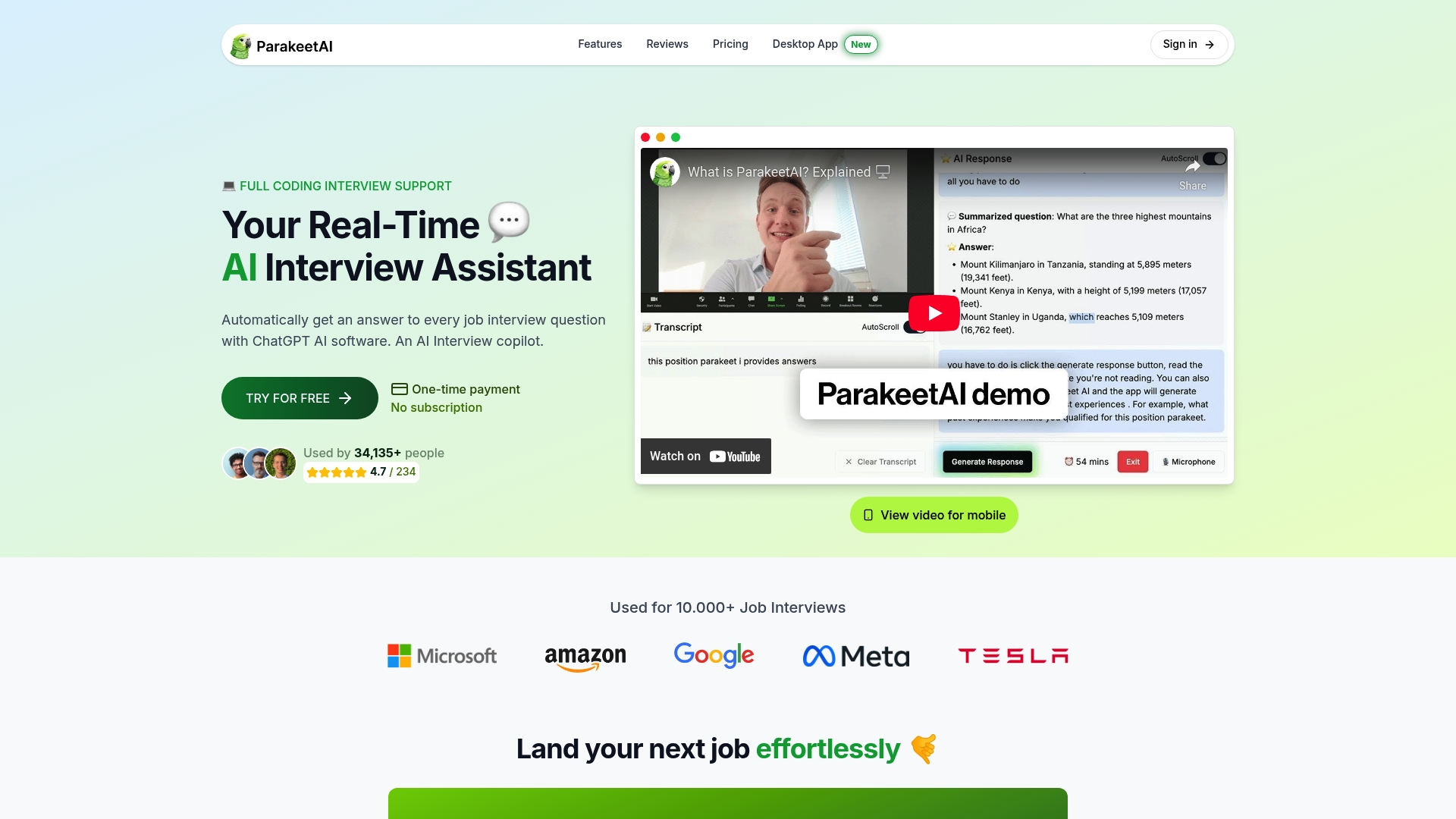
ParakeetAI is a real-time AI interview assistant that listens to your interview and automatically surfaces answers and prompts based on what is being asked. Whether you are a hiring manager streamlining a complex process or a job seeker preparing for a high-stakes role, ParakeetAI gives you the consistency and confidence that manual preparation alone cannot deliver. It bridges the gap between knowing what great interviews look like and actually executing them under pressure. Start with a demo and see how AI-driven interview support changes the experience from both sides of the table.
FAQ
What are the best questions to ask in an interview?
Effective interviews use a mix of behavioral, situational, and values-based questions tied directly to the role’s core competencies. behavioral, situational, and competency-based formats are recommended by the Society for Human Resource Management for the fairest and most predictive results.
How can AI improve the interview process?
AI tools help standardize scoring rubrics, ensure consistent evaluation, detect bias in questions and responses, and automate interview analytics at scale. AI can standardize rubrics and enable blind scoring to reduce evaluator bias significantly.
Why are structured interviews better than unstructured ones?
Structured interviews deliver higher predictive validity and inter-rater reliability while reducing the impact of unconscious bias. predictive validity and inter-rater reliability are both measurably higher for structured interview formats.
What is the S.T.A.R. method and why use it?
The S.T.A.R. method organizes behavioral answers using four components: situation, task, action, and result. The S.T.A.R. method structures responses to behavioral questions so evaluators can compare candidates on equal terms.